
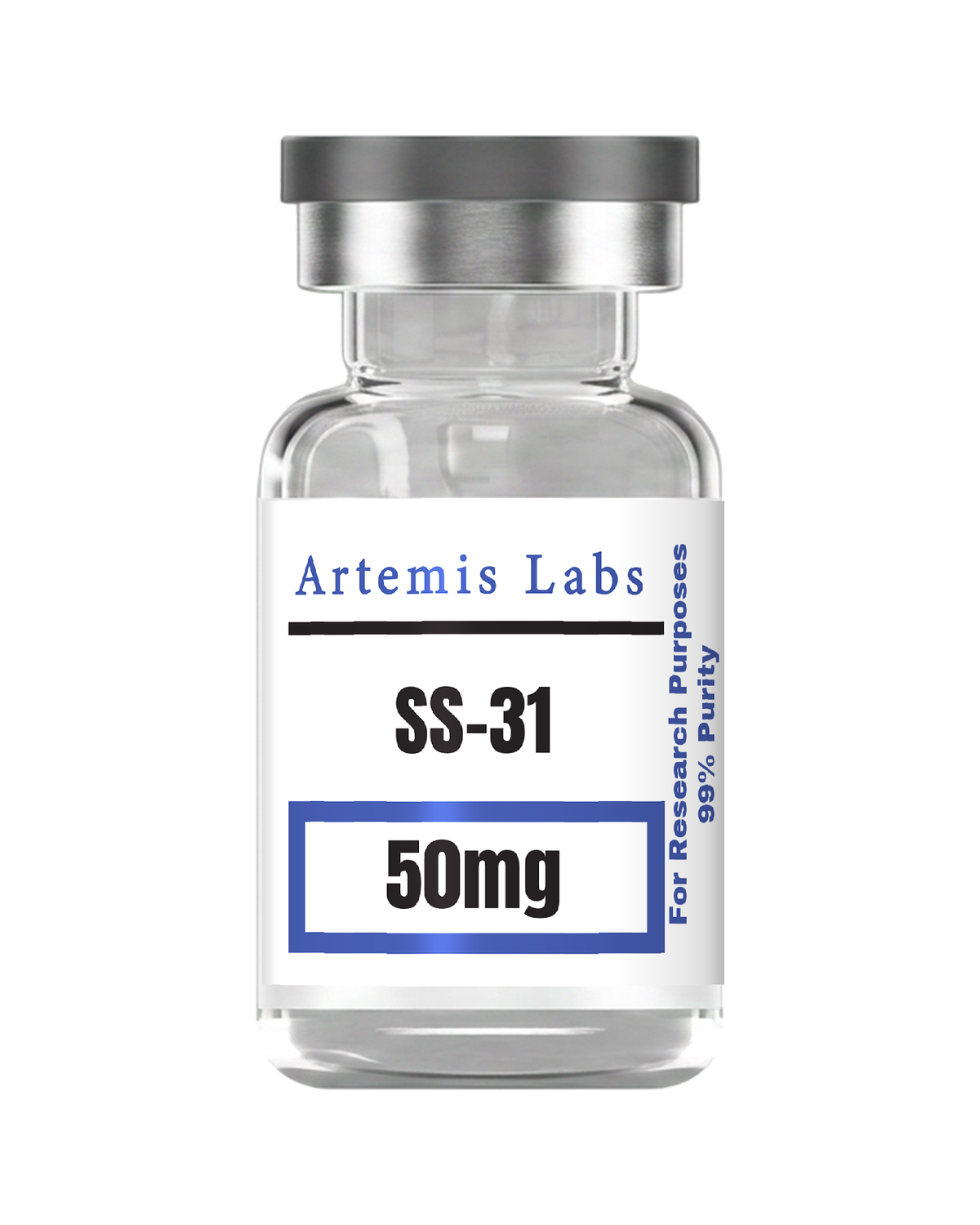
SS-31 (Elamipretide)
$110.00
Mitochondria have an inner membrane, and that membrane is held together partly by a fat called cardiolipin. When cardiolipin is damaged, the membrane leaks and energy production falls apart. SS-31 is a four-amino-acid peptide that binds cardiolipin directly — the first compound of its kind. It is not boosting a pathway; it is stabilising a structure.
Continue readingShow less
Where the evidence is strongest and weakest. The Barth syndrome programme carried through: TAZPOWER 168-week extension data (Thompson 2024, PMID 38602181) supported an FDA accelerated approval in September 2025 (PMID 41260682). But the pivotal MMPOWER-3 trial in primary mitochondrial myopathy failed its co-primary endpoints at week 24 (PMID 37268435), and earlier dose-dependent Phase 2 signals did not survive confirmation. ReCLAIM-2 in dry AMD was mixed (PMID 39605874).
Read that pattern. A clean mechanism and a real approval in one rare disease, alongside a failed Phase 3 in another. The mechanism-to-outcome gap here is documented and repeated, and it is the most useful thing to know about this compound.
Lyophilized aromatic-cationic tetrapeptide at ≥99% HPLC-verified purity, batch-specific Certificate of Analysis.
Description
SS-31 is a lab-made peptide built from only four amino acids. It also goes by the name elamipretide. The peptide sticks to cardiolipin, a fat found in the inner wall of the mitochondrion. The mitochondrion is the part of a cell that makes energy. Artemis Labs supplies SS-31 as a dry powder for lab research only.
Reviewed August 21, 2026 · Artemis Labs
What is SS-31 (elamipretide)?
SS-31 — also known as elamipretide and MTP-131 — is a synthetic 4-amino-acid aromatic-cationic tetrapeptide (D-Arg-Dmt-Lys-Phe-NH2) that selectively binds cardiolipin in the inner mitochondrial membrane. Artemis Labs supplies SS-31 as a 50 mg lyophilized research reference compound at ≥99% HPLC purity, with identity confirmed by mass spectrometry and a lot-specific Certificate of Analysis available on request.
Why do researchers study SS-31?
Cardiolipin-directed mitochondrial-membrane interactions are studied across multiple research contexts: cardiac and skeletal-muscle bioenergetics, hyperoxia-induced alveolar injury models (Lu et al. 2026, PMID 42074001), peroxiredoxin-pathway cardioprotection (Park et al. 2026, PMID 42013545), spinal-cord-injury axonal remodeling (Song et al. 2026, PMID 42082001), and nanoparticle-mediated mitochondrial delivery (Huang et al. 2026, PMID 42057685).
Is Artemis Labs SS-31 the same as FDA-approved elamipretide?
The active ingredient elamipretide received FDA accelerated approval on September 19, 2025 for Barth syndrome in patients aged ≥1 year (Zhao et al. 2026, PMID 41260682) — making it the first cardiolipin-directed mitochondrial therapeutic ever approved. The approval was granted to Stealth BioTherapeutics, not to Artemis Labs. Artemis Labs does not market, substitute for, or offer the FDA-approved elamipretide product. The Artemis SKU is supplied strictly as a research reference compound; no therapeutic indication is implied.
What does the SS-31 evidence not show?
The MMPOWER-3 Phase 3 RCT in primary mitochondrial myopathy (Karaa et al. 2023, PMID 37268435) did not demonstrate significant benefit on its primary endpoint. The ReCLAIM-2 Phase 2 RCT in dry AMD (Ehlers et al. 2024, PMID 39605874) missed its primary endpoint but reported a 43% photoreceptor-preservation signal. Counter-evidence is part of the literature; we report it.
How does SS-31 differ from MOTS-c?
SS-31 is a 4-amino-acid synthetic aromatic-cationic peptide acting via direct cardiolipin binding on the inner mitochondrial membrane. MOTS-c is a 16-amino-acid mitochondrial-DNA-encoded peptide acting via the AMPK pathway. Different molecules, different mechanisms; both are mitochondrial-research compounds only in the broad sense.
How does Artemis Labs verify SS-31 purity and identity?
Artemis Labs verifies every lot by third-party reverse-phase HPLC for purity and by mass spectrometry for identity; the lot-specific Certificate of Analysis ships with every order.
Analytical Specifications
| Sequence | D-Arg-Dmt-Lys-Phe-NH2 (4 amino acids; aromatic-cationic tetrapeptide) |
| Alternate names | elamipretide; MTP-131; SS-31 |
| Purity | ≥99% purity (RP-HPLC); identity confirmed by mass spectrometry |
| Form | Lyophilized powder; 50 mg per vial |
| Molecular weight | 639.79 Da · Molecular formula: C32H49N9O5 |
| Registry identifiers | CAS: 736992-21-5 · DrugBank DB17087 · ChEMBL CHEMBL5095202 · PubChem CID 11954369 |
| Storage | ≤ −20 °C (lyophilized), desiccated, protected from light · 2–8 °C reconstituted (refer to lot COA) |
| Certificate of Analysis | Third-party Certificate of Analysis supplied on request |
For research use only. Not for human consumption. These statements have not been evaluated by the FDA.
References
- Zhao et al. (2026) — FDA accelerated approval of elamipretide for Barth syndrome, 19 September 2025 (Stealth BioTherapeutics). PMID 41260682
- Lu et al. (2026) — SLC25A28 interaction in alveolar epithelium; hyperoxia-induced injury model. PMID 42074001
- Park et al. (2026) — PrxIII-pathway cardioprotection in doxorubicin-treated PrxIII-KO mice. PMID 42013545
- Song et al. (2026) — axonal / synaptic remodeling after spinal-cord injury. PMID 42082001
- Huang et al. (2026) ACS Nano — PEGylated nanoparticle delivery for ischaemia–reperfusion injury. PMID 42057685
- Thompson et al. (2024) — TAZPOWER 168-week extension in Barth syndrome; sustained 6-minute walk improvement. PMID 38602181
- Karaa et al. (2023) — MMPOWER-3 Phase 3 RCT in primary mitochondrial myopathy; negative primary endpoint. PMID 37268435
- Ehlers et al. (2024) — ReCLAIM-2 Phase 2 RCT in dry AMD; missed primary endpoint, 43% photoreceptor-preservation signal. PMID 39605874
Additional information
| Vial Size | 50mg |
|---|
Science & Research
Science & Research
Mechanism of Action (Preclinical Models)
SS-31’s selective binding to cardiolipin in the inner mitochondrial membrane is the mechanism class that supported elamipretide’s 2025 FDA accelerated approval for Barth syndrome (Zhao et al. 2026, PMID 41260682). 2026 work narrowed the mechanism further:
- SLC25A28 interaction in alveolar epithelium — Lu et al. 2026, PMID 42074001
- PrxIII-pathway cardioprotection in doxorubicin-treated PrxIII-KO mice — Park et al. 2026, PMID 42013545
- Axonal / synaptic remodeling after SCI — Song et al. 2026, PMID 42082001
- PEGylated nanoparticle delivery for IR injury — Huang et al. 2026 ACS Nano, PMID 42057685
Clinical Trial Record (Counter-Evidence Included)
- TAZPOWER 168-week extension in Barth syndrome reported sustained 6-minute walk improvement — Thompson et al. 2024, PMID 38602181
- MMPOWER-3 in primary mitochondrial myopathy — negative primary endpoint — Karaa et al. 2023, PMID 37268435
- ReCLAIM-2 in dry AMD — missed primary endpoint, 43% photoreceptor-preservation signal — Ehlers et al. 2024, PMID 39605874
- FDA accelerated approval Sept 19, 2025 for Barth syndrome (Stealth BioTherapeutics, not Artemis Labs) — Zhao et al. 2026, PMID 41260682
Class Position
Unlike MOTS-c — a 16-amino-acid mitochondrial-DNA-encoded peptide acting via the AMPK pathway — SS-31 is a 4-amino-acid synthetic aromatic-cationic peptide acting via direct cardiolipin binding on the inner mitochondrial membrane. Different molecules, different mechanisms. Both are mitochondrial-research compounds only in the broad sense.
Research Pairings
Research Pairings
Pairing rationale below is mechanistic only, drawn from peer-reviewed pre-clinical literature. No dosing, scheduling, or human-use guidance is provided. All references are for in-vitro / laboratory research framing.
- SS-31 × MOTS-c — Two distinct mitochondrial peptides (cardiolipin-binding vs. AMPK-activating); studied in preclinical mitochondrial-stress models.
- SS-31 × DSIP — The 2026 Rahman review groups SS-31 and DSIP within “circadian + mitochondrial regulators.”
- SS-31 × GHK-Cu × Semax × MOTS-c — The “Longevity Quartet” combines mitochondrial-targeted peptides (MOTS-c, SS-31) with neurotrophic (Semax) and copper-tripeptide (GHK-Cu) effects in longevity-research models.
- SS-31 × BPC-157 / TB-500 — Mitochondrial inner-membrane protection (SS-31) + extracellular tissue-repair signaling (BPC-157/TB-500) pairing studied in preclinical recovery models.
Reviews (0)
Be the first to review “SS-31 (Elamipretide)”
Related products
weight-management
Reviews
There are no reviews yet.