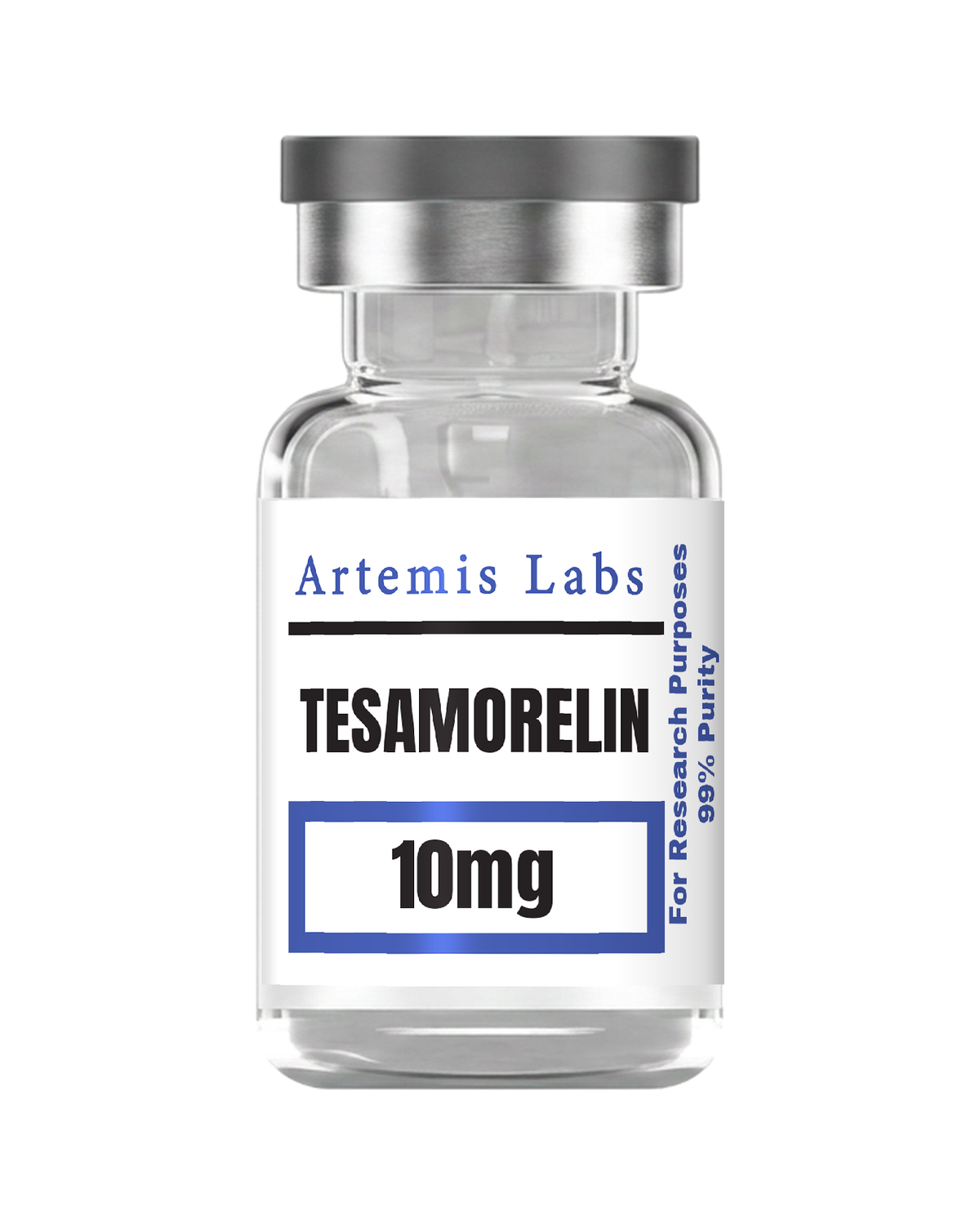
Tesamorelin
$80.00
Tesamorelin is a GHRH analog with a chemical group added to its front end for one reason: to survive an enzyme called DPP-IV that would otherwise break it down. It is the only compound of its type here with a completed regulatory approval behind it — as EGRIFTA, for one specific condition, which is a different thing from being approved generally.
Continue readingShow less
What the published work describes. The N-acyl modification blocks DPP-IV degradation, the main clearance route for native GHRH. The intact peptide acts at the pituitary GHRH receptor, raising pulsatile GH and downstream hepatic IGF-1 (Mendias 2026, PMID 41966639; Renke 2026, PMID 42123471). Effects on visceral fat in HIV-associated lipodystrophy are downstream of that GH/IGF-1 rise rather than a direct action on fat tissue.
Worth being precise about. EGRIFTA WR (Theratechnologies) has carried an approval since 2010 for reduction of excess abdominal fat in HIV-associated lipodystrophy. That approval belongs to that product and that indication. Reported adverse events in the trial literature included myalgia, paresthesia and injection-site reactions.
Supplied as lyophilized 44-amino-acid GHRH analog, for laboratory research use only.
23 in stock
Free shipping on orders over $300
Pay by Venmo or Cash App — instructions are emailed with your order.
11 published sources cited on this page see them
For research use only. Not for human consumption.
Description
Tesamorelin is a man-made copy of a natural body signal. That signal tells the pituitary gland to release growth hormone. Scientists study tesamorelin to learn how the body stores fat deep in the belly, around the organs. It is not the approved drug Egrifta. Artemis Labs sells it as a dry powder for lab work only.
Reviewed August 22, 2026 · Artemis Labs
What is tesamorelin?
Tesamorelin is a synthetic 44-amino-acid analog of growth hormone-releasing hormone (GHRH). The N-terminal tyrosine carries a trans-3-hexenoyl modification that blocks dipeptidyl peptidase-IV degradation — the primary clearance mechanism for native GHRH — extending plasma half-life in research models from ~10 minutes (native) to 26 and 38 minutes respectively. Artemis Labs supplies tesamorelin acetate as a lyophilized research reference compound.
Is tesamorelin the same thing as Egrifta?
The finished pharmaceutical Egrifta SV / Egrifta WR (Theratechnologies) is FDA-approved (since 2010) for reduction of excess abdominal fat in HIV-associated lipodystrophy That approval belongs to that product and that indication; it does not attach to research-grade material. Artemis Labs does not market, substitute for, or offer the FDA-approved Egrifta product. The Artemis SKU is a research reagent only and is not intended for human use. Tesamorelin is also on the WADA Prohibited List, Section S2, prohibited at all times in competitive sport.
What is tesamorelin studied for?
Tesamorelin is studied in laboratory contexts examining GHRH-receptor pharmacology (Class-B GPCR; Gαs / cAMP / PKA signalling on anterior-pituitary somatotrophs), pulsatile GH-secretion dynamics, IGF-1-axis modelling, and visceral-adipose-tissue lipolysis pathways. Recent 2025-2026 reviews position tesamorelin in metabolic-dysfunction-associated-steatotic-liver-disease (MASLD) research (Gattu 2025, PMID 40397552) and in lean-mass-preservation research (Arora 2026, PMID 41598480).
What did the 2026 meta-analysis of five trials report?
A 2026 meta-analysis of five randomized controlled trials in HIV-associated lipodystrophy (Badran et al. 2026, Obesity Research & Clinical Practice, PMID 41545261) reported significant reductions in visceral adipose tissue, hepatic fat, and waist circumference with increases in lean body mass; adverse events were limited to mild arthralgia, myalgia, paresthesia, and injection-site reactions. The published trial dataset cited above refers to the Egrifta pharmaceutical product, not to Artemis Labs reagent.
What does the combination research examine?
Beach et al. (2026, PMID 42139091) document distinct therapeutic pathway research using tesamorelin and GLP-1 receptor agonists in HIV-positive populations with different body-composition presentations — leveraging GHRH-axis (tesamorelin) and incretin-axis (GLP-1 receptor agonist) mechanisms as complementary rather than redundant in research-design rationale.
What does the tesamorelin evidence not show?
Everything on this page comes from published work on the pharmaceutical, not from Artemis Labs testing. Five limits are worth stating plainly.
- The trial dataset is about Egrifta, not about this reagent. The record states it directly: the published trial dataset refers to the Egrifta pharmaceutical product, not to Artemis Labs reagent. Nothing on this page is a finding about the vial being sold.
- The randomised evidence sits in one population. All five randomised controlled trials pooled by Badran et al. 2026 were conducted in HIV-associated lipodystrophy. No randomised evidence outside that population appears in this record.
- The combination work is a case series. Beach et al. 2026 is catalogued in this record’s own reference list as a case series — an uncontrolled design that generates hypotheses rather than testing them.
- Adverse events were reported, not absent. The same meta-analysis recorded mild arthralgia, myalgia, paresthesia and injection-site reactions.
- Prohibited in sport. Tesamorelin is on the WADA Prohibited List, Section S2, prohibited at all times in competitive sport.
Where can I read the tesamorelin research in more depth?
Artemis Labs publishes a twelve-page tesamorelin research cluster, every page built from the same verified record as this one. Start with what tesamorelin is studied for, then the Phase 3 trial record, what the FDA approval actually covers, the sequence and molecular-weight record, the safety research, and the reversal-on-discontinuation finding. The cluster also covers research outside HIV, liver fat, cognition, reading a tesamorelin COA, tesamorelin versus sermorelin and tesamorelin and ipamorelin together.
Analytical Specifications
| Sequence basis | Synthetic 44-residue GHRH(1-44) analog modified with a trans-3-hexenoyl group at the N-terminus |
| Molecular formula | C221H366N72O67S |
| Molecular weight | 5136 (PubChem CID 16137828 — the single value the primary source returns) |
| CAS number | 218949-48-5 |
| CAS number — acetate salt | 901758-09-6 |
| Form | Lyophilized white powder; 10 mg per vial (acetate salt) |
| Storage | ≤ −20 °C lyophilized, desiccated, protected from light · 2-8 °C reconstituted |
| Published plasma half-life | 26 minutes in healthy subjects and 38 minutes in HIV-infected patients (PubChem, Biological Half-Life) |
| Regulatory status (2026) | The finished pharmaceutical Egrifta SV / Egrifta WR is FDA-approved; the Artemis SKU is a research reagent only. WADA Prohibited List Section S2. |
References
- Badran AS et al. 2026 — meta-analysis 5 RCTs — PMID 41545261
- Beach R et al. 2026 — case-series tesamorelin + GLP-1 receptor agonist — PMID 42139091
- Parienti JJ 2026 — IDWeek 2025 industry roundup — PMID 42139090
- Chege BM 2026 — ART rodent model cardioprotection — PMID 42018810
- Gattu AK 2025 — MASLD in HIV — PMID 40397552
- Renke G 2026 — therapeutic-peptide review; GHRH-analog class positioning — PMID 42123471
- Mendias CL 2026 — peptide therapies MSK/athletic — PMID 41966639
- Arora G 2026 — lean body mass preservation — PMID 41598480
- Rahman OF 2026 — orthopaedic peptides — PMID 41490200
- Coutinho LFD 2026 — peptide-drugs in sport (WADA) — PMID 41880199
- Villegas Meza AD 2026 — injectable peptides in sports medicine — PMID 42160466
For research use only. Not for human consumption. These statements have not been evaluated by the FDA. Tesamorelin is prohibited under WADA Section S2 at all times in competitive sport.
Additional information
| Vial Size | 10mg |
|---|
Science & Research
Science & Research
Mechanism of Action
Tesamorelin is a synthetic 44-amino-acid GHRH analog carrying a trans-3-hexenoyl group on the N-terminal tyrosine. This N-acyl modification confers resistance to dipeptidyl peptidase-IV (DPP-IV) degradation, the primary clearance mechanism for native GHRH. The intact peptide binds the GHRH receptor (GHRH-R), a Class-B GPCR expressed on anterior-pituitary somatotrophs; receptor activation drives Gαs / cAMP / PKA signalling, increasing pulsatile GH secretion and subsequent hepatic IGF-1 production (Mendias 2026, PMID 41966639; Renke 2026, PMID 42123471).
Pharmacokinetic Profile (Published Research, Egrifta)
- Plasma half-life 26 minutes in healthy subjects and 38 minutes in HIV-infected patients (PubChem, Biological Half-Life)
- Time-to-peak reported in the published pharmacokinetic literature
- Renal clearance of intact peptide; enzymatic degradation by serum peptidases
- DPP-IV resistance is the basis for extended half-life vs native GHRH
Note: these figures characterize the published Egrifta clinical pharmacokinetics, not Artemis Labs reagent handling. Artemis supplies tesamorelin as a research-grade reference compound.
2026 Meta-Analysis (Badran 2026)
Badran et al. 2026 (Obesity Research & Clinical Practice, PMID 41545261) synthesized five randomized controlled trials of tesamorelin in HIV-associated lipodystrophy:
- Significant reductions in visceral adipose tissue, trunk fat, hepatic fat percentage, and waist circumference
- Statistically significant increases in lean body mass
- Adverse events limited to mild arthralgia, myalgia, paresthesia, and injection-site erythema
- No serious glucose perturbations across analyzed cohorts
Class positioning (GHRH analog comparator snapshot)
| Compound | Sequence basis | FDA status (2026) | Half-life |
|---|---|---|---|
| Tesamorelin | trans-3-hexenoyl GHRH(1-44) | A separately manufactured product (EGRIFTA SV/WR, application 022505) holds approval; research-grade material does not | 26 min / 38 min |
| Sermorelin | Native GHRH(1-29)NH₂ | Reported as approved and later discontinued; unverified at the primary source | ~10-20 min |
| CJC-1295 (no DAC) | Modified GRF(1-29) | Not approved | ~30 min |
| CJC-1295 + DAC | Modified + MPA-Lys albumin handle | Not approved | ~6-8 days |
| Ipamorelin | Pentapeptide GHS-R1a agonist (different receptor) | Not approved | ~2 hr |
Verified PubMed references (Builder 1 / Scout 3 2026-05-20 set)
- Badran AS et al. 2026 — meta-analysis 5 RCTs — PMID 41545261
- Beach R et al. 2026 — case-series tesamorelin + GLP-1 receptor agonist — PMID 42139091
- Parienti JJ 2026 — IDWeek 2025 industry roundup — PMID 42139090
- Chege BM 2026 — ART rodent model cardioprotection — PMID 42018810
- Gattu AK 2025 — MASLD in HIV — PMID 40397552
- Renke G 2026 — therapeutic-peptide review; GHRH-analog class positioning — PMID 42123471
- Mendias CL 2026 — peptide therapies MSK/athletic — PMID 41966639
- Arora G 2026 — lean body mass preservation — PMID 41598480
- Rahman OF 2026 — orthopaedic peptides — PMID 41490200
- Coutinho LFD 2026 — peptide-drugs in sport (WADA) — PMID 41880199
- Villegas Meza AD 2026 — injectable peptides in sports medicine — PMID 42160466
Research Pairings (Mechanism-Only)
Research Pairings (Mechanism-Only)
Pairing rationale below is mechanistic only, drawn from peer-reviewed pre-clinical and clinical literature. No dosing, scheduling, or human-use guidance is provided. All references are for in-vitro / laboratory research framing.
- Tesamorelin × CJC-1295 — Two GHRH-axis comparators: long-acting modified GRF(1-29) (CJC-1295) versus DPP-IV-resistant GHRH(1-44) (tesamorelin). Useful for kinetic-comparator research designs studying GHRH-R desensitization vs sustained signalling.
- Tesamorelin × Sermorelin — Native GHRH(1-29) reference comparator versus N-acyl-stabilized full-length GHRH(1-44). Half-life × receptor-engagement comparison.
- Tesamorelin × Ipamorelin — Orthogonal-receptor pairing (GHRH-R + GHS-R1a). Beach et al. 2026 (PMID 42139091) describes complementary mechanism research in HIV-associated lipodystrophy.
- Tesamorelin × MOTS-c — Co-studied for metabolic effects downstream of GH/IGF-1 (tesamorelin) versus mitochondrial AMPK-mediated metabolism (MOTS-c).
- Tesamorelin × GLP-1 receptor agonists (tirzepatide, retatrutide) — Distinct receptor pathways (GHRH-R vs incretin axis) — Beach et al. 2026 explicitly examines these as complementary in research-design contexts.
Related products