
Tesamorelin and Cognition: One Positive, Then Two Nulls | Artemis Labs
Aug
Tesamorelin and cognition: one unreplicated positive, then two nulls
Published August 28, 2026 · Artemis Labs
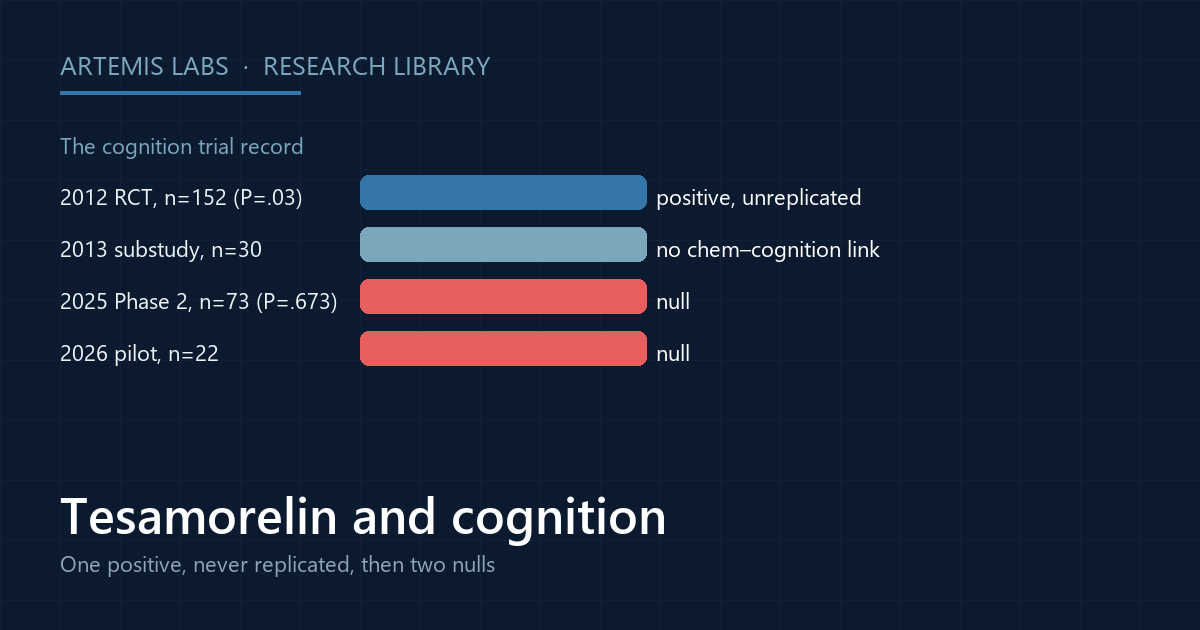
Tesamorelin cognition research — The cognition record for tesamorelin consists of one positive randomized trial from 2012, in 152 older adults with and without mild cognitive impairment, that reported a favorable effect of GHRH on cognition (P=.03); a mechanistic substudy of the same trial that found no significant associations between brain-chemistry changes and cognitive changes; a 2025 open-label Phase 2 trial in 73 people with HIV in which the between-group difference was not significant (P = .673); and a 2026 pilot in 22 adults in which treatment was not directly linked with significant changes in study measures. No independent group has replicated the 2012 result in fourteen years. The widely repeated cognition claim for tesamorelin traces to a 2012 news headline with no data behind it.
Key findings
- The positive trial. Randomized, double-blind, placebo-controlled, 20 weeks, 152 adults aged 55 to 87 (66 with mild cognitive impairment), 137 completers, single US site: intent-to-treat effect on cognition P=.03, executive function P=.005, verbal memory a trend at P=.08 (Arch Neurol 2012, PMID 22869065).
- Inside that trial, adverse events nearly doubled. Adverse events were mild and were reported by 68% of GHRH treated adults and 36% of those who received placebo; fasting insulin rose 35% in the MCI group.
- The first null. Six-month Phase 2, open-label, 73 participants with HIV and abdominal obesity: between-group difference P = .673; conclusion suggests no clear benefit (J Infect Dis 2025, PMID 39813152).
- The second null. Ten-week double-blind pilot, 22 adults: Low-dose GHRH treatment was not directly linked with significant changes in study measures (eNeurologicalSci 2026, PMID 42382101).
What did the 2012 trial find, exactly?
A University of Washington group ran a randomized, double-blind, placebo-controlled trial of tesamorelin for 20 weeks in 152 adults, 66 of whom had mild cognitive impairment (MCI), a condition of measurable memory or thinking decline short of dementia. The mean age was 68. The intervention is described in the abstract as tesamorelin (Theratechnologies Inc), a stabilized analog of human GHRH, which is worth noting: the material was the sponsor’s. In the intent-to-treat analysis, the authors reported a favorable effect of GHRH on cognition (P=.03), which was comparable in adults with MCI and healthy older adults. A completer analysis showed a stronger effect (P=.002); a positive effect on executive function (P=.005); and a trend showing a similar treatment-related benefit in verbal memory (P=.08), which is not a significant result. IGF-1 rose 117% and remained within the physiological range (PMID 22869065).
The same abstract reports two things that are usually left out. Adverse events, described as mild, were reported by 68% of GHRH treated adults and 36% of those who received placebo, close to double. And fasting insulin rose 35% in adults with MCI, within the normal range, but not in healthy adults. The authors’ closing sentence asks for longer-duration treatment trials. None with a positive result has followed.
What did the brain-chemistry substudy add?
Thirty participants from the same trial had magnetic resonance spectroscopy at baseline and again after the 20-week treatment period. GABA levels rose in all brain regions measured (P < .04), and two other metabolites changed in specific regions (JAMA Neurol 2013, PMID 23689947). Two sentences in that abstract bound the finding. No changes in the brain levels of glutamate were observed. And: No significant associations were observed between treatment-related changes in neurochemical and cognitive outcomes. The brain chemistry changed; the changes did not track the cognitive scores. It is the same trial (NCT00257712), so it is not a replication.
What did the 2025 Phase 2 trial find?
A six-month randomized, open-label Phase 2 trial compared tesamorelin against standard of care in 73 virally suppressed people with HIV, abdominal obesity and neurocognitive impairment, randomized 3:2 (J Infect Dis 2025, PMID 39813152). The tesamorelin group showed a trend toward improved neurocognitive performance after 6 months (mean change, 0.146; 95% CI, −.002 to .294; P = .060), the standard-of-care group did not, but the between-group difference was not significant (P = .673). IGF-1 rose but changes did not correlate with summary regression change score. The authors’ conclusion: Recognizing the limitations of insufficient power and no placebo arm, this study suggests no clear benefit of short-term AO reduction with tesamorelin on NCI. It is an open-label trial in a different population from 2012, and it is the most recent dedicated cognition trial in the record.
What did the 2026 pilot find?
A ten-week double-blind, placebo-controlled pilot assessed 22 adults whose cognition ranged from normal to mild cognitive impairment, measuring fat and lean mass, fatigue, sleep, physical performance, glucose tolerance, cognitive function and brain imaging (eNeurologicalSci 2026, PMID 42382101). The pre-specified result: Low-dose GHRH treatment was not directly linked with significant changes in study measures. The authors then applied machine-learning models and reported potential treatment-related differences in some brain regions. Those are post-hoc pattern findings on 22 subjects after a stated null on every planned measure, and the paper’s own framing is that it highlights the potential benefits of pairing cognitive tests and neuroimaging with ML tools, a claim about method, not about the compound. PubMed does not tag it as a clinical trial. It cannot be cited as evidence of a cognitive effect.
Where did the cognition claim come from?
From a 2012 news item in a review journal, commenting on the Washington trial, whose headline asserted a cognitive benefit as if it were settled. It has no abstract and no data; it is commentary, and it is the likely origin of every downstream claim to that effect. Artemis Labs does not cite it, and we treat its assertive title as a warning about how a single trial becomes a settled fact. The primary record is what is above: one positive trial, its own substudy finding no link between chemistry and cognition, and two later nulls.
What the research does not show
The record does not show a replicated cognitive effect of tesamorelin in any population. The 2012 positive result stands alone after fourteen years; the two subsequent trials were null on their primary comparison; and the one mechanistic study found no association between the brain-chemistry changes it measured and cognitive outcomes. Every study used the sponsor’s licensed product in a clinical setting, not research-grade material, so nothing here transfers to a research vial. No approved indication for cognition exists; the only approved indication is in HIV-associated lipodystrophy, on our page on research outside HIV. And the positive trial’s own safety line, adverse events in 68% versus 36%, has never been examined in a longer study.
Frequently asked questions
Did a randomized trial find a cognitive benefit?
One did, in 2012, at P=.03 in intent-to-treat analysis, in 152 older adults at one US site (PMID 22869065). It has not been replicated.
What did the later trials find?
A 2025 Phase 2 trial found no significant between-group difference (P = .673; PMID 39813152). A 2026 pilot found no significant change on any planned measure (PMID 42382101).
Did brain chemistry change in the 2012 trial?
GABA levels rose in a 30-person substudy, but no significant associations were observed between treatment-related changes in neurochemical and cognitive outcomes (PMID 23689947).
Where is the compound record?
On the tesamorelin research page, which carries the identity table and the full reference list with counter-evidence.
References
- Effects of growth hormone–releasing hormone on cognitive function in adults with mild cognitive impairment and healthy older adults: results of a controlled trial. Arch Neurol. 2012. PMID 22869065 · DOI. NCT00257712.
- Growth hormone-releasing hormone effects on brain γ-aminobutyric acid levels in mild cognitive impairment and healthy aging. JAMA Neurol. 2013. PMID 23689947 · DOI.
- Effects of Tesamorelin on Neurocognitive Impairment in Persons With HIV and Abdominal Obesity. J Infect Dis. 2025. PMID 39813152 · DOI.
- The effect of growth hormone-releasing hormone on cognition and brain connectivity in adults with cognition ranging from normal to mild cognitive impairment. eNeurologicalSci. 2026. PMID 42382101 · DOI.
Methodology: every quotation was transcribed from the PubMed abstract of the cited record via NCBI E-utilities on August 27, 2026, with hedges preserved. Last verified August 28, 2026.
All compounds sold by Artemis Labs are for laboratory research use only. Nothing on this page is medical advice, and no statement has been evaluated by the FDA.
