
Tesamorelin After Discontinuation: The Reversal Finding | Artemis Labs
Aug
Tesamorelin after discontinuation: the reversal finding in the trial program’s own words
Published August 28, 2026 · Artemis Labs
Tesamorelin reversal on discontinuation — The tesamorelin Phase 3 program in HIV-associated lipodystrophy reported that its effect on visceral adipose tissue did not outlast treatment. The pivotal extension trial’s abstract states: Upon discontinuation of tesamorelin, VAT reaccumulated, and concludes that these effects do not last beyond the duration of treatment. The second Phase 3 trial reported that improvements were rapidly lost in patients switched to placebo. A 2026 meta-analysis added a discontinuation risk ratio of 2.25 for the drug against placebo. These statements come from the trial authors themselves, and they describe a licensed product, EGRIFTA, not research-grade material.
Key findings
- Four independent statements of reversal, three sources. PMID 18690162 (twice), PMID 20101189, and the two 2011 Adis reviews (PMIDs 21668043 and 22050344), which use identical wording: discontinuation of therapy during this period resulted in the reaccumulation of VAT.
- The discontinuation arm was small. The switch-to-placebo group in the 52-week extension had 50 patients (T-P arm), against 154 who continued.
- Stopping was itself more common on the drug. The 2026 meta-analysis of four RCTs reported higher discontinuation rates (RR2.25, 95%CI[0.98,5.17], p=0.06) for tesamorelin (PMID 42538058), and the first Phase 3 trial reported that more patients in the tesamorelin group withdrew from the study because of an adverse event (PMID 18057338).
- One partial exception, on a different endpoint. A sponsor-co-authored 2017 analysis found a liver-enzyme improvement in responders persisted over 52 weeks even in those switched to placebo despite a partial reaccumulation of VAT (PMID 28832410). The enzymes stayed better; the fat came back.
What exactly did the extension trial find?
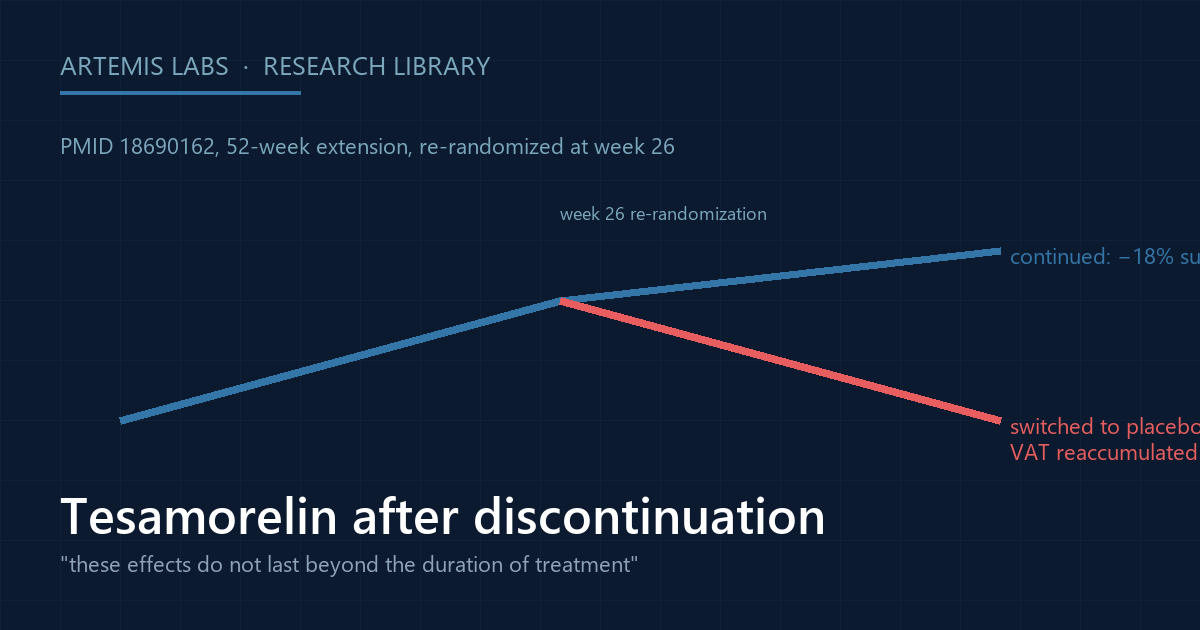
The first Phase 3 trial randomized 410 HIV patients with central fat accumulation to tesamorelin (n = 273) or placebo (n = 137) for 26 weeks. At week 26, patients who had been on tesamorelin were re-randomized to continue (T-T group, n = 154) or to switch to placebo (T-P group, n = 50), while placebo patients were switched to tesamorelin (P-T group, n = 111) (AIDS 2008, PMID 18690162). This design is what makes the reversal finding a prospective, randomized observation instead of an anecdote: the switch to placebo was assigned, blinded, and compared against continuation.
In the continuing group, the change in VAT was sustained at −18% over 52 weeks of treatment, as was the triglyceride change of −51 mg/dl. In the switched group, the abstract reports one sentence: Upon discontinuation of tesamorelin, VAT reaccumulated. The conclusion generalises it: Though effects on VAT are sustained during treatment for 52 weeks, these effects do not last beyond the duration of treatment.
The second Phase 3 trial, 404 patients over 12 months with the same re-randomization at month six, reported the same thing in different words: The initial improvements over 6 months in VAT were rapidly lost in those switching from tesamorelin to placebo (JAIDS 2010, PMID 20101189). Two trials, same design, same outcome.
Why does this matter for reading the efficacy numbers?
Because the strong evidence and the maintenance-dependence are the same evidence. The 15.2% and 10.9% VAT reductions reported in the two Phase 3 trials, and the −24 cm² pooled treatment effect at week 26, are measurements taken during treatment. The same program that produced them produced the observation that the measurement reverts when treatment stops. Any summary that reports the first set of numbers without the second is reporting half of the abstract. Artemis Labs’ summary of the tesamorelin trial record keeps the two together on purpose.
The word the trials use is discontinuation. It is the trials’ own design word for the switch-to-placebo arm. Nothing about that arm is guidance for anyone; it is a description of what the researchers observed after a randomized switch.
How common was stopping treatment in the trials?
Two figures speak to this. The first Phase 3 trial’s abstract reports that adverse events did not differ significantly between the two study groups, but more patients in the tesamorelin group withdrew from the study because of an adverse event (PMID 18057338). The 2026 meta-analysis of four RCTs and 909 patients pooled discontinuation and reported a risk ratio of 2.25 with a 95% confidence interval of 0.98 to 5.17 and a p-value of 0.06 (PMID 42538058). That interval crosses 1, so the result is not statistically significant. But a point estimate of roughly double is unfavorable, and it should not be reported as “no difference”. The same review’s authors wrote that limited data on long-term safety, optimal dosing strategies, and durability of treatment effects warrant caution.
Did anything persist after stopping?
One analysis says yes, on one endpoint, with caveats. A 2017 paper co-authored with Theratechnologies examined liver enzymes in the pooled Phase 3 population and reported that the transaminase improvement seen in VAT responders persisted over 52 weeks even in those switched to placebo despite a partial reaccumulation of VAT (AIDS 2017, PMID 28832410). Three things bound that finding: it is restricted to responders, its endpoint is a blood test instead of the fat itself, and the sponsor is on the author list. It does not contradict the reversal; the same sentence confirms that VAT partially reaccumulated.
A second observation from the 52-week data bears on what non-responders experienced while still on treatment. In the per-protocol analysis of 402 patients, those who did not achieve the responder threshold showed fasting glucose changes of 8 ± 17 mg/dL at 52 weeks against −1 ± 14 in responders, and HbA1c changes of 0.2–0.3% against 0.0% (Clin Infect Dis 2012, PMID 22495074). The authors describe responders as showing attenuated glucose changes, a word that presupposes a change to attenuate. Patients who took the drug and did not lose visceral fat drifted toward worse glycaemia. That is the other side of the responder split, and it belongs beside the reversal finding.
What the research does not show
Everything on this page describes the licensed product EGRIFTA in adults with HIV-associated lipodystrophy. None of it attaches to research-grade material of the same sequence, and none of it is a claim about what any research vial does. The reversal finding rests on a 50-patient switch arm in one trial and a re-randomized arm in a second; it is consistent across both, but it is not a large dataset. The trials measured imaging-defined visceral fat and blood markers, not clinical events, so the record says nothing about whether the temporary reduction changed any health outcome, and the product’s own label states that long-term cardiovascular safety … has not been established. And there is no published study of what happens after discontinuation in any population other than adults with HIV.
Frequently asked questions
Is the reversal finding an interpretation or a reported result?
A reported result, in the abstract of the Phase 3 extension trial (PMID 18690162), from a randomized switch-to-placebo arm, and repeated in the second Phase 3 trial (PMID 20101189).
Was the discontinuation risk ratio statistically significant?
No. RR 2.25, 95% CI 0.98–5.17, p = 0.06 (PMID 42538058). The point estimate is unfavorable; the interval crosses 1.
Did any benefit persist?
A liver-enzyme improvement in responders persisted in a sponsor-co-authored analysis (PMID 28832410), while the visceral fat partially reaccumulated in the same patients.
Where does the safety record sit?
On our tesamorelin safety research page, which collects the glucose composite, the class-typical adverse events and the pharmacovigilance signal. The compound’s identity record is on the tesamorelin research page.
References
- Long-term safety and effects of tesamorelin, a growth hormone-releasing factor analogue, in HIV patients with abdominal fat accumulation. AIDS. 2008. PMID 18690162 · DOI.
- Effects of tesamorelin, a growth hormone-releasing factor, in HIV-infected patients with abdominal fat accumulation: a randomized placebo-controlled trial with a safety extension. J Acquir Immune Defic Syndr. 2010. PMID 20101189 · DOI.
- Metabolic effects of a growth hormone-releasing factor in patients with HIV. N Engl J Med. 2007. PMID 18057338 · DOI.
- Efficacy and Safety of Tesamorelin in People Living With HIV (PLWH) With Lipodystrophy: A Systematic Review and Meta-Analysis. J Int Assoc Provid AIDS Care. 2026. PMID 42538058 · DOI.
- Reduction in visceral adiposity is associated with an improved metabolic profile in HIV-infected patients receiving tesamorelin. Clin Infect Dis. 2012. PMID 22495074 · DOI.
- Visceral fat reduction with tesamorelin is associated with improved liver enzymes in HIV. AIDS. 2017. PMID 28832410 · DOI. Co-authored with Theratechnologies Inc.
- Tesamorelin (Egrifta). Drugs. 2011. PMID 21668043; and BioDrugs. 2011. PMID 22050344.
Methodology: every quotation was transcribed from the PubMed abstract of the cited record via NCBI E-utilities on August 27, 2026. Last verified August 28, 2026.
All compounds sold by Artemis Labs are for laboratory research use only. Nothing on this page is medical advice, and no statement has been evaluated by the FDA.
