
Sermorelin Sequence, Structure and Molecular Weight | Artemis Labs
Aug
Sermorelin sequence, structure and molecular weight: the verified identity record
Published August 28, 2026 · Artemis Labs
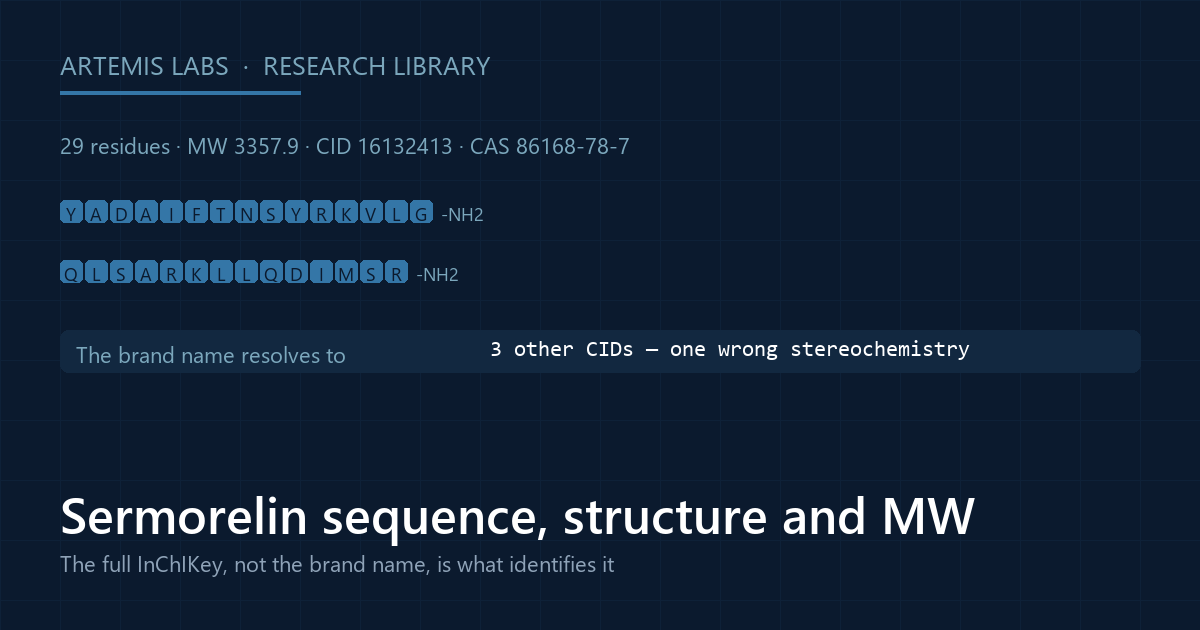
Sermorelin identity — Sermorelin is a synthetic peptide identical in sequence to the first 29 amino acids of human growth hormone-releasing hormone (GHRH), ending in an amide. PubChem lists it under CID 16132413 with molecular formula C149H246N44O42S, molecular weight 3357.9, CAS number 86168-78-7 and WHO ATC codes H01AC04 and V04CD03. The name of the pharmaceutical product it was once sold as resolves in PubChem to three other records, one of them a different stereoisomer, so an identity check should use the CID, the InChIKey or the CAS number instead of the brand. Sermorelin is not tesamorelin (44 residues, 5136) and not native GHRH(1-44) (5040).
Key findings
- One record, one molecular weight. PubChem CID 16132413: C149H246N44O42S, molecular weight 3357.9, exact mass 3356.8220541, InChIKey WGWPRVFKDLAUQJ-MITYVQBRSA-N, fetched August 28, 2026.
- The sequence is the first 29 residues of GHRH. YADAIFTNSYRKVLGQLSARKLLQDIMSR, with a C-terminal amide on the arginine at position 29. No N-terminal modification.
- The brand name is a trap. It returns three PubChem CIDs, 16132412 (the acetate salt, molecular weight 3417.9), 16129620 (a stereochemistry-undefined duplicate) and 57303711 (a different stereoisomer). None of them is the sermorelin record.
- Three look-alikes, three masses. Sermorelin 3357.9 · native GHRH(1-44), called somatorelin, 5040 · tesamorelin 5136. A tesamorelin sheet that reports a mass near 3,358 has described sermorelin.
What is the verified structure?
Human GHRH is 44 amino acids long. Its first 29 residues carry the activity at the GHRH receptor, and the 29-residue fragment, made synthetically and finished with an amide instead of a free acid, is sermorelin. PubChem’s mechanism annotation states the pharmacology in one sentence: Sermorelin binds to the growth hormone releasing hormone receptor and mimics native GRF in its ability to stimulate growth hormone secretion (CID 16132413). Its pharmacodynamics annotation adds that the product is similar to the full-length native hormone (44 residues) in its ability to stimulate GH secretion in humans.
Two verified facts follow from the structure and matter for anyone reading a specification sheet. Because sermorelin has no cap on its N-terminus, the blood enzyme that clips native GHRH acts on it too; PubChem’s Biological Half-Life annotation gives 11-12 min. And because it is a fragment, its mass is far below the two full-length molecules it is often confused with.
Which identifiers belong on the record?
| Field | Verified value (PubChem CID 16132413, fetched August 28, 2026) |
|---|---|
| Molecular formula | C149H246N44O42S |
| Molecular weight | 3357.9 (free base) |
| Exact mass | 3356.8220541 |
| InChIKey | WGWPRVFKDLAUQJ-MITYVQBRSA-N |
| CAS | 86168-78-7 |
| UNII | 89243S03TE |
| WHO ATC | H01AC04; V04CD03 |
| Residues | 29 (GHRH 1-29); C-terminal Arg29 amide; unmodified N-terminus |
The approved pharmaceutical product, sold in the 1990s, was sermorelin acetate, so a sheet describing the acetate salt should say so and give the salt’s mass, not the free base’s. PubChem’s separate acetate record (CID 16132412) lists a molecular weight of 3417.9; that figure is the salt, not sermorelin, and an identity line that pairs the free-base formula with the salt’s mass has mixed two records.
Why does the brand name resolve to the wrong records?
In the PubChem name index, the brand under which sermorelin acetate was marketed returns three compound identifiers, and the correct sermorelin record is not among them. CID 16132412 is the acetate salt, formula C151H250N44O44S, InChIKey BVLCEKWPOSAKSZ-YQMCHIOTSA-N. CID 16129620 has the same mass as sermorelin but a stereochemistry-undefined InChIKey, WGWPRVFKDLAUQJ-UHFFFAOYSA-N. CID 57303711 also has the same mass but a different stereo block, WGWPRVFKDLAUQJ-IKDFWVMUSA-N, with several centres specified as (2R) where the true sermorelin record has (2S). Three of these four records share the first fourteen characters of the InChIKey, WGWPRVFKDLAUQJ, and differ only after the hyphen. So an identity check that matches on the InChIKey skeleton alone can accept a wrong-stereochemistry record as sermorelin. The full InChIKey, WGWPRVFKDLAUQJ-MITYVQBRSA-N, or the CID, or the CAS number 86168-78-7, separates them.
How does sermorelin compare with the full-length molecules?
| Sermorelin | Somatorelin (native GHRH 1-44) | Tesamorelin | |
|---|---|---|---|
| PubChem CID | 16132413 | 16132353 | 16137828 |
| Residues | 29 | 44 | 44 + trans-3-hexenoyl cap on Tyr1 |
| Molecular weight | 3357.9 | 5040 | 5136 |
| CAS | 86168-78-7 | 83930-13-6 | 218949-48-5 |
| ATC | H01AC04; V04CD03 | (none returned) | H01AC06 |
The gaps are large and exact: tesamorelin minus sermorelin is 1778.1 daltons, fifteen residues plus the cap; somatorelin minus sermorelin is 1682.1 daltons, the fifteen residues alone. The most common error in this family runs the other way, a tesamorelin sheet carrying sermorelin’s mass, and our tesamorelin versus sermorelin page sets the two records side by side. Our three-way comparison of sermorelin, CJC-1295 and ipamorelin covers the other two compounds this one is usually sold beside.
What the research does not show
Identity is not evidence of activity, purity or safety for any given vial; those are lot-level analytical questions, and this page reports no lot. The approved sermorelin acetate products, described on our page on the sermorelin FDA record, were specific manufactured products under specific applications, both now discontinued; nothing about them attaches to research-grade material of the same sequence. Two figures in wide circulation are not published here because the primary record does not support them: a half-life range of “10 to 20 minutes” (PubChem gives 11 to 12) and a superlative describing sermorelin as the most faithful GHRH analog, which has no source in the record. What the record does support is the plainer statement: sermorelin is identical in sequence to residues 1 to 29 of native GHRH.
Frequently asked questions
What is sermorelin’s molecular weight?
3357.9 for the free base (PubChem CID 16132413). The acetate salt’s separate record lists 3417.9.
Is sermorelin the same as tesamorelin?
No. Tesamorelin is the full 44-residue GHRH sequence with a hexenoyl cap, molecular weight 5136. Sermorelin is the 29-residue fragment, 3357.9.
Why does searching the brand name give a different structure?
Because the name resolves to three other PubChem records, including a different stereoisomer. Use CID 16132413, CAS 86168-78-7 or the full InChIKey.
Where is Artemis Labs’ sermorelin record?
On the sermorelin research page, which carries the identity table above and the published research with its counter-evidence.
References
- PubChem. Sermorelin, CID 16132413: properties, synonyms, ATC, Biological Half-Life, Mechanism of Action, Pharmacodynamics. National Library of Medicine. pubchem.ncbi.nlm.nih.gov/compound/16132413 (fetched 2026-08-28).
- PubChem. CIDs 16132412, 16129620, 57303711 (brand-name resolution), 16132353 (somatorelin), 16137828 (tesamorelin). pubchem.ncbi.nlm.nih.gov (fetched 2026-08-27/28).
Methodology: identity fields were fetched from PubChem PUG REST and PUG-View on August 27–28, 2026; name-resolution results are from the PUG REST name lookup endpoint. Last verified August 28, 2026.
All compounds sold by Artemis Labs are for laboratory research use only. Nothing on this page is medical advice, and no statement has been evaluated by the FDA.
