
Is Sermorelin FDA-Approved? The Two Applications, Dated | Artemis Labs
Aug
Is sermorelin FDA-approved? The two applications, dated from the record
Published August 28, 2026 · Artemis Labs
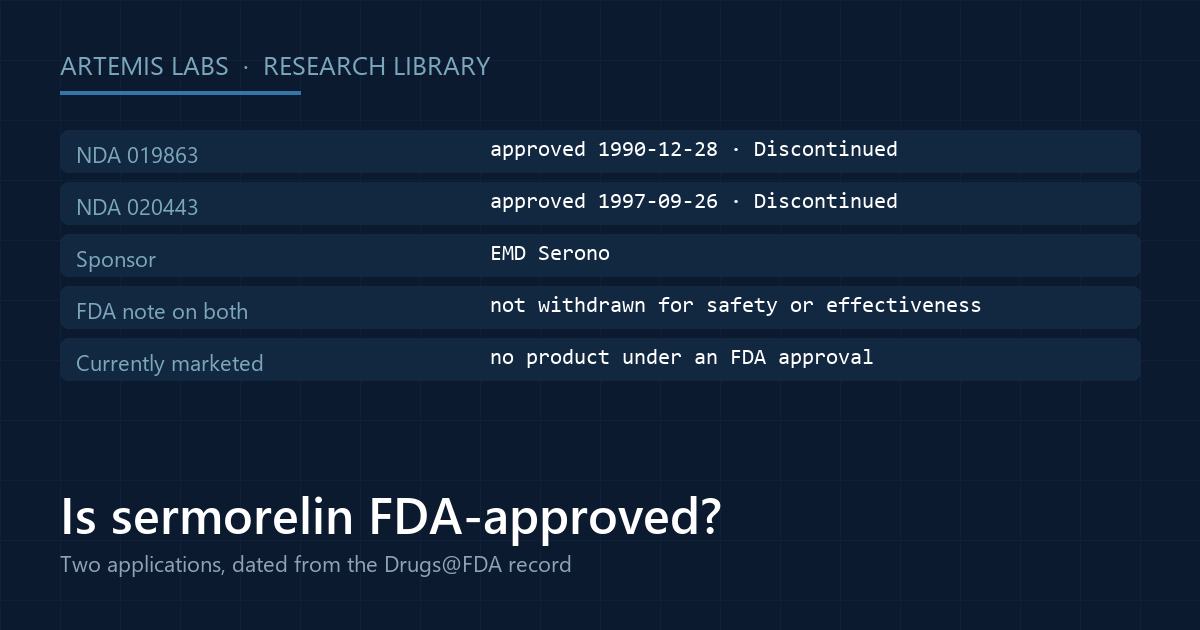
Sermorelin FDA record — Sermorelin acetate was an FDA-approved prescription drug. Drugs@FDA lists two applications, both held by EMD Serono: NDA 019863, originally approved December 28, 1990 as a new molecular entity, and NDA 020443, approved September 26, 1997 as a new dosage form. Both are marked Discontinued, and both product records carry the note that there was a Federal Register determination that product was not discontinued or withdrawn for safety or effectiveness reasons. No sermorelin product is currently marketed under an FDA approval. That history belongs to specific manufactured products; it does not attach to research-grade material of the same sequence.
Key findings
- Two applications, not one. NDA 019863 (ampule presentation, sermorelin acetate equivalent to 0.05 mg base per ampule) and NDA 020443 (vials, equivalent to 0.5 mg and 1 mg base per vial).
- The first approval was 1990, not 1997. Drugs@FDA records the original NDA 019863 submission as approved 1990-12-28, classified Type 1 – New Molecular Entity. The 1997 date belongs to the second application, classified Type 3 – New Dosage Form.
- Discontinued, and the reason is on the record. Both product entries carry the Federal Register determination language quoted above.
- The discontinuation dates are in the record — in a different document from the approval entries. Federal Register 2013-04827 (Docket FDA-2012-P-1071) states that EMD Serono notified FDA by letter dated July 11, 2008 that GEREF 0.05 mg base/amp was being discontinued, and by letter dated December 2, 2008 that GEREF was being discontinued with withdrawal of NDA 20-443 requested. The document records no reason beyond the determination quoted above.
What does the Drugs@FDA record say, field by field?
Drugs@FDA is the FDA database of approved drug products and their regulatory histories. Retrieved through the openFDA interface on August 28, 2026, the sermorelin acetate records read as follows.
| Field | NDA 019863 | NDA 020443 |
|---|---|---|
| Sponsor | EMD Serono | EMD Serono Inc |
| Original approval | 1990-12-28, Type 1 – New Molecular Entity | 1997-09-26, Type 3 – New Dosage Form |
| Presentation | Injectable, ampule (sermorelin acetate EQ 0.05MG BASE/AMP) | Injectable, vial (EQ 0.5MG and EQ 1MG BASE/VIAL) |
| Marketing status | Discontinued | Discontinued |
| Product-record note | Federal Register determination that product was not discontinued or withdrawn for safety or effectiveness reasons | |
| Later submissions | Manufacturing supplements 1991 and 1998; labeling supplements 1998 and 2001 | None recorded beyond the original |
That note in the last row is the significant one, and it is the FDA’s own language. When a product leaves the market, the agency records whether the withdrawal was driven by safety or effectiveness findings, because that determination governs whether generic versions may still be approved. For both sermorelin acetate applications, the determination is that it was not.
What was it approved for?
The openFDA record we retrieved carries the applications, sponsors, presentations and dates, but not the indication text. PubChem’s annotation, sourced from DrugBank, describes the product’s use in children: Sermorelin is used in the treatment of children with growth hormone deficiency or growth failure. That framing matches the trial literature of the period, which is pediatric growth research, including the multicenter study published by the product’s own international study group (PMID 8772599). Our trial-record page sets out those trials, including the two randomized comparisons in which growth hormone outperformed the peptide.
Two things this page does not state, because the primary record does not support them. It does not state a specific indication wording, since we did not retrieve a label. And it does not repeat a second use that appears in the same PubChem annotation but is not corroborated anywhere else in the record we checked.
What about the 503A compounding lists?
A claim circulates, including in Artemis Labs’ own earlier product copy, that sermorelin was placed on the FDA’s interim 503A bulk drug substances Category 2 list in September 2023 and removed on September 27, 2024, citing Federal Register document 2024-24828. We retrieved that document. It is a notice of a Pharmacy Compounding Advisory Committee meeting, published October 25, 2024, and the substances it names for discussion are AOD-9604-related bulk drug substances, CJC-1295-related bulk drug substances in five forms including the DAC version, and Thymosin alpha-1-related bulk drug substances. Sermorelin is not mentioned in it. The claim is therefore unverified against its own cited source, and this cluster does not publish it. We have corrected our product copy accordingly. What the document does establish, and what our comparison page reports, is that CJC-1295 forms were before that committee in late 2024.
Does any of this attach to research-grade material?
No, and the structure of the record is why. An FDA approval is granted to a specific manufactured product: a named application number, a named sponsor, a named drug substance, a named presentation and strength, made to a reviewed process. Every field in the table above describes something EMD Serono made. Material with the same sequence, made by anyone else, is covered by none of it, carries no approval, and has no approved use. Artemis Labs sells research-grade sermorelin for laboratory use and states that plainly on the sermorelin research page.
What the research does not show
The regulatory record shows that a sermorelin acetate product met FDA’s standard decades ago and is no longer marketed. It does not show that the compound is safe or effective for any use today, and it does not show why the product left the market, only that the reason was not a safety or effectiveness finding. The record we retrieved carries no indication text, no label, and no discontinuation date, so none is stated here. The 503A Category 2 history that circulates for sermorelin is unverified against its cited source. And nothing in the record speaks to research-grade material of the same sequence.
Frequently asked questions
Is sermorelin FDA-approved today?
No product is currently marketed under an FDA approval. Two applications exist and both are discontinued.
Was it withdrawn for safety reasons?
No. Both product records carry the FDA determination that discontinuation was not for safety or effectiveness reasons.
When was it first approved?
December 28, 1990, under NDA 019863. The 1997 date belongs to a second application for a different presentation.
Is it on a compounding list?
Not per any primary source we verified. The Federal Register document usually cited for that claim does not mention sermorelin.
References
- FDA Drugs@FDA. Sermorelin acetate: NDA 019863 and NDA 020443 (EMD Serono), applications, submissions, products and marketing status; retrieved via the openFDA
drugsfdaendpoint on 2026-08-28. accessdata.fda.gov/scripts/cder/daf. - Federal Register document 2024-24828, Pharmacy Compounding Advisory Committee; Notice of Meeting …, published 2024-10-25, full text retrieved 2026-08-28. federalregister.gov/d/2024-24828.
- PubChem. Sermorelin, CID 16132413: Drug Indication and Pharmacodynamics annotations. pubchem.ncbi.nlm.nih.gov/compound/16132413.
- Once daily growth hormone-releasing hormone therapy accelerates growth in growth hormone-deficient children during the first year of therapy. J Clin Endocrinol Metab. 1996. PMID 8772599.
Methodology: regulatory fields were retrieved from Drugs@FDA via the openFDA API and from the Federal Register API on August 28, 2026, and are quoted as returned. Last verified August 28, 2026.
All compounds sold by Artemis Labs are for laboratory research use only. Nothing on this page is medical advice, and no statement has been evaluated by the FDA.
