
CJC-1295 and Ipamorelin Together: What the Record Contains | Artemis Labs
Aug
CJC-1295 and ipamorelin together: what the research record actually contains
Published August 28, 2026 · Artemis Labs
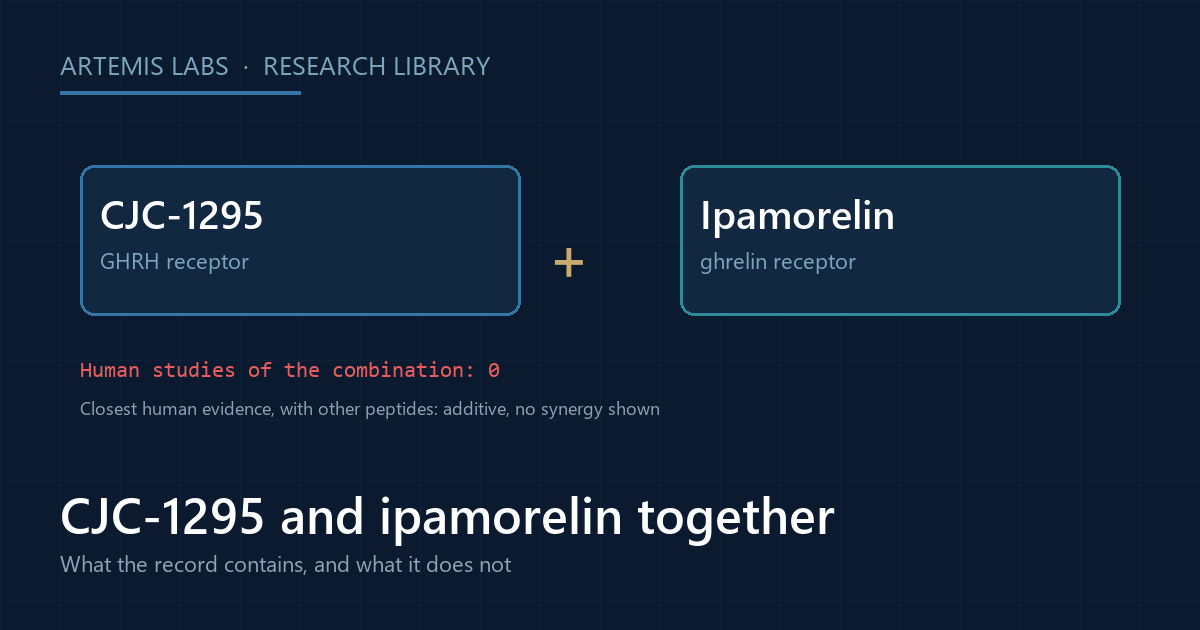
CJC-1295 and ipamorelin — The two compounds are sold as a pair more often than any other combination in this category, and no published human study has tested them together. A PubMed search for both names returns ten records, every one a review or narrative summary. The closest primary evidence uses different peptides: in eight healthy men, GHRH(1-29) plus GHRP-2 produced a larger growth-hormone response than either alone, but the authors could not demonstrate synergy, and the combined response was not significantly different from the sum of the two separately. A 2026 review reports a mouse muscle finding for the CJC-1295 and ipamorelin pairing and says plainly that it is limited to animal studies. This page reports the absence, because that is what the record contains.
Key findings
- No human combination study exists. (CJC-1295 OR CJC1295) AND ipamorelin returned 10 PubMed records on August 28, 2026, all reviews; none reports original data on the pair.
- The one human GHRH-plus-GHRP result is additive, not synergistic. Although the GH releasing potency of GHRP-2 significantly exceeded that of GHRH1-29NH2, we were not able to demonstrate synergy between the two substances (PMID 7586605).
- The pathways are interdependent. Blocking GHRH with an antagonist eliminated most of the GH response to GHRP-6: endogenous GHRH is necessary for most of the GH response to GHRP-6 in humans (PMID 9543138).
- The mouse finding, reported as a review’s summary. A 2026 primer states that CJC-1295 combined with ipamorelin showed significantly improved maximum tetanic tension in murine models with glucocorticoid-induced muscle loss, but these findings are limited to animal studies (PMID 41476424).
What are the two compounds?
CJC-1295 is a modified GHRH(1-29): four amino-acid substitutions plus a chemical handle at the C terminus that binds covalently to albumin in the blood. Its originating paper, from the company developing it, describes the handle as an N epsilon-3-maleimidopropionamide derivative of lysine bonding to the free thiol on Cys34 of serum albumin, and reports the compound present in plasma beyond 72 h in rats (PMID 15817669). In healthy adults, two randomized, placebo-controlled, double-blind ascending-dose trials estimated its half-life at 5.8-8.1 d and reported growth hormone raised 2- to 10-fold for 6 d or more and IGF-I 1.5- to 3-fold for 9-11 d, with no serious adverse reactions (PMID 16352683).
Ipamorelin is a five-residue peptide, Aib-His-D-2-Nal-D-Phe-Lys-NH2, that acts on a different receptor: the paper that introduced it reports that it stimulates GH release via a GHRP-like receptor, the ghrelin receptor, and that in swine it did not raise ACTH or cortisol the way comparator peptides did (PMID 9849822). Its human pharmacokinetics were characterised in 1999, with a short terminal half-life of 2 hours (PMID 10496658), and its only published clinical efficacy trial, in 114 bowel-resection patients, found no significant differences between ipamorelin and placebo in the key and secondary efficacy analyses (PMID 25331030). Our three-way comparison sets both records beside sermorelin‘s.
What is the rationale for pairing them, and what tests it?
The argument is mechanistic: two receptors, one endpoint. A GHRH-receptor agonist and a ghrelin-receptor agonist both end in growth-hormone release through different intracellular routes, so combining them might produce more than either alone. That question has been asked in humans, though with different peptides than the pair sold today.
The direct test came in 1995. Eight healthy non-obese men aged 25 to 34 received GHRH(1-29)NH2 alone, GHRP-2 alone, and both together, in randomized order. Peak growth hormone was highest with the combination. But the authors’ conclusion is the sentence that matters: Although the GH releasing potency of GHRP-2 significantly exceeded that of GHRH1-29NH2, we were not able to demonstrate synergy between the two substances, and the combined area under the curve was not significantly different from the sum of the GH AUCs of each subject after the separate tests (PMID 7586605). Additive, in other words, not more than additive.
A 1998 study explains why the two are not independent. In nine healthy men, a GHRH antagonist given before GHRP-6 eliminated most of the GH response, cutting the peak rise from 33.8 to 6.2 micrograms per litre. The authors concluded that endogenous GHRH is necessary for most of the GH response to GHRP-6 in humans (PMID 9543138). A ghrelin-receptor agonist, on that evidence, works largely by leaning on the GHRH pathway instead of beside it, which is a reason to expect addition instead of multiplication.
Mayo Clinic groups later used GHRH plus GHRP-2 co-infusion as a research tool, finding that the size of the combined response depends on age, body fat and IGF-1 (PMIDs 18073313, 19240251). And in mice lacking GHRH entirely, a GHRH analog plus a GHRP produced more growth than the analog alone, while the presence of GHRH seems necessary for the stimulation of GH secretion by GHRP-2 (PMID 16601359). All of this describes the class. None of it used CJC-1295 or ipamorelin.
What exists for this exact pair?
Ten PubMed records mention both names, and each is a review. The most specific claim among them comes from a 2026 primer for orthopaedic and sports-medicine physicians, which reports that CJC-1295 combined with ipamorelin showed significantly improved maximum tetanic tension in murine models with glucocorticoid-induced muscle loss, but these findings are limited to animal studies (PMID 41476424). That is a review’s summary of a mouse experiment; the primary paper is not in our verified corpus, so we cite the review as a review and not as the study. The same review notes that tesamorelin has no supporting orthopaedic evidence, and a second 2026 review states that growth-hormone-axis secretagogues including CJC-1295 and ipamorelin remain investigational, with uncertain safety profiles, product quality concerns, and widespread antidoping restrictions (PMID 42160466). A 2026 scoping review of six emerging peptides concludes that the claimed benefits of emerging peptide supplements for musculoskeletal recovery and performance remain unsubstantiated by current human trials (PMID 42578445).
What the research does not show
There is no human study of CJC-1295 with ipamorelin: not a trial, not a pharmacokinetic study, not a safety study. Nothing establishes how the two behave together in a vial or in any model. The closest human evidence used different peptides and found addition instead of synergy, and a second study suggests one of the two pathways depends on the other. The one combination finding for this exact pair is in mice, reported second-hand through a review, in a glucocorticoid muscle-loss model. Neither compound has an approved product; both are named on the WADA 2026 Prohibited List at section S2.2.4, alongside sermorelin and tesamorelin, as our WADA page quotes. Artemis Labs supplies these compounds for laboratory research and states plainly that the combination research has not been done.
Frequently asked questions
Is there a study of CJC-1295 with ipamorelin?
No human study. Ten PubMed records mention both, all reviews; one reports a mouse muscle finding and says so.
Do GHRH analogs and ghrelin-receptor agonists act synergistically?
The one human test of that question, with different peptides, could not demonstrate synergy; the combined response matched the sum of the parts.
Which has the better human record on its own?
CJC-1295 has two ascending-dose trials in healthy adults. Ipamorelin’s only clinical efficacy trial was null.
Where are the individual records?
On our three-way comparison, and the ipamorelin and CJC-1295 research pages.
References
- PubMed search (CJC-1295 OR CJC1295) AND ipamorelin, NCBI E-utilities, 2026-08-28: Count 10, all reviews.
- GH responses to intravenous bolus infusions of GH releasing hormone and GH releasing peptide 2 separately and in combination in adult volunteers. Clin Endocrinol. 1995. PMID 7586605 · DOI.
- Growth hormone (GH)-releasing peptide-6 requires endogenous hypothalamic GH-releasing hormone for maximal GH stimulation. J Clin Endocrinol Metab. 1998. PMID 9543138 · DOI.
- Prolonged stimulation of GH and IGF-I secretion by CJC-1295 in healthy adults. J Clin Endocrinol Metab. 2006. PMID 16352683.
- Identification of CJC-1295 as a long-lasting GRF analog. Endocrinology. 2005. PMID 15817669. ConjuChem-authored.
- Ipamorelin, the first selective growth hormone secretagogue. Eur J Endocrinol. 1998. PMID 9849822. Novo Nordisk-authored.
- Pharmacokinetic-pharmacodynamic modeling of ipamorelin in human volunteers. Pharm Res. 1999. PMID 10496658.
- Proof-of-concept study of ipamorelin for postoperative ileus in bowel resection patients. Int J Colorectal Dis. 2014. PMID 25331030.
- Effects of combined long-term treatment with a GHRH analogue and a GH secretagogue in the GHRH knockout mouse. Neuroendocrinology. 2005. PMID 16601359.
- Gonadal status and body mass index jointly determine GHRH/GHRP synergy in healthy men. J Clin Endocrinol Metab. 2008. PMID 18073313. Determinants of GHRH and GHRP synergy in men. Am J Physiol Endocrinol Metab. 2009. PMID 19240251.
- Injectable Peptide Therapy: A Primer for Orthopaedic and Sports Medicine Physicians. Am J Sports Med. 2026. PMID 41476424.
- Injectable Peptides in Sports Medicine. JBJS Rev. 2026. PMID 42160466. Peptide Supplements and Their Therapeutic Applications in Sports Medicine. Am J Sports Med. 2026. PMID 42578445.
Methodology: the combination search and every quotation were retrieved via NCBI E-utilities on August 28, 2026; where a finding is reported by a review instead of a primary paper, this page says so. Last verified August 28, 2026.
All compounds sold by Artemis Labs are for laboratory research use only. Nothing on this page is medical advice, and no statement has been evaluated by the FDA.
