
What Is Tesamorelin Studied For? Research Overview | Artemis Labs
Aug
What is tesamorelin studied for? A plain-language research overview
Published August 28, 2026 · Artemis Labs
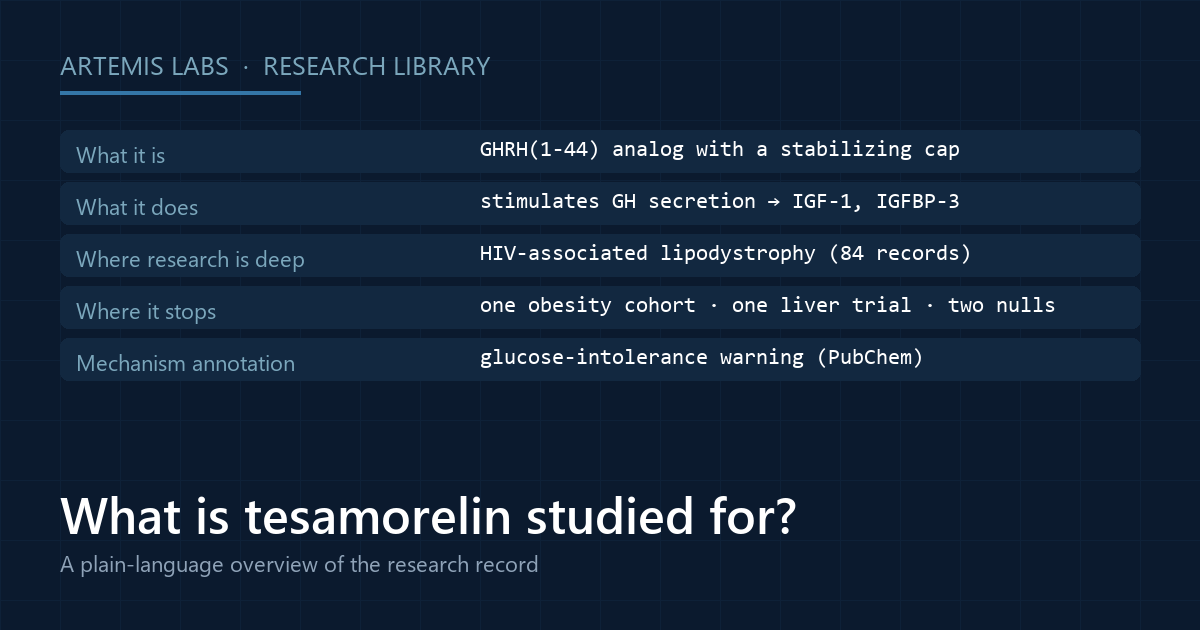
Tesamorelin — Tesamorelin is a synthetic analog of human growth hormone-releasing hormone (GHRH), the signal the brain sends to the pituitary gland to release growth hormone. It is the 44-residue GHRH sequence with one added group, trans-3-hexenoyl, on its first amino acid, which makes it more resistant to a blood enzyme that breaks native GHRH down. Almost all of its human research is in one setting: adults with HIV whose treatment has caused abdominal fat to build up, where a licensed pharmaceutical product, EGRIFTA, was tested in two Phase 3 trials. Outside that setting the research thins to single small trials, and the product’s own mechanism annotation carries a warning about glucose.
Key findings
- What it does, in one verified sentence. PubChem’s pharmacodynamics annotation reads: Tesamorelin stimulates growth hormone secretion, and subsequently increases IGF-1 and IGFBP-3 levels. FDA classes it as a Growth Hormone Releasing Factor Analog.
- Where the research is deep. tesamorelin AND HIV returns 84 PubMed records; the lane holds two Phase 3 trials, a pooled analysis of 806 patients and two 2026 meta-analyses.
- Where it is shallow. Non-HIV obesity: one cohort published twice. Liver fat: one 61-patient trial re-analyzed at least six ways. Cognition: one unreplicated positive, then two nulls. Sarcopenia, sport, wound: zero primary studies. Animal studies: two papers, both sponsor-linked.
- The mechanism annotation includes a safety statement. PubChem’s Mechanism of Action section says the drug predisposes the patient to glucose intolerance and can also increase the risk of type 2 diabetes.
What is tesamorelin, in plain terms?
Growth hormone-releasing hormone, GHRH, is a 44-amino-acid peptide made in the hypothalamus. Its job is to tell the pituitary gland to release growth hormone. In the blood it lasts only minutes, because an enzyme called dipeptidyl peptidase-IV clips residues off its front end. Tesamorelin is GHRH with a small chemical cap on that front end. The developer’s own non-clinical paper describes it as an analogue of human growth hormone-releasing factor (hGRF1-44NH2) minimally modified by addition of a trans-3-hexenoyl moiety to Tyr1, and reports that the cap made it resistant to dipeptidyl aminopeptidase-IV deactivation and slowed the in vitro degradation of the peptide in rat, dog and human plasma (Theratechnologies, 2007, PMID 17214611). That is the sponsor’s paper, not an independent one, but PubChem’s structure record confirms the same modification.
The verified identity is on our sequence and molecular-weight page: PubChem CID 16137828, formula C221H366N72O67S, molecular weight 5136, CAS 218949-48-5, a C-terminal amide, and a plasma half-life that PubChem states as 26 and 38 minutes in healthy subjects and HIV-infected patients, respectively.
What does it do in the body, according to the primary record?
PubChem’s pharmacodynamics annotation states it in one sentence: Tesamorelin stimulates growth hormone secretion, and subsequently increases IGF-1 and IGFBP-3 levels. IGF-1 is the hormone the liver makes in response to growth hormone, and IGFBP-3 is its main carrier protein. FDA’s pharmacologic classification lists the established class as Growth Hormone Releasing Factor Analog and the physiologic effect as Increased GHRH Activity.
The IGF-1 rise is the most consistently repeated measurement in the whole tesamorelin record. In the first Phase 3 trial, IGF-I increased by 81.0% in the tesamorelin group and decreased by 5.0% in the placebo group (PMID 18057338). In the pooled analysis of both trials, mean IGF-I increased 108 ± 112 vs. −7 ± 64 ng/ml (PMID 20554713). In a 2012 trial in older adults, treatment increased insulin like growth factor 1 levels by 117%, which remained within the physiological range (PMID 22869065).
The same primary record carries a warning in an unusual place. PubChem’s Mechanism of Action section, after describing pituitary stimulation, continues: Tesamorelin therapy predisposes the patient to glucose intolerance and can also increase the risk of type 2 diabetes, so the drug is contraindicated in pregnancy. That is a safety statement inside a mechanism annotation, and it belongs in any overview.
Where is the research deep?
In one place. A licensed product containing tesamorelin, EGRIFTA, made by Theratechnologies Inc. under FDA application 022505, was tested in adults with HIV and abdominal fat accumulation, a condition called HIV-associated lipodystrophy. Two randomized, placebo-controlled trials of 412 and 404 patients reported visceral fat reductions of 15.2% and 10.9% over 26 weeks versus placebo (PMIDs 18057338, 20101189). A pooled analysis of 806 patients (PMID 20554713) and two 2026 meta-analyses (PMIDs 42538058, 41545261) sit on top of them. The same program reported that the effect did not last after treatment stopped: these effects do not last beyond the duration of treatment (PMID 18690162). Our trial-record page sets out the whole lane, and our page on what the FDA approval actually covers explains why none of it attaches to research-grade material.
The approved indication, in the label’s own words, is the reduction of excess abdominal fat in HIV-infected adult patients with lipodystrophy. That is the only indication.
Where does the research stop?
Everywhere else, and quickly. The PubMed search tesamorelin NOT HIV returns 37 records, most of them analytical-chemistry methods, reviews and news items. Lane by lane, as of August 27, 2026:
| Research lane | What actually exists |
|---|---|
| Liver fat (NAFLD) | One randomized trial of 61 people, all with HIV (Lancet HIV 2019, PMID 31611038); its authors wrote might. At least six later papers re-analyze the same 61 patients. |
| Obesity without HIV | One cohort of about 60 people with reduced growth-hormone secretion, published twice (PMIDs 23015655, 24178787). |
| Cognition | One positive 2012 trial (PMID 22869065), never replicated, then a null 2025 Phase 2 trial (PMID 39813152) and a null 2026 pilot (PMID 42382101). |
| Muscle, frailty, sarcopenia | Zero completed trials. One responder-only secondary analysis and one protocol with no results. |
| Sport, tendon, wound, musculoskeletal | Nine records, all reviews. Zero primary studies. |
| Animal studies | Two papers, both sponsor-linked, both before 2008 (PMIDs 17214611, 15113616). |
That last row is the inverse of the usual research-peptide profile. Most compounds in this category have a large animal literature and almost no human trials. Tesamorelin has a real human trial record in one indication and almost no independent animal work at all. Our page on research outside HIV walks through each lane with its own numbers.
What the research does not show
The controlled human evidence for tesamorelin is confined to adults with HIV-associated lipodystrophy, and it describes a licensed pharmaceutical product, not research-grade material of the same sequence. Nothing on this page is a claim about what any research vial does. The record shows no approved indication beyond the one quoted above; no independent replication of the single positive cognition trial; no completed trial in muscle or frailty; no primary study in sport or tissue repair; and, for a compound that raises growth hormone and IGF-1, no long-term malignancy surveillance study in PubMed at all. The trials measured imaging-defined fat and blood markers, not clinical events, and the approved product’s own label states that its long-term cardiovascular safety has not been established. Three 2026 reviews name tesamorelin in the context of unregulated self-administration and warn that rigorous human safety data are scarce for the category (PMIDs 41966639, 42395176, 42160466); that context argues for restraint in how any of this is read.
Frequently asked questions
Is tesamorelin a growth hormone?
No. It is an analog of the hormone that tells the pituitary to release growth hormone. PubChem’s annotation: it stimulates growth hormone secretion, and subsequently increases IGF-1 and IGFBP-3 levels.
Is it the same as sermorelin?
No. Sermorelin is GHRH(1-29), a 29-residue fragment with molecular weight 3357.9; tesamorelin is the full 44-residue sequence with the hexenoyl cap, molecular weight 5136. See tesamorelin versus sermorelin.
What is it approved for?
A product containing it, EGRIFTA, is approved for the reduction of excess abdominal fat in HIV-infected adult patients with lipodystrophy. Nothing else. Research-grade tesamorelin carries no approval.
Where is the compound record?
On the tesamorelin research page, with the identity table and the full reference list, and on the secretagogue research topic page.
References
- PubChem. Tesamorelin, CID 16137828: Pharmacodynamics, Mechanism of Action, FDA Pharmacological Classification, Biological Half-Life. pubchem.ncbi.nlm.nih.gov/compound/16137828 (fetched 2026-08-27).
- Non-clinical pharmacology and safety evaluation of TH9507, a human growth hormone-releasing factor analogue. Basic Clin Pharmacol Toxicol. 2007. PMID 17214611 · DOI. Sponsor-authored.
- Metabolic effects of a growth hormone-releasing factor in patients with HIV. N Engl J Med. 2007. PMID 18057338 · DOI.
- Effects of tesamorelin, a growth hormone-releasing factor, in HIV-infected patients with abdominal fat accumulation: a randomized placebo-controlled trial with a safety extension. J Acquir Immune Defic Syndr. 2010. PMID 20101189.
- Long-term safety and effects of tesamorelin, a growth hormone-releasing factor analogue, in HIV patients with abdominal fat accumulation. AIDS. 2008. PMID 18690162.
- Pooled analysis of two multicenter, double-blind placebo-controlled phase 3 trials with safety extension data. J Clin Endocrinol Metab. 2010. PMID 20554713.
- Effects of growth hormone-releasing hormone on cognitive function in adults with mild cognitive impairment and healthy older adults: results of a controlled trial. Arch Neurol. 2012. PMID 22869065.
- Effects of tesamorelin on non-alcoholic fatty liver disease in HIV: a randomised, double-blind, multicenter trial. Lancet HIV. 2019. PMID 31611038.
- Meta-analyses, 2026: PMID 42538058; PMID 41545261. Cognition nulls: PMID 39813152; PMID 42382101. Non-HIV obesity cohort: PMID 23015655; PMID 24178787.
- 2026 reviews naming the compound in a grey-market context: PMID 41966639; PMID 42395176; PMID 42160466.
Methodology: PubChem annotations were fetched from PUG-View for CID 16137828 and every trial quotation was transcribed from the cited PubMed abstract via NCBI E-utilities on August 27, 2026. Last verified August 28, 2026.
All compounds sold by Artemis Labs are for laboratory research use only. Nothing on this page is medical advice, and no statement has been evaluated by the FDA.
