
Sermorelin Safety Research: What the Trials Reported | Artemis Labs
Aug
Sermorelin safety research: what the trials reported, and what was never studied
Published August 28, 2026 · Artemis Labs
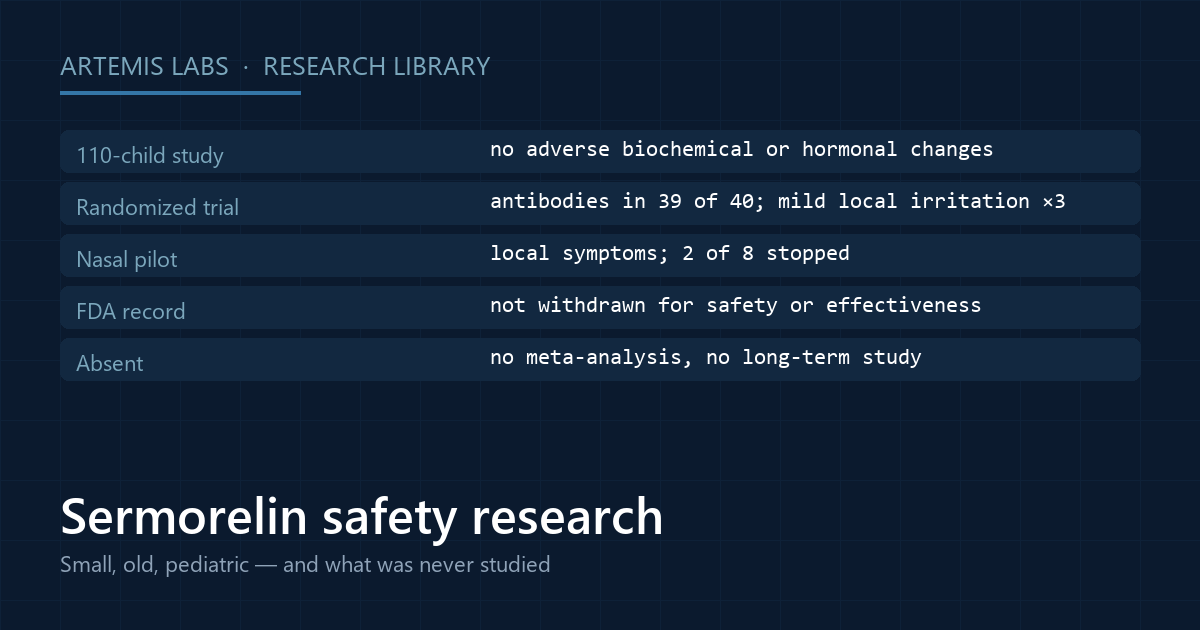
Sermorelin safety — The published safety record for sermorelin is small, old and pediatric. The largest study, 110 children treated for up to a year, reported no adverse changes in general biochemical or hormonal analyses and no change in fasting glucose. A randomized trial in 60 children found nearly universal antibody formation against the peptide and mild injection-site irritation in three participants. When the marketed product was discontinued, FDA recorded a determination that it was not discontinued or withdrawn for safety or effectiveness reasons. What does not exist is equally important: no meta-analysis, no modern adult safety trial, and no long-term surveillance study of any kind.
Key findings
- The largest study reported clean chemistry. No adverse changes in general biochemical or hormonal analyses were noted. No change in fasting glucose concentration or excessive generation of insulin-like growth factor I occurred, and overall GHRH was well tolerated (JCEM 1996, PMID 8772599, 110 children, up to 12 months, open-label).
- Antibodies were near-universal in the trial that measured them. 39 of 40 treated children, faded within nine months of stopping, with no correlation between antibody titres and increase in height (PMID 8329830).
- Local reactions in the nasal pilot. Most others reported sneezing immediately after insufflation, rhinorrhoea and mild mucosal burning, and treatment was discontinued in two of eight children (PMID 8329828).
- The regulatory record is explicit about why it left the market. Both FDA product entries carry the note Federal Register determination that product was not discontinued or withdrawn for safety or effectiveness reasons.
What did the trials report on safety?
The one-year multicenter study is the largest safety dataset in the record. It monitored clinical chemistry alongside growth every three to six months in 110 children and reported no adverse biochemical or hormonal changes, no change in fasting glucose, and no excessive IGF-1 generation. The last of those matters for a compound that works by raising growth hormone: IGF-1 is the downstream hormone, and pushing it above the normal range is the concern that governs growth-hormone therapy generally. The authors reported that it did not happen in this study (PMID 8772599).
The randomized Shanghai trial measured immunogenicity, and this is where the record is least comfortable. Nearly every treated child produced antibodies to the peptide within six months. The authors also reported that no growth-hormone antibodies were detected, that the GHRH antibodies had almost disappeared by 9 months after stopping treatment, and that there was no correlation between antibody titres and increase in height. The only adverse events named were mild irritation at the injection site in three children (PMID 8329830). Our page on desensitization and antibodies sets that finding beside the receptor-level evidence.
The eight-child nasal pilot reported the most tolerability problems, all local: good tolerance in one child and, in most of the rest, sneezing, runny nose and mild mucosal burning, with two children stopping treatment at six and twelve weeks (PMID 8329828). Those are properties of that formulation instead of of the molecule.
What does the adult record say about safety?
Very little, and what exists is about a different analog. The 1997 UCSD studies in 19 adults aged 55 to 71 used [Nle27]GHRH-(1-29)-NH2 and reported blood pressure, weight, fasting insulin and glucose, blood counts and chemistry as monitored measures; the immunology paper described increases in some lymphocyte populations and no change in T-cell subsets or natural killer cells (PMIDs 9141536, 9360512). The physiology studies in healthy men were single-session or short, and were designed to measure hormone release instead of safety. There is no adult safety trial of sermorelin itself in our verified corpus, and PubMed indexes no meta-analysis of any kind for the compound.
What do the recent reviews say about the category?
Three 2026 reviews name sermorelin, and all three describe the wider unregulated-peptide category instead of reporting new data on this compound. A sports-medicine review states that for unapproved peptides generally, rigorous human safety data are scarce, and there is potential for serious harm to patients (PMID 41966639). An endocrinology review describing self-administration of GH-axis peptides lists reported adverse effects across the class as endocrine and metabolic disturbances (including prolactin and cortisol elevations, appetite changes, and dysglycaemia), fluid retention syndromes, musculoskeletal symptoms (myalgia/arthralgia), and injection-site reactions (PMID 42395176). A critical review of peptide use in sport concludes that such use should be considered high-risk and ethically problematic until longitudinal data exist (PMID 41880199). These are class-level statements from narrative reviews, not sermorelin findings, and they are reported as such.
What the research does not show
There is no long-term safety study of sermorelin in any population. There is no adult safety trial of the compound itself. There is no meta-analysis. The pediatric safety data are from studies of six to twelve months, three decades ago, in a total of fewer than 200 children, and the largest of them had no control group. Immunogenicity was measured in exactly one trial. The clean chemistry findings in that record are real and are reported here, but they are not evidence of long-term safety, and the absence of harm in a small short study is not the same as a demonstration of safety. Everything cited describes clinical preparations used in studies; none of it describes research-grade material, and no claim is made about what any vial does. The FDA record, on our regulatory page, establishes only that the marketed product’s withdrawal was not driven by a safety or effectiveness finding.
Frequently asked questions
Was sermorelin withdrawn for safety reasons?
No. FDA’s product records carry a determination that discontinuation was not for safety or effectiveness reasons.
Did the trials find side effects?
Mild injection-site irritation in three of 40 children in one randomized trial; local nasal symptoms in most of eight children in a formulation pilot; no adverse biochemical changes in the 110-child study.
What about antibodies?
39 of 40 treated children developed antibodies to the peptide in the trial that measured them; they faded within nine months and did not correlate with growth.
Is there long-term safety data?
No. The longest studies ran twelve months, in children, in the 1990s.
References
- Geref International Study Group. One-year multicenter open-label study in 110 GH-deficient children. J Clin Endocrinol Metab. 1996. PMID 8772599.
- A comparative study of growth hormone (GH) and GH-releasing hormone(1-29)-NH2 for stimulation of growth in children with GH deficiency. Acta Paediatr Suppl. 1993. PMID 8329830.
- Intranasal administration of growth hormone-releasing hormone(1-29)-NH2 in children with growth hormone deficiency. Acta Paediatr Suppl. 1993. PMID 8329828.
- Endocrine and metabolic effects of long-term administration of [Nle27]GHRH-(1-29)-NH2 in age-advanced men and women. J Clin Endocrinol Metab. 1997. PMID 9141536. Immune-system companion study: PMID 9360512.
- FDA Drugs@FDA: sermorelin acetate, NDA 019863 and NDA 020443, marketing status and Federal Register determination; retrieved via openFDA 2026-08-28.
- Safety and Efficacy of Approved and Unapproved Peptide Therapies for Musculoskeletal Injuries and Athletic Performance. Sports Med. 2026. PMID 41966639.
- The emerging landscape of performance-enhancing peptides modulating GH-IGF1 axis. Front Endocrinol. 2026. PMID 42395176.
- A new era of doping? Use of peptide and peptide-analog drugs in recreational and professional sport and bodybuilding: a critical review. J Sports Med Phys Fitness. 2026. PMID 41880199.
Methodology: every quotation was transcribed from the PubMed abstract of the cited record via NCBI E-utilities on August 28, 2026; regulatory fields from Drugs@FDA the same day. Last verified August 28, 2026.
All compounds sold by Artemis Labs are for laboratory research use only. Nothing on this page is medical advice, and no statement has been evaluated by the FDA.
