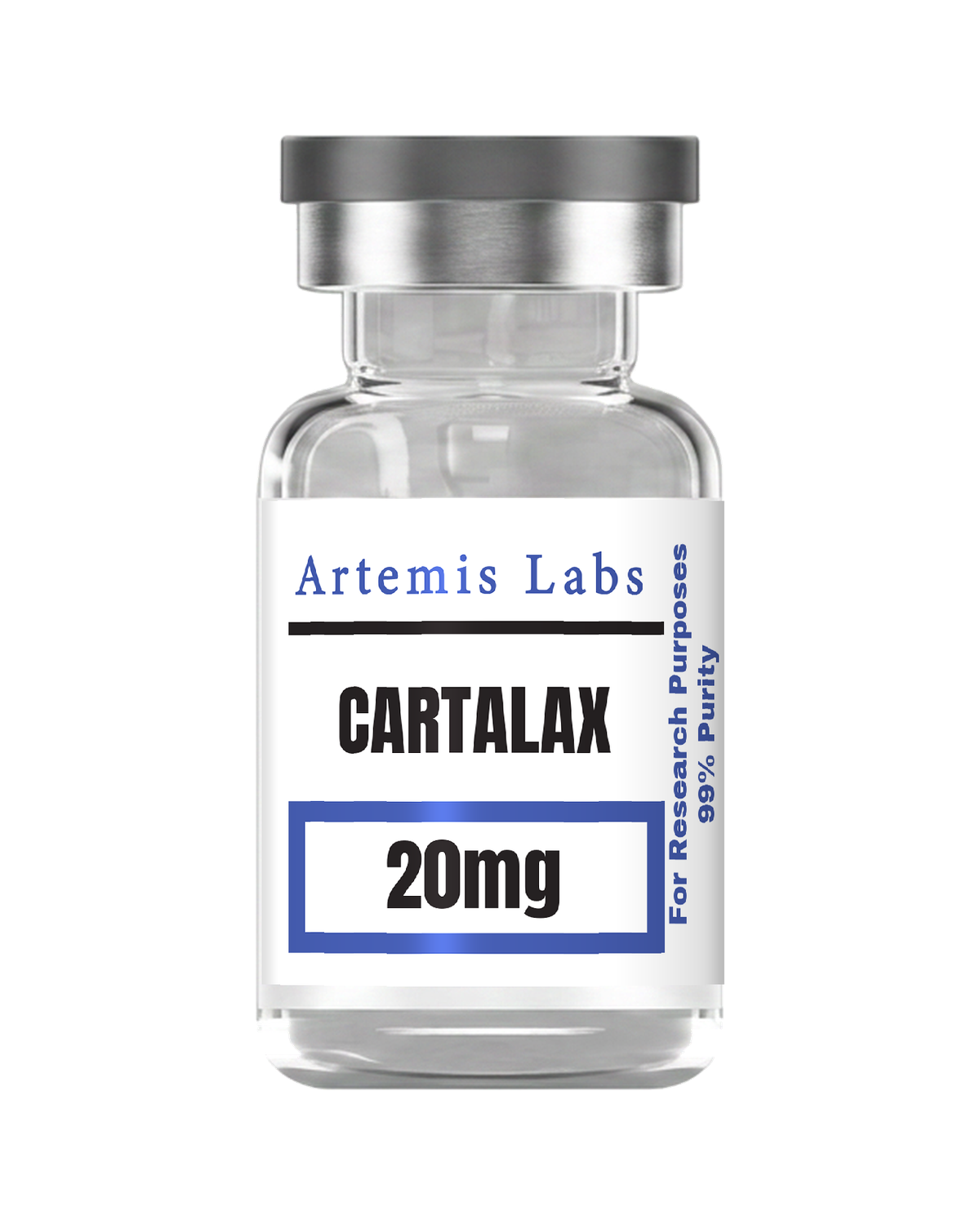
Cartalax (AED Tripeptide)
$55.00
Cartalax is a three-amino-acid peptide from the Khavinson "bioregulator" school of research, which proposes that very short peptides enter the nucleus and bind DNA directly to change gene expression. It is included here as a research compound with an unusually thin evidence base, and the summary below says exactly how thin.
Continue readingShow less
What is actually published. The proposed mechanism is direct epigenetic modulation rather than receptor agonism — short peptides penetrating the nuclear membrane and binding DNA (Khavinson 2016, PMID 27909961). That paper assigned Cartalax a preferred binding site by molecular docking. That is a computational prediction, not a measurement: no wet-lab affinity, ChIP or structural data for the peptide–DNA interaction appears in the indexed literature.
The independence problem. PubMed indexes six records naming Cartalax. Khavinson is an author on five, and every author on the sixth shares the same St. Petersburg institute affiliation. The one paper with Western co-authors has Khavinson as senior author. No unaffiliated laboratory has replicated the work, and there is no registered interventional trial, no human pharmacokinetics, and no toxicology data of any kind.
Supplied as lyophilized tripeptide, for laboratory research use only.
15 in stock
Free shipping on orders over $300
Pay by Venmo or Cash App — instructions are emailed with your order.
18 published sources cited on this page see them
For research use only. Not for human consumption.
Description
Cartalax is a man-made peptide. It is very short — just three amino acids, joined in a row. Labs study it in cartilage research, almost always in cells grown in a dish. The evidence base is small and all preclinical. No lab outside the one that made it has repeated the findings.
Reviewed August 22, 2026 · Artemis Labs
What is Cartalax?
Cartalax is the synthetic tripeptide Ala-Glu-Asp (AED), catalogued in the Russian literature under the laboratory designation T-31 and sold under the brand name Cartalax (Kartalax). It belongs to the class of short peptide bioregulators developed at the St. Petersburg Institute of Bioregulation and Gerontology, whose sequences were derived by fractionating polypeptide complexes extracted from animal tissue — in AED’s case, cartilage.
Why does Artemis Labs say the evidence is thin?
Cartalax is the first bioregulator-class compound in the Artemis Labs catalogue, and it carries the thinnest evidence base of anything we list. We would rather say so on the product page than let the page imply otherwise.
What does the published research actually report?
What the published work actually reports is cell-culture data. AED at 200 ng/ml in culture medium activated gene expression and protein synthesis of the chondrocyte markers SOX9, aggrecan, type II collagen, and COMP in replicatively aging human mesenchymal stem cells (Myakisheva 2023, PMID 37782646). In aging chondrocytes, AED normalised synthesis of senescence-associated secretory phenotype molecules across a panel of p16, p21, p53, TNF-α, IL-1α, and Sirt1 (Myakisheva 2023, PMID 37356100). In replicatively aging human skin fibroblasts, AED activated synthesis of sirtuin-1, sirtuin-6, and collagen I (Fridman 2020, PMID 33231794), and across a four-peptide comparison all four inhibited MMP-9 synthesis while AED and AEDG additionally suppressed caspase-3-dependent apoptosis (Lin’kova 2016, PMID 27259496).
What does the Cartalax evidence not show?
What the published work does not contain is equally important. There is no registered human clinical trial of Cartalax of any design. There is no human pharmacokinetic, dose-ranging, or toxicology data. No laboratory outside the originating institute has published a replication of any AED finding. And although the compound’s name points at cartilage, the originating group’s own English-language review of peptide regulation of chondrogenic stem-cell differentiation (Linkova 2023, PMID 37176122) names nine candidate peptides and does not include AED among them.
Is Cartalax the same thing as Epitalon?
Cartalax is also frequently confused with Epitalon, which is the same three residues plus a glycine — Ala-Glu-Asp-Gly, a tetrapeptide with a different molecular formula, molecular weight, and CAS number. A sequence search that fails to exclude the tetrapeptide will materially overstate this compound’s literature.
Analytical Specifications
| Sequence | Ala-Glu-Asp (AED); also catalogued as T-31 |
| Molecular formula | C12H19N3O8 |
| Molecular weight | 333.29 g/mol |
| PubChem CID | 87815447 |
| CAS number | Withheld. Two CAS numbers circulate for this compound. One of them, 205640-90-0, is Orexin A — a 33-residue neuropeptide of molecular weight 3561 — confirmed against six independent chemical suppliers. The other could not be confirmed against a registry authority. We publish no CAS rather than an unverified one. |
| Form | Lyophilised powder |
| Vial size | 20 mg |
| Storage | This record specifies no storage condition for Cartalax, and none is asserted here. |
| Evidence stage | Preclinical, in vitro |
Cartalax research library
Five plain-language pages on this compound: what Cartalax is studied for, the published record and its limits, sequence and identity data, Cartalax vs Epitalon, and the Khavinson peptide family.
References
- Myakisheva 2023. AED at 200 ng/ml activated SOX9, aggrecan, type II collagen, and COMP in replicatively aging human MSCs. PMID 37782646
- Myakisheva 2023. AED normalised synthesis of senescence-associated secretory phenotype molecules in aging chondrocytes. PMID 37356100
- Fridman 2020. AED activated sirtuin-1, sirtuin-6, and collagen I synthesis in aging skin fibroblasts. PMID 33231794
- Lin’kova 2016. four-peptide comparison; all four inhibited MMP-9 synthesis, AED and AEDG additionally suppressed caspase-3-dependent apoptosis. PMID 27259496
- Linkova 2023. the originating group’s own review of peptide regulation of chondrogenic stem-cell differentiation — names nine candidate peptides and does not include AED. PMID 37176122
- Khavinson, Lin’kova & Tarnovskaya 2016. spatial DNA-peptide models for 19 short peptides by molecular docking; AED assigned a preferred binding site at the
acctsequence — a computational prediction, not a measurement. PMID 27909961 - Khavinson 2014. AED and EDL increased proliferation and decreased p16, p21, p53 while increasing SIRT-6 in aging renal cell culture; also proposes AED forms stable minor-groove complexes with DNA. PMID 25946838
- Khavinson 2014. T-31 activated renal epithelial cell renewal. PMID 24958378
- Fedoreyeva et al. 2011. nuclear penetration of fluorescence-labelled epithalon, pinealon, testagen and bronchogen in HeLa cells — AED was not among the peptides tested. PMID 22117547
- Khavinson, Fedoreyeva & Vanyushin 2011. site-specific binding at methylated NG- and CG-sites modulating eukaryotic endonuclease activity — AED not tested. PMID 22442805
- Fedoreyeva et al. 2013. the same peptide set examined against histones and histone-oligonucleotide complexes — AED not tested. PMID 23581987
- Ashapkin 2020. AED, KED and KE at nanomolar concentrations raised IGF1 expression 3.5-5.6-fold in human embryonic bone-marrow MSCs; the eightfold TERT difference was a property of the aging model, not a peptide effect. PMID 32399807
- Chalisova 2015. in rat kidney explants AED raised Ki-67 and lowered p53, but less than the whole polypeptide complex. PMID 26033601
- Zamorskii 2018. increased diuresis 1.2-1.4-fold in old rats — one of only two in-vivo datasets. PMID 30607912
- Povorozniuk 2007. osteoprotective effect on bone mineral density in an ovariectomised-rat model, where the cartilage extract significantly outperformed T-31. PMID 18306703
- Caputi 2019. neuronal differentiation — counter-evidence: the GAP43 increase came from KED and the combination, not AED; the one paper with Western co-authors, with Khavinson as senior author. PMID 30791821
- Counter-evidence. aging thymocytes — only AB-9 was active; AED was the null result. PMID 22238759
- Counter-evidence. cisplatin-induced renal failure — the effect belonged to EDL, not AED. PMID 26515176
Supplied as lyophilised powder. For in-vitro and pre-clinical laboratory research only. Not for human consumption.
Additional information
| Vial Size | 20mg |
|---|
Science & Research
Science & Research
Mechanism of Action
The proposed mechanism for this entire peptide class is direct epigenetic modulation of gene expression rather than receptor agonism. As framed by Khavinson, Lin’kova & Tarnovskaya (2016, PMID 27909961), short peptides are held to penetrate the cytoplasmic and nuclear membranes and bind DNA, with a single peptide capable of regulating dozens of genes. That paper constructed spatial DNA-peptide models for 19 short peptides by molecular docking and assigned AED a preferred binding site at the acct sequence.
That assignment is a computational prediction, not a measurement. No wet-lab affinity, ChIP, or structural data for AED-DNA binding appears in the indexed literature. A related modelling argument (Khavinson 2014, PMID 25946838) proposes AED forms stable minor-groove complexes with DNA.
The experimental work grounding the class hypothesis was performed on other members of the family. Fedoreyeva et al. (2011, PMID 22117547) demonstrated nuclear penetration of fluorescence-labelled epithalon (AEDG), pinealon (EDR), testagen (KEDG), and bronchogen (AEDL) in HeLa cells with preferential binding to CNG methylation-target motifs. Khavinson, Fedoreyeva & Vanyushin (2011, PMID 22442805) reported site-specific binding at methylated NG- and CG-sites modulating eukaryotic endonuclease activity, and Fedoreyeva et al. (2013, PMID 23581987) examined the same peptide set against histones and histone-oligonucleotide complexes.
AED was not among the peptides tested in any of those three papers. Nuclear entry is therefore a class-level hypothesis extrapolated to AED, not a demonstrated property of it.
Reported Findings (all preclinical)
- Chondrogenic differentiation: AED at 200 ng/ml activated SOX9, aggrecan, type II collagen, and COMP in replicatively aging human MSCs; the cartilage polypeptide complex required a tenfold higher concentration for comparable effect (Myakisheva 2023, PMID 37782646).
- SASP normalisation: AED and the cartilage polypeptide complex both normalised synthesis of SASP molecules in chondrocytes across p16, p21, p53, TNF-α, IL-1α, and Sirt1 (Myakisheva 2023, PMID 37356100).
- Fibroblast matrix and sirtuins: AED activated sirtuin-1, sirtuin-6, and collagen I synthesis in aging skin fibroblasts. The anti-inflammatory profile in that same study — reduced IL-1, NF-κB, TGF-β — was attributed to KE, not to AED (Fridman 2020, PMID 33231794).
- Matrix turnover: across KE, KED, AED, and AEDG on aging skin fibroblasts, all four inhibited MMP-9 and enhanced Ki-67 and CD98hc; AED and AEDG additionally suppressed caspase-3-dependent apoptosis (Lin’kova 2016, PMID 27259496).
- Stem-cell gene expression: in human embryonic bone-marrow MSCs, AED, KED, and KE at nanomolar concentrations raised IGF1 expression 3.5-5.6-fold and stimulated NF-κB gene expression. FOXO1 and TNKS2 effects belonged to KED and KE, not AED; the eightfold TERT difference was a property of the aging model, not a peptide effect (Ashapkin 2020, PMID 32399807).
- Renal tissue, the largest AED dataset: AED and EDL increased proliferation and decreased p16, p21, p53 while increasing SIRT-6 in aging renal cell culture (Khavinson 2014, PMID 25946838); T-31 activated renal epithelial cell renewal (Khavinson 2014, PMID 24958378); in rat kidney explants it raised Ki-67 and lowered p53, but less than the whole polypeptide complex (Chalisova 2015, PMID 26033601).
- In vivo, only two datasets exist: increased diuresis 1.2-1.4-fold in old rats (Zamorskii 2018, PMID 30607912), and an osteoprotective effect on bone mineral density in an ovariectomised-rat model where the cartilage extract significantly outperformed T-31 (Povorozniuk 2007, PMID 18306703).
Counter-Evidence and Limitations
We publish negative findings for compounds we sell. For Cartalax they are substantial.
- No human evidence of any kind. A ClinicalTrials.gov query across Ala-Glu-Asp, Cartalax, and Khavinson returned one unrelated enteral-nutrition study. No registered interventional trial exists.
- No independent replication. PubMed indexes six records naming Cartalax; Khavinson authors five, and the sixth lists the St. Petersburg Institute as the affiliation for every author. The one paper with Western co-authors (Caputi 2019, PMID 30791821) has Khavinson as senior author.
- The originating group’s own chondrogenic review omits AED (Linkova 2023, PMID 37176122).
- AED was the null result in three separate studies: aging thymocytes, where only AB-9 was active (PMID 22238759); cisplatin-induced renal failure, where the effect belonged to EDL (PMID 26515176); and neuronal differentiation, where the GAP43 increase came from KED and the combination (PMID 30791821).
- The whole polypeptide complex matched or beat the isolated tripeptide in kidney explants (PMID 26033601) and in the ovariectomised-rat bone model (PMID 18306703). The case for isolating this tripeptide from its source complex is not settled.
- No telomerase effect is supportable — the eightfold TERT change was a difference between aging models, not a peptide effect (PMID 32399807).
- The mechanism’s hardest step is unmeasured. An intact tripeptide must survive plasma peptidases and cross both the plasma membrane and the nuclear envelope. Unmodified native peptides are typically cleared within minutes; Cartalax carries no stabilising modification, and no plasma-stability or cellular-uptake study specific to AED exists.
- CAS number withheld. Two CAS numbers circulate for this compound. One of them, 205640-90-0, is Orexin A — a 33-residue neuropeptide of molecular weight 3561 — confirmed against six independent chemical suppliers. The other could not be confirmed against a registry authority. We publish no CAS rather than an unverified one.
Evidence-Density Note
Of the twenty citations behind this page, fourteen genuinely test or name AED, three establish a class-level mechanism in peptides other than AED, and three are background biology that does not concern the compound. Fourteen of the primary papers appear in just two journals, one of them Q4 and largely Russian-language, and every primary paper traces to a single institute. Abstracts routinely omit concentrations, replicate counts, effect sizes, and statistics. We list this compound because researchers ask for it and because the data that exists is real — not because the data is strong.
Regulatory Status
- FDA: not an approved drug for any indication; no pharmacopoeial monograph; not a lawful dietary-supplement ingredient.
- FDA 503A: appears on no bulk-substances list — not Category 1, 2, or 3 — and was never nominated. Absent from the April 2026 Category 2 action and the July 2026 PCAC peptide review, even though the sibling bioregulator Epitalon was reviewed there. Absence reflects the lack of a nomination package, not a safety clearance.
- WADA: not named on the Prohibited List, but Section S0 covers any pharmacological substance not approved by any governmental health authority — the same provision that captures BPC-157. On its face S0 would apply. This is a reading of the published S0 definition, not an explicit WADA ruling.
- EMA: no marketing authorisation identified.
- Several commercial sources state Cartalax is approved and clinically used in Russia. We could not verify this against any regulatory register and do not assert it.
Entity Disambiguation
| Compound | Sequence | Formula | MW | Note |
|---|---|---|---|---|
| Cartalax (AED, T-31) | Ala-Glu-Asp | C12H19N3O8 | 333.29 | PubChem CID 87815447 |
| Epitalon (AEDG) | Ala-Glu-Asp-Gly | C14H22N4O9 | 390.35 | Tetrapeptide, CAS 307297-39-8 |
| GHK-Cu | Gly-His-Lys + Cu(II) | C14H24N6O4 + Cu | 340.4 (free) | Endogenous human plasma peptide |
| KPV | Lys-Pro-Val | — | — | Receptor-mediated (melanocortin) |
No dosing, reconstitution, administration, or human-use guidance is provided for this compound, and none should be inferred. All findings above are preclinical and constitute no therapeutic, joint-health, cartilage-repair, or longevity claim. Concentrations quoted are in-vitro culture-medium concentrations reported by the cited authors, not doses.
Research Pairings
Research Pairings
Cartalax’s own citation base is fibroblast, mesenchymal stem cell, and renal — not chondrocyte-exclusive. The pairings below are built on that actual evidence rather than on joint-supplement logic.
GHK-Cu — the closest mechanistic sibling in the catalogue. Both are tripeptides proposed to act as gene-expression modulators rather than receptor agonists, and both were tested on replicatively aging human skin fibroblasts in the same 2016 study (PMID 27259496). GHK-Cu has been studied for extracellular-matrix remodelling; Cartalax was studied for senescence-marker and SASP endpoints.
BPC-157 / TB-500 — connective-tissue repair through non-overlapping pathways: VEGFR2-Akt-eNOS angiogenic signalling and G-actin sequestration driving cell migration. Repair execution, against Cartalax’s reported effects on repair capacity in aging cells.
No dosing, frequency, or human protocol is provided.
Related products