
What Is Cartalax Studied For? The Published Record | Artemis Labs
Aug
What Is Cartalax Studied For?
Published August 28, 2026 · Artemis Labs
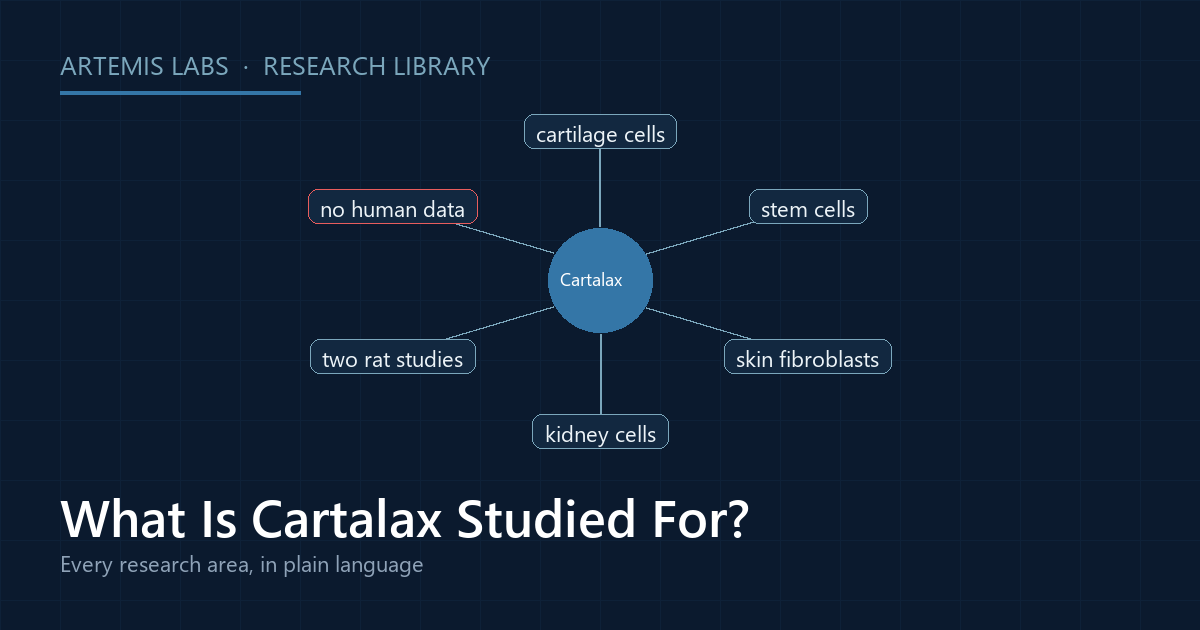
Cartalax is a synthetic peptide made of three amino acids: alanine, glutamic acid and aspartic acid (Ala-Glu-Asp, or AED). Researchers have studied Cartalax almost entirely in cells grown in a dish: aging cartilage cells, aging skin fibroblasts and aging kidney cells. The reported endpoints are markers of cell aging, sirtuin proteins and cartilage-matrix genes. Two small rat studies exist. No human study of any design has been published, and every primary paper comes from one research group in St. Petersburg, Russia.
Key findings
- In replicatively aging human mesenchymal stem cells, AED at 200 ng/ml in the culture medium activated gene expression and protein synthesis of the cartilage markers SOX9, aggrecan, type II collagen and COMP (Myakisheva 2023, St. Petersburg, PMID 37782646).
- In aging skin fibroblasts, AED activated synthesis of sirtuin-1, sirtuin-6 and collagen I. The anti-inflammatory result in the same paper belonged to a different peptide, KE, not to AED (Fridman 2020, PMID 33231794).
- In aging kidney cell cultures, AED and a second peptide, EDL, increased proliferation and lowered the aging markers p16, p21 and p53 (Khavinson 2014, PMID 25946838).
- In three separate studies AED was tested and was not the active peptide. Those results are listed below, because a page that hides them is not a research page.
What kind of compound is Cartalax?
Cartalax belongs to a family sometimes called “short peptide bioregulators.” The idea behind the family comes from the St. Petersburg Institute of Bioregulation and Gerontology. Its researchers extracted protein mixtures from animal tissues, broke them into fragments, and chose very short sequences to make synthetically. Cartalax came from cartilage tissue, which is where its name comes from. The name describes where the sequence was found. It does not describe a proven effect on cartilage in a living animal or person.
The proposed way these peptides work is unusual. Most peptides act by binding a receptor on the outside of a cell. The Khavinson group proposes instead that very short peptides enter the cell nucleus and bind DNA directly, changing which genes are switched on (Khavinson 2016, PMID 27909961). For Cartalax specifically, that idea rests on a computer model, not a laboratory measurement. The review of the published record explains what that distinction means.
What did the cartilage and stem-cell studies report?
The most recent work is three 2023 papers from the same group, all in the Russian journal Advances in Gerontology. In one, human mesenchymal stem cells that had aged through repeated division were exposed to AED at 200 ng/ml. The cells increased their production of SOX9, aggrecan, type II collagen and COMP, four proteins that a cartilage-forming cell makes. The whole cartilage protein mixture the peptide came from needed about ten times the concentration to reach a comparable result (PMID 37782646).
In a second paper, aging chondrocytes, the cells that live inside cartilage, were studied for what researchers call the senescence-associated secretory phenotype, or SASP. That is the mix of inflammatory signals an old cell releases. AED and the whole cartilage complex both normalised synthesis of p16, p21, p53, TNF-α, IL-1α and Sirt1, with broadly comparable effects (Myakisheva 2023, PMID 37356100).
The third 2023 paper is a narrative review, not an experiment. It is the paper that states Cartalax and AED are the same compound. It also asserts an effect in animal osteoarthritis models. We could not trace that assertion to any indexed primary study, so we do not repeat it as a finding (PMID 37782637).
What did the skin fibroblast studies report?
Skin fibroblasts are the cells that make collagen. In 2016 the group tested four short peptides, KE, KED, AED and AEDG, on aging fibroblasts. All four inhibited synthesis of MMP-9, an enzyme that breaks down matrix, and raised two markers of cell activity, Ki-67 and CD98hc. AED and AEDG also suppressed a form of programmed cell death that depends on caspase-3 (Lin’kova 2016, PMID 27259496).
A 2020 paper compared KE and AED head to head in the same cell type. AED raised sirtuin-1, sirtuin-6 and collagen I, measured by immunocytochemistry and confocal microscopy. The reduction in IL-1, NF-κB and TGF-β reported in that paper was attributed to KE (Fridman 2020, PMID 33231794). Reading that paper as “AED reduced inflammation” would be a mistake, and several commercial pages make it.
What did the kidney studies report?
The kidney work is the largest AED dataset. In aging renal cell culture, AED and EDL increased proliferation, decreased p16, p21 and p53, and increased SIRT-6 (PMID 25946838). Under its laboratory name T-31, the peptide activated cell-renewal processes in renal epithelium (Khavinson 2014, PMID 24958378). In kidney tissue explants from young and old rats, T-31 raised Ki-67 and lowered p53, but to a lesser degree than the whole polypeptide complex it was derived from (Chalisova 2015, PMID 26033601).
Two rat studies make up the entire in-vivo record. In old rats, AED and EDL increased urine output 1.2 to 1.4-fold (Zamorskii 2018, PMID 30607912). In a rat model of bone loss after ovary removal, both a cartilage-extract preparation and T-31 showed an effect on bone mineral density, and the extract was significantly more effective than the isolated peptide (Povorozniuk 2007, PMID 18306703).
What the research does not show
No human study of Cartalax exists. A search of ClinicalTrials.gov for the compound, its sequence and the Khavinson name returned one unrelated nutrition trial and no interventional study of any bioregulator peptide. There is no human pharmacokinetic data, no dose-ranging study and no toxicology data.
No laboratory outside the originating institute has repeated the findings. PubMed indexes six records that name Cartalax. Khavinson is an author on five, and every author on the sixth shares the St. Petersburg affiliation. The one paper with Western co-authors, from the University of Chieti-Pescara in Italy, has Khavinson as senior author, and in that paper the effect belonged to a different peptide (Caputi 2019, PMID 30791821).
AED was the null result three times. In aging thymus cell cultures, only the peptide AB-9 showed an effect; AED did not (Lin’kova 2011, PMID 22238759). In a cisplatin kidney-injury model, the protective effect belonged to EDL (Zamorskii 2015, PMID 26515176). In neuronal differentiation of periodontal stem cells, the GAP43 increase was attributed to KED and to the peptide combination (PMID 30791821).
Finally, the group’s own 2023 review of peptides that steer stem cells toward cartilage names nine candidate peptides. AED is not among them (Linkova 2023, PMID 37176122). The researchers who produced the AED cartilage data did not carry it into their own summary of the field.
Frequently asked questions
Is Cartalax the same as Epitalon?
No. Cartalax is three amino acids (Ala-Glu-Asp). Epitalon is four (Ala-Glu-Asp-Gly). They are different molecules with different formulas and weights. The Cartalax vs Epitalon page covers the difference in detail.
Why does the name mention cartilage if there is no cartilage study in animals?
Because the sequence was found by fractionating a cartilage protein extract. The name records the source tissue. The only cartilage-related data are cell-culture experiments.
How many papers are there?
Six indexed records name Cartalax by name. Counting papers that test or name the AED sequence brings the total to roughly seventeen, all from one institute. A raw search for “Ala-Glu-Asp” returns far more, but most of those concern the four-amino-acid peptide AEDG.
What does Artemis Labs sell it for?
Laboratory research only. The Cartalax product page carries the full reference list and the analytical specification.
References
- Myakisheva SN et al. Advances in Gerontology. 2023. PMID 37782646
- Myakisheva SN et al. Advances in Gerontology. 2023. PMID 37356100
- Myakisheva SN et al. Advances in Gerontology. 2023. PMID 37782637
- Fridman NV et al. Bulletin of Experimental Biology and Medicine. 2020. PMID 33231794
- Lin’kova NS et al. Bulletin of Experimental Biology and Medicine. 2016. PMID 27259496
- Khavinson VK et al. Bulletin of Experimental Biology and Medicine. 2016. PMID 27909961
- Khavinson VKh et al. Advances in Gerontology. 2014. PMID 25946838
- Khavinson VKh et al. Bulletin of Experimental Biology and Medicine. 2014. PMID 24958378
- Chalisova NI et al. Bulletin of Experimental Biology and Medicine. 2015. PMID 26033601
- Zamorskii II et al. Advances in Gerontology. 2018. PMID 30607912
- Povorozniuk VV et al. Advances in Gerontology. 2007. PMID 18306703
- Lin’kova NS et al. Bulletin of Experimental Biology and Medicine. 2011. PMID 22238759
- Zamorskii II et al. Bulletin of Experimental Biology and Medicine. 2015. PMID 26515176
- Caputi S et al. International Journal of Immunopathology and Pharmacology. 2019. PMID 30791821
- Linkova N et al. International Journal of Molecular Sciences. 2023. PMID 37176122
Methodology: this page draws only on the PubMed-indexed papers listed above, each re-verified through NCBI E-utilities on August 28, 2026, and on the Artemis Labs Cartalax record. Concentrations quoted are the cited authors’ culture-medium conditions, not doses.
All compounds sold by Artemis Labs are for laboratory research use only. Nothing on this page is medical advice, and no statement has been evaluated by the FDA.
