
Cartalax vs Epitalon: Three Amino Acids or Four | Artemis Labs
Aug
Cartalax vs Epitalon: Three Amino Acids or Four
Published August 28, 2026 · Artemis Labs
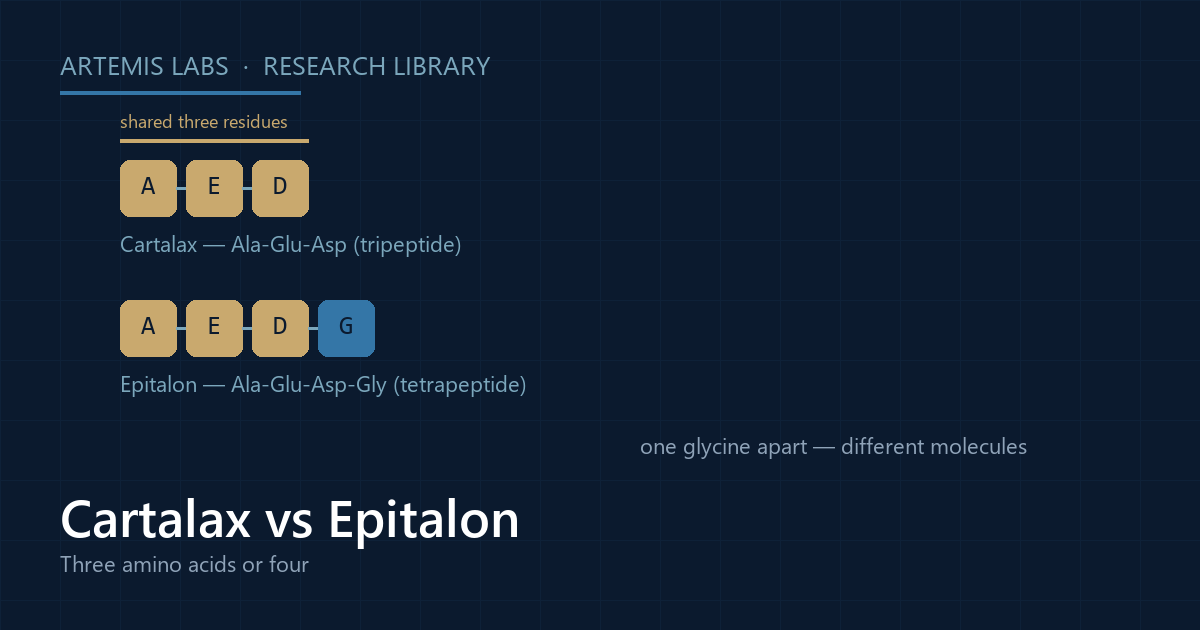
Cartalax and Epitalon are two different research peptides from the same Russian laboratory family. Cartalax is the tripeptide Ala-Glu-Asp (AED), with the molecular formula C12H19N3O8 and a molecular weight of 333.29 g/mol. Epitalon is the tetrapeptide Ala-Glu-Asp-Gly (AEDG), one glycine longer. The two are confused so often that most online summaries of Cartalax quietly borrow Epitalon’s much larger literature. Artemis Labs sells Cartalax and does not sell Epitalon.
Key findings
- Cartalax is Ala-Glu-Asp: three residues, C12H19N3O8, 333.29 g/mol, PubChem CID 87815447. These values were re-verified against PubChem on August 28, 2026.
- Epitalon is Ala-Glu-Asp-Gly: four residues. Our catalog record lists it as C14H22N4O9, 390.35 g/mol, CAS 307297-39-8.
- A PubMed search for “Ala-Glu-Asp” returns roughly a hundred records, and the great majority concern the four-residue peptide. Only six indexed records name Cartalax.
- Several commercial pages describe Cartalax as “Ala-Glu-Asp-Gly” and call it a tripeptide in the same sentence. That is a contradiction; a four-residue sequence is not a tripeptide.
What is the actual difference between the two molecules?
One amino acid. Cartalax is alanine, glutamic acid, aspartic acid. Epitalon is those same three plus a glycine on the end. In chemistry that one residue changes the formula, the mass, the charge distribution and the shape. In the literature it changes almost everything, because the two peptides were studied in different tissues for different questions.
Both come from the St. Petersburg Institute of Bioregulation and Gerontology. That group derived its short peptides by fractionating protein extracts from animal tissues. Cartalax was derived from cartilage. Epitalon was derived from the pineal gland. The names carry the source tissue, not a demonstrated effect. The page on the Khavinson peptide family explains how the group’s naming works.
How do the two compare on paper?
| Field | Cartalax (AED) | Epitalon (AEDG) |
|---|---|---|
| Sequence | Ala-Glu-Asp | Ala-Glu-Asp-Gly |
| Residues | 3 | 4 |
| Molecular formula | C12H19N3O8 (PubChem, verified) | C14H22N4O9 (catalog record) |
| Molecular weight | 333.29 g/mol (PubChem, verified) | 390.35 g/mol (catalog record) |
| PubChem CID | 87815447 | listed separately in PubChem |
| CAS number | Unresolved; see below | 307297-39-8 (catalog record) |
| Laboratory designation | T-31 | none needed; widely named |
| Source tissue | Cartilage | Pineal gland |
| Sold by Artemis Labs | Yes, research use only | No |
The Cartalax column was verified fresh against PubChem’s compound record on August 28, 2026. The Epitalon column is carried from the Artemis Labs catalog record and is stated here as what that record notes. The Cartalax sequence and identity page covers the tripeptide’s analytical data, including why no CAS number is published for it.
Why does the mix-up matter for anyone reading the research?
Because it changes the size of the evidence. If you search PubMed for the sequence “Ala-Glu-Asp” you will get roughly a hundred results. Most of them are about the tetrapeptide AEDG, which has been studied for decades in the same laboratory. Only six indexed records name Cartalax. Counting papers that test or name the AED tripeptide by its sequence brings the total to roughly seventeen, every one of them from the same institute. Any summary of Cartalax that cites dozens of papers has almost certainly counted Epitalon’s.
The confusion runs the other way too. In a 2016 skin fibroblast study, AED and AEDG were tested side by side along with two other peptides. All four inhibited MMP-9 synthesis and raised Ki-67 and CD98hc, and AED and AEDG both suppressed caspase-3-dependent apoptosis (Lin’kova 2016, St. Petersburg, PMID 27259496). That is one of the few papers where both compounds appear with separate results. It is also a paper where a careless reader could assign either peptide’s result to the other.
In the wet-lab work that supports the family’s proposed mechanism, the tetrapeptide was tested and the tripeptide was not. Fluorescence-labeled AEDG, EDR, KEDG and AEDL were shown to enter the nucleus of HeLa cells and bind preferentially to certain DNA motifs (Fedoreyeva 2011, PMID 22117547). AED was not among the peptides in that experiment. So the sentence “Cartalax enters the nucleus and binds DNA” is a claim borrowed from Epitalon’s data. For Cartalax the nuclear-entry idea rests on a docking model (Khavinson 2016, PMID 27909961).
What the research does not show
Nothing in the indexed literature compares Cartalax and Epitalon as a head-to-head question in a living animal or in humans. No human study of Cartalax exists at all. The cell-culture papers that include both peptides report them as separate arms of a multi-peptide experiment, not as a comparison designed to rank them.
This page does not describe what Epitalon does. Artemis Labs does not sell it, has not built a verified fact base for it, and will not summarise its literature from secondary sources. The Epitalon facts here are limited to identity fields from our catalog record.
The regulatory histories also differ, and that is worth stating plainly. Our catalog record notes that Epitalon was reviewed by the FDA’s Pharmacy Compounding Advisory Committee in July 2026. Cartalax appears on no FDA 503A bulk-substances list, was never nominated, and was absent from that review. Absence from a list is not a safety finding in either direction; it means no one filed a package.
Frequently asked questions
Is Cartalax just “Epitalon without the glycine”?
Structurally, yes: it is the first three residues of AEDG. Scientifically, no: the two were derived from different tissues, studied for different endpoints, and one has a far larger literature than the other.
Does Cartalax have Epitalon’s telomerase data?
No. The only telomerase-related figure in the Cartalax literature, an eightfold TERT difference, was a difference between two aging cell models, not a peptide effect (Ashapkin 2020, PMID 32399807). Any telomerase claim attached to Cartalax has been borrowed.
Why does a vendor page say Cartalax is Ala-Glu-Asp-Gly?
Because the two compounds are confused at the source-material level and the error gets copied. PubChem’s compound record for Cartalax (CID 87815447) lists three residues.
Does Artemis Labs sell Epitalon?
No. The Cartalax product page is the only bioregulator-class compound in the catalog.
References
- Lin’kova NS et al. Bulletin of Experimental Biology and Medicine. 2016. PMID 27259496
- Fedoreyeva LI et al. Biochemistry (Moscow). 2011. PMID 22117547
- Khavinson VK et al. Bulletin of Experimental Biology and Medicine. 2016. PMID 27909961
- Ashapkin V et al. Molecular Biology Reports. 2020. PMID 32399807
- PubChem compound record, CID 87815447 (Cartalax / Ala-Glu-Asp). pubchem.ncbi.nlm.nih.gov/compound/87815447
Methodology: Cartalax identity fields re-verified against PubChem PUG REST on August 28, 2026; PMIDs re-verified through NCBI E-utilities the same day. Epitalon identity fields are from the Artemis Labs catalog record and were not independently re-verified for this page.
All compounds sold by Artemis Labs are for laboratory research use only. Nothing on this page is medical advice, and no statement has been evaluated by the FDA.
