
Cartalax Sequence, Molecular Weight and Identity Data | Artemis Labs
Aug
Cartalax Sequence, Molecular Weight and Identity Data
Published August 28, 2026 · Artemis Labs
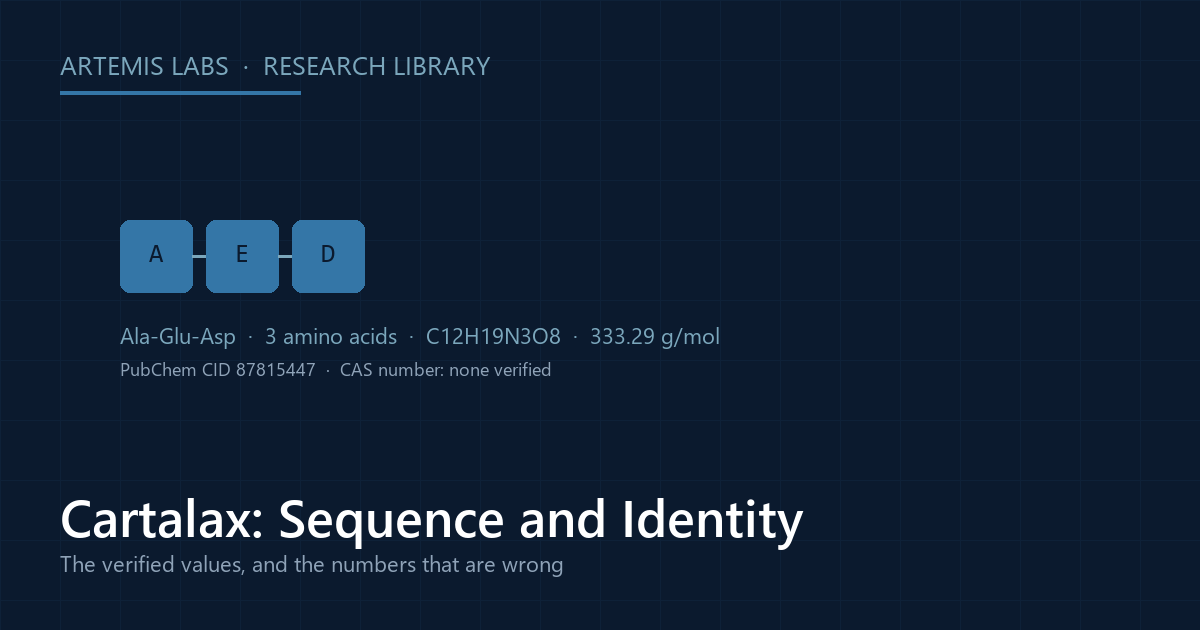
Cartalax is the tripeptide Ala-Glu-Asp (AED), also catalogued under the laboratory designation T-31. Its molecular formula is C12H19N3O8, its molecular weight is 333.29 g/mol, and its PubChem compound identifier is CID 87815447. Artemis Labs publishes no CAS number for Cartalax because none could be verified: one number in circulation belongs to a different molecule, and the other rests on a single unconfirmed synonym. This page lists every identity field a researcher needs and says exactly which ones are verified.
Key findings
- Sequence: Ala-Glu-Asp. Three residues. Verified against PubChem CID 87815447 on August 28, 2026.
- Formula C12H19N3O8, molecular weight 333.29 g/mol, exact mass 333.1172, InChIKey KXEVYGKATAMXJJ-ACZMJKKPSA-N. All verified against the same record.
- Some vendors publish C12H19N3O7 and 317.30 g/mol. That formula is short one oxygen atom and is wrong.
- CAS 205640-90-0, used on several vendor pages, is Orexin A, a 33-amino-acid neuropeptide of molecular weight about 3561. It cannot be Cartalax.
What is the Cartalax sequence?
Cartalax is three amino acids joined in order: L-alanine, then L-glutamic acid, then L-aspartic acid. Written in three-letter code that is Ala-Glu-Asp. In one-letter code it is AED. The full chemical name is L-alanyl-L-glutamyl-L-aspartic acid, and PubChem gives the systematic name as (2S)-2-[[(2S)-2-[[(2S)-2-aminopropanoyl]amino]-4-carboxybutanoyl]amino]butanedioic acid.
The peptide has a free amino group at the alanine end and free carboxyl groups at the aspartic acid end and on the side chains of both acidic residues. That is what “H-Ala-Glu-Asp-OH”, one of its PubChem synonyms, spells out: an unmodified N-terminus and an unmodified C-terminus. There is no acetyl cap and no amide. This matters when reading a certificate for any vendor’s material, because a capped or amidated version would have a different mass.
In the Russian literature the compound also appears as T-31. The paper that ties the T-31 designation to the AED sequence is a 2015 kidney tissue-culture study from the St. Petersburg Institute of Bioregulation and Gerontology (Chalisova 2015, PMID 26033601). The trade name Cartalax, sometimes spelled Kartalax, is tied to AED in a 2023 review from the same group (PMID 37782637).
What are the verified analytical values?
| Field | Value | Status |
|---|---|---|
| Sequence | Ala-Glu-Asp (AED) | Verified, PubChem |
| Residues | 3 | Verified |
| Molecular formula | C12H19N3O8 | Verified, PubChem |
| Molecular weight | 333.29 g/mol | Verified, PubChem |
| Exact (monoisotopic) mass | 333.1172 | Verified, PubChem |
| InChIKey | KXEVYGKATAMXJJ-ACZMJKKPSA-N | Verified, PubChem |
| PubChem CID | 87815447 | Verified |
| ChEBI | CHEBI:158137 | Listed as a PubChem synonym |
| CAS number | None published | Unresolved, see below |
| Other names | Kartalax, T-31, H-Ala-Glu-Asp-OH | From literature and PubChem |
Every “Verified” row was read directly from the PubChem compound record on August 28, 2026. Nothing in that table comes from a vendor page.
Why is there no CAS number on this page?
Because Artemis Labs could not verify one, and publishing an unverified registry number is worse than publishing a gap. Two numbers circulate for Cartalax in the research-chemical market.
The first, 205640-90-0, appears on several vendor pages. It is the CAS number of Orexin A, a 33-residue neuropeptide with a molecular weight near 3561. That was confirmed against six independent chemical suppliers when the Artemis Labs record was built. A three-residue peptide of mass 333 cannot share a registry number with a 33-residue peptide of mass 3561. This number is definitively wrong for Cartalax.
The second, 85806-95-7, is the only plausible candidate. It appears as a synonym on the PubChem record and on one manufacturer’s page. CAS Common Chemistry and ChemSpider both refused unauthenticated verification, and neither ChEBI nor the compound’s Wikipedia entry lists a CAS number. A registry number supported by one synonym string and one seller is not verified. Until it is, this page publishes none.
Which other values in circulation are wrong?
Some vendors list the formula as C12H19N3O7 with a molecular weight of 317.30 g/mol. That is one oxygen atom short. Three amino acids with two acidic side chains cannot be assembled into that formula. The verified values are C12H19N3O8 and 333.29 g/mol. A certificate of analysis for any vendor’s material that reports a mass near 317 has either measured the wrong compound or copied the wrong reference.
The most common identity error is not a number at all. It is calling Cartalax “Ala-Glu-Asp-Gly.” That four-residue sequence is Epitalon, a different compound with a different formula and weight. The Cartalax vs Epitalon page lays out the difference field by field.
What the research does not show
Identity data tells you what a molecule is. It says nothing about what it does. Cartalax has no human study of any kind, and every primary paper on it comes from a single institute in St. Petersburg. The plain-language summary of what Cartalax is studied for and the review of the published record cover the evidence and its limits.
Nor does the indexed literature contain a plasma-stability or cellular-uptake study specific to AED. Unmodified native peptides are generally cleared by plasma peptidases and renal filtration within minutes unless they are chemically stabilised (Nordell 2026, PMID 41661442). Cartalax carries no such modification. That is a general principle applied to this molecule, not a measurement of it.
Frequently asked questions
Is AED the same as Cartalax?
Yes. AED is the one-letter code for the sequence Ala-Glu-Asp, and Cartalax is the trade name. T-31 is the laboratory designation used in the older Russian papers. All three refer to the same tripeptide.
What molecular weight should a certificate show?
A value consistent with 333.29 g/mol for the free peptide. Salt forms, if a vendor supplies one, would shift the measured mass, and the certificate should say so.
Why does PubChem list a CAS-shaped number if it is unverified?
PubChem synonym lists collect strings submitted by many depositors. A synonym entry is not a registry verification.
Where can I read the compound’s full record?
The Cartalax product page carries the analytical specification, the full reference list and the counter-evidence section.
References
- PubChem compound record, CID 87815447 (Cartalax / Ala-Glu-Asp). pubchem.ncbi.nlm.nih.gov/compound/87815447
- Chalisova NI et al. Bulletin of Experimental Biology and Medicine. 2015. PMID 26033601
- Myakisheva SN et al. Advances in Gerontology. 2023. PMID 37782637
- Nordell P et al. Clinical Pharmacokinetics. 2026. PMID 41661442
Methodology: identity values read from PubChem PUG REST (formula, molecular weight, exact mass, InChIKey, IUPAC name, synonym list) on August 28, 2026; PMIDs re-verified through NCBI E-utilities the same day. The CAS assessment is from the Artemis Labs Cartalax record (July 2026) and was not re-attempted against authenticated registry services for this page.
All compounds sold by Artemis Labs are for laboratory research use only. Nothing on this page is medical advice, and no statement has been evaluated by the FDA.
