
This field studies how cells make and manage energy, and how that changes with age. Its readouts are NAD+ levels, mitochondrial function and redox state. Three Artemis compounds appear in the literature. This page explains the questions and lists the articles.
Research Articles
What Is Cartalax Studied For? The Published Record | Artemis Labs
Cartalax (AED, Ala-Glu-Asp) is a three-amino-acid research peptide studied in cell-culture aging models. Every paper comes from one institute; no human data exists.
Read article →ArticleCartalax vs Epitalon: Three Amino Acids or Four | Artemis Labs
Cartalax (Ala-Glu-Asp) and Epitalon (Ala-Glu-Asp-Gly) are different molecules that get confused constantly. The sequences, weights and why the mix-up inflates Cartalax's literature.
Read article →ArticleCartalax Sequence, Molecular Weight and Identity Data | Artemis Labs
Cartalax (AED) is Ala-Glu-Asp: C12H19N3O8, 333.29 g/mol, PubChem CID 87815447. Why no CAS number is published, and which circulating numbers are wrong.
Read article →ArticleCartalax Research: The Published Record and Its Limits | Artemis Labs
A plain review of every indexed Cartalax (AED) paper: what was measured, in which cells, by whom, and the three studies where AED was…
Read article →ArticleCartalax and the Khavinson Short Peptides, Explained | Artemis Labs
Cartalax (AED) is one of the Khavinson short peptide bioregulators. How the family was derived, how the names work, and which sibling peptide each…
Read article →ArticleWhat Is NAD+ Studied For? A Coenzyme, Not a Peptide | Artemis Labs
NAD+ is a dinucleotide coenzyme, not a peptide. What the research record actually covers, and why almost all human trial evidence involves precursors instead.
Read article →ArticleWhat Is MOTS-c Studied For? The Honest Scope | Artemis Labs
MOTS-c is a 16-amino-acid peptide encoded in mitochondrial DNA. What researchers have actually studied it for, in plain words, and what has never been…
Read article →ArticleWhat Is 5-Amino-1MQ Studied For? Plain Guide | Artemis Labs
5-Amino-1MQ is a small molecule, not a peptide. What NNMT does, what blocking it means, and why the published record is entirely rodent and…
Read article →ArticleNAD+ Identity: CID 5892, CAS 53-84-9, MW 663.4 | Artemis Labs
NAD+ is the inner-salt, zwitterionic form of a dinucleotide coenzyme: CID 5892, CAS 53-84-9, MW 663.4. What each identifier means and which lookalikes to…
Read article →ArticleNAD+ Human Evidence: The Two Direct Studies | Artemis Labs
Every published human study of NAD+ itself, reported precisely: a 180-patient heart-failure trial and an 11-person infusion pilot with a negative finding.
Read article →ArticleNAD+ vs Precursor Trials: Whose Evidence Is Whose? | Artemis Labs
Two published human studies tested NAD+ itself. About 45 randomized trials tested NR or NMN precursors. Why the two evidence bases must never be…
Read article →ArticleMOTS-c Sequence and Identity: CID, CAS, Formula | Artemis Labs
The verified MOTS-c identifiers: CID 146675088, C101H152N28O22S2, CAS 1627580-64-6 — and the mis-drawn isomer that shares the same formula, weight and exact mass.
Read article →ArticleMOTS-c Human Evidence: Zero Published Trials | Artemis Labs
No published human interventional trial of MOTS-c exists. The registry record stated precisely, the biomarker-versus-intervention distinction, and the counter-evidence set.
Read article →ArticleMOTS-c Exercise and Metabolism Research Reviewed | Artemis Labs
The preclinical MOTS-c record by species, the exercise study that reports only a trend, and the negative findings on brain entry and oral delivery,…
Read article →Article5-Amino-1MQ Salt Forms: Chloride vs Iodide | Artemis Labs
The chloride is CID 176507677 at 194.66 with no registered CAS. The iodide is CAS 42464-96-0 at 286.11. Mixing them creates a 1.47x molarity…
Read article →Article5-Amino-1MQ Muscle and Metabolism Research | Artemis Labs
What the aged-mouse muscle studies actually measured, why the ~70% figure is a recovery-after-injury result in aged male mice, and the counter-evidence usually left…
Read article →Article5-Amino-1MQ Human Evidence: There Is None | Artemis Labs
Zero human studies exist for 5-Amino-1MQ or any NNMT inhibitor. How that zero was verified across seven PubMed searches and a registry query, and…
Read article →ArticleLongevity Research Peptides 2026 | MOTS-C, SLU-PP-332
Pillar guide to longevity research peptides — MOTS-C, SLU-PP-332, GHK-Cu, 5-Amino-1MQ — mechanisms, 2024–2026 data, and comparative pharmacology.
Read article →ArticleSLU-PP-332: Exercise-Mimetic ERRα Agonist 2026
SLU-PP-332 ERRα agonist deep dive — mechanism, the 2023 Saint Louis University publication, exercise-mimetic transcriptional signature, and 2024-2026 follow-up research.
Read article →Related Products
Mitochondrial & NAD+ Research
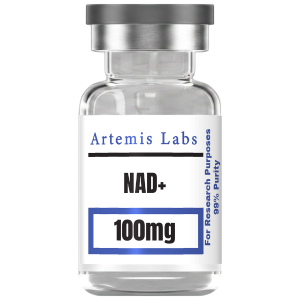
Mitochondrial & NAD+ Research
What question does this field ask?
Why does NAD+ fall with age, what does that do to mitochondria, and can any input change it? The 2026 review in Mechanisms of Ageing and Development frames NAD+ as a hub connecting several hallmarks of aging. Most experiments then change one input, a precursor, a peptide or an enzyme inhibitor, and read the pathway.
Which compounds appear, and why?
NAD+ itself, MOTS-c, and 5-Amino-1MQ. MOTS-c is a peptide encoded in mitochondrial DNA, studied in injury and stress models. 5-Amino-1MQ inhibits NNMT, an enzyme that consumes an NAD+ precursor; its record is mouse studies. Glutathione sits in the product class but is filed under redox biology, not this field.
What do the studies measure?
Blood and tissue NAD+, mitochondrial respiration, Nrf2 and sirtuin pathway markers, and energy-metabolism endpoints in mice. The 2026 MOTS-c paper, for instance, read Nrf2 activation in a radiation-injury lung model after targeted delivery of an engineered analog. The human evidence is thin and mostly about precursors, as the 2023 study comparing how different precursors raise blood NAD+ shows; no human study of MOTS-c or 5-Amino-1MQ has been published.
How do the compounds compare?
| Compound | What it is | Sequence / formula | Molecular weight | Sources cited on its page |
|---|---|---|---|---|
| NAD+ | dinucleotide redox cofactor (not a peptide) | C₂₁H₂₇N₇O₁₄P₂ | 663.4 g/mol | 53 |
| MOTS-c | 16-amino-acid mitochondrial-derived peptide (12S rRNA region) | MRWQEMGYIFYPRKLR | 2,174.6 g/mol | 22 |
| 5-Amino-1MQ | small-molecule NNMT inhibitor (not a peptide) | quinolinium salt | verifying (salt-dependent) | 11 |
Sequences and molecular weights are the values verified on each product page. "Sources cited" is the count shown on that page on 28 August 2026.
Where do I read more?
Every compound on this page is supplied for laboratory research only. Each product page carries its full reference list.
References
- Pei Z et al. (2026). NAD⁺ as a central metabolic hub regulating the hallmarks of aging. Mech Ageing Dev. PMID 41812700
- Li J et al. (2023). The acute effect of different NAD⁺ precursors included in the combined metabolic activators. Free Radic Biol Med. PMID 37271226
- Zhang YL et al. (2026). LAT1-mediated delivery of engineered R13A-MOTS-c attenuates radiation-induced lung injury via Nrf2 activation. Redox Biol. PMID 42142418
- Kraus D et al. (2014). Nicotinamide N-methyltransferase knockdown protects against diet-induced obesity. Nature. PMID 24717514