NAD+ Identity: CID 5892, CAS 53-84-9, MW 663.4 | Artemis Labs
Aug
NAD+ identity: what exactly is in the vial?
Published August 26, 2026 · Artemis Labs
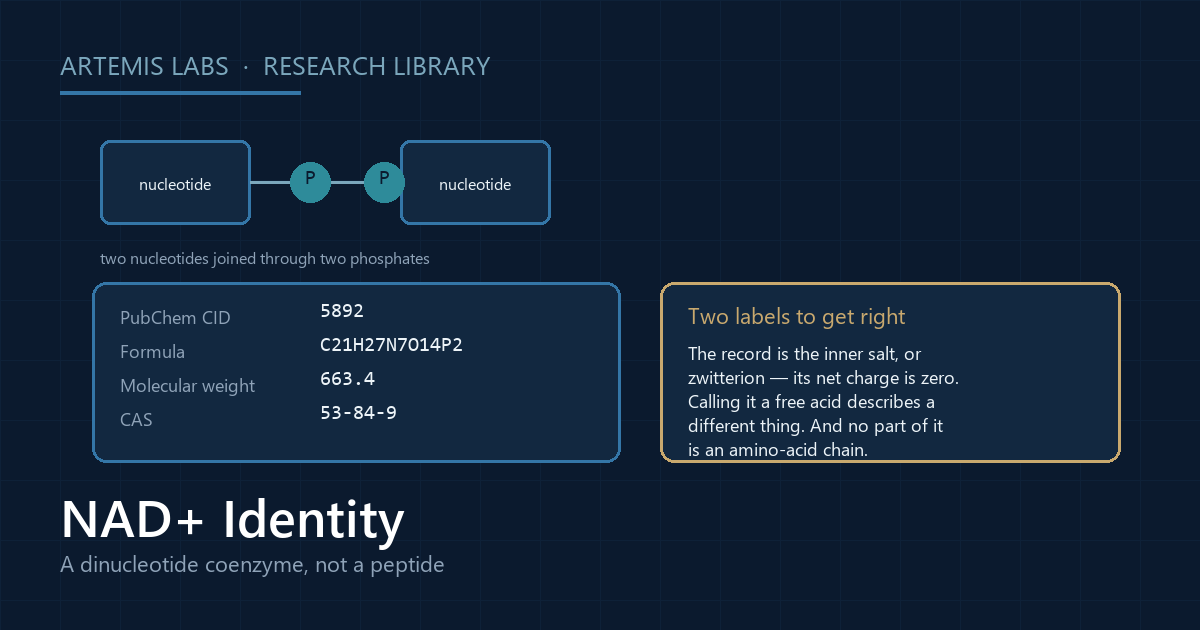
NAD+ identity — answer capsule: NAD+ (nicotinamide adenine dinucleotide) is a dinucleotide coenzyme, not a peptide, catalogued by PubChem as CID 5892 with the record title Nadide, molecular formula C21H27N7O14P2, molecular weight 663.4, and CAS registry number 53-84-9. That record describes the inner-salt, or zwitterionic, form: the molecule carries an internal positive charge and an internal negative charge that cancel, so PubChem reports a net charge of zero. Its DrugBank entry is DB14128. Several distinct chemical entities travel under similar names — the reduced form NADH, the disodium salt, hydrates, and the precursors NMN and NR — each with its own mass, so an identifier is only meaningful with its CID beside it. Artemis Labs supplies NAD+ as a laboratory research compound.
Key findings
- One molecule, five load-bearing identifiers. PubChem CID 5892; CAS 53-84-9; molecular formula C21H27N7O14P2; molecular weight 663.4; InChIKey
BAWFJGJZGIEFAR-NNYOXOHSSA-N. DrugBank lists it as DB14128, and its FDA UNII code is0U46U6E8UK. All values retrieved fresh from PubChem, August 27, 2026. - It is a zwitterion, not a plain “free acid.” PubChem’s synonym list calls CID 5892
NAD zwitterionand aninner salt, and its Charge field reads0— a net zero produced by internal charges cancelling, not by an absence of charge. - The nearest lookalike differs by two mass units. NADH, the reduced form, is a separate record (CID 439153, MW 665.4) whose InChIKey shares its middle block with NAD+’s. A fuzzy comparison calls them identical; they are not.
- Not a peptide, verified from structure. The formula contains two phosphorus atoms — an element no peptide contains — and the record carries no amino-acid sequence or backbone of any kind.
What does each identifier mean, in plain words?
PubChem CID 5892. A CID is the record number in PubChem, the public chemistry database run by the US National Library of Medicine. It points to one exact structure. The record’s title is Nadide — the compound’s international nonproprietary name — and searches for “NAD”, “NAD+”, and the full spelled-out name all resolve to this same CID.
CAS 53-84-9. A CAS number is a registry number assigned by the Chemical Abstracts Service, the chemistry world’s longest-running index. This is the number universally quoted for NAD+, and it belongs to CID 5892 specifically — the inner-salt form, not any sodium salt or hydrate. (A second CAS, 64417-72-7, also appears in the record’s synonym list.)
Molecular formula and weight. C21H27N7O14P2, molecular weight 663.4. The two phosphorus atoms are the quickest structural proof that NAD+ is not a peptide: peptides are chains of amino acids and contain no phosphorus. The structure is two nucleotides — one carrying adenine, one carrying nicotinamide, a form of vitamin B3 — joined by a phosphate bridge. Suppliers sometimes print an extra decimal (663.43); PubChem’s own value is 663.4.
InChIKey. A 27-character fingerprint computed from the structure itself, BAWFJGJZGIEFAR-NNYOXOHSSA-N for NAD+. Two substances with different structures get different keys, which makes it the cleanest single check that two records describe the same molecule — provided the full key is compared, a caveat that matters below.
DrugBank DB14128 and UNII 0U46U6E8UK. DrugBank is a drug-information database; the UNII is an FDA ingredient identifier. Both are catalog entries, and neither is an approval. PubChem’s drug-development annotation for NAD+, sourced from ChEMBL, lists a maximum development phase of Phase 2 — a value whose own scale runs up to “approved,” a level this compound has not reached.
Why “inner salt / zwitterion,” and why not “free acid”?
A zwitterion is a molecule that is charged in two places at once, positively and negatively, with the charges cancelling. In NAD+, the nicotinamide ring carries a positive charge (that is what the “+” in the name refers to) and one of the phosphate oxygens carries a negative charge. The net result is zero, which is exactly what PubChem’s Charge field reports for CID 5892. The database’s own synonyms say it plainly: NAD zwitterion, and two long chemical names ending in inner salt.
Here is the trap. The same synonym list also contains reagent-catalog strings such as NAD, Grade I, free acid. So PubChem simultaneously calls this record a zwitterion, an inner salt, and a free acid, and a label-writer could quote any of them. The defensible, source-backed statement — and the one we use — is: CAS 53-84-9 / CID 5892 is the inner-salt, zwitterionic form of β-NAD+. A bare “free acid” designation overstates what the record settles.
The charge question has a research consequence. The one human infusion pilot of NAD+ (direct NAD+, PMID 31572171) reasons from the molecule’s charged, polar character that it is unable to cross cellular membranes passively and therefore must be actively transported across the membrane. That functional statement is citable. The same paper’s premise that NAD+ has “an overall negative charge” conflicts with PubChem’s net-zero Charge field — both describe the same molecule, one reporting net formal charge and the other its charged character — so we publish the functional claim with its citation and not the bare charge claim. What that pilot found when NAD+ was actually infused is reported on our NAD+ human evidence page.
Which lookalike entities get mixed up with NAD+?
NADH — two mass units away. NADH is NAD+ after it has accepted electrons: the reduced form, where NAD+ is the oxidized form. It is a separate PubChem record (CID 439153) with formula C21H29N7O14P2 and weight 665.4, against NAD+’s 663.4. The two InChIKeys share their middle block (NNYOXOHSSA) and differ only at the front, so a truncated comparison will merge them. Worse, PubChem’s synonym list for the oxidized record itself contains the string beta-Nicotinamide adenine dinucleotide, reduced — a NADH name filed under NAD+. Any pipeline that matches labels by synonym text can cross these records without an error message. Compare full InChIKeys or CIDs, never names or approximate masses.
Salts and hydrates — different masses, same nickname. The disodium salt of NAD is its own record, CID 3033990, weight 708.4. Lithium-salt and trihydrate names also circulate as synonyms. A vial labeled with a salt or hydrate name does not weigh 663.4 per molecule, and publishing 663.4 against such a label misstates the material.
The precursors — different molecules entirely. NMN (CID 14180, MW 334.22) is roughly half of an NAD+ molecule; NR (CID 439924, MW 255.25) is NMN without its phosphate and carries a permanent +1 charge. They are covered on our overview of what NAD+ is studied for, and the rule is absolute: their research literatures are their own, never NAD+’s.
Why does precise identity matter for a research reagent?
Because in a laboratory, identity errors turn into quantitative errors. Molar calculations divide by molecular weight, so pairing the right name with the wrong form — the reduced form, a salt, a hydrate, a precursor — silently changes every concentration downstream. The 2-dalton NAD+/NADH gap and the shared InChIKey block make this a field where “close enough” matching produces confidently wrong numbers.
It also matters because NAD+ wears four different institutional hats at once, and PubChem documents all four on one record: an investigational drug annotation (ChEMBL maximum phase 2, not approved), listings from the NIH’s supplement-label database showing NAD+ named on US dietary-supplement labels under at least three names, a food-database entry (it occurs naturally in foods), and a long tail of laboratory-reagent catalog names sold by purity grade and vial size. None of those framings validates another. NAD+ from Artemis Labs is supplied under the last one — a research reagent — which is precisely why the CID, CAS, and mass on this page are stated with their sources.
What the research does not show
Identity facts establish what a compound is, never what it does. Nothing on this page is evidence of any biological effect, and the direct human evidence for NAD+ is thin: two published studies, neither measuring an aging, cognition, or energy outcome, one of which found infused NAD+ was cleared from plasma without raising measured levels for two hours (direct NAD+, PMID 31572171).
- No identifier here is an approval. A DrugBank ID is a database entry. A UNII is an ingredient code. ChEMBL’s
Phase 2is a maximum-ever-reached development value across all sponsors, explicitly not “approved,” and translates into no claim about any NAD+ product. - A supplement-label listing is not a safety or efficacy finding. The NIH database that records NAD+ on US supplement labels catalogs what labels say; it does not adjudicate them.
- Formula and mass for the salt and hydrate forms are not stated here beyond the disodium record’s own values, because the verification pass behind this page did not fetch the rest. Absent numbers are left absent rather than filled in.
Frequently asked questions
Is NAD+ a peptide?
No. It is a dinucleotide coenzyme. The structural proof is in its own record: two phosphorus atoms in the formula, no amino-acid chain, no sequence. It sits in a peptide catalog because the same researchers study it, not because it is one.
What does the “+” in NAD+ mean if the net charge is zero?
The “+” names the positive charge on the nicotinamide ring, which is real and permanent in the oxidized form. In the inner-salt form PubChem catalogs, that positive charge is balanced by a negative charge on a phosphate oxygen inside the same molecule, so the net formal charge is zero.
How should a researcher verify an NAD+ lot’s identity?
By identifiers that point to one structure: the CID (5892), the CAS number (53-84-9), or the full InChIKey — never by name matching or by molecular weight alone, since NADH sits two mass units away and PubChem’s own synonym lists cross the two records.
References
- PubChem Compound record CID 5892 (Nadide): molecular formula, weight, exact mass 663.10912256, Charge 0, InChIKey, IUPAC name, and synonym list including
NAD zwitterion, the inner-salt names, CAS 53-84-9 and 64417-72-7, UNII 0U46U6E8UK, and DrugBank DB14128 (confirmed via the PUG-View DrugBank ID heading); retrieved via PUG REST and PUG-View, August 27, 2026. - PubChem Compound record CID 439153 (NADH): C21H29N7O14P2, MW 665.4, InChIKey
BOPGDPNILDQYTO-NNYOXOHSSA-N; retrieved August 27, 2026. - PubChem Compound records CID 3033990 (NAD disodium salt, MW 708.4), CID 14180 (NMN, MW 334.22), CID 439924 (NR, MW 255.25, Charge +1); retrieved August 27, 2026.
- PubChem PUG-View annotations for CID 5892: Drug and Medication Information (ChEMBL Max Phase
Phase 2), Dietary Supplement Label Database references, and FooDB entry FDB031053; retrieved August 27, 2026. - Front Aging Neurosci, 2019.
A Pilot Study Investigating Changes in the Human Plasma and Urine NAD+ Metabolome During a 6 Hour Intravenous Infusion of NAD.n=11, open-label (direct NAD+); source of the membrane-crossing statement. PMID 31572171 · DOI 10.3389/fnagi.2019.00257
Methodology: this page draws on PubChem records CID 5892, 439153, 3033990, 14180, and 439924 retrieved through PUG REST and PUG-View, plus one PubMed record and its publisher full text, with every quoted string transcribed verbatim from the named source; last verified August 27, 2026.
All compounds sold by Artemis Labs are for laboratory research use only. Nothing on this page is medical advice, and no statement has been evaluated by the FDA.
