
Sermorelin vs CJC-1295 vs Ipamorelin: Three Records Compared | Artemis Labs
Aug
Sermorelin vs CJC-1295 vs ipamorelin: three molecules, two receptors, three records
Published August 28, 2026 · Artemis Labs
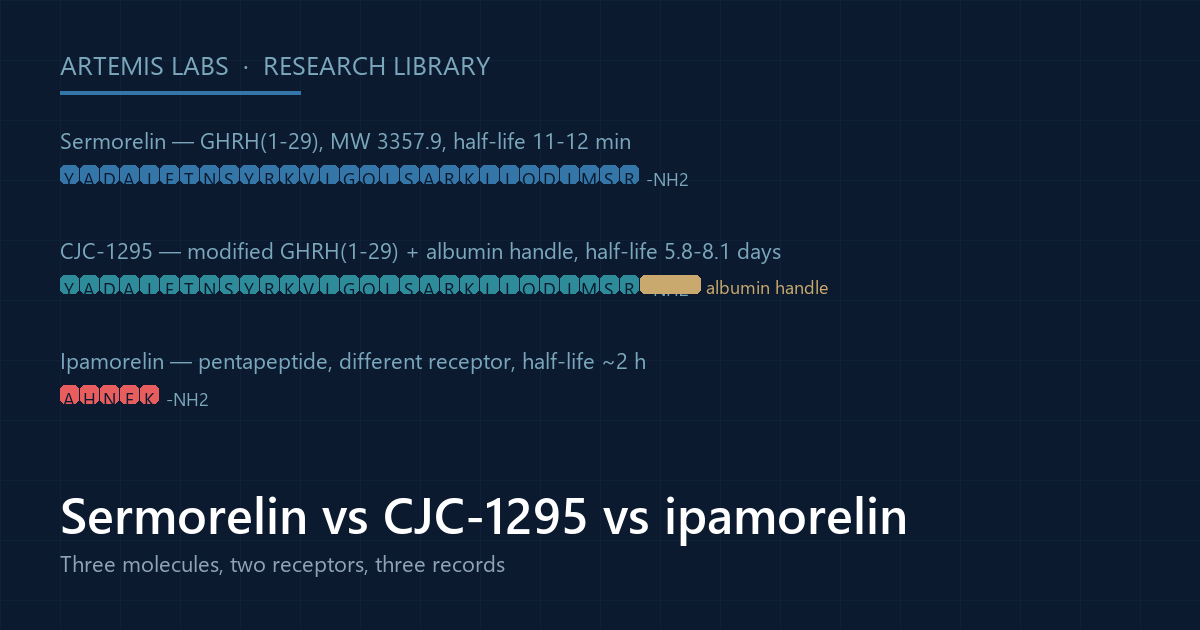
Sermorelin, CJC-1295 and ipamorelin — These three compounds are usually sold and discussed together, and they are not variations on one thing. Sermorelin is the natural GHRH(1-29) sequence, cleared in about 11 to 12 minutes. CJC-1295 is a four-substitution version of the same fragment carrying a chemical handle that binds to blood albumin, giving an estimated half-life of 5.8 to 8.1 days in healthy adults. Ipamorelin is a five-residue peptide that acts on an entirely different receptor, the ghrelin receptor, and whose only published Phase 2 trial reported no significant difference from placebo. Their evidence bases differ as much as their structures.
Key findings
- Two receptors, not one. Sermorelin and CJC-1295 act at the GHRH receptor; ipamorelin, per the paper that first described it, stimulates GH release via a GHRP-like receptor (PMID 9849822).
- Three half-lives, three orders of magnitude apart. Sermorelin 11-12 min (PubChem); ipamorelin a short terminal half-life of 2 hours in healthy volunteers (PMID 10496658); CJC-1295 5.8-8.1 d (PMID 16352683).
- Only CJC-1295 has a modern healthy-adult trial record. Two randomized, placebo-controlled, double-blind ascending-dose trials reported growth hormone 2- to 10-fold for 6 d or more and IGF-I 1.5- to 3-fold for 9-11 d (PMID 16352683).
- Ipamorelin’s only Phase 2 trial was null. In 114 bowel-resection patients, there were no significant differences between ipamorelin and placebo in the key and secondary efficacy analyses (PMID 25331030).
What are the three molecules?
| Sermorelin | CJC-1295 | Ipamorelin | |
|---|---|---|---|
| Structure | GHRH(1-29) amide, unmodified | Tetrasubstituted GHRH(1-29) with a maleimidopropionamide lysine at the C terminus | Pentapeptide Aib-His-D-2-Nal-D-Phe-Lys-NH2 |
| Receptor | GHRH receptor | GHRH receptor | Ghrelin / GHRP-like receptor (GHS-R1a) |
| PubChem CID | 16132413 | 91971820 | 9831659 |
| Half-life (published) | 11–12 min (PubChem) | 5.8–8.1 days (PMID 16352683) | ~2 hours (PMID 10496658) |
| Human trial record | 1990s pediatric growth trials; adult physiology studies | Two ascending-dose trials in healthy adults; one pulsatility study | One PK/PD study in healthy men; one null Phase 2 in surgical patients |
| WADA 2026 | Named, S2.2.4 | Named, S2.2.4 | Named, S2.2.4 |
The structural difference between the first two is the whole point of CJC-1295’s design. Its originating paper describes it as a tetrasubstituted form of hGRF(1-29) with an added N epsilon-3-maleimidopropionamide derivative of lysine at the C terminus, which bioconjugates to the free thiol on Cys34 of serum albumin; in rats, the result was present in plasma beyond 72 h (Endocrinology 2005, PMID 15817669). That paper is from ConjuChem, the company developing the compound, and is not independent. Sermorelin’s verified identity record is on our identity page.
What does each record contain?
Sermorelin. The deepest but oldest record: 1990s trials in children with growth hormone deficiency, where an approved product existed, plus adult physiology work using the peptide as a probe. In the one three-arm randomized comparison, growth hormone produced substantially more growth and the authors called the peptide unlikely to be as effective as GH (PMID 8329830). PubMed indexes no sermorelin meta-analysis. Full account on our trial-record page.
CJC-1295. The most substantial healthy-adult data of the three. Two randomized, placebo-controlled, double-blind ascending-dose trials in healthy subjects aged 21 to 61 reported dose-dependent increases in growth hormone by 2- to 10-fold for 6 d or more and IGF-I by 1.5- to 3-fold for 9-11 d, with mean IGF-I still above baseline for up to 28 days after multiple administrations, and no serious adverse reactions (JCEM 2006, PMID 16352683). A separate study at the University of Illinois found that pulsatility survived: growth-hormone secretion rose with preserved pulsatility, with trough levels up 7.5-fold and IGF-I up 45% (PMID 17018654). In GHRH-knockout mice, daily administration maintain[ed] normal body composition and growth (PMID 16822960). Note also that CJC-1295 forms were among the bulk drug substances on the FDA Pharmacy Compounding Advisory Committee’s agenda in October 2024, per the meeting notice; the outcome is not in our verified record and no conclusion is drawn here.
Ipamorelin. The thinnest human record of the three. Its describing paper, from Novo Nordisk, characterised it in cells, rats and swine, and its notable finding was selectivity: unlike two comparator peptides, ipamorelin did not release ACTH or cortisol in levels significantly different from those observed following GHRH stimulation, even at high multiples of the effective concentration (PMID 9849822). A 1999 study in healthy men characterised its pharmacokinetics and modeled the growth-hormone response, finding a short terminal half-life of 2 hours and a single release episode peaking at 0.67 hours (PMID 10496658). The one clinical efficacy trial, a Phase 2 study in 114 patients recovering from bowel surgery, was null: there were no significant differences between ipamorelin and placebo in the key and secondary efficacy analyses, with the treatment well tolerated (PMID 25331030).
Do a GHRH analog and a ghrelin-receptor agonist work together?
The mechanistic argument for pairing them is that they act on different receptors, so the signals might combine. The human evidence is thinner than the argument. In eight healthy men given GHRH(1-29) and GHRP-2 separately and together, the combination produced a larger response than either alone, but the authors wrote plainly: we were not able to demonstrate synergy between the two substances, and the combined response was not significantly different from the sum of the separate ones (PMID 7586605). A separate study showed the dependence runs the other way too: a GHRH antagonist eliminated most of the GH response to GHRP-6, so endogenous GHRH is necessary for most of the GH response to GHRP-6 in humans (PMID 9543138). Neither study used our compounds; both used GHRH(1-29) with a different GHRP. Our page on the CJC-1295 and ipamorelin blend reports what does and does not exist for that specific pairing.
What the research does not show
No trial has compared these three compounds against each other. Their records are not commensurable: sermorelin’s is pediatric and thirty years old, CJC-1295’s is two ascending-dose studies in healthy adults with no clinical outcome measured, and ipamorelin’s clinical record is a single null Phase 2 in a surgical population. Two of the three key papers are authored by the companies developing the compounds and are not independent. None of the three has a meta-analysis, a long-term safety study, or an approved indication today, and all three are named on the WADA 2026 Prohibited List. Nothing here describes research-grade material or claims anything about what any vial does.
Frequently asked questions
Which one lasts longest?
CJC-1295, by a wide margin: an estimated 5.8 to 8.1 days versus about two hours for ipamorelin and 11 to 12 minutes for sermorelin.
Do they act on the same receptor?
Sermorelin and CJC-1295 do. Ipamorelin acts on the ghrelin-type receptor.
Is any of them approved?
Not currently. Sermorelin acetate products were approved and are discontinued; see our FDA-record page. CJC-1295 and ipamorelin have no approved product.
Are they on the WADA list?
All three, in section S2.2.4 of the 2026 List. See our WADA page.
References
- Prolonged stimulation of growth hormone (GH) and insulin-like growth factor I secretion by CJC-1295, a long-acting analog of GH-releasing hormone, in healthy adults. J Clin Endocrinol Metab. 2006. PMID 16352683 · DOI.
- Pulsatile secretion of growth hormone persists during continuous stimulation by CJC-1295. J Clin Endocrinol Metab. 2006. PMID 17018654 · DOI.
- Human growth hormone-releasing factor (hGRF)1-29-albumin bioconjugates activate the GRF receptor on the anterior pituitary in rats: identification of CJC-1295 as a long-lasting GRF analog. Endocrinology. 2005. PMID 15817669. ConjuChem-authored.
- Study of daily CJC-1295 administration in the GHRH knockout mouse. Am J Physiol Endocrinol Metab. 2006. PMID 16822960.
- Ipamorelin, the first selective growth hormone secretagogue. Eur J Endocrinol. 1998. PMID 9849822. Novo Nordisk-authored.
- Pharmacokinetic-pharmacodynamic modeling of ipamorelin in human volunteers. Pharm Res. 1999. PMID 10496658.
- Prospective, randomized, controlled, proof-of-concept study of the ghrelin mimetic ipamorelin for the management of postoperative ileus in bowel resection patients. Int J Colorectal Dis. 2014. PMID 25331030 · DOI.
- GH responses to intravenous bolus infusions of GH releasing hormone and GH releasing peptide 2 separately and in combination in adult volunteers. Clin Endocrinol. 1995. PMID 7586605.
- GHRP-6 requires endogenous hypothalamic GH-releasing hormone for maximal GH stimulation. J Clin Endocrinol Metab. 1998. PMID 9543138.
- A comparative study of GH and GHRH(1-29)-NH2 for stimulation of growth in children with GH deficiency. Acta Paediatr Suppl. 1993. PMID 8329830.
- Federal Register document 2024-24828 (PCAC meeting notice naming CJC-1295-related bulk drug substances), published 2024-10-25. federalregister.gov/d/2024-24828.
- PubChem CIDs 16132413 (sermorelin), 91971820 (CJC-1295), 9831659 (ipamorelin). pubchem.ncbi.nlm.nih.gov.
Methodology: every quotation was transcribed from the PubMed abstract of the cited record via NCBI E-utilities on August 28, 2026; identity fields from PubChem the same day. Sponsor affiliations are stated where the authors are the developing company. Last verified August 28, 2026.
All compounds sold by Artemis Labs are for laboratory research use only. Nothing on this page is medical advice, and no statement has been evaluated by the FDA.
