
Sermorelin Human Trials: What the Record Actually Contains | Artemis Labs
Aug
Sermorelin human trials: what the record actually contains
Published August 28, 2026 · Artemis Labs
Sermorelin human trials — PubMed indexes 331 sermorelin records, 29 tagged as clinical trials, 19 as randomized controlled trials, and zero meta-analyses. The trials themselves are mostly from the 1990s and mostly in children with growth hormone deficiency, from the period when a sermorelin acetate product was marketed. A one-year open-label study in 110 children reported height velocity roughly doubling. Two randomized trials that compared the peptide against growth hormone directly both favored growth hormone, and in the larger of them nearly every treated child developed antibodies to the peptide. A separate adult literature used it as a physiology probe instead of a treatment.
Key findings
- The open-label growth study. One hundred and ten previously untreated prepubertal GH-deficient children were treated for up to 1 yr in a multicenter, open label study; height velocity rose from 4.1 ± 0.9 cm/yr at baseline to 8.0 ± 1.5 and 7.2 ± 1.3 cm/yr after 6 and 12 months, with 74% counted as good responders at six months (JCEM 1996, PMID 8772599). No control arm.
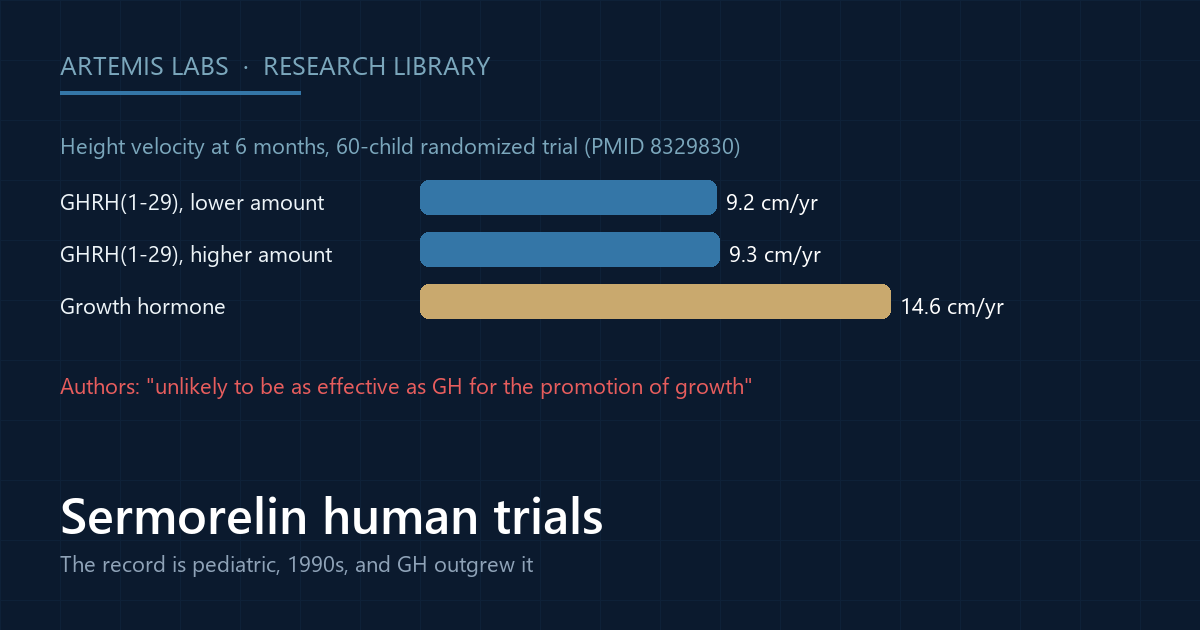
- The head-to-head result. In 60 children randomized to two peptide arms or growth hormone, growth in the GH group was significantly better than in the other two groups (p < 0.01), with mean height velocities of 9.2, 9.3 and 14.6 cm/year (PMID 8329830).
- Antibodies were the rule, not the exception. In that trial, all 20 patients on high-dose GHRH(1-29)-NH2 and 19 of 20 patients on low-dose GHRH(1-29)-NH2 developed GHRH antibodies, which had almost disappeared by 9 months after stopping treatment.
- No meta-analysis exists. sermorelin AND meta-analysis[pt] returned zero records on August 28, 2026.
What did the largest study find?
The Geref International Study Group ran a multicenter, open-label study in 110 previously untreated prepubertal children with growth hormone deficiency, treating for up to one year, with 86 evaluable for the efficacy analysis (JCEM 1996, PMID 8772599). The measured outcomes were height velocity, bone-age progression and routine safety chemistry. Mean height velocity rose from 4.1 to 8.0 cm per year at six months and settled at 7.2 at twelve. The ratio of bone-age change to height-age change was not significantly different from unity at 12 months, which matters because a treatment that advances bone maturation faster than height buys nothing in final stature. On safety, the authors reported no adverse changes in general biochemical or hormonal analyses and no change in fasting glucose concentration or excessive generation of insulin-like growth factor I.
The design limit is on the face of it: open-label, no placebo and no comparator. Children with growth hormone deficiency grow faster when treated with anything effective, and they also grow at different rates by age and baseline, so an uncontrolled before-and-after comparison cannot separate the treatment from the population. The two randomized trials below were built to answer that.
What happened when it was compared against growth hormone?
Two randomized trials, both published in 1993, both in children with growth hormone deficiency of hypothalamic origin, both six months long, and both with a growth hormone arm.
In Istanbul, 43 prepubertal children were randomized to low-dose peptide, high-dose peptide or growth hormone. Height velocity during treatment was lowest in the LD group, but comparable in the HD and GH groups, and, in the authors’ words, an increase in height SDS for bone age occurred only in the GH-treated group (PMID 8329826). The trial also observed a priming effect: the growth-hormone response to a test dose of the peptide was larger after low-dose treatment, and smaller in the children treated with growth hormone.
In Shanghai, 60 children were randomized into three equal groups on the same design (PMID 8329830). Mean height velocities at six months were 9.2 cm/year on low-dose peptide, 9.3 on high-dose, and 14.6 on growth hormone, with the difference significant at p < 0.01. IGF-I rose initially, but then fell to values similar to those before treatment. And nearly every treated child produced antibodies against the peptide, which faded within nine months of stopping. The authors’ conclusion is quoted in full because it is the cleanest sentence in the whole sermorelin record: this treatment is unlikely to be as effective as GH for the promotion of growth in GHD.
What about the intranasal formulation study?
A German group tested a nasal formulation for six months in eight short prepubertal children and reported it did not work as delivered (PMID 8329828). Growth-hormone peak amplitudes were variably reduced after 6 weeks in most patients, and further reduced at 6 months; three of the eight developed antibodies within six weeks; and while a short-term growth measure rose early, the mean 6-month stadiometric height velocity did not increase. The authors concluded the formulation was not suitable in its present form for use in children, because of decreasing absorption and effectiveness with concomitant development of antibodies and local reactions. It is named here because it is part of the record and because it is one of the clearest published examples of a peptide’s effect fading over weeks of continued exposure. Our page on desensitization and antibodies collects that literature.
What is the adult literature, and what is it for?
Mostly physiology instead of treatment. In 30 healthy men aged 19 to 43, intravenous administration produced growth-hormone release, and although the peptide was rapidly eliminated, growth-hormone levels stayed elevated for about 3 hours; nasal bioavailability was only 3-5% (PMID 8329825). A dose-response study in ten adult male volunteers found that larger amounts delayed the time to peak growth hormone and kept levels significantly elevated two hours after injection (PMID 7921207). A peptide-clamp study at University College London used continuous infusion to probe pulse generation and found it amplified peak GH concentrations while pulse timing remained unaffected (PMID 10594518). And in adults who had received cranial irradiation in childhood, the response was blunted, which the authors read as direct pituitary damage and/or the loss of the tropic effects of chronic GHRH deficiency (PMID 10754477).
None of those is a treatment trial. They are studies of how the growth-hormone axis works, using GHRH(1-29) as the stimulus. Citing them as evidence that sermorelin does something for adults is a category error, and it is a common one. Our adult-research page examines what does and does not exist in that lane.
What the research does not show
There is no meta-analysis, no systematic review in our verified corpus, and no modern randomized trial of sermorelin in adults for any purpose. The pediatric evidence is thirty years old, and where it was tested head to head, growth hormone produced roughly 60% more height velocity. Antibody formation was near-universal in the trial that measured it, and the growth-hormone response attenuated over weeks in the formulation study that tracked it. Every study on this page tested a clinical preparation in a study setting; none of it describes research-grade material, and no claim is made here about what any research vial does. Two 2026 reviews naming sermorelin describe the wider category as one where rigorous human safety data are scarce (PMID 41966639) and where use in sport should be considered high-risk and ethically problematic (PMID 41880199).
Frequently asked questions
How many randomized trials of sermorelin exist?
PubMed tags 19 records as randomized controlled trials, but most are small physiology studies. The treatment trials are the 1990s pediatric ones described above.
Did it work in children?
It increased height velocity in an uncontrolled study. In the two randomized comparisons, growth hormone worked better, and one trial’s authors said so explicitly.
Is there any adult treatment trial?
Not for sermorelin in our verified corpus. The 1997 studies in older adults used a different analog; see our adult-research page.
Where is the compound record?
On the sermorelin research page, with the identity table and references.
References
- Geref International Study Group. One-year multicenter open-label study in 110 GH-deficient children. J Clin Endocrinol Metab. 1996. PMID 8772599 · DOI.
- A comparative study of growth hormone (GH) and GH-releasing hormone(1-29)-NH2 for stimulation of growth in children with GH deficiency. Acta Paediatr Suppl. 1993. PMID 8329830 · DOI.
- Growth response to growth hormone-releasing hormone(1-29)-NH2 compared with growth hormone. Acta Paediatr Suppl. 1993. PMID 8329826 · DOI.
- Intranasal administration of growth hormone-releasing hormone(1-29)-NH2 in children with growth hormone deficiency. Acta Paediatr Suppl. 1993. PMID 8329828 · DOI.
- Pharmacokinetics of growth hormone-releasing hormone(1-29)-NH2 and stimulation of growth hormone secretion in healthy subjects. Acta Paediatr Suppl. 1993. PMID 8329825.
- Low-dose growth hormone-releasing hormone tests: a dose-response study. Eur J Endocrinol. 1994. PMID 7921207.
- The relative roles of continuous GHRH(1-29)NH2 and intermittent somatostatin in GH pulse generation. Clin Endocrinol. 1999. PMID 10594518.
- The GH response to low-dose bolus GHRH(1-29)NH2 is attenuated in patients with longstanding post-irradiation GH insufficiency. Eur J Endocrinol. 2000. PMID 10754477.
- Safety and Efficacy of Approved and Unapproved Peptide Therapies. Sports Med. 2026. PMID 41966639. A new era of doping? J Sports Med Phys Fitness. 2026. PMID 41880199.
Methodology: every quotation was transcribed from the PubMed abstract of the cited record via NCBI E-utilities on August 28, 2026, with the studies’ own hedges preserved. Study arm sizes are reported; the regimens named in those abstracts are deliberately not reproduced. Last verified August 28, 2026.
All compounds sold by Artemis Labs are for laboratory research use only. Nothing on this page is medical advice, and no statement has been evaluated by the FDA.
