
Sermorelin, Desensitization and Antibodies: The Fading Response | Artemis Labs
Aug
Sermorelin, desensitization and antibodies: the two findings that fade the response
Published August 28, 2026 · Artemis Labs
Sermorelin desensitization and antibodies — Two findings run through the GHRH(1-29) literature and are rarely reported side by side. First, the pituitary becomes less responsive to continued GHRH stimulation: in normal men, a six-hour infusion blunted the growth-hormone response to a later challenge, and in cultured rat pituitary cells the effect tracked a measurable loss of GHRH binding sites. Second, in the pediatric trials, treated children produced antibodies against the peptide: 39 of 40 in one randomized trial, and 3 of 8 within six weeks in a formulation pilot where the growth-hormone peaks shrank over the same period. Both findings are from the primary literature, and both bound how the compound behaves under repeated exposure.
Key findings
- Desensitization in humans. After a six-hour GHRH infusion in ten normal men, the response to a later GHRH challenge was smaller than after saline, while the response to a different stimulus was preserved: somatotrophs become partially refractory to GHRH stimulation over time, but remain responsive to an alternate stimulus of GH secretion (JCEM 1986, PMID 3080467).
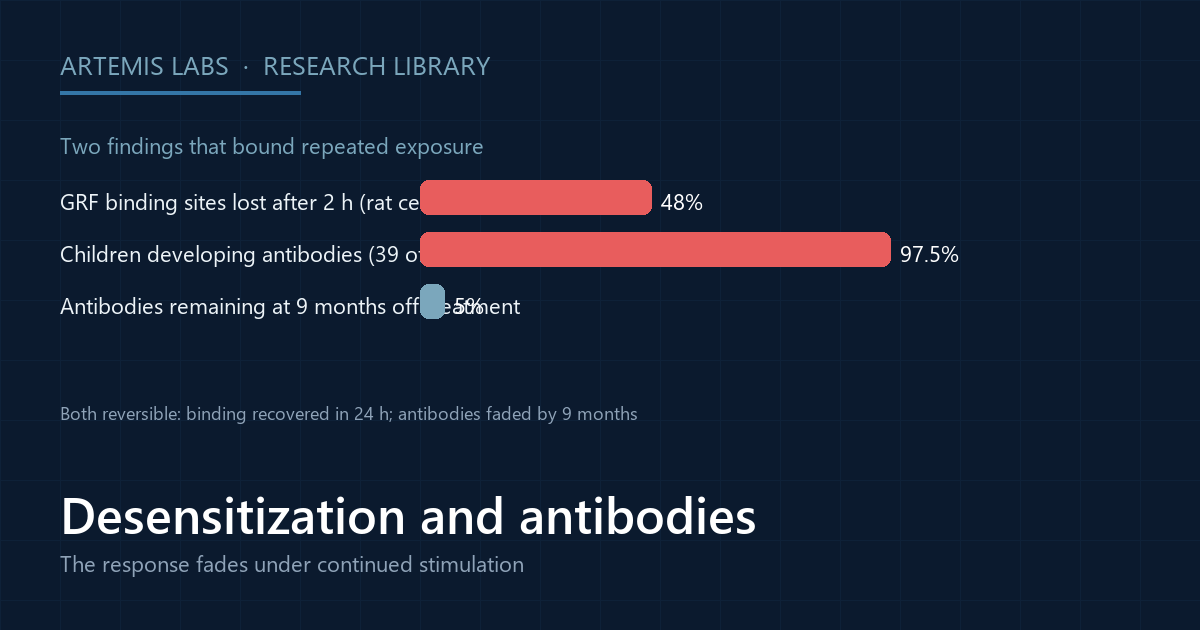
- A mechanism in cells. In cultured rat pituitary cells, desensitization was associated with a time-dependent decrease in … GRF-binding capacity; a 48% loss of binding sites was evident after a 2-h pretreatment, and both effects were reversible after 24 h (Endocrinology 1986, PMID 3009146).
- Antibodies in the pediatric trial. All 20 patients on high-dose GHRH(1-29)-NH2 and 19 of 20 patients on low-dose GHRH(1-29)-NH2 developed GHRH antibodies. These had almost disappeared by 9 months after stopping treatment (PMID 8329830).
- A shrinking response over six months. In the nasal-formulation pilot, growth-hormone peak amplitudes were variably reduced after 6 weeks in most patients, and further reduced at 6 months, with antibodies positive in three of eight children by six weeks (PMID 8329828).
What does desensitization mean in this context?
A receptor that is stimulated continuously often responds less over time. The classic human demonstration for the GHRH receptor came in 1986: ten normal men received either saline or a six-hour GHRH infusion, then a challenge. The growth-hormone response to a large GHRH dose was greater after saline infusion than after GHRH infusion. Critically, the response to insulin-induced hypoglycaemia, a different route to growth-hormone release, was significantly greater after GHRH infusion, so the pituitary had not run out of hormone; it had become less responsive to that particular signal. The authors’ reading: either partial desensitization or down-regulation of the GHRH receptor (PMID 3080467). That study used native GHRH instead of the 29-residue fragment, so it is class evidence about the receptor, not a sermorelin-specific result.
The cellular counterpart, published the same year, measured what was happening. Rat anterior pituitary cells chronically stimulated with rat GRF became less sensitive, with the half-maximal effective concentration rising over hours, and the change tracked a loss of binding sites: a 48% loss of binding sites was evident after a 2-h pretreatment, with maximum loss by eight hours. The binding sites’ affinity did not change, only their number, and both sensitivity and binding recovered within 24 hours (PMID 3009146). It is a rat, in vitro, with rat GRF; it explains a mechanism instead of predicting a human outcome.
What happened over months in the pediatric trials?
The Shanghai randomized trial measured antibodies deliberately, and found them almost everywhere in the treated arms: all 20 children on the higher amount and 19 of 20 on the lower developed GHRH antibodies, which had almost disappeared by 9 months after stopping treatment. The trial reported no correlation between antibody titres and increase in height, so the antibodies were not shown to blunt growth in that study, and side effects were limited to mild injection-site irritation in three children. But IGF-I in the same trial rose initially, but then fell to values similar to those before treatment, and growth hormone itself produced substantially more growth (PMID 8329830). Our trial-record page carries that comparison in full.
The German nasal pilot is the clearest picture of a response fading with continued exposure. Growth-hormone peaks after each administration were variably reduced after 6 weeks in most patients, and further reduced at 6 months; three of the eight children had developed antibodies by six weeks; short-term growth rose then rapidly declined; and the six-month height-velocity measure did not increase at all. The authors called the formulation unsuitable as delivered, citing decreasing absorption and effectiveness with concomitant development of antibodies and local reactions (PMID 8329828).
What this means for reading the rest of the record
Two practical consequences follow, and both are about time. Short studies cannot see either effect, and most of this literature is short. The healthy-volunteer pharmacokinetic and dose-response studies, which run for hours, measure the acute response and say nothing about what happens after weeks; the open-label pediatric study reported a height velocity at six months lower than at three to six months, which is the shape the fading-response data would predict but does not by itself demonstrate. And any research design that stimulates the receptor repeatedly should account for the possibility that the second measurement is not comparable to the first. That is a study-design point, not advice to anyone.
What the research does not show
The human desensitization study used native GHRH, not sermorelin, and the binding-site study was in rat cells with rat GRF: neither is a sermorelin-specific finding, and both are reported here as class mechanism. The antibody findings are from two small pediatric studies, one randomized and one an eight-child pilot; no adult antibody data exist in our verified corpus, and no study has measured whether antibody formation reduces the response in a way that matters clinically, because the one trial that looked found no correlation with growth. There is no modern study of either phenomenon with the compound as sold today, and nothing here describes research-grade material. The compound’s identity record is on the sermorelin research page.
Frequently asked questions
Does the response to sermorelin fade?
In the studies that tracked it over weeks, yes: growth-hormone peaks shrank in the nasal pilot and IGF-I returned to baseline in the randomized pediatric trial. The mechanism the record shows receptor desensitization and binding-site loss for GHRH generally.
Did children develop antibodies?
In one randomized trial, 39 of 40 treated children did, and the antibodies faded within nine months of stopping. That trial found no correlation between antibody levels and growth.
Is desensitization permanent?
In the rat-cell study, both sensitivity and binding recovered within 24 hours of removing the stimulus.
Where is the rest of the record?
On our human-trials page and safety page.
References
- Dual effects of growth hormone (GH)-releasing hormone infusion in normal men: somatotroph desensitization and increase in releasable GH. J Clin Endocrinol Metab. 1986. PMID 3080467 · DOI.
- Desensitization to growth hormone-releasing factor (GRF) is associated with down-regulation of GRF-binding sites. Endocrinology. 1986. PMID 3009146 · DOI.
- A comparative study of growth hormone (GH) and GH-releasing hormone(1-29)-NH2 for stimulation of growth in children with GH deficiency. Acta Paediatr Suppl. 1993. PMID 8329830.
- Intranasal administration of growth hormone-releasing hormone(1-29)-NH2 in children with growth hormone deficiency. Acta Paediatr Suppl. 1993. PMID 8329828.
- Geref International Study Group. One-year multicenter open-label study in 110 GH-deficient children. J Clin Endocrinol Metab. 1996. PMID 8772599.
Methodology: every quotation was transcribed from the PubMed abstract of the cited record via NCBI E-utilities on August 28, 2026; species and preparation are stated for each finding. Last verified August 28, 2026.
All compounds sold by Artemis Labs are for laboratory research use only. Nothing on this page is medical advice, and no statement has been evaluated by the FDA.
