
What Is Sermorelin Studied For? Research Overview | Artemis Labs
Aug
What is sermorelin studied for? A plain-language research overview
Published August 28, 2026 · Artemis Labs
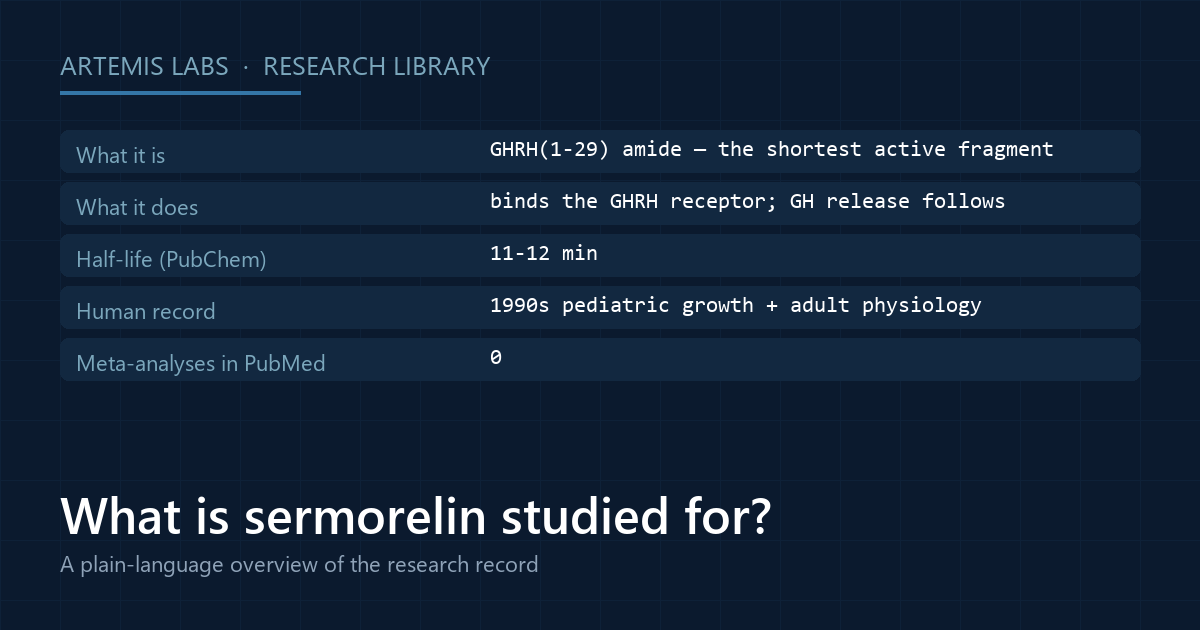
Sermorelin — Sermorelin is a synthetic copy of the first 29 amino acids of human growth hormone-releasing hormone (GHRH), the signal the brain sends to the pituitary gland to release growth hormone. Those 29 residues are the shortest piece of the hormone that still activates its receptor. Its human research record has two halves: 1990s trials of growth in children with growth hormone deficiency, where a sermorelin acetate product was approved and later discontinued, and adult physiology studies that used the peptide as a probe to understand how growth hormone is released. PubMed indexes no sermorelin meta-analysis. In the one head-to-head pediatric trial, growth hormone itself outperformed it.
Key findings
- What it is. GHRH(1-29) with a C-terminal amide; PubChem CID 16132413, molecular weight 3357.9, CAS 86168-78-7. PubChem’s mechanism annotation: it binds to the growth hormone releasing hormone receptor and mimics native GRF in its ability to stimulate growth hormone secretion.
- Short-lived by design. PubChem’s Biological Half-Life annotation reads 11-12 min. It carries no stabilizing modification, so the enzyme that clips native GHRH acts on it too.
- The evidence is old and mostly pediatric. 331 PubMed records, 29 tagged clinical trial, 19 randomized, and zero meta-analyses (searches run August 28, 2026).
- The honest headline from the one head-to-head trial. In 60 children randomized across three arms, mean height velocities at six months were 9.2, 9.3 and 14.6 cm/year for low-dose GHRH(1-29), high-dose, and growth hormone; the authors concluded the peptide is unlikely to be as effective as GH for the promotion of growth (PMID 8329830).
What is sermorelin, in plain terms?
The hypothalamus makes a 44-amino-acid peptide, GHRH, whose job is to tell the pituitary to release growth hormone. Researchers established decades ago that the first 29 residues carry the activity, and sermorelin is that fragment, made synthetically and finished with an amide group at its end. Because it is the natural sequence instead of a modified one, it is cleared quickly: PubChem’s half-life annotation gives 11 to 12 minutes. Chemists later built longer-lasting versions by changing residues or attaching the peptide to a blood protein, which is what CJC-1295 is, and by capping the full-length hormone, which is what tesamorelin is. Our identity page carries the verified structural record, including the trap that the old brand name resolves to three different PubChem entries.
What does the human record actually contain?
Two distinct bodies of work, and it helps to keep them apart.
Pediatric growth trials, 1990s. A multicenter open-label study treated 110 previously untreated prepubertal children with growth hormone deficiency for up to a year and reported mean height velocity rising from 4.1 ± 0.9 cm/yr at baseline to 8.0 ± 1.5 and 7.2 ± 1.3 cm/yr after 6 and 12 months, with 74% of the children considered good responders at six months and no change in fasting glucose (JCEM 1996, PMID 8772599). It had no control arm. Two randomized trials the same decade compared the peptide against growth hormone directly, in 43 children in Turkey (PMID 8329826) and 60 children in China (PMID 8329830). Both found growth hormone better. Our trial-record page reports them in full.
Adult physiology studies. A separate literature used GHRH(1-29) not as a treatment but as a tool, to ask how the pituitary generates growth-hormone pulses. In healthy men, an intravenous dose produced growth-hormone elevation lasting about 3 hours despite the peptide clearing in minutes (PMID 8329825). In a peptide-clamp study, continuous infusion amplified peak GH concentrations while pulse timing remained unaffected (PMID 10594518). In adults treated with cranial irradiation years earlier, the response was blunted (PMID 10754477). These are mechanism studies in small groups, not treatment trials, and they are frequently mis-cited as evidence of benefit.
What about the adult and aging research?
This is where the record is most often overstated, and the reason is specific. The two 1997 studies most often cited for sermorelin in older adults tested [Nle27]GHRH(1-29)-NH2, a norleucine-substituted analog, not sermorelin (PMIDs 9141536, 9360512). They are worth reading, and one of them found that the IGF-1 rise was returning toward baseline by 16 weeks, but they are studies of a different molecule. The widely cited 2006 paper framing sermorelin as an approach to adult growth hormone insufficiency is an editorial with no abstract in PubMed (PMID 18046908): an opinion piece, not data. Our adult-research page works through what does and does not exist here.
What is its regulatory status?
Two FDA applications for sermorelin acetate exist, both held by EMD Serono and both discontinued: NDA 019863, first approved December 28, 1990, and NDA 020443, approved September 26, 1997. Both product records carry the note that discontinuation was not … for safety or effectiveness reasons. No sermorelin product is currently marketed under an FDA approval, and none of that history attaches to research-grade material. Sermorelin is also named by name on the WADA 2026 Prohibited List under section S2.2.4, growth hormone releasing factors. Both records are set out on our pages on the FDA record and the WADA listing.
What the research does not show
PubMed indexes zero meta-analyses of sermorelin. The controlled human evidence is largely pediatric, from the 1990s, and where a randomized trial compared it against growth hormone, growth hormone won. Antibody formation was common in those trials: in the 60-child study, all 20 patients on high-dose GHRH(1-29)-NH2 and 19 of 20 patients on low-dose developed GHRH antibodies. The adult and aging literature that circulates under sermorelin’s name is largely about a different analog or is an unabstracted editorial. Three 2026 reviews that name sermorelin do so in the context of unregulated use, one stating that rigorous human safety data are scarce for this category (PMID 41966639). No claim is made here about what any research vial does; every study cited tested a clinical or research preparation in a study setting, not our material.
Frequently asked questions
Is sermorelin growth hormone?
No. It is a fragment of the hormone that tells the pituitary to release growth hormone.
Was it ever an approved medicine?
Yes, as sermorelin acetate, first approved in 1990 and later discontinued for reasons FDA recorded as not related to safety or effectiveness.
How long does it last in the blood?
PubChem’s annotation gives 11 to 12 minutes. The growth-hormone rise it triggers outlasts it, at about three hours in one healthy-volunteer study (PMID 8329825).
How does it compare with CJC-1295 and ipamorelin?
Different molecules and, for ipamorelin, a different receptor. See our three-way comparison and the sermorelin research page.
References
- PubChem. Sermorelin, CID 16132413: Mechanism of Action, Pharmacodynamics, Biological Half-Life. pubchem.ncbi.nlm.nih.gov/compound/16132413 (fetched 2026-08-28).
- Geref International Study Group. One-year multicenter open-label study in 110 GH-deficient children. J Clin Endocrinol Metab. 1996. PMID 8772599.
- A comparative study of growth hormone (GH) and GH-releasing hormone(1-29)-NH2 for stimulation of growth in children with GH deficiency. Acta Paediatr Suppl. 1993. PMID 8329830.
- Growth response to growth hormone-releasing hormone(1-29)-NH2 compared with growth hormone. Acta Paediatr Suppl. 1993. PMID 8329826.
- Pharmacokinetics of growth hormone-releasing hormone(1-29)-NH2 and stimulation of growth hormone secretion in healthy subjects. Acta Paediatr Suppl. 1993. PMID 8329825.
- The relative roles of continuous GHRH(1-29)NH2 and intermittent somatostatin in GH pulse generation. Clin Endocrinol. 1999. PMID 10594518. Attenuated response after cranial irradiation. Eur J Endocrinol. 2000. PMID 10754477.
- Endocrine and metabolic effects of long-term administration of [Nle27]GHRH-(1-29)-NH2 in age-advanced men and women. J Clin Endocrinol Metab. 1997. PMID 9141536 (a different analog).
- Safety and Efficacy of Approved and Unapproved Peptide Therapies for Musculoskeletal Injuries and Athletic Performance. Sports Med. 2026. PMID 41966639.
- FDA Drugs@FDA: sermorelin acetate, NDA 019863 and NDA 020443 (EMD Serono), retrieved via openFDA 2026-08-28.
Methodology: PubChem annotations via PUG-View and every trial quotation from the cited PubMed abstract via NCBI E-utilities, retrieved August 28, 2026; regulatory fields from Drugs@FDA the same day. Last verified August 28, 2026.
All compounds sold by Artemis Labs are for laboratory research use only. Nothing on this page is medical advice, and no statement has been evaluated by the FDA.
