
Sermorelin and the WADA Prohibited List: The Exact Wording | Artemis Labs
Aug
Sermorelin and the WADA Prohibited List: the exact wording, from the List itself
Published August 28, 2026 · Artemis Labs
Sermorelin WADA status — The World Anti-Doping Agency’s 2026 Prohibited List names sermorelin explicitly. Section S2.2.4, Growth hormone releasing factors, lists growth hormone-releasing hormone (GHRH) and its analogues (e.g. CJC-1293, CJC-1295, sermorelin and tesamorelin), and, on the next line, growth hormone secretagogues (GHS) and their mimetics [e.g. anamorelin, capromorelin, ibutamoren (MK-677), ipamorelin, lenomorelin (ghrelin), macimorelin and tabimorelin]. Four of the compounds Artemis Labs supplies for research are named in that single section. This page quotes the entry instead of paraphrasing it, because vendor pages routinely get the section number and the scope wrong.
Key findings
- The section is S2.2.4, Growth hormone releasing factors, including, but not limited to, inside category S2, Peptide Hormones, Growth Factors, Related Substances and Mimetics.
- Sermorelin is named by name, alongside CJC-1293, CJC-1295 and tesamorelin, as a GHRH analogue.
- Ipamorelin is named separately, as a growth hormone secretagogue and mimetic, in the same section.
- The list is not exhaustive — its own wording is including, but not limited to, so an unnamed analogue of a named class is still covered.
What does the List actually say?
The WADA Prohibited List is published annually and takes effect on January 1. The 2026 edition, retrieved directly as a PDF from wada-ama.org on August 28, 2026, sets out section S2 as Peptide Hormones, Growth Factors, Related Substances and Mimetics, and within it, at S2.2.4:
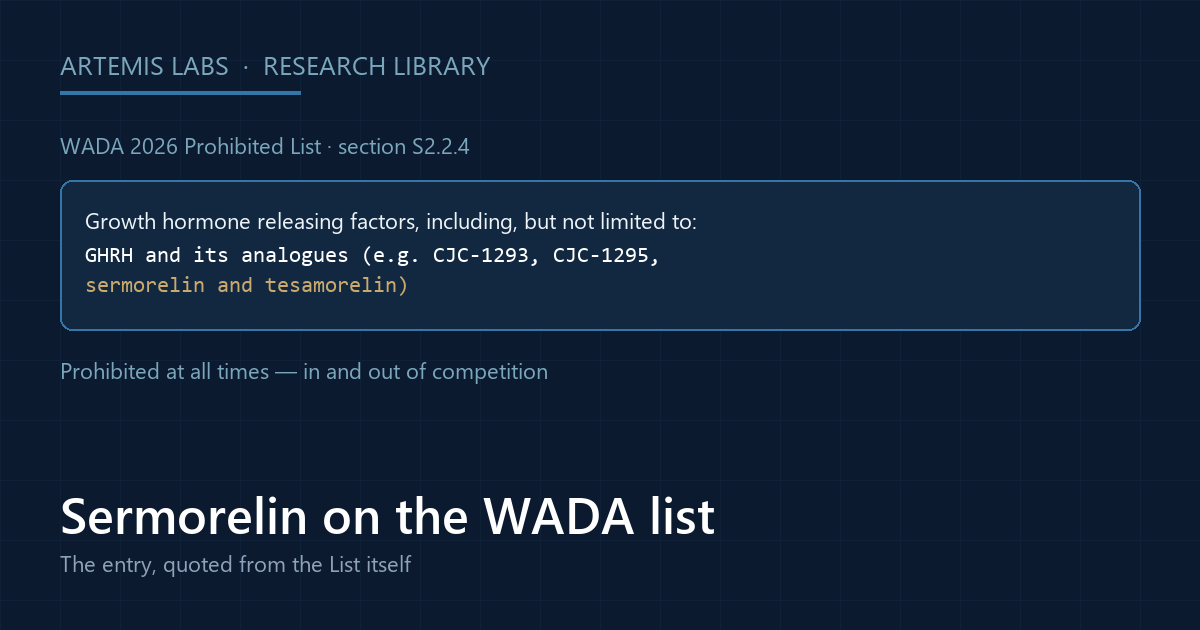
Growth hormone releasing factors, including, but not limited to:
growth hormone-releasing hormone (GHRH) and its analogues (e.g. CJC-1293, CJC-1295, sermorelin and tesamorelin)
growth hormone secretagogues (GHS) and their mimetics [e.g. anamorelin, capromorelin, ibutamoren (MK-677), ipamorelin, lenomorelin (ghrelin), macimorelin and tabimorelin]
GH-releasing peptides (GHRPs) [e.g. alexamorelin, examorelin (hexarelin), GHRP-1, GHRP-2 (pralmorelin), GHRP-3, GHRP-4, GHRP-5 and GHRP-6]
The same section of the List also covers growth hormone itself, its analogues such as somatropin and somatrogon, and growth hormone fragments including AOD-9604. Substances in category S2 are prohibited at all times, meaning both in and out of competition, which is how the List’s own structure separates S2 from categories that apply in competition only.
Why does the exact wording matter?
Three reasons, all practical for anyone reading vendor pages in this category.
The section number is often wrong. Pages frequently cite “Section S2” without the subsection, or cite a subsection number from an older edition. The List is renumbered between editions, and a citation to a section that no longer says what it used to is worse than no citation. This page cites S2.2.4 of the 2026 edition and links the source document.
The scope is broader than the named list. The phrase including, but not limited to is doing real work. A compound that is a GHRH analogue but is not printed in the example list is still within the class the section prohibits. Reading the named examples as a complete list is the common error.
Naming is not the same as evidence. WADA lists substances that meet its criteria for prohibition, which include its potential effect on performance, potential health risk, and violation of the spirit of sport. Appearing on the List says nothing about whether a compound has been shown to do anything in a trial. In sermorelin‘s case, our trial-record page shows a pediatric-growth literature in which growth hormone outperformed it, and no adult treatment trial at all.
Who does the List apply to?
Athletes subject to anti-doping rules under the World Anti-Doping Code, which covers Olympic and many national and international sports federations, and anyone else whose organization has adopted the Code. It does not itself make a substance illegal to possess or sell in any country; it governs eligibility to compete. Artemis Labs supplies research-grade compounds for laboratory use, not to athletes for use, and the material is not for human use in any context. We publish this page because the WADA status is a factual, checkable attribute of the compound that a researcher may need to know, and because the citation is easy to get wrong.
The three 2026 reviews that discuss this class in a sports context all note the anti-doping dimension: one describes growth-hormone-axis secretagogues as remaining investigational, with uncertain safety profiles, product quality concerns, and widespread antidoping restrictions (PMID 42160466), and another describes analytical challenges in detection arising from these peptides’ structural similarity to endogenous hormones and short half-lives (PMID 41880199).
What the research does not show
The List entry establishes a regulatory status in sport and nothing else. It is not evidence that sermorelin, CJC-1295, tesamorelin or ipamorelin improves any measure of performance; no trial in our verified corpus tested any of them for that purpose, and the pediatric-growth trials that do exist for sermorelin favored growth hormone over it. It also says nothing about safety, and nothing about research-grade material of the same sequences. The List is republished annually, so this page reports the 2026 edition and should be re-checked against the current edition before being relied on.
Frequently asked questions
Is sermorelin banned in sport?
It is named on the WADA 2026 Prohibited List at section S2.2.4, in the growth hormone releasing factors group, which is prohibited at all times.
Are CJC-1295 and ipamorelin on it too?
Yes. CJC-1293 and CJC-1295 appear in the same GHRH-analogue line as sermorelin; ipamorelin appears in the growth hormone secretagogues line immediately below.
Does being on the List mean it works?
No. Listing reflects WADA’s criteria for prohibition, not a demonstration of effect. See our trial-record page.
Where can I read the List?
At wada-ama.org/en/prohibited-list, which publishes the current edition as a PDF.
References
- World Anti-Doping Agency. 2026 Prohibited List, section S2.2.4. PDF retrieved 2026-08-28 from wada-ama.org (2026 List PDF); current editions at wada-ama.org/en/prohibited-list.
- Injectable Peptides in Sports Medicine: A Structured Narrative Review of Evidence, Safety, and Antidoping Implications. JBJS Rev. 2026. PMID 42160466.
- A new era of doping? Use of peptide and peptide-analog drugs in recreational and professional sport and bodybuilding: a critical review. J Sports Med Phys Fitness. 2026. PMID 41880199.
Methodology: the section text was extracted directly from the WADA 2026 Prohibited List PDF on August 28, 2026 and is quoted verbatim; review quotations are from PubMed abstracts via NCBI E-utilities the same day. Last verified August 28, 2026.
All compounds sold by Artemis Labs are for laboratory research use only. Nothing on this page is medical advice, and no statement has been evaluated by the FDA.
