Ipamorelin
$70.00
There are two ways to raise growth hormone: mimic the signal that tells the pituitary to release it, or mimic ghrelin — the hunger hormone that also triggers release, through a different receptor. Ipamorelin takes the second route. What made it notable is how quiet it is: earlier compounds in its class dragged cortisol and prolactin up alongside GH, and in published selectivity work ipamorelin does not.
Continue readingShow less
What the published work describes. Ipamorelin binds GHS-R1a on pituitary somatotrophs, driving phospholipase-C signalling, a calcium rise, and release of stored GH vesicles (Raun 1998, PMID 9849822). In receptor-selectivity assays it showed negligible activity at corticotroph and lactotroph receptors, with no measurable rise in ACTH, cortisol, prolactin, FSH, LH or TSH — the profile that separates it from earlier GHRPs (Renke 2026, PMID 42123471).
What is missing. The selectivity data is strong; the outcome data is not. There are no completed human efficacy trials, and long-term exposure has not been characterised in any published model.
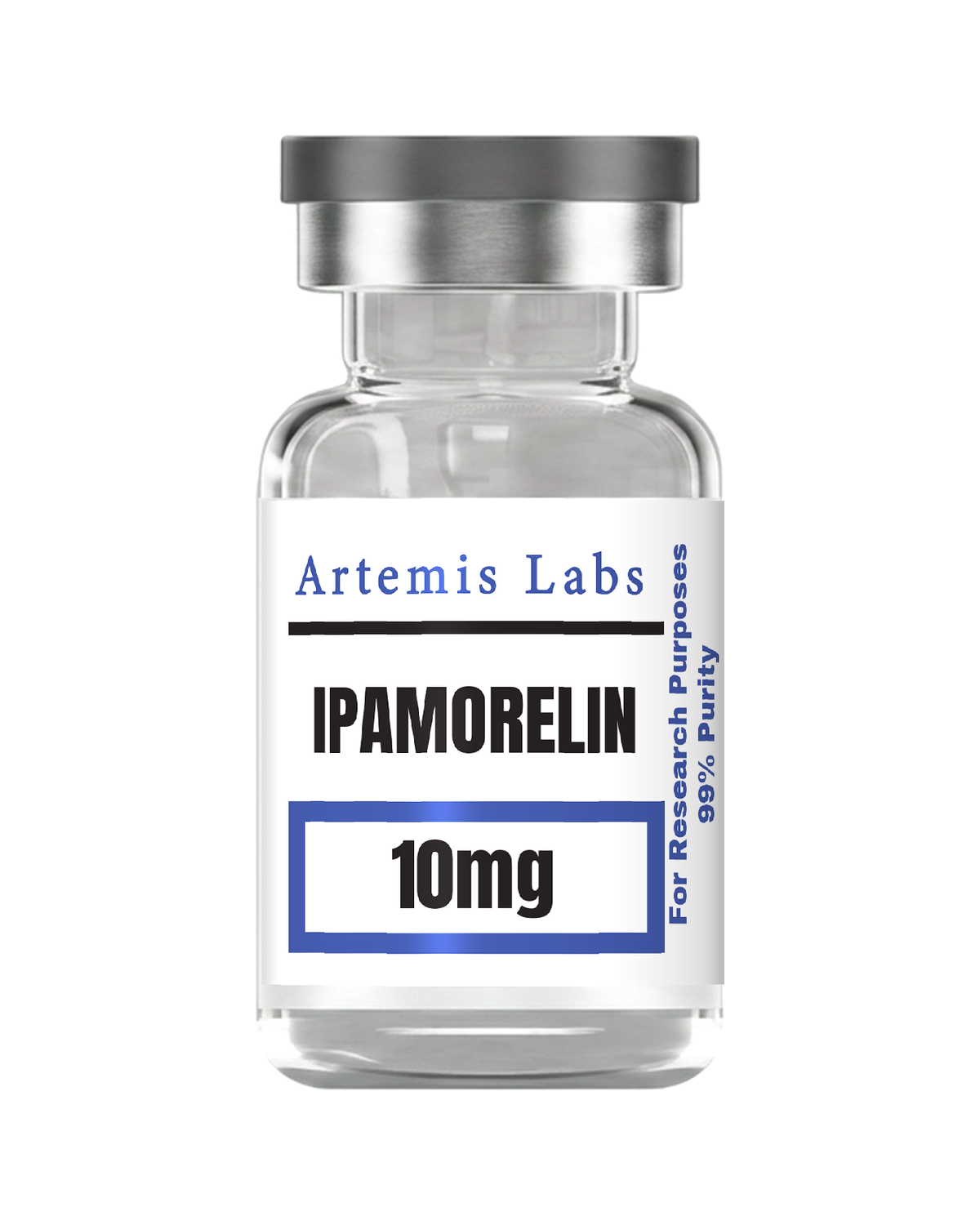
Supplied as lyophilized pentapeptide, for laboratory research use only.
20 in stock
Free shipping on orders over $300
Pay by Venmo or Cash App — instructions are emailed with your order.
14 published sources cited on this page see them
For research use only. Not for human consumption.
Description
Ipamorelin is a lab-made peptide of five building blocks. It turns on the ghrelin receptor. That is the same switch the body’s own hunger hormone uses. In the first study of it, ipamorelin raised growth hormone but did not move cortisol or prolactin. Artemis Labs sells it as a dry powder.
Reviewed August 21, 2026 · Artemis Labs
What is ipamorelin?
Ipamorelin is a synthetic 5-residue pentapeptide with sequence Aib-His-D-2-Nal-D-Phe-Lys-NH₂ (free base C₃₈H₄₉N₉O₅, MW 711.86 g/mol, CAS 170851-70-4, PubChem CID 9831659). It is one of the most receptor-selective ghrelin-receptor (GHS-R1a) agonists yet characterised. Originally developed by Novo Nordisk in the 1990s under the code NNC 26-0161, it was advanced through clinical development for post-operative ileus by Helsinn / Novo Nordisk before that program was discontinued.
Why is ipamorelin called a selective growth-hormone secretagogue?
The foundational ipamorelin paper (Raun et al. 1998, PMID 9849822) characterised the compound as the first selective growth-hormone secretagogue: in pituitary-cell and animal receptor-selectivity assays, ipamorelin produced dose-dependent, pulsatile GH release without statistically significant elevation of ACTH, cortisol, prolactin, FSH, LH, or TSH. Earlier GHRPs (GHRP-2, GHRP-6, hexarelin) elevate one or more of these hormones in published research. The 2026 review literature (Renke 2026, PMID 42123471; Mavrych 2026, PMID 42021992) confirms ipamorelin’s continued use as the reference standard for ACTH-neutral GHS-R1a research pharmacology.
What did the 2024 preclinical studies report?
- Peripheral vs central GHS-R1a effects — Lu et al. 2024 (PMID 39043357): in a ferret cisplatin chemotherapy model, both ipamorelin and the longer-acting analog anamorelin reduced delayed-phase weight loss by ~24%; only anamorelin (not ipamorelin) had central anti-emetic effects via intracerebroventricular administration. Reaffirms a peripheral / GI-axis-dominated mechanism for ipamorelin and points to brain penetrance differentiating the two analogs.
- HPG-axis cross-talk — Gouda & Ganesh 2024 (PMID 38996787): in a teleost model (Oreochromis mossambicus), ipamorelin acetate enhanced germ-cell development during meiosis-I via increased pituitary and testicular androgen-receptor signalling. Non-mammalian demonstration of GHS-R1a downstream effects beyond the somatotroph axis.
What is ipamorelin’s regulatory status?
Ipamorelin has had a complex regulatory trajectory:
- September 2023: placed on the FDA’s interim 503A Category 2 bulks list (alongside CJC-1295), restricting compounded use — safety concerns cited included a cardiac signal, impurity profiles, and immunogenicity.
- September 18, 2024: FDA referred ipamorelin-related bulk drug substances (ipamorelin acetate and ipamorelin free base) to the Pharmacy Compounding Advisory Committee for review of inclusion on the 503A Bulks List; the uses FDA evaluated were growth hormone deficiency and postoperative ileus (Federal Register 2024-21241). The committee voted 0-12-1 against listing on October 29, 2024, a recommendation the FDA has not acted on. As of 2026 ipamorelin is not on the FDA positive bulks list and is not FDA-approved for any human indication.
- WADA prohibition: Ipamorelin is prohibited at all times under Section S2 (Mendias 2026, PMID 41966639; Coutinho 2026, PMID 41880199).
- Discontinued POI development: Helsinn / Novo Nordisk phase-2 trials in approximately 114 bowel-resection patients did not meet primary efficacy endpoints (Beck et al. 2014, PMID 25331030).
- Comparator-class status: Anamorelin — a closely related GHS-R1a agonist — is approved in Japan (2021, Adlumiz / Encinosa) for cancer cachexia. Ipamorelin itself has no market approval anywhere.
What does the ipamorelin evidence not show?
(1) Discontinued human development. The phase-2 POI program did not meet primary endpoints — ipamorelin must not be represented as a clinically validated therapy. (2) Brief 503A Category 2 placement by the FDA in 2023 was based on cardiac-signal, impurity, and immunogenicity concerns; the Category 2 removal in 2024 followed nominator withdrawal, and a safety-and-efficacy evaluation did take place: FDA’s 55-page briefing document reviewed ipamorelin for growth hormone deficiency and postoperative ileus, and on October 29, 2024 the Pharmacy Compounding Advisory Committee voted 0 for and 12 against listing it, with one abstention, citing a lack of information supporting safety and efficacy. A committee vote is a recommendation; the FDA has not acted on it. (3) WADA-prohibited at all times (Section S2). (4) Most 2026 review literature classifies ipamorelin alongside anamorelin and MK-677 as investigational ghrelin-receptor pharmacology — not validated therapy. (5) Newer 2024 mechanism work (Lu, Gouda) extends ipamorelin biology into GI-axis and HPG-axis contexts but does not change the regulatory or clinical-validation framing.
How does ipamorelin differ from the GHRH-class peptides?
Ipamorelin acts on a different receptor (GHS-R1a / ghrelin) than the GHRH-class peptides CJC-1295, Sermorelin, and Tesamorelin (GHRH-R). Published research describes additive or synergistic GH release when GHS-R1a and GHRH-R are co-activated in pituitary-explant studies (Mavrych 2026, PMID 42021992) — which is why ipamorelin is one of the most-studied research peptides in combination-stimulation pharmacology.
What is the research-use-only framing?
Ipamorelin is not FDA-approved for any human therapeutic indication. Human development for post-operative ileus was discontinued. Briefly placed on FDA 503A Category 2 in 2023, removed in 2024. Prohibited at all times under WADA Section S2. Research-use-only framing applies to all commercial supply. These statements have not been evaluated by the FDA. Not for human consumption, therapeutic use, or veterinary use.
Analytical Specifications
| Sequence | Aib-His-D-2-Nal-D-Phe-Lys-NH₂ (5 residues, C-terminal amide) |
| Molecular formula | C₃₈H₄₉N₉O₅ |
| Molecular weight | 711.86 g/mol (free base); acetate / acetate-hydrate salt forms have higher reported masses |
| CAS number | 170851-70-4 |
| PubChem CID | 9831659 |
| Form | Lyophilised white powder, 10 mg per vial |
| Storage (lyophilised) | −20 °C, desiccated |
| Plasma half-life (published research) | ~2 hours in published animal studies |
| Regulatory status (2026) | Not FDA-approved; not on the FDA positive 503A bulks list; POI development discontinued. WADA Section S2, prohibited at all times |
References
- Raun K et al. (1998). Ipamorelin, the first selective growth hormone secretagogue. Eur J Endocrinol. PMID 9849822
- Beck DE et al. (2014). Phase-2 evaluation of ipamorelin in post-operative ileus. PMID 25331030
- Lu Z et al. (2024). Peripheral vs central GHS-R1a effects in a ferret cisplatin model. Physiol Behav. PMID 39043357 · DOI 10.1016/j.physbeh.2024.114644
- Gouda MNR, Ganesh CB. (2024). Ipamorelin acetate and germ-cell development in Oreochromis mossambicus. Anim Reprod Sci. PMID 38996787 · DOI 10.1016/j.anireprosci.2024.107550
- Villegas Meza AD et al. (2026). Injectable peptides in sports medicine. JBJS Rev. PMID 42160466
- Renke G et al. (2026). Therapeutic peptides in aesthetic, metabolic, and endocrine conditions. Int J Mol Sci. PMID 42123471
- Mavrych V et al. (2026). Therapeutic peptides in gerontology. Front Aging. PMID 42021992
- Mendias CL et al. (2026). Sports Med. PMID 41966639
- Coutinho LFD et al. (2026). J Sports Med Phys Fitness. PMID 41880199
- Rahman OF et al. (2026). J Am Acad Orthop Surg Glob Res Rev. PMID 41490200
- Mayfield CK et al. (2026). Am J Sports Med. PMID 41476424
- Uçaktürk E et al. (2026). Nano-LC + Q-Orbitrap MS detection of GHRH analogs and the GHS class in urine. J Pharm Biomed Anal. PMID 41138283
- Federal Register (2024). PCAC review of inclusion on the 503A Bulks List, document 2024-21241. federalregister.gov/d/2024-21241
Where to read more about ipamorelin research
Each page below walks through one part of the published record in plain language, with every claim linked to the study it came from.
- What is ipamorelin studied for? — the research areas, in plain language
- The selectivity research — what the 1998 study measured, and what it did not
- The human trials — two studies, and one null result
- Compared with GHRP-2, GHRP-6 and hexarelin
- Bone and muscle research in rats
- Gut motility research
- Sequence, formula and molecular weight
- What forensic laboratories found in seized material
Additional information
| Vial Size | 10mg |
|---|
Science & Research
Science & Research
Mechanism of Action — GHS-R1a Selectivity
Ipamorelin (Aib-His-D-2-Nal-D-Phe-Lys-NH₂) is a synthetic pentapeptide that binds the growth-hormone-secretagogue receptor type 1a (GHS-R1a), a Gαq-coupled class-A G-protein-coupled receptor expressed on anterior-pituitary somatotrophs and on enteric neurons. Receptor activation drives phospholipase-C / IP₃ signalling, increases intracellular Ca²⁺, and triggers exocytosis of GH-containing secretory vesicles (Raun et al. 1998, PMID 9849822).
Pharmacokinetic Profile (Published Research)
- Plasma half-life: ~2 hours in published animal studies
- Onset of GH response: plasma GH rises within ~15–30 min in published research models
- Duration of GH pulse: ~4–8 hours
- Selectivity profile: GH-stimulating without measurable ACTH, cortisol, prolactin, FSH, LH, or TSH elevation in receptor-selectivity studies
- Clearance: rapid renal clearance; oral bioavailability negligible
2024 Primary Research
- Lu et al. 2024 (PMID 39043357 · DOI: 10.1016/j.physbeh.2024.114644) — ferret cisplatin chemotherapy model: ipamorelin and anamorelin both reduced delayed-phase weight loss by ~24%; only anamorelin had central anti-emetic effects via intracerebroventricular administration. Reaffirms peripheral / GI-axis-dominated mechanism for ipamorelin.
- Gouda & Ganesh 2024 (PMID 38996787 · DOI: 10.1016/j.anireprosci.2024.107550) — ipamorelin acetate enhanced spermatogenesis via increased pituitary/testicular androgen signalling in Oreochromis mossambicus. Non-mammalian HPG-axis demonstration of GHS-R1a downstream effects.
2026 Peer-Reviewed Reviews
- Villegas Meza AD, et al. (2026). Injectable peptides in sports medicine. JBJS Rev. PMID 42160466
- Renke G, et al. (2026). Therapeutic peptides in aesthetic, metabolic, and endocrine conditions. Int J Mol Sci. PMID 42123471
- Mavrych V, et al. (2026). Therapeutic peptides in gerontology. Front Aging. PMID 42021992
- Mendias CL, et al. (2026). Sports Med. PMID 41966639
- Coutinho LFD, et al. (2026). J Sports Med Phys Fitness. PMID 41880199
- Rahman OF, et al. (2026). J Am Acad Orthop Surg Glob Res Rev. PMID 41490200
- Mayfield CK, et al. (2026). Am J Sports Med. PMID 41476424
- Uçaktürk E, et al. (2026). Nano-LC + Q-Orbitrap MS detection of GHRH analogs and GHS class in urine. J Pharm Biomed Anal. PMID 41138283
Entity Disambiguation
| Compound | Receptor | Selectivity | Half-life | Status (2026) |
|---|---|---|---|---|
| Ipamorelin | GHS-R1a | ACTH-neutral; prolactin-neutral | ~2 hr | Not approved; abandoned POI development; WADA-prohibited |
| GHRP-2 | GHS-R1a | Raises cortisol + prolactin | ~30 min | Not approved |
| Anamorelin | GHS-R1a | Higher appetite/cachexia activity; CNS penetrant | ~7 hr | Approved in Japan (2021) for cancer cachexia |
| CJC-1295 | GHRH-R (different receptor) | GHRH-axis stimulation | 6–8 days (DAC variant) | See product page |
Quality and Specifications
- Sequence: Aib-His-D-2-Nal-D-Phe-Lys-NH₂ (5 residues, C-terminal amide)
- Molecular formula: C₃₈H₄₉N₉O₅
- Molecular weight: 711.86 g/mol (free base); acetate / acetate-hydrate salt forms have higher reported masses
- CAS number: 170851-70-4
- PubChem CID: 9831659
- Form: Lyophilised white powder, 10 mg/vial
- Storage: Lyophilised −20 °C, desiccated
Honest Limitations
- Discontinued human development. Phase-2 POI trials in ~114 patients did not meet primary endpoints (Beck et al. 2014, PMID 25331030). Ipamorelin is not a clinically validated therapy.
- Brief FDA 503A Category 2 placement in September 2023 was based on cardiac-signal + impurity + immunogenicity concerns. The 2024 removal followed nominator withdrawal; a safety-and-efficacy evaluation still took place, and on October 29, 2024 the Pharmacy Compounding Advisory Committee voted 0-12-1 against listing ipamorelin for growth hormone deficiency and postoperative ileus, citing a lack of information supporting safety and efficacy. As of 2026 ipamorelin is not on the FDA positive bulks list, and the FDA has not acted on the vote.
- WADA-prohibited at all times under Section S2 (Peptide Hormones, Growth Factors, Related Substances and Mimetics).
- Salt-form heterogeneity in commercial supply. Some vendor catalogs cite ~901 g/mol (di-acetate dihydrate) rather than the 711.86 g/mol free base — published studies may use either salt form; check which one a paper used.
- Anamorelin comparator-class context. Anamorelin (closely related GHS-R1a agonist with ~7 hr half-life) is approved in Japan for cancer cachexia; ipamorelin itself has no market approval anywhere — comparator-class approval does not transfer.
Research Pairings
Research Pairings
Pairing rationale below is mechanistic only. No dosing, frequency, duration, or human-use guidance is provided. Researchers design their own studies against their own institutional review, not against vendor copy.
Why is ipamorelin studied with CJC-1295?
GHS-R1a agonist × GHRH-R agonist. The canonical pairing in dual-receptor somatotroph-stimulation research. Published research describes additive or synergistic GH release in animal pituitary-explant studies (Mavrych 2026, PMID 42021992) when both receptors are co-activated. The two compounds work via entirely different molecular axes; this is the most-studied research peptide combination in GH-axis pharmacology.
Why is ipamorelin studied with sermorelin?
GHS-R1a agonist × short-acting GHRH(1-29). Native GHRH reference comparator for dual-receptor research design. Useful when researchers want shorter-acting GHRH-side stimulation than CJC-1295 DAC provides.
Why is ipamorelin studied with tesamorelin?
GHS-R1a agonist × the only FDA-approved GHRH analog. Useful as a safety/efficacy benchmark comparator for dual-receptor research designs.
Why is ipamorelin studied with MOTS-c?
GHS-R1a agonist × mitochondrial-derived peptide. Studied side-by-side in research models examining the downstream metabolic effects of GH/IGF-1 signalling (ipamorelin) layered onto mitochondrial-derived retrograde signalling (MOTS-c). Cross-axis research design.
What related compounds are in the catalogue?
For GHRH-axis comparators see CJC-1295, Sermorelin, Tesamorelin. For mitochondrial axis see MOTS-c.
Related products
Metabolic Research