CJC-1295 w/DAC
$40.00
The pituitary releases growth hormone in pulses, on a schedule set by a signalling peptide called GHRH. Natural GHRH is broken down within minutes. CJC-1295 with DAC is a modified copy that latches chemically onto albumin in the blood — turning a minutes-long signal into a days-long one. The research question is what changes when a naturally pulsed signal is made continuous.
Continue readingShow less
How it works. The DAC component forms a thioether bond with cysteine-34 of serum albumin, creating a peptide depot that resists enzymatic clearance. The intact peptide still acts at the GHRH receptor on pituitary somatotrophs, driving cAMP/PKA signalling and GH transcription (Teichman 2006, PMID 16352683; Alba 2006, PMID 16822960).
The trade-off researchers argue about. Making the signal continuous is precisely what makes it unlike the body’s own pattern. Natural GH release is pulsatile, and the pulses themselves carry information — so sustained elevation is a different biological input, not simply more of the same one.
Lyophilized modified GHRH(1-29) analog.
20 in stock
Free shipping on orders over $300
Pay by Venmo or Cash App — instructions are emailed with your order.
12 published sources cited on this page see them
For research use only. Not for human consumption.
Description
CJC-1295 with DAC is a lab-made version of the human hormone GHRH. A small chemical handle on its tail locks it onto albumin, a protein in blood, so it lasts far longer than the natural hormone. Published human work put that span near six to eight days. Artemis Labs supplies it as a dry powder.
Reviewed August 21, 2026 · Artemis Labs
For laboratory research use only. Not for human consumption or veterinary use.
What is CJC-1295 with DAC?
CJC-1295 with DAC is a synthetic 30-residue analog of growth hormone-releasing hormone (GHRH 1-29). The peptide carries four backbone substitutions (D-Ala², Gln⁸, Ala¹⁵, Leu²⁷) that confer resistance to dipeptidyl peptidase IV, terminating in a C-terminal Lys-εMPA (maleimidopropionic-acid) residue — the drug affinity complex that covalently bonds to cysteine-34 of circulating serum albumin via a thioether linkage. CAS 863288-34-0; molecular formula C₁₅₂H₂₅₂N₄₄O₄₂; molecular weight 3,367.95 g/mol. Atomic-resolution structural and pharmacologic characterization is documented across the published research base.
How does CJC-1295 act at the GHRH receptor?
CJC-1295 is a selective agonist of the GHRH receptor (GHRH-R), a Class B G-protein-coupled receptor expressed on anterior pituitary somatotrophs. Receptor activation drives Gαs / adenylyl-cyclase / cAMP / PKA signaling, increasing GH gene transcription and pulsatile exocytosis in published in-vitro and in-vivo research models (Teichman et al., J Clin Endocrinol Metab 2006, PMID 16352683; Alba et al., Am J Physiol Endocrinol Metab 2006, PMID 16822960). The receptor is selective for GH stimulation and does not significantly cross-activate ACTH, prolactin, or other pituitary hormone axes in published research.
Why does the DAC version last six to eight days?
In the foundational human pharmacology study (Teichman et al. 2006, PMID 16352683), the albumin-bound depot generated by the DAC moiety extends circulating half-life to roughly 6–8 days in healthy adult research populations. Reported research outcomes from that single-dose human study: 2–10× elevation in plasma GH persisting >6 days; 1.5–3× elevation in IGF-1 sustained 9–11 days post-administration. The Alba 2006 GHRH-knockout mouse model demonstrated normalization of growth with once-daily administration. These are research-context outcome figures only — no human dosing, administration, or therapeutic-use guidance is provided.
What is CJC-1295’s regulatory status in 2026?
CJC-1295 is not FDA-approved for any human indication. It was placed on FDA 503A interim Category 2 bulks list in September 2023 — the FDA cited a cardiovascular adverse-event signal in addition to general impurity and immunogenicity concerns for the peptide class. CJC-1295 was removed from Category 2 on September 27, 2024 following nominator withdrawal (FDA-2024-N-4777-0002, attachment 7), and was referred in October 2024 to the Pharmacy Compounding Advisory Committee for transparent public review (Federal Register document 2024-24828). That review concluded on December 4, 2024: the committee voted against listing every form of CJC-1295, including both DAC forms sold here (0 for and 13 against on the free base; 1 for and 12 against on the acetate; 0 for and 13 against on each of the DAC free base, DAC acetate and DAC trifluoroacetate). FDA’s briefing document said the available toxicity studies suggest the DAC forms may pose safety risks
and that no safety information exists on use in children (FDA briefing document, December 2024). A committee vote is a recommendation, not a listing; the FDA has not acted on it. As of 2026, CJC-1295 is not on the FDA positive 503A bulks list. Compounded human use is restricted under the current interim policy. For research use only.
What FDA says about CJC-1295. CJC-1295 is listed on FDA’s page Certain Bulk Drug Substances for Use in Compounding that May Present Significant Safety Risks (content current April 22, 2026) under “Bulk drug substances nominated but withdrawn.” FDA’s stated concern, quoted: “FDA has identified serious adverse events associated with CJC-1295 including increased heart rate and systemic vasodilatory reaction. Available clinical data are limited.” (FDA)
What does the CJC-1295 evidence not show?
Published 2026 sports-medicine and peptide-therapy reviews reference the FDA’s 2023 cardiovascular adverse-event signal alongside the broader absence of long-term safety data and the lack of any Phase 3 human clinical trials on CJC-1295 (Mendias et al., Sports Med 2026, PMID 41966639; Villegas Meza et al., JBJS Rev 2026, PMID 42160466). The 2025 anti-doping detection literature (Uçaktürk et al., J Pharm Biomed Anal 2026, PMID 41138283) reports nano-LC + Q-Orbitrap MS methods that detect CJC-1295 at sub-pg/mL levels in urine — researchers in regulated-sport contexts should be aware of detection sensitivity.
Is CJC-1295 prohibited in sport?
CJC-1295 is prohibited at all times under the World Anti-Doping Agency Prohibited List, Section S2 (Peptide Hormones, Growth Factors, Related Substances and Mimetics). Factual regulatory context only.
How is this compound supplied?
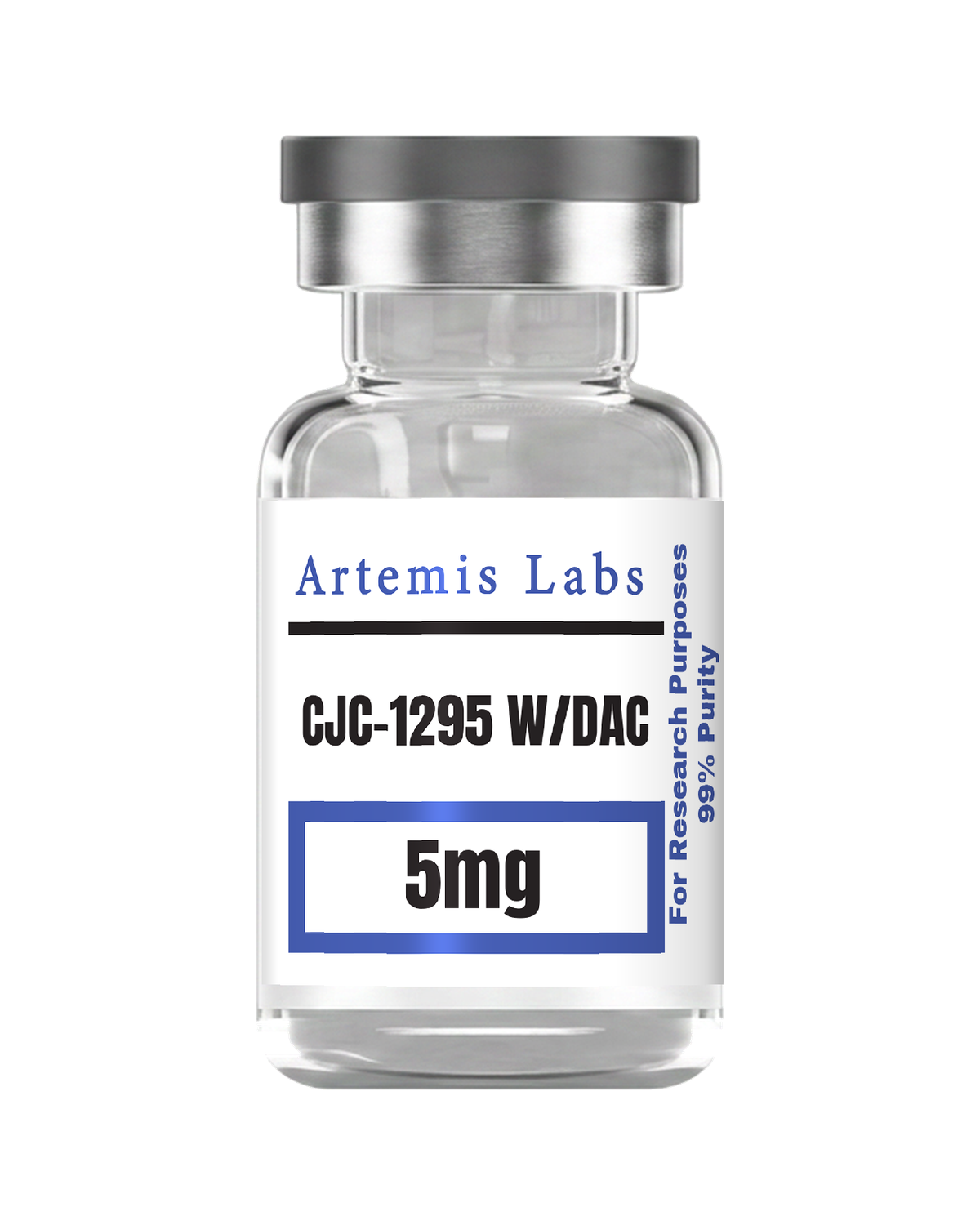
Supplied as 5 mg lyophilised white powder per vial.
Analytical Specifications
| Backbone | 30-residue GHRH(1-29) analog; substitutions D-Ala², Gln⁸, Ala¹⁵, Leu²⁷ (DPP-IV resistance) |
| Drug affinity complex (DAC) | C-terminal Lys-εMPA (maleimidopropionic acid); covalent thioether bond to cysteine-34 of serum albumin |
| Molecular formula | C₁₅₂H₂₅₂N₄₄O₄₂ |
| Molecular weight | 3,367.95 g/mol |
| CAS number | 863288-34-0 |
| Form | Lyophilised white powder, 5 mg per vial |
| Circulating half-life (published human research) | ~6–8 days (Teichman et al. 2006, PMID 16352683) |
| Storage | Not specified in this record |
| Regulatory status (2026) | Not FDA-approved; not on the FDA positive 503A bulks list; the Pharmacy Compounding Advisory Committee voted against listing every form on December 4, 2024, a recommendation the FDA has not acted on. WADA Section S2, prohibited at all times |
References
- Teichman SL et al. (2006). Prolonged stimulation of GH and IGF-I secretion by CJC-1295. J Clin Endocrinol Metab. PMID 16352683
- Alba M et al. (2006). Once-daily administration of CJC-1295 normalizes growth in the GHRH knockout mouse. Am J Physiol Endocrinol Metab. PMID 16822960
- Villegas Meza AD et al. (2026). Injectable peptides in sports medicine. JBJS Rev. PMID 42160466
- Renke G et al. (2026). Therapeutic peptides in aesthetic, metabolic, and endocrine conditions. Int J Mol Sci. PMID 42123471
- Mavrych V et al. (2026). Therapeutic peptides in gerontology. Front Aging. PMID 42021992
- Mendias CL et al. (2026). Safety and efficacy of approved and unapproved peptide therapies. Sports Med. PMID 41966639
- Coutinho LFD et al. (2026). A new era of doping? Peptide drug use in sport. J Sports Med Phys Fitness. PMID 41880199
- Rahman OF et al. (2026). Therapeutic peptides in orthopaedics. J Am Acad Orthop Surg Glob Res Rev. PMID 41490200
- Mayfield CK et al. (2026). Injectable peptide therapy primer. Am J Sports Med. PMID 41476424
- Uçaktürk E et al. (2026). Nano-LC + Q-Orbitrap MS detection of CJC-1295. J Pharm Biomed Anal. PMID 41138283
- Thomas A et al. (2024). Chromatographic-MS of 2–10 kDa peptide analytes in doping-control urine. J Mass Spectrom. PMID 38197510
- Cristea CD et al. (2023). Cationic-exchange SPE + UHPLC-MS/MS detection of GHRHs. Anal Biochem. PMID 37806509
- Federal Register (2024). PCAC referral of peptide bulk substances, document 2024-24828. federalregister.gov/d/2024-24828
- U.S. Food & Drug Administration. Certain Bulk Drug Substances for Use in Compounding that May Present Significant Safety Risks — CJC-1295 entry under “Bulk drug substances nominated but withdrawn.” Content current April 22, 2026. fda.gov
For laboratory research use only. No human dosing, administration, therapeutic, diagnostic, or preventative claim is made. These statements have not been evaluated by the FDA.
Additional information
| Vial Size | 5mg |
|---|
Science & Research
Science & Research
Structural Pharmacology
CJC-1295 with DAC is a 30-residue tetra-substituted analog of growth hormone-releasing hormone GHRH(1-29). The four backbone substitutions D-Ala², Gln⁸, Ala¹⁵, Leu²⁷ confer resistance to dipeptidyl peptidase IV and other serum peptidases. The C-terminal Lys-εMPA residue carries a maleimidopropionic-acid moiety that forms a covalent thioether bond with cysteine-34 of circulating serum albumin. The resulting peptide-albumin complex is shielded from peptidase cleavage and follows the slow clearance kinetics of albumin itself, extending in-vivo half-life from minutes (native GHRH) to ~6–8 days (Teichman et al., J Clin Endocrinol Metab 2006, PMID 16352683). Molecular formula C₁₅₂H₂₅₂N₄₄O₄₂; molecular weight 3,367.95 g/mol; CAS 863288-34-0.
GHRH Receptor Agonism
CJC-1295 retains full agonist activity at the GHRH receptor (GHRH-R), a Class B G-protein-coupled receptor expressed on anterior pituitary somatotrophs. Receptor activation drives Gαs-protein coupling → adenylyl cyclase activation → cAMP elevation → PKA-mediated phosphorylation of transcription factors → GH gene transcription → vesicular GH mobilization and pulsatile exocytosis. Receptor selectivity is high for GH stimulation in published research; CJC-1295 does not significantly cross-activate ACTH, prolactin, or other anterior-pituitary hormone axes. Pituitary somatostatin feedback remains intact, providing physiologic regulation of GH output (mechanism reaffirmed across 2026 review literature including Renke et al., Int J Mol Sci 2026, PMID 42123471; Mavrych et al., Front Aging 2026, PMID 42021992).
Published Pharmacokinetic and Pharmacodynamic Findings (Research Context Only)
Reported research outcomes from the foundational published human single-dose study (Teichman et al. 2006, PMID 16352683): plasma half-life ~6–8 days in healthy adult research populations, modelled up to ~14 days in subset analyses; 2–10× elevation in plasma GH following a single dose, persisting >6 days; 1.5–3× elevation in IGF-1 sustained 9–11 days post-administration; clearance via albumin-bound depot with renal clearance of free peptide. In the Alba et al. 2006 GHRH-knockout mouse model (PMID 16822960), once-daily administration normalized growth in animals lacking endogenous GHRH. No human dosing, administration, or therapeutic-use guidance is provided — the values above are reported research outcomes from published primary literature only.
Regulatory Status (2023–2026)
- September 2023: CJC-1295 placed on FDA 503A interim Category 2 bulks list. FDA cited a cardiovascular adverse-event signal in addition to general impurity and immunogenicity concerns for the peptide class.
- September 27, 2024: CJC-1295 removed from Category 2 of the interim 503A bulks list following nominator withdrawal (FDA-2024-N-4777-0002, attachment 7).
- October 2024: FDA referred CJC-1295 and other peptide bulk substances to the Pharmacy Compounding Advisory Committee for transparent public review (Federal Register 2024-24828).
- December 4, 2024: the Pharmacy Compounding Advisory Committee voted against listing every form of CJC-1295, including both DAC forms sold here (0-13 on the free base, 1-12 on the acetate, 0-13 on each DAC form). A committee vote is a recommendation, not a listing; the FDA has not acted on it.
- Current (2026): CJC-1295 is not on the FDA positive 503A bulks list and is not FDA-approved for any human indication. Compounded human use is restricted under the current interim policy.
- FDA bulk-substances safety page (current April 22, 2026): listed under “nominated but withdrawn” on Certain Bulk Drug Substances for Use in Compounding that May Present Significant Safety Risks. FDA, quoted: “FDA has identified serious adverse events associated with CJC-1295 including increased heart rate and systemic vasodilatory reaction. Available clinical data are limited.” (FDA)
Counter-Evidence and Safety Context (Disclosed Honestly)
The cardiovascular adverse-event signal cited in the 2023 Category 2 placement is referenced in current peer-reviewed safety reviews (Mendias et al., Sports Med 2026, PMID 41966639; Villegas Meza et al., JBJS Rev 2026, PMID 42160466). These reviews also catalogue the absence of long-term safety data and the lack of any Phase 3 human clinical trials on CJC-1295. Per Artemis Labs content policy, counter-evidence and limitations are surfaced alongside positive findings.
WADA Anti-Doping Detection (2023–2026 Analytical Chemistry)
CJC-1295 is prohibited at all times under WADA Prohibited List Section S2 (Peptide Hormones, Growth Factors, Related Substances and Mimetics). Anti-doping laboratories have published successive improvements in detection sensitivity: Cristea et al. (Anal Biochem 2023, PMID 37806509); Thomas (J Mass Spectrom 2024, PMID 38197510); Uçaktürk et al. (J Pharm Biomed Anal 2026, PMID 41138283) reporting nano-LC + Q-Orbitrap MS delivering 10–100× greater sensitivity. CJC-1295 is detectable at sub-pg/mL levels in modern anti-doping workflows.
Reference List (verified PubMed citations)
- Teichman SL et al. (2006). Prolonged stimulation of GH and IGF-I secretion by CJC-1295. J Clin Endocrinol Metab. PMID 16352683
- Alba M et al. (2006). Once-daily administration of CJC-1295 normalizes growth in the GHRH knockout mouse. Am J Physiol Endocrinol Metab. PMID 16822960
- Villegas Meza AD et al. (2026). Injectable peptides in sports medicine. JBJS Rev. PMID 42160466
- Renke G et al. (2026). Therapeutic peptides in aesthetic, metabolic, and endocrine conditions. Int J Mol Sci. PMID 42123471
- Mavrych V et al. (2026). Therapeutic peptides in gerontology. Front Aging. PMID 42021992
- Mendias CL et al. (2026). Safety and efficacy of approved and unapproved peptide therapies. Sports Med. PMID 41966639
- Coutinho LFD et al. (2026). A new era of doping? Peptide drug use in sport. J Sports Med Phys Fitness. PMID 41880199
- Rahman OF et al. (2026). Therapeutic peptides in orthopaedics. J Am Acad Orthop Surg Glob Res Rev. PMID 41490200
- Mayfield CK et al. (2026). Injectable peptide therapy primer. Am J Sports Med. PMID 41476424
- Uçaktürk E et al. (2026). Nano-LC + Q-Orbitrap MS detection of CJC-1295. J Pharm Biomed Anal. PMID 41138283
- Thomas A et al. (2024). Chromatographic-MS of 2–10 kDa peptide analytes in doping-control urine. J Mass Spectrom. PMID 38197510
- Cristea CD et al. (2023). Cationic-exchange SPE + UHPLC-MS/MS detection of GHRHs. Anal Biochem. PMID 37806509
- U.S. Food & Drug Administration. Certain Bulk Drug Substances for Use in Compounding that May Present Significant Safety Risks — CJC-1295 entry under “Bulk drug substances nominated but withdrawn.” Content current April 22, 2026. fda.gov
For laboratory research use only. No human dosing, administration, therapeutic, diagnostic, or preventative claim is made. These statements have not been evaluated by the FDA.
Research Pairings
Research Pairings
Pairing commentary below is restricted to in-vitro and pre-clinical research-design rationale. No dosing, frequency, route, or human-use guidance is provided.
Why is CJC-1295 studied alongside ipamorelin?
The most frequently studied pairing in the published GHS (growth hormone secretagogue) research literature combines a GHRH-receptor agonist with a GHSR-1a (ghrelin-receptor) agonist. The two receptors are independently expressed on anterior pituitary somatotrophs and signal through distinct intracellular cascades — GHRH-R via Gαs/cAMP/PKA, GHSR-1a via Gαq/PLC/IP₃/calcium influx + PKC. Published in-vitro pituitary explant studies report additive or synergistic GH secretion when both pathways are activated in parallel (Mavrych et al. 2026, PMID 42021992; Rahman et al. 2026, PMID 41490200). This is a mechanistic-complementarity research framing, not a claim of additive therapeutic efficacy in humans.
What are the comparator compounds in the Artemis catalog?
- Ipamorelin — GHSR-1a agonist; the canonical orthogonal-receptor pairing in published research literature.
- Sermorelin — native GHRH(1-29) without the DAC modification; short-acting reference comparator for receptor-binding selectivity research.
- Tesamorelin — the only FDA-approved GHRH analog (Egrifta SV/WR); benchmark for safety and efficacy data within the GHRH-analog class.
- MOTS-c — mitochondrial-derived peptide; orthogonal mechanism studied alongside the GH/IGF-1 axis for metabolic-research designs.
How do the GH-axis comparators differ?
| Compound | Class / Receptor | Published Half-Life | FDA Status (2026) |
|---|---|---|---|
| CJC-1295 (DAC) | GHRH analog / GHRH-R | ~6–8 days | Not approved; advisory committee voted against listing, December 2024; FDA has not acted |
| CJC-1295 (no DAC) / Mod-GRF 1-29 | GHRH analog / GHRH-R | ~30 min | Not approved |
| Sermorelin (GHRH 1-29) | Native GHRH / GHRH-R | ~10–20 min | Geref (sermorelin acetate) FDA-approved 1990 (NDA 019863); marketing discontinued, no date in the FDA record |
| Tesamorelin | trans-3-hexenoyl GHRH(1-44) / GHRH-R | ~26–38 min | FDA-approved (Egrifta SV/WR) |
| Ipamorelin | GHSR-1a agonist | ~2 hr | Not approved |
For deeper analytic context see the Complete Guide to Growth Hormone Research Peptides (2026) and the CJC-1295 vs Sermorelin GHRH Comparison.
For laboratory research use only.
Related products
Tissue-Repair Research