
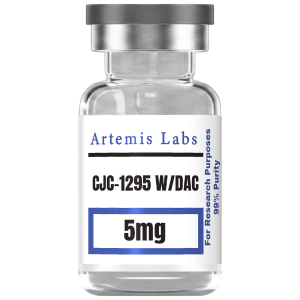
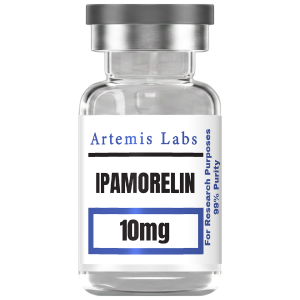
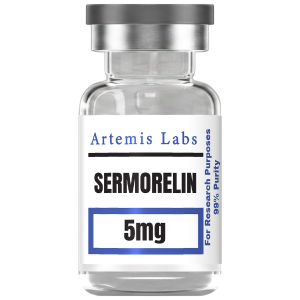
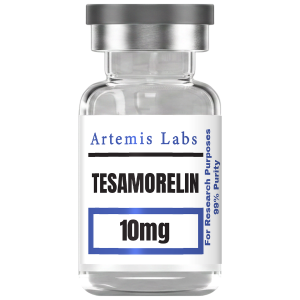
Secretagogues are compounds studied for how they act on the growth-hormone axis. Three here are GHRH analogs of different lengths and stability: sermorelin, CJC-1295 with DAC and tesamorelin. Ipamorelin acts on a different receptor, the ghrelin receptor GHS-R1a. Each product page reports the published work and links every paper.
Secretagogues (GHRH & GHS)
What is in this class?
The growth-hormone axis runs on two inputs. Growth-hormone-releasing hormone (GHRH) from the hypothalamus tells the pituitary to release GH in pulses, and ghrelin, acting through the GHS-R1a receptor, adds a second signal. Downstream, GH raises IGF-1. This class collects the research compounds built on those two inputs. Sermorelin is the first 29 amino acids of GHRH, the part that binds the receptor. CJC-1295 with DAC is the same 29-residue backbone with four substitutions and a drug-affinity complex that extends its time in circulation. Tesamorelin is a 44-residue GHRH analog with a modified N-terminus. Ipamorelin is a five-residue peptide selected in 1998 for acting on the ghrelin receptor without the ACTH and cortisol signal older secretagogues produced.
What do the studies actually measure?
The endpoints are hormone dynamics: GH pulse height and frequency, IGF-1 over time, and receptor selectivity. The evidence base is mixed in kind. Sermorelin and tesamorelin have clinical-pharmacology papers behind them; CJC-1295 has a small number of human pharmacokinetic studies; ipamorelin's record is mostly animal and a discontinued clinical program. Newer work reads GHRH signaling in other tissues, such as a 2026 mouse study of amyloid deposition. Each product page separates human data from animal data so you can see which is which.
How do the compounds compare?
| Compound | What it is | Sequence / formula | Molecular weight | Sources cited on its page |
|---|---|---|---|---|
| Sermorelin | GHRH(1–29) amide, 29 amino acids | YADAIFTNSYRKVLGQLSARKLLQDIMSR-NH₂ | 3,357.9 g/mol | 11 |
| CJC-1295 with DAC | tetrasubstituted GHRH(1–29) analog with a drug-affinity complex | modified GHRH(1–29) | 3,647.2 g/mol | 12 |
| Tesamorelin | GHRH(1–44) analog with an N-terminal trans-3-hexenoyl group | modified GHRH(1–44) | 5,135.9 g/mol | 11 |
| Ipamorelin | 5-residue ghrelin-receptor (GHS-R1a) agonist | Aib-His-D-2-Nal-D-Phe-Lys-NH₂ | 711.9 g/mol | 14 |
Sequences and molecular weights are the values verified on each product page. "Sources cited" is the count shown on that page on 28 August 2026.
Where do I read more?
- The complete guide to growth-hormone peptides (2026)
- Secretagogues as a research field
- The Artemis glossary
- Questions we don't answer
Every compound on this page is supplied for laboratory research only. Each product page carries its full reference list.
References
- Teichman SL et al. (2006). Prolonged stimulation of GH and IGF-I secretion by CJC-1295, a long-acting GHRH analog. J Clin Endocrinol Metab. PMID 16352683
- Raun K et al. (1998). Ipamorelin, the first selective growth hormone secretagogue. Eur J Endocrinol. PMID 9849822
- Badran AS et al. (2026). Body composition, hepatic fat, metabolic and safety outcomes of tesamorelin, a GHRH analogue, in HIV-associated lipodystrophy: meta-analysis. Obes Res Clin Pract. PMID 41545261
- Pedrolli F et al. (2026). Growth hormone-releasing hormone attenuates amyloid deposition and neuroinflammation in Alzheimer's disease models. Cell Death Dis. PMID 41946684
- Mendias CL, Awan TM (2026). Safety and efficacy of approved and unapproved peptide therapies for musculoskeletal injuries and athletic performance. Sports Med. PMID 41966639