
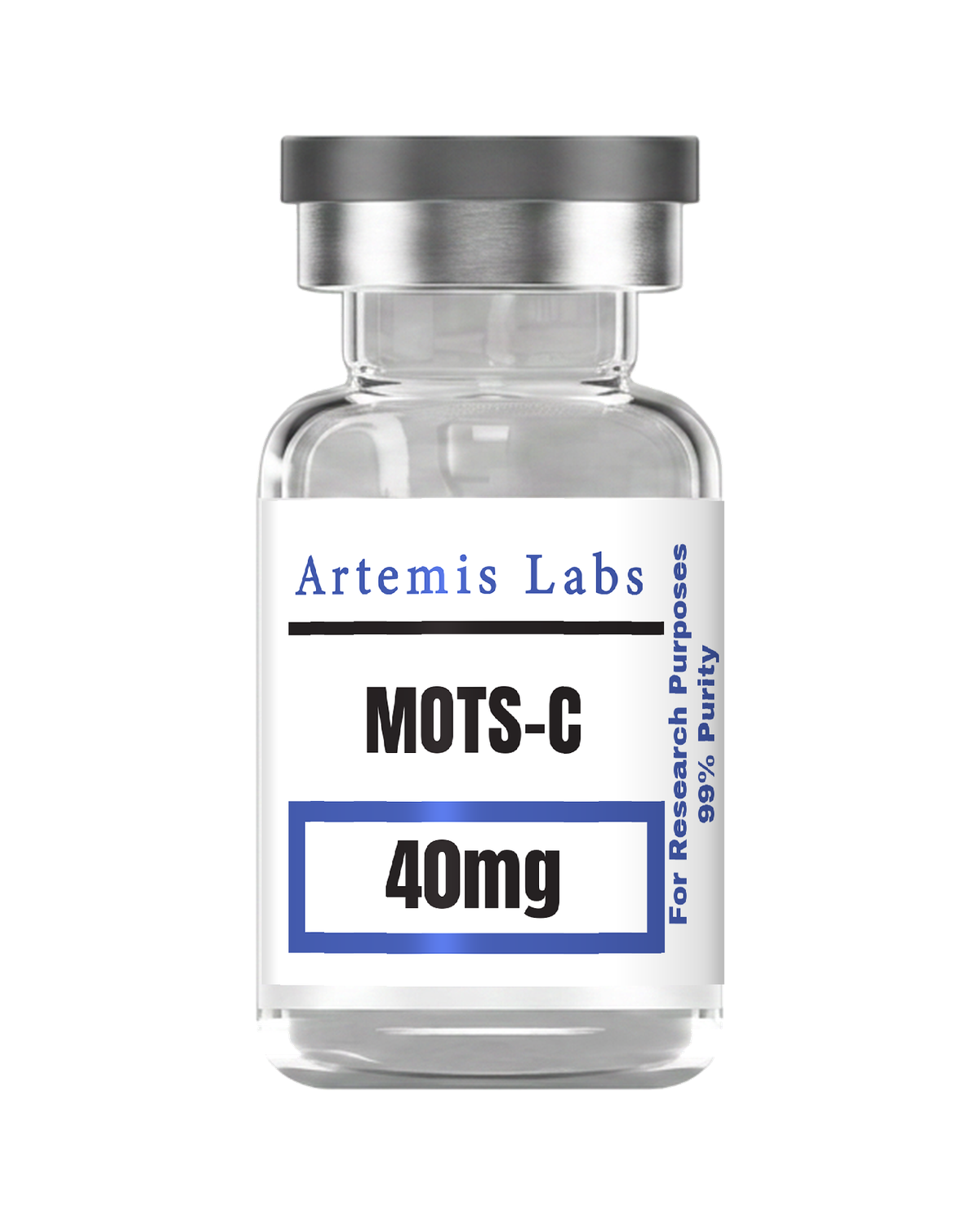
MOTS-C
$135.00
Most peptides are encoded by the DNA in a cell’s nucleus. MOTS-c is encoded by the DNA inside the mitochondria — the cell’s power plants. When the cell is under stress, MOTS-c leaves the mitochondria and travels to the nucleus to change which genes are switched on. It is the mitochondria talking back to the rest of the cell, which is why the field calls it retrograde signalling.
Continue readingShow less
What the published work describes. MOTS-c is a 16-residue peptide encoded within the 12S mitochondrial rRNA gene, the founding member of a small class of mitochondrial-derived peptides. Under glucose restriction, oxidative load or exercise it translocates to the nucleus and modulates stress-response genes through AMPK signalling (Harding 2026, Cell Commun Signal).
Three limits worth knowing. The 2026 human work (Peng, PMID 42072458; Musolino, PMID 42126770) is observational — it establishes MOTS-c as a candidate disease marker, which is a different claim from supplying it changing anything. Only one small human interventional trial exists (CB4211, 20 participants, 28 days). And several high-impact 2026 papers use engineered variants rather than the wild-type sequence, so their results do not transfer directly.
Lyophilized 16-residue mitochondrial-derived peptide.
11 in stock
Free shipping on orders over $300
Pay by Venmo or Cash App — instructions are emailed with your order.
22 published sources cited on this page see them
For research use only. Not for human consumption.
Description
MOTS-c is a short peptide of 16 building blocks that mitochondria make themselves. Cells release it when energy runs low, and it moves to the nucleus to change which genes are switched on. Most of what is known comes from animal and cell studies. Artemis Labs supplies MOTS-c as a freeze-dried powder for lab research only.
Reviewed August 21, 2026 · Artemis Labs
What is MOTS-c?
MOTS-c (Mitochondrial Open Reading-frame of the Twelve S rRNA-c) is an endogenous 16-amino-acid peptide encoded within the human mitochondrial 12S rRNA gene (MT-RNR1). Unlike most research peptides — which are synthetic novel sequences — MOTS-c is a member of the small class of mitochondrial-derived peptides (MDPs), alongside humanin and the SHLPs. It was characterised by Cohen and colleagues (Lee et al., Cell Metabolism 2015) as the founding member of the MDP class.
What did the 2026 MOTS-c research find?
A wave of 2026 peer-reviewed research has identified previously unrecognised MOTS-c mechanisms, expanding the mitochondrial-derived-peptide pharmacology beyond AMPK signalling alone:
- Lysosomal membrane protection — Shi et al., Autophagy 2026 (PMID 42153537). Newly identified MOTS-c role with relevance to autophagy and tissue-transplantation survival research models.
- Nrf2 antioxidant defence (engineered variant) — Zhang et al., Redox Biol 2026 (PMID 42142418). LAT1-mediated delivery of an engineered R13A-MOTS-c variant attenuates radiation-induced lung injury via Nrf2 pathway. Note: Artemis supplies wild-type MOTS-c, not R13A-MOTS-c.
- Oxeiptosis inhibition — Li et al., Life Sci 2026 (PMID 42128272). MOTS-c attenuates hyperoxia-induced neonatal cardiac injury via maintenance of KEAP1-PGAM5 interaction.
- Spermatogenesis preservation via SLC7A11 — Liu et al., Free Radic Biol Med 2026 (PMID 41933740). MOTS-c suppresses ferroptosis in spermatogenesis under oxidative stress.
- Class-level retrograde-signalling review — Harding et al., Cell Commun Signal 2026 (PMID 41937181) — consolidates mitochondrial-DNA-derived peptide signalling as a class.
What does the human biomarker evidence show?
The 2026 clinical literature is converging on serum MOTS-c as a candidate observational biomarker. Important caveat: these are correlation studies, not therapeutic-endpoint studies — they establish that MOTS-c levels track disease state, not that exogenous MOTS-c modifies disease outcome.
- Myocardial ischaemia–reperfusion injury (Peng et al., Biomedicines 2026, PMID 42072458)
- Peritoneal dialysis arterial stiffness (Musolino et al., Int Urol Nephrol 2026, PMID 42126770)
- Polycystic ovary syndrome (Filibeli et al., Arch Endocrinol Metab 2026, PMID 41945630)
How is this compound supplied?
The compound shipped is wild-type human MOTS-c (sequence MRWQEMGYIFYPRKLR, molecular weight 2,174.6 g/mol, molecular formula C₁₀₁H₁₅₂N₂₈O₂₂S₂). Engineered variants such as R13A-MOTS-c are separate research molecules and not what Artemis supplies.
What does the MOTS-c evidence not show?
The MOTS-c literature is rich on mechanism and observational biomarker work but thin on randomised controlled trial evidence in humans. The single published interventional human study (CB4211 Phase 1a/1b, 20 obese participants, 28 days) is small and short-duration. Several high-impact 2026 mechanism papers test engineered variants (e.g. R13A-MOTS-c) — Artemis supplies wild-type only, and engineered-variant findings do not directly transfer. The 2026 mechanism surge introduces multiple new pathways (lysosomal protection, oxeiptosis, ferroptosis, SLC7A11) each as first-or-second-report findings; independent replication is pending. Endogenous-peptide status does not equal supraphysiological-exposure safety — the relevant pharmacology question is not answered in the 2024–2026 literature.
What related catalogue compounds are studied alongside MOTS-c?
Related catalogue compounds include GHK-Cu (gene-expression modulator), Semax (neuropeptide), and the broader CJC-1295 / Ipamorelin GH-axis pair.
What is the regulatory status of MOTS-c?
MOTS-c is an endogenous human peptide — encoded within human mitochondrial DNA and naturally expressed across all human cells. Despite this endogenous origin, no FDA-approved human therapeutic indication exists for MOTS-c. The compound was not placed on FDA 503A Category 2 during the 2023–2024 peptide review process. MOTS-c is not currently on the WADA Prohibited List as of the 2026 update; given growing exercise-physiology and metabolism literature, future WADA list changes warrant monitoring. Research-use-only framing applies to all commercial supply. These statements have not been evaluated by the FDA. Not for human consumption, therapeutic use, or veterinary use.
What did the second half of 2026 add?
Two findings published after this page’s previous revision change how the compound should be read, and they point in opposite directions.
A second function. Rice et al. (2026, eLife, PMID 42611943) report MOTS-c as the first described mitochondrial-encoded host defense peptide. In the models studied it acted directly on Escherichia coli and methicillin-resistant Staphylococcus aureus through its hydrophobic and cationic domains, neutralised MRSA infectivity in a mouse peritonitis model, and was induced in human monocytes by interferon gamma and lipopolysaccharide. Exogenous MOTS-c applied during monocyte differentiation reprogrammed the cells into macrophages with antigen-presentation and interferon signatures. The senior author is a consultant and shareholder of CohBar, Inc.; the disclosure is in the paper and is reported here rather than omitted. The practical consequence is that MOTS-c is now studied along two independent axes — metabolic retrograde signalling and innate immune defence.
And a counter-finding. Xing et al. (2026, Inflamm Regen, PMID 42324588) tested whether restoring MOTS-c signalling would rescue adipose-derived mesenchymal stromal cells from donors with obesity. Exogenous MOTS-c did activate AMPK, as the metabolic literature predicts. It also reduced proliferation, raised the senescence-associated genes p16 and p21, and upregulated TNF-α. In a mouse renal-artery-stenosis model the pretreated cells failed to improve perfusion, fibrosis, or tubular injury — and blunted the reparative effect of lean-donor cells as well. The authors describe a dissociation between metabolic activation and functional stemness. Activating the pathway is not the same as producing a benefit, and this page reports that plainly.
Three further pre-clinical reports from this window describe partial effects: cardiac ischaemia–reperfusion in isolated rat hearts (PMID 42228044, mechanisms stated by the authors to require further validation), inflammasome activity in a diabetic rat model (PMID 42321010), and C26 cachexia, whose own title uses the word “partially” (PMID 42266945). On the biomarker side, Hashimoto’s thyroiditis is associated with reduced circulating MOTS-c (PMID 42278864) — the opposite direction to several earlier correlations, which is a caution against treating any single association as a general rule.
Analytical Specifications
| Sequence | MRWQEMGYIFYPRKLR (16 amino acids; Met-Arg-Trp-Gln-Glu-Met-Gly-Tyr-Ile-Phe-Tyr-Pro-Arg-Lys-Leu-Arg) |
| Molecular formula | C₁₀₂H₁₅₈N₂₈O₂₂S₂ |
| Molecular weight | 2,174.6 g/mol |
| Gene origin | Human MT-RNR1 (12S mitochondrial rRNA gene) |
| CAS number | CAS 1627580-64-6 (verified against PubChem CID 146675088, 2026-08-27). This record also directs identity verification by sequence and HRMS/MS rather than by CAS lookup; no CAS is asserted here. |
| Form | Lyophilised white powder, 40 mg per vial |
| Storage | −20 °C, desiccated, protected from light |
| Variant supplied | Wild-type human MOTS-c. R13A-MOTS-c is an engineered variant and is not supplied. |
References
- Shi J. (2026). Autophagy — MOTS-c and lysosomal membrane permeability in soft-tissue transplantation models. PMID 42153537
- Zhang YL. (2026). Redox Biol — LAT1-mediated delivery of engineered R13A-MOTS-c; Nrf2 pathway. PMID 42142418
- Li SH. (2026). Life Sci — MOTS-c and oxeiptosis in hyperoxia-induced neonatal cardiac injury (KEAP1-PGAM5). PMID 42128272
- Liu S. (2026). Free Radic Biol Med — MOTS-c, SLC7A11 and ferroptosis in spermatogenesis under oxidative stress. PMID 41933740
- Blatkiewicz M. (2026). Folia Histochem Cytobiol — adrenal-cortex metabolic priming. PMID 41811086
- Musolino M. (2026). Int Urol Nephrol — serum MOTS-c and peritoneal-dialysis arterial stiffness (observational). PMID 42126770
- Peng L. (2026). Biomedicines — serum MOTS-c in myocardial ischaemia–reperfusion injury (observational). PMID 42072458
- Filibeli BE. (2026). Arch Endocrinol Metab — serum MOTS-c in polycystic ovary syndrome (observational). PMID 41945630
- Harding E. (2026). Cell Commun Signal — mitochondrial-DNA-derived peptide retrograde signalling (class review). PMID 41937181
- Mendias CL, Awan TM. (2026). Sports Med — approved and unapproved peptide therapies for musculoskeletal injuries. PMID 41966639
- Lee C et al. (2015). Cell Metabolism — founding characterisation of MOTS-c as a mitochondrial-derived peptide. PMID not present in the source record — verifying.
- Rice MC, Imun M, Jung SW, et al. (2026). eLife — MOTS-c is a mitochondrial-encoded interferon-linked host defense peptide. PMID 42611943
- Xing L, Lu B, Zhu X, et al. (2026). Inflamm Regen — MOTS-c activates metabolic signalling but blunts reparative function in human mesenchymal stromal cells. Counter-evidence. PMID 42324588
- Santhanam SS, et al. (2026). Mol Biol Rep — mitochondrial subpopulation bioenergetics in cardiac ischaemia–reperfusion. PMID 42228044
- Mills AR, et al. (2026). Exp Physiol — systemic and cardiac inflammasome activation in a diabetic rat model. PMID 42321010
- Jamnick NA, et al. (2026). Front Med — partial protection against skeletal-muscle deterioration in C26 cachexia. PMID 42266945
- Sonay. (2026). J Clin Med — reduced circulating MOTS-c in Hashimoto’s thyroiditis. PMID 42278864
- Horwath. (2026). Exp Physiol — circulating mitochondrial-derived microproteins at rest and after acute endurance exercise. PMID 42349896
- Li. (2026). Bioact Mater — mitochondria-derived peptide hydrogel augmenting mitochondrial transplantation. PMID 42633281
- Zhao. (2026). Eur J Pharmacol — MOTS-c in sepsis-induced cardiomyopathy (review). PMID 42633878
- Amado. (2026). J Transl Med — MOTS-c and inflammatory lung disease (review). PMID 42243958
- Ayubi. (2026). Physiol Int — exercise-activated mitochondrial-derived peptides (systematic review). PMID 42640735
- Suliman. (2026). Antioxidants (Basel) — AGEs-RAGE axis and mitochondrial-derived peptides in advanced CKD. PMID 42650220
Additional information
| Vial Size | 40mg |
|---|
Science & Research
Science & Research
Mechanism of Action — Mitochondrial-to-Nuclear Retrograde Signalling
MOTS-c is a 16-residue peptide (sequence MRWQEMGYIFYPRKLR; Met-Arg-Trp-Gln-Glu-Met-Gly-Tyr-Ile-Phe-Tyr-Pro-Arg-Lys-Leu-Arg) encoded within the human 12S mitochondrial ribosomal RNA gene (MT-RNR1). It was first characterised by Cohen and colleagues (Lee et al. 2015, Cell Metabolism) and is the founding member of a class of mitochondrial-derived peptides (MDPs), alongside humanin and the SHLPs (SHLP1–6).
Under basal conditions MOTS-c is primarily mitochondrial. Under metabolic stress (glucose restriction, oxidative load, exercise), MOTS-c is released and translocates to the nucleus, where it modulates expression of nuclear stress-response genes via AMPK-pathway activation. This mitochondrial-to-nuclear retrograde signalling pathway is reviewed as a class-level mechanism for MDPs (Harding et al. 2026, Cell Commun Signal, PMID 41937181).
2024–2026 Mechanism Updates
- Lysosomal membrane protection — Shi et al. 2026 (PMID 42153537): MOTS-c ameliorates lysosomal membrane permeability and improves survival in soft tissue transplantation research models.
- Engineered variant + targeted delivery — Zhang et al. 2026 (PMID 42142418): LAT1-mediated delivery of an engineered R13A-MOTS-c variant attenuates radiation-induced lung injury via Nrf2 activation. Note: R13A-MOTS-c is an engineered variant; Artemis supplies wild-type MOTS-c.
- Oxeiptosis inhibition in cardiac tissue — Li et al. 2026 (PMID 42128272): MOTS-c attenuates hyperoxia-induced neonatal cardiac injury by inhibiting oxeiptosis — a recently characterised oxygen-radical-driven cell-death pathway — via maintenance of the KEAP1-PGAM5 interaction.
- Reproductive-axis activity (ferroptosis suppression) — Liu et al. 2026 (PMID 41933740): MOTS-c targets SLC7A11 (cystine/glutamate antiporter) to preserve spermatogenesis under oxidative stress by suppressing ferroptosis.
- Adrenal-cortex metabolic priming — Blatkiewicz et al. 2026 (PMID 41811086): MOTS-c primes adrenal cortex metabolism without directly driving steroidogenesis — distinguishes metabolic priming from hormone-secretion stimulation.
Emerging Clinical Biomarker Evidence (Observational)
2026 clinical correlation studies demonstrate that serum MOTS-c levels track disease severity across multiple human populations. These are correlation studies, not therapeutic-endpoint studies — biomarker work, not treatment validation.
- Myocardial ischaemia–reperfusion injury — Peng et al., Biomedicines 2026, PMID 42072458.
- Peritoneal-dialysis arterial stiffness — Musolino et al., Int Urol Nephrol 2026, PMID 42126770.
- Polycystic ovary syndrome — Filibeli et al., Arch Endocrinol Metab 2026, PMID 41945630.
Cross-Cutting Peptide-Therapy Review (2026)
Mendias and Awan, Sports Med 2026 (PMID 41966639): approved and unapproved peptide therapies for musculoskeletal injuries and athletic performance — MOTS-c covered in the mitochondrial-derived peptide section as an investigational research compound.
A Second Functional Class — Host Defense (2026)
Rice et al. (2026, eLife, PMID 42611943) report MOTS-c as a mitochondrial-encoded host defense peptide — the first described. Observations, in the models studied:
- Amphipathic and cationic peptide chemistry characteristic of known host defense peptides; targeted E. coli and MRSA in part by acting on bacterial membranes through its hydrophobic and cationic domains.
- Neutralised MRSA infectivity in a mouse model of acute peritonitis.
- Interferon gamma, lipopolysaccharide, and differentiation signals each induced endogenous MOTS-c in human monocytes — placing the peptide downstream of interferon signalling, not only of metabolic stress.
- Exogenous MOTS-c applied during primary mouse monocyte differentiation reprogrammed the cells into macrophages with antigen-presentation and interferon-signalling transcriptomic signatures, enhanced bacterial clearance, and shifted metabolism.
Declared interest: the senior author is a consultant and shareholder of CohBar, Inc. Disclosed in the paper; noted here because readers should weigh it.
2026 Pre-Clinical Additions (post-May)
- Cardiac ischaemia–reperfusion (Santhanam et al. 2026, PMID 42228044). Isolated female Wistar rat hearts (n = 6/group, Langendorff, 30 min global ischaemia / 60 min reperfusion), MOTS-c at 53 µM. Improved post-ischaemic mechanical recovery and partially preserved mitochondrial enzyme activities and membrane potential, with responses varying by parameter. The authors state the signalling mechanisms require further validation.
- Inflammasome activity in a diabetic model (Mills et al. 2026, PMID 42321010). High-fat-diet/streptozotocin rat model; reduced fasting blood glucose and circulating C-reactive protein, and lower NLRP3, ASC, and cleaved caspase-1 in left-ventricular tissue.
- Cancer cachexia (Jamnick et al. 2026, PMID 42266945). MOTS-c at 50 µM in differentiated myotubes partially protected against skeletal-muscle deterioration in the C26 model; the authors state human studies are still needed.
- Delivery-format research (Li et al. 2026, PMID 42633281). A mitochondria-derived peptide hydrogel augmenting mitochondrial transplantation for cardiac repair — a formulation study, not a study of the free peptide.
Counter-Evidence Added 2026-08-27
- MOTS-c made human stem cells worse, not better, in a 2026 study. Xing et al. (2026, PMID 42324588) found that exogenous MOTS-c restored intracellular levels and activated AMPK in adipose-derived mesenchymal stromal cells from donors with obesity (n = 6/group vs lean donors) while reducing proliferation, increasing the senescence-associated genes p16 and p21, and upregulating TNF-α. In a mouse renal-artery-stenosis model, MOTS-c-pretreated cells failed to improve renal perfusion, fibrosis, or tubular injury, and pretreatment blunted the reparative efficacy of lean-donor cells as well. The authors’ conclusion — “a dissociation between metabolic activation and functional stemness” — is the sentence to carry: AMPK activation is not a proxy for benefit, and a protective result in one tissue model does not generalise to another.
- “Partial” is the recurring word. Both the cachexia (PMID 42266945) and cardiac ischaemia–reperfusion (PMID 42228044) reports describe partial protection with responses varying across measured parameters.
- Biomarker direction is not consistent. Serum MOTS-c is reported as elevated with severity in some populations and reduced in Hashimoto’s thyroiditis (PMID 42278864). A marker that moves in both directions across diseases is not a settled marker of anything general.
- Declared commercial interest on the host-defense finding. The senior author of Rice 2026 (PMID 42611943) is a consultant and shareholder of CohBar, Inc.
Entity Disambiguation
| Compound | Class | Origin | Mechanism |
|---|---|---|---|
| MOTS-c (wild-type) | Mitochondrial-derived peptide (16 aa) | Endogenous (human MT-RNR1) | AMPK activation; mt→nuclear retrograde signalling |
| R13A-MOTS-c (engineered) | MOTS-c variant | Synthetic engineered | Same scaffold; modified pharmacokinetics — Artemis does not supply |
| Humanin | Mitochondrial-derived peptide | Endogenous (16S mt-rRNA) | Anti-apoptotic; neuroprotective; metabolic |
Quality and Specifications
- Sequence: MRWQEMGYIFYPRKLR (16 amino acids)
- Molecular formula: C₁₀₁H₁₅₂N₂₈O₂₂S₂
- Molecular weight: 2,174.6 g/mol
- Gene origin: Human MT-RNR1 (12S mitochondrial rRNA gene)
- Form: Lyophilised white powder, 40 mg/vial
- Storage: Lyophilised at −20°C desiccated, protected from light
Counter-Evidence and Honest Limitations
- Observational biomarker work is not therapeutic validation. The 2026 clinical correlations (Peng, Musolino, Filibeli) show MOTS-c level tracks disease state — not that exogenous MOTS-c modifies disease outcome.
- Single small human interventional trial. CB4211 Phase 1a/1b (20 participants, 28 days) is the only published interventional human study. Sample size, duration, and endpoint scope are limited.
- Engineered-variant vs wild-type confound. Multiple 2026 mechanism papers test R13A-MOTS-c (Zhang 2026 PMID 42142418) — wild-type findings may not transfer.
- 2026 mechanism surge is uncorroborated. Lysosomal protection, oxeiptosis inhibition, and SLC7A11/ferroptosis suppression are each first-or-second-report findings; independent replication pending.
- Endogenous status ≠ supraphysiological-exposure safety. Natural production does not validate exogenous research exposure levels.
- CAS verified (1627580-64-6, CID 146675088). Still rely on sequence and HRMS/MS confirmation alongside CAS lookup for chemical identity verification.
References (22 PubMed-Verified)
- Shi J. (2026) Autophagy. PMID 42153537
- Zhang YL. (2026) Redox Biol. PMID 42142418
- Li SH. (2026) Life Sci. PMID 42128272
- Liu S. (2026) Free Radic Biol Med. PMID 41933740
- Blatkiewicz M. (2026) Folia Histochem Cytobiol. PMID 41811086
- Musolino M. (2026) Int Urol Nephrol. PMID 42126770
- Peng L. (2026) Biomedicines. PMID 42072458
- Filibeli BE. (2026) Arch Endocrinol Metab. PMID 41945630
- Harding E. (2026) Cell Commun Signal. PMID 41937181
- Mendias CL, Awan TM. (2026) Sports Med. PMID 41966639
- Rice MC, Imun M, Jung SW, et al. (2026). eLife — MOTS-c is a mitochondrial-encoded interferon-linked host defense peptide. PMID 42611943
- Xing L, Lu B, Zhu X, et al. (2026). Inflamm Regen — MOTS-c activates metabolic signalling but blunts reparative function in human mesenchymal stromal cells. Counter-evidence. PMID 42324588
- Santhanam SS, et al. (2026). Mol Biol Rep — mitochondrial subpopulation bioenergetics in cardiac ischaemia–reperfusion. PMID 42228044
- Mills AR, et al. (2026). Exp Physiol — systemic and cardiac inflammasome activation in a diabetic rat model. PMID 42321010
- Jamnick NA, et al. (2026). Front Med — partial protection against skeletal-muscle deterioration in C26 cachexia. PMID 42266945
- Sonay. (2026). J Clin Med — reduced circulating MOTS-c in Hashimoto’s thyroiditis. PMID 42278864
- Horwath. (2026). Exp Physiol — circulating mitochondrial-derived microproteins at rest and after acute endurance exercise. PMID 42349896
- Li. (2026). Bioact Mater — mitochondria-derived peptide hydrogel augmenting mitochondrial transplantation. PMID 42633281
- Zhao. (2026). Eur J Pharmacol — MOTS-c in sepsis-induced cardiomyopathy (review). PMID 42633878
- Amado. (2026). J Transl Med — MOTS-c and inflammatory lung disease (review). PMID 42243958
- Ayubi. (2026). Physiol Int — exercise-activated mitochondrial-derived peptides (systematic review). PMID 42640735
- Suliman. (2026). Antioxidants (Basel) — AGEs-RAGE axis and mitochondrial-derived peptides in advanced CKD. PMID 42650220
Research Pairings
Research Pairings
Pairing rationale below is mechanistic only. No dosing, frequency, duration, or human-use guidance is provided. Researchers design their own studies against their own institutional review, not against vendor copy.
Why is MOTS-c studied alongside GHK-Cu?
Mitochondrial-derived peptide × copper-tripeptide gene-expression modulator. MOTS-c modulates nuclear stress-response gene transcription via AMPK; GHK-Cu has independent broad gene-expression effects including mitochondrial biogenesis markers. The combined ‘Longevity Quartet’ research framing (MOTS-c + GHK-Cu + Semax) appears in multi-compound longevity research design.
Why is MOTS-c studied alongside CJC-1295 and Ipamorelin?
Mitochondrial retrograde signalling × GH-axis stimulation. Studied together for downstream metabolic effects of GH/IGF-1 signalling layered onto MOTS-c-driven AMPK-pathway activation. Cross-pathway research design.
Why is MOTS-c studied alongside 5-Amino-1MQ?
Mitochondrial-derived peptide × NNMT inhibitor (small molecule). Both engage NAD⁺-axis biology from different molecular entry points — MOTS-c via mitochondrial-to-nuclear retrograde signalling, 5-Amino-1MQ via NNMT inhibition preserving the nicotinamide salvage substrate pool. Useful research-model pairing to dissect cofactor-pool effects from peptide-signalling effects.
Related Compounds in Catalogue
For mitochondrial-axis research see 5-Amino-1MQ. For longevity-quartet research frame see GHK-Cu and Semax. For GH-axis cross-research see CJC-1295 and Ipamorelin.
Related products
Metabolic Research