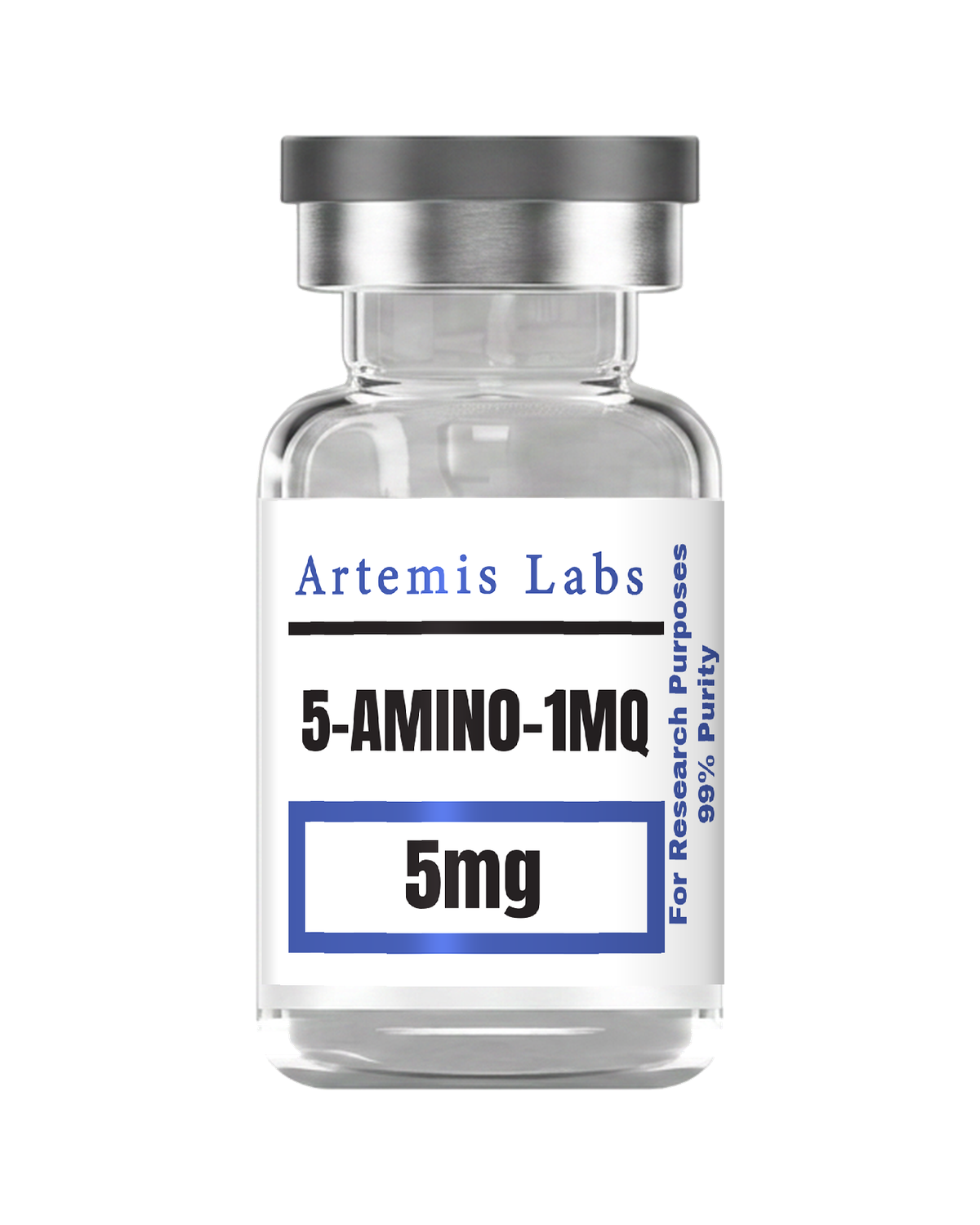
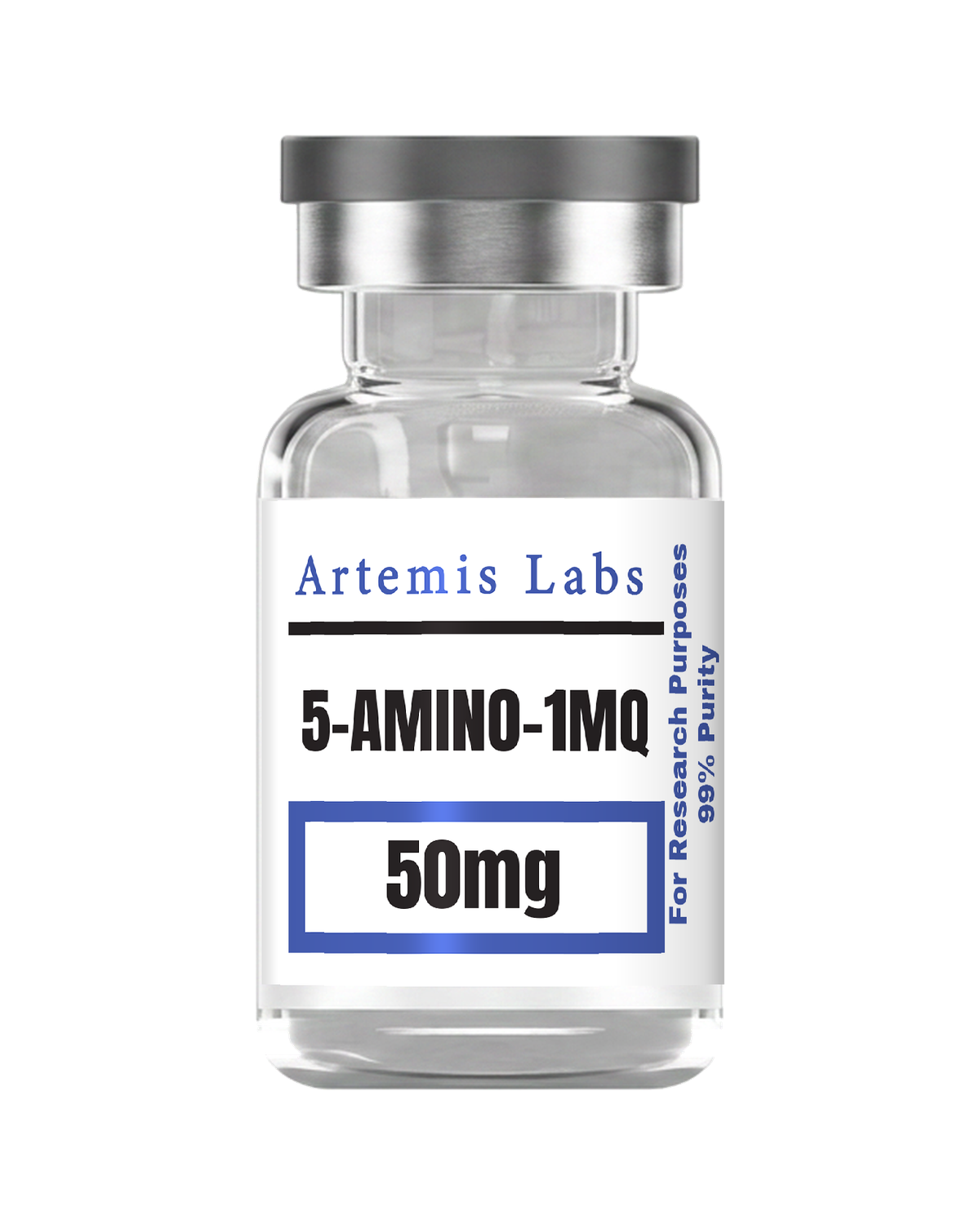
5-Amino-1MQ
Price range: $50.00 through $90.00
Cells run on a molecule called NAD⁺ — the thing that turns food into usable energy. An enzyme called NNMT quietly burns through the raw material cells use to make it. 5-Amino-1MQ blocks that enzyme. So the idea being tested isn’t "add more NAD⁺" — it’s "stop wasting the NAD⁺ you already make." That is what separates it from NMN and NR, which top the pool up from the other end.
Continue readingShow less
What the published work found — in mice. Two places. Fat: 28 days of 5-Amino-1MQ in obese mice produced dose-dependent drops in body weight and fat mass, better glucose handling, and less fat in the liver (Babula 2024, PMID 39161060). Muscle: in aged mice, this chemotype woke up dormant muscle stem cells — regenerating fibres came back nearly twice as large, and peak force in injured muscle rose about 70% (Neelakantan 2019, PMID 30753815). Run alongside exercise, it added to the gains through a different molecular route rather than duplicating them (Dimet-Wiley 2024, PMID 38969654).
What nobody knows yet. There are no human trials — not one. Everything above is cells and rodents, and mouse metabolic findings fail in humans more often than they succeed. Nothing beyond about ten weeks of exposure has been published, and most of the in-vivo work comes from a single laboratory.
Lyophilized small molecule — not a peptide.
Free shipping on orders over $300
Pay by Venmo or Cash App — instructions are emailed with your order.
11 published sources cited on this page see them
For research use only. Not for human consumption.
Description
5-Amino-1MQ is a small molecule, not a peptide. It blocks an enzyme called NNMT, which normally tags the vitamin nicotinamide for disposal. Blocking NNMT leaves more nicotinamide for the cell to recycle into NAD+. All published work so far is in cells and mice. Artemis Labs supplies it for lab research only.
Reviewed August 21, 2026 · Artemis Labs
What is 5-Amino-1MQ?
5-Amino-1MQ (5-amino-1-methylquinolinium) is a small-molecule selective inhibitor of nicotinamide N-methyltransferase (NNMT) — the enzyme that methylates nicotinamide using S-adenosylmethionine (SAM) as the methyl donor. NNMT inhibition raises cellular NAD⁺ and SAM pools and has been characterized in rodent research models. 5-Amino-1MQ is a small molecule, not a peptide — catalogued alongside research peptides because of its mechanistic adjacency to metabolic and longevity research.
Why do researchers study 5-Amino-1MQ?
Adipocyte and whole-body metabolic axis. The foundational NNMT-knockdown paper (Kraus et al., Nature 2014, PMID 24717514) established NNMT as a master regulator of adipocyte energy metabolism. Dimet-Wiley et al. (Scientific Reports 2022, PMID 35013352) showed 5-Amino-1MQ administration combined with a low-fat diet produced whole-body adiposity reduction and a distinct gut microbiome signature in diet-induced-obese mice. Babula et al. (Diabetes, Obesity and Metabolism 2024, PMID 39161060) extended the metabolic dossier with dose-dependent body-weight + fat-mass reduction, improved glucose tolerance, and attenuated hepatic steatosis in obese mice.
Skeletal-muscle regenerative-biology axis. Neelakantan et al. (Biochemical Pharmacology 2019, PMID 30753815) demonstrated activation of senescent muscle stem cells in aged mice with ≈70% increase in regenerated-muscle peak torque. Dimet-Wiley et al. (Scientific Reports 2024, PMID 38969654) showed 5A-1MQ and progressive weighted exercise produce additive grip-strength gains in aged mice via distinct molecular mechanisms. Liang et al. (Aging Cell 2024, PMID 38838088) identified elevated NNMT as a sarcopenia-status predictor (AUC > 0.7).
Which salt form of 5-Amino-1MQ is used in published studies?
Vendor supply across the wider market varies between the chloride salt (C₁₀H₁₁N₂·Cl, MW 194.66 g/mol; no CAS is registered for the chloride — PubChem CID 176507677) and the iodide salt (CAS 42464-96-0, MW 286.11 g/mol, PubChem CID 66522933) — verify which form was used in any published study design being reproduced.
What does the 5-Amino-1MQ evidence not show?
The entire 5-Amino-1MQ efficacy and safety dossier consists of in-vitro and rodent studies — no human clinical trials have been published. Long-term (multi-month) exposure data does not exist in any published model; drug-interaction studies are absent; and most foundational in-vivo work originates from a single laboratory group (Watowich / Neelakantan at UTMB). Independent replication remains limited. The 2026 Trends in Pharmacological Sciences review frames NNMT-inhibitor clinical translation as an emerging opportunity rather than a delivered therapeutic result. Researchers should weight these gaps alongside the positive preclinical findings.
How does 5-Amino-1MQ differ from NMN, NR and SLU-PP-332?
Unlike the NAD⁺ precursors NMN and NR (which directly supply pathway precursors), 5-Amino-1MQ acts upstream by preventing nicotinamide methylation — preserving the substrate pool. Unlike pan-ERR agonists such as SLU-PP-332, 5-Amino-1MQ targets cofactor metabolism rather than nuclear-receptor transcriptional programs. The two axes are often paired as orthogonal-mechanism research models — for example with MOTS-c (mitochondrial signalling).
What is the regulatory status of 5-Amino-1MQ?
5-Amino-1MQ is a preclinical research compound. It has not entered human clinical trials, is not approved by the FDA or any other regulatory authority for human use, and is supplied by Artemis Labs strictly for in-vitro and pre-clinical laboratory research. State shipping restrictions may apply. WADA classification: not currently a named compound on the WADA Prohibited List; the broader “metabolic modulators” category is on WADA monitoring lists — factual framing only. These statements have not been evaluated by the FDA. Not for human consumption, therapeutic use, or veterinary use.
Analytical Specifications
| Class | Small-molecule selective NNMT inhibitor — not a peptide; no amino-acid sequence |
| Salt form supplied | Chloride salt (iodide form also common in the wider market) |
| Molecular formula | C₁₀H₁₁N₂·Cl |
| Molecular weight | 194.66 g/mol |
| CAS number | 42464-96-0 |
| Form | Lyophilized powder |
| Storage | −20 °C, protected from light |
References
- Kraus D et al. (2014). Nature — NNMT as a regulator of adipocyte energy metabolism. PMID 24717514 · doi:10.1038/nature13198
- Ehebauer F et al. (2020). Life Sciences — glucose-responsive NNMT expression in adipocytes. PMID 32112869
- Dimet-Wiley A et al. (2022). Scientific Reports — 5-Amino-1MQ in diet-induced-obese mice; gut-microbiome signature. PMID 35013352
- Park J et al. (2024). Archives of Pharmaceutical Research. PMID 39604638
- Yang M et al. (2024). J ImmunoTherapy Cancer — NNMT in cancer-associated fibroblasts. PMID 39067875
- Heide J et al. (2025). Nature — NNMT inhibition and antitumor immunity. PMID 40702186
- Neelakantan H et al. (2019). Biochemical Pharmacology — senescent muscle stem cell activation in aged mice; peak torque ≈70%. PMID 30753815
- Liang J et al. (2024). Aging Cell — elevated NNMT as a sarcopenia-status predictor (AUC > 0.7). PMID 38838088
- Dimet-Wiley AL et al. (2024). Scientific Reports — 5A-1MQ and progressive weighted exercise, additive grip-strength gains in aged mice. PMID 38969654
- Babula JJ et al. (2024). Diabetes, Obesity and Metabolism — dose-dependent body-weight and fat-mass reduction in obese mice. PMID 39161060
Additional information
| Vial Size | 5mg, 50mg |
|---|
Science & Research
Science & Research
Mechanism of Action — NNMT and the NAD⁺ Salvage Pathway
Nicotinamide N-methyltransferase (NNMT) catalyses the transfer of a methyl group from S-adenosylmethionine (SAM) to nicotinamide (NAM), producing 1-methylnicotinamide (1-MNA) and S-adenosylhomocysteine (SAH). NNMT activity therefore consumes both the NAD⁺-biosynthesis precursor (via the salvage pathway) and the universal methyl donor SAM. 5-Amino-1MQ is a competitive small-molecule inhibitor binding at the NNMT active site; inhibition raises intracellular nicotinamide and SAM pools and increases poly-ADP-ribosylation and protein methylation in research-model adipocytes (Kraus et al., Nature 2014, PMID 24717514).
Research Axis 1 — Adipocyte and Whole-Body Metabolism
- NNMT knockdown protects against DIO — Kraus et al., 2014 (PMID 24717514): white-adipose NAD⁺ and SAM rise; energy expenditure rises; diet-induced obesity is resisted.
- Adipocyte glucose-responsive expression — Ehebauer et al., Life Sciences 2020 (PMID 32112869): NNMT is regulated by glucose availability in adipocytes.
- 5-Amino-1MQ in DIO mice + microbiome shift — Dimet-Wiley et al., Scientific Reports 2022 (PMID 35013352): whole-body adiposity reduction and distinct gut-microbiome signature.
- 28-day 5A1MQ obesity-dysfunction confirmation — Babula et al., Diabetes, Obesity and Metabolism 2024 (PMID 39161060): dose-dependent weight + fat-mass reduction; improved oral glucose tolerance; attenuated hepatic steatosis; PK confirms adipose / muscle / liver distribution.
Research Axis 2 — Skeletal Muscle and Sarcopenia
- Senescent muscle stem cell activation in aged mice — Neelakantan et al., Biochemical Pharmacology 2019 (PMID 30753815): NNMT inhibitor increased muscle stem cell proliferation and fusion, nearly doubled regenerating myofiber cross-sectional area, and increased peak torque ≈70%.
- NNMT as a sarcopenia target — Liang et al., Aging Cell 2024 (PMID 38838088): elevated NNMT in human sarcopenia samples; AUC > 0.7 for sarcopenia status.
- 5A-1MQ + exercise additive in aged mice — Dimet-Wiley et al., Scientific Reports 2024 (PMID 38969654): NNMT inhibition and progressive resistance exercise contribute distinct molecular mechanisms; combined treatment yields additive grip-strength gains.
Research Axis 3 — Tumor Microenvironment (Emerging Caveat)
NNMT-inhibition pharmacology extends into tumor microenvironment biology (Yang et al., J ImmunoTherapy Cancer 2024, PMID 39067875; Heide et al., Nature 2025, PMID 40702186) — NNMT in cancer-associated fibroblasts drives tumor progression and immunotherapy resistance; pharmacological NNMT inhibition restores antitumor immunity. Regard this as an emerging research axis distinct from the metabolic / muscle framing.
Class Comparator Snapshot
| Compound | Mechanism | Stage | Notable Research Phenotype |
|---|---|---|---|
| 5-Amino-1MQ | NNMT inhibitor | Preclinical | Adiposity ↓ + aged-muscle stem cell rescue (mice) |
| NMN / NR (precursors) | NAD⁺ pathway precursors | Supplement + research | NAD⁺ pool elevation reported; weak human metabolic effects |
| SLU-PP-332 | Pan-ERR agonist | Preclinical | Exercise mimetic, oxidative-fibre phenotype |
| MOTS-c | Mitochondrial-derived peptide | Research | Mitochondrial AMPK signalling |
| AICAR | AMPK activator | Discontinued for performance use | Endurance ↑ in mice |
Honest Limitations
No human clinical trials. Long-term-exposure data absent. Drug interactions unstudied. Most foundational in-vivo work originates from a single laboratory group (Watowich / Neelakantan, UTMB) — independent replication outside this group remains thin. Vendor supply varies in salt form (chloride vs iodide vs free base) — verify which form was used in any literature being reproduced.
Quality and Specifications
- Form: Lyophilized powder.
- Storage: Lyophilized at −20°C protected from light; reconstituted at 2–8°C, use within research-validated stability window.
- Salt form: Chloride salt form (C₁₀H₁₁N₂·Cl, MW 194.66 g/mol; no CAS is registered for the chloride — PubChem CID 176507677) widely supplied; the iodide salt (CAS 42464-96-0, MW 286.11 g/mol, CID 66522933) is also common in the market. The two differ by ≈47% in molecular weight — molarity calculations must use the weight of the form actually supplied. Published study designs may use different salt forms; check which form a paper used before comparing results.
References (10 PubMed-Verified)
- Kraus D, et al. (2014). Nature. PMID 24717514 · doi:10.1038/nature13198
- Ehebauer F, et al. (2020). Life Sciences. PMID 32112869
- Dimet-Wiley A, et al. (2022). Scientific Reports. PMID 35013352
- Park J, et al. (2024). Archives of Pharmaceutical Research. PMID 39604638
- Yang M, et al. (2024). J ImmunoTherapy Cancer. PMID 39067875
- Heide J, et al. (2025). Nature. PMID 40702186
- Neelakantan H, et al. (2019). Biochemical Pharmacology. PMID 30753815
- Liang J, et al. (2024). Aging Cell. PMID 38838088
- Dimet-Wiley AL, et al. (2024). Scientific Reports. PMID 38969654
- Babula JJ, et al. (2024). Diabetes, Obesity and Metabolism. PMID 39161060
Research Pairings
Research Pairings
Pairing rationale below is mechanistic only. No dosing, frequency, duration, or human-use guidance is provided. Researchers design their own studies against their own institutional review, not against vendor copy.
Why is 5-Amino-1MQ studied alongside MOTS-c?
NNMT inhibitor × mitochondrial-derived peptide. Both modulate NAD⁺-axis biology and mitochondrial signalling from different molecular entry points. Used in research models examining whether cofactor-pool restoration (5-Amino-1MQ) and mitochondrial-derived signalling (MOTS-c) produce additive or redundant phenotypes.
Why is 5-Amino-1MQ studied alongside SLU-PP-332?
NNMT inhibitor × pan-ERR agonist. Parallel-pathway research model: adipocyte NAD⁺ pool restoration alongside ERR-driven oxidative-metabolism transcription. Mechanistically orthogonal — examined together to dissect cofactor-pool effects from nuclear-receptor effects.
Why is 5-Amino-1MQ studied alongside Tirzepatide?
Small-molecule NNMT inhibitor × incretin co-agonist. Used as orthogonal mechanism comparator in adipocyte and hepatic research models — NNMT-mediated cofactor pharmacology versus incretin-driven satiety signalling. The two compounds work via entirely different molecular axes; pairing them is a research-model tool for separating central-appetite effects from peripheral-metabolic effects.
Related Compounds in Catalogue
For NAD⁺-axis research see MOTS-c. For appetite / metabolic-rate research see Tirzepatide, Retatrutide. For tissue-regenerative research context see BPC-157, BPC-157 / TB-500.
Related products
Mitochondrial & NAD+ Research