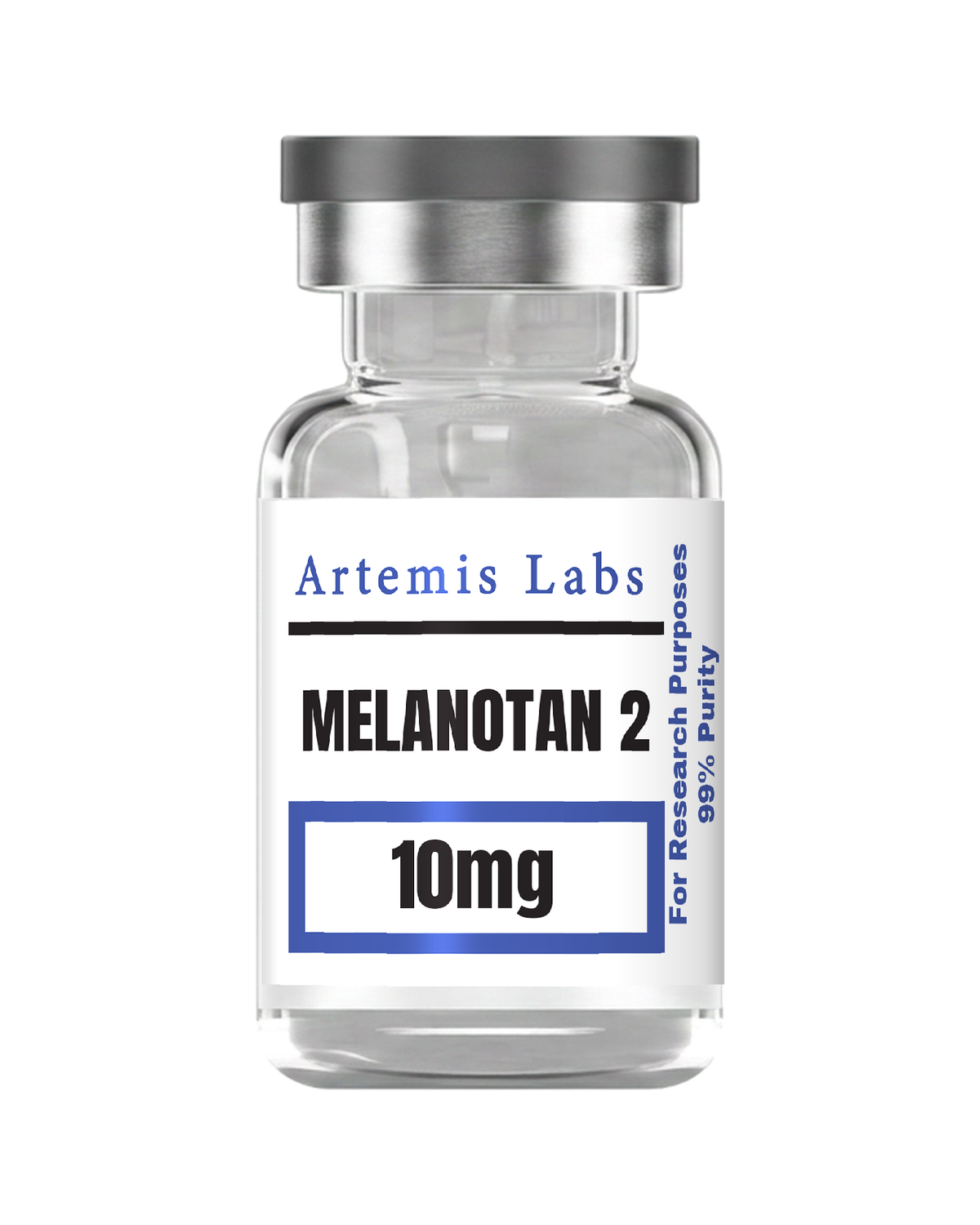
Melanotan 2
$45.00
The body makes a hormone called α-MSH that acts on five related receptors — one controls pigment, others sit in appetite and arousal circuits. Melanotan-2 is a synthetic copy that hits all of them, indiscriminately. That lack of selectivity is the whole story: it is why the effects are broad and why the adverse-event literature is what it is.
Continue readingShow less
What the literature reports. MT-II is a non-selective MC1R/MC3R/MC4R/MC5R agonist — distinct from PT-141, which is selective for MC3R/MC4R. Documented adverse events include gingival pigmentation (Bonchev 2026, PMID 41752902), with broader unregulated-use risks reviewed by Sidhu 2026 (PMID 41559011). 2026 stability work by LC-HRMS identified 14 degradation products under stress conditions (Chawathe & Sharma, PMID 41547183).
Be clear on the regulatory picture. MT-II is not approved in any formulation, anywhere. The selective relative PT-141 is the approved active ingredient in a different product; that approval does not extend to this molecule.
Lyophilized cyclic α-MSH analog.
20 in stock
Free shipping on orders over $300
Pay by Venmo or Cash App — instructions are emailed with your order.
11 published sources cited on this page see them
For research use only. Not for human consumption.
Description
Melanotan-II is a lab-made copy of part of a body signal called alpha-MSH. It switches on all five melanocortin receptors, not just one. Research asks how MC1R drives melanin, the pigment that colours skin. The same research records real harms from unregulated use. Artemis Labs ships it as a dry powder for lab use.
Reviewed August 22, 2026 · Artemis Labs
What is Melanotan-II?
Melanotan-II (MT-II) is a 7-residue cyclic heptapeptide (Ac-Nle-cyclo[Asp-His-D-Phe-Arg-Trp-Lys]-NH₂, cyclized via Asp-Lys lactam bridge; molecular formula C₅₀H₆₉N₁₅O₉; MW 1024.18 Da; CAS 121062-08-6; PubChem CID 92432). It is derived from the active core of alpha-melanocyte-stimulating hormone (alpha-MSH) and acts as a non-selective agonist at MC1R, MC3R, MC4R, and MC5R melanocortin G-protein-coupled receptors. The class distinguishes MT-II from the MC3R/MC4R-selective cyclic alpha-MSH(4-10) analog bremelanotide (PT-141), and from the linear 13-amino-acid alpha-MSH analog afamelanotide (Scenesse®).
Is Melanotan-II the same thing as afamelanotide / Scenesse®?
Melanotan-II is NOT afamelanotide / Scenesse®. Afamelanotide (Scenesse®, Clinuvel Pharmaceuticals) is a linear 13-amino-acid alpha-MSH analog FDA-approved in October 2019 for adult erythropoietic protoporphyria. Afamelanotide is structurally distinct from MT-II (different sequence, different length, different cyclization) and has a different regulatory status. Artemis Labs does NOT market, NOT substitute for, and NOT reference clinical indications of afamelanotide or Scenesse®. Our MT-II is a research-grade lyophilized peptide for in vitro and IACUC-approved animal research only. Several U.S. state Boards of Pharmacy have issued advisories against compounding melanotan products for cosmetic use; Artemis Labs PT-141, MT-II, and the broader research catalog are supplied strictly as research reagents – not as compounded pharmaceuticals and not as tanning, cosmetic, or self-administered preparations.
How do the two alpha-MSH-analog compounds compare?
| Compound | Structure | FDA Status | Artemis Catalog |
|---|---|---|---|
| Melanotan-II (MT-II) | Cyclic 7-aa peptide; non-selective MC1R-MC5R | NOT FDA-approved | This research SKU |
| Afamelanotide / Scenesse® | Linear 13-aa alpha-MSH analog | FDA-approved Oct 2019 for adult EPP | NOT an Artemis product |
What has Melanotan-II research reported since 2025?
- Adverse-event documentation – Resnick et al. 2026 (PMID 41890775): tanning-biology review explicitly documents unregulated Melanotan I/II adverse events including rhabdomyolysis, renal infarction, and priapism. Cited by Artemis as a primary reason for the research-only positioning.
- Persistent gingival pigmentation case report – Bonchev 2026 (PMID 41752902): brown maxillary and mandibular gingival pigmentation following self-administered MT-II injections, persisting at least 3 months after discontinuation. Cited as a documented adverse-event signal.
- Public-health signal – Sidhu et al. 2026 (PMID 41559011): social-media-driven unregulated MT-II misuse linked to ‘looksmaxxing’ and body-image culture as an emerging dermatologic and public-health risk.
- Class-level stability mapping – Chawathe & Sharma 2026 (PMID 41547183): LC-HRMS analytical framework mapping 14 distinct degradation products of afamelanotide under acidic, basic, neutral, oxidative, UV, and thermal stress. Directly applicable to MT-II’s purity verification as alpha-MSH-class context.
- Sustained-release alpha-MSH-class delivery – Anderson et al. 2026 (PMID 41999898): stereocomplexed beta-strand/hairpin hydrogel releasing alpha-MSH-analog peptide over months. Class-level PK innovation cited as alpha-MSH-class context only – not as an MT-II use recommendation.
How is this compound supplied?
The compound shipped is the canonical 7-mer cyclic Ac-Nle-Asp-His-D-Phe-Arg-Trp-Lys-NH₂ sequence with Asp-Lys lactam closure. The 2026 Chawathe & Sharma LC-HRMS degradation map (PMID 41547183) is the relevant alpha-MSH-class analytical reference.
What does the Melanotan-II evidence not show?
(1) Documented adverse-event signal from unregulated use. The 2026 dermatology literature (PMID 41890775, PMID 41752902, PMID 41559011) documents rhabdomyolysis, renal infarction, priapism, persistent gingival pigmentation, and social-media-driven misuse. These findings strengthen the case for research-only positioning. (2) Mechanistically related to but not equivalent to afamelanotide. Both are alpha-MSH analogs but they are different molecules (cyclic vs linear; 7-aa vs 13-aa; non-selective vs the afamelanotide profile). Afamelanotide clinical findings do not transfer to MT-II positioning. (3) Not FDA-approved in any formulation. Several U.S. state Boards of Pharmacy have issued compounding advisories. (4) Non-selective receptor profile creates broad systemic effects. Compared with MC3R/MC4R-selective bremelanotide (PT-141), MT-II’s non-selective activation across MC1R-MC5R produces a broader effect profile that is studied in the preclinical literature as a feature of the compound class, not as a clinical advantage.
How does Melanotan-II differ from PT-141 and oxytocin?
Unlike PT-141 (selective MC3R/MC4R cyclic alpha-MSH(4-10) analog), MT-II is non-selective across MC1R-MC5R and is not FDA-approved in any formulation. Unlike oxytocin (9-aa cyclic OXTR-agonist neuropeptide), MT-II acts through the broader melanocortin receptor family. The 2024 Inozemtseva et al. (PMID 39442746) paper directly compared MT-II vs Semax antidepressant/antistress effects in chronic stress models – see Semax for the mechanism-comparator citation.
What is the regulatory status of Melanotan-II?
Melanotan-II is NOT FDA-approved, NOT EMA-approved, and NOT DEA-scheduled. Afamelanotide / Scenesse® (a different molecule) is FDA-approved for adult erythropoietic protoporphyria – this approval does not transfer to MT-II. Several U.S. state Boards of Pharmacy have issued advisories against compounded melanotan products for cosmetic use. MT-II is not on the WADA Prohibited List 2026. Artemis Labs does NOT market Melanotan-II as a tanning agent, cosmetic, sexual-enhancement product, or self-administered preparation. Research-use-only framing applies to all Artemis Labs commercial supply. These statements have not been evaluated by the FDA. Not for human consumption, therapeutic use, or veterinary use.
What FDA says about Melanotan II. Melanotan II is listed on FDA’s page Certain Bulk Drug Substances for Use in Compounding that May Present Significant Safety Risks (content current April 22, 2026) under “Bulk drug substances nominated but withdrawn.” FDA’s stated concern, quoted: compounded drugs containing Melanotan II “may pose risk for immunogenicity for certain routes of administration due to the potential for aggregation or peptide-related impurities. Published case reports discuss serious adverse events including melanoma, posterior reversible encephalopathy syndrome, sympathomimetic toxidrome and priapism.” (FDA)
Analytical Specifications
| Property | Value |
|---|---|
| Sequence | Ac-Nle-cyclo[Asp-His-D-Phe-Arg-Trp-Lys]-NH₂ (Asp-Lys lactam) |
| Molecular formula | C₅₀H₆₉N₁₅O₉ |
| Molecular weight | 1024.18 Da |
| CAS number | 121062-08-6 |
| ChEMBL | |
| PubChem CID | 92432 |
| Wikidata | |
| DrugBank | (not indexed) |
| Form | Lyophilised white powder, 10 mg per vial |
| Storage | ≤ −20 °C, desiccated, protected from light |
References
- Minder AE, Barman-Aksoezen J (2025). JAAD Case Reports. PMID 41542313
- Chawathe A, Sharma N (2026). J Pharm Biomed Anal. PMID 41547183
- Sidhu AS et al. (2026). Int J Dermatol. PMID 41559011
- Peshin S et al. (2026). Reports (MDPI). PMID 41718315
- Bonchev A (2026). Life (Basel). PMID 41752902
- Shetty N et al. (2026). Photochem Photobiol. PMID 41766687
- Seidl-Philipp M et al. (2026). J Dtsch Dermatol Ges. PMID 41793078
- Barman-Aksoezen J et al. (2026). Expert Opin Pharmacother. PMID 41885813
- Resnick G et al. (2026). J Clin Aesthet Dermatol. PMID 41890775
- Anderson CF, Wang X, Schneider JP (2026). J Control Release. PMID 41999898
- Inozemtseva LS et al. (2024). Comparison of MT-II and Semax antidepressant / antistress effects in chronic stress models. PMID 39442746
- U.S. Food & Drug Administration. Certain Bulk Drug Substances for Use in Compounding that May Present Significant Safety Risks — Melanotan II entry under “Bulk drug substances nominated but withdrawn.” Content current April 22, 2026. fda.gov
Additional information
| Vial Size | 10mg |
|---|
Science & Research
Science & Research
How does Melanotan-II act across the melanocortin receptors?
Melanotan-II is an alpha-MSH-derived cyclic heptapeptide that activates the melanocortin G-protein-coupled receptors MC1R, MC3R, MC4R, and MC5R non-selectively. MC1R activation on melanocytes drives eumelanin synthesis; MC3R/MC4R activation occurs across CNS reward and arousal circuitry; MC5R is expressed across exocrine and immune tissues. The non-selective receptor profile distinguishes MT-II from the MC3R/MC4R-selective bremelanotide (PT-141) and from the linear afamelanotide.
What did 2025-2026 research refine?
- Adverse-event documentation – Resnick et al. 2026 (PMID 41890775; in J Clin Aesthet Dermatol): tanning-biology review explicitly documents unregulated Melanotan I/II adverse events including rhabdomyolysis, renal infarction, and priapism.
- Persistent gingival pigmentation – Bonchev 2026 (PMID 41752902; in Life (Basel)): case report of brown maxillary and mandibular gingival pigmentation following self-administered MT-II injections; mucosal pigmentation persisted at least 3 months after discontinuation.
- Public-health and dermatology signal – Sidhu et al. 2026 (PMID 41559011; in Int J Dermatol): social-media-driven unregulated melanotan use linked to ‘looksmaxxing’ culture and body-dysmorphic-disorder overlap.
- alpha-MSH-class stability landscape – Chawathe & Sharma 2026 (PMID 41547183; in J Pharm Biomed Anal): LC-HRMS framework mapping 14 distinct degradation products of afamelanotide under acidic, basic, neutral, oxidative, UV, and thermal stress. Cited as alpha-MSH-class analytical context relevant to MT-II purity verification.
- Sustained-release alpha-MSH-class delivery – Anderson et al. 2026 (PMID 41999898; in J Control Release): stereocomplexed beta-strand/hairpin hydrogel platform releasing alpha-MSH-analog peptide over months. Class-level PK innovation, cited as alpha-MSH-class context only.
- Afamelanotide-class context – Seidl-Philipp et al. 2026 (PMID 41793078; Austrian EPP real-world QoL data) + Barman-Aksoezen et al. 2026 (PMID 41885813; emerging EPP pharmacotherapies review) + Peshin et al. 2026 (PMID 41718315; CEP case) + Minder & Barman-Aksoezen 2025 (PMID 41542313; first pediatric afamelanotide case) – these are afamelanotide findings, cited here as alpha-MSH-class context only. They do NOT transfer to MT-II positioning.
- EPP combination context – Shetty et al. 2026 (PMID 41766687; in Photochem Photobiol): Polypodium leucotomos extract adjunct to afamelanotide implants in EPP. Afamelanotide-class context only.
Entity Disambiguation
| Identifier | Value |
|---|---|
| Sequence | Ac-Nle-cyclo[Asp-His-D-Phe-Arg-Trp-Lys]-NH2 (Asp-Lys lactam) |
| Molecular formula | C50H69N15O9 |
| Molecular weight | 1024.18 Da |
| CAS | 121062-08-6 |
| PubChem CID | 92432 |
| DrugBank | (not indexed) |
Quality and Specifications
- Form: Lyophilised white powder, 10 mg/vial
- Storage: Lyophilised ≤ -20°C, desiccated, protected from light
What does the Melanotan-II evidence not show?
- Documented adverse-event signal from unregulated use – rhabdomyolysis, renal infarction, priapism, persistent gingival pigmentation, social-media-driven misuse (Resnick 2026, Bonchev 2026, Sidhu 2026).
- Not FDA-approved in any formulation – several U.S. state Boards of Pharmacy have issued compounding advisories.
- FDA bulk-substances safety page (current April 22, 2026) – listed under “nominated but withdrawn” on Certain Bulk Drug Substances for Use in Compounding that May Present Significant Safety Risks. FDA, quoted: “Published case reports discuss serious adverse events including melanoma, posterior reversible encephalopathy syndrome, sympathomimetic toxidrome and priapism.” (FDA)
- Mechanistically related to but distinct from afamelanotide / Scenesse® – afamelanotide clinical findings do not transfer to MT-II positioning.
- Non-selective receptor profile creates broader systemic effects than the MC3R/MC4R-selective bremelanotide (PT-141).
- NOT a tanning agent, cosmetic, or self-administered preparation – Artemis Labs supplies MT-II strictly as a research reference compound.
References (10 PubMed-Verified, Scout 3 2026-05-20)
- Minder AE, Barman-Aksoezen J (2025). JAAD Case Reports. PMID 41542313
- Chawathe A, Sharma N (2026). J Pharm Biomed Anal. PMID 41547183
- Sidhu AS et al. (2026). Int J Dermatol. PMID 41559011
- Peshin S et al. (2026). Reports (MDPI). PMID 41718315
- Bonchev A (2026). Life (Basel). PMID 41752902
- Shetty N et al. (2026). Photochem Photobiol. PMID 41766687
- Seidl-Philipp M et al. (2026). J Dtsch Dermatol Ges. PMID 41793078
- Barman-Aksoezen J et al. (2026). Expert Opin Pharmacother. PMID 41885813
- Resnick G et al. (2026). J Clin Aesthet Dermatol. PMID 41890775
- Anderson CF, Wang X, Schneider JP (2026). J Control Release. PMID 41999898
- U.S. Food & Drug Administration. Certain Bulk Drug Substances for Use in Compounding that May Present Significant Safety Risks — Melanotan II entry under “Bulk drug substances nominated but withdrawn.” Content current April 22, 2026. fda.gov
Research Pairings
Research Pairings
Pairing rationale below is mechanistic only. No dosing, frequency, duration, or human-use guidance is provided. Researchers design their own studies against their own institutional review, not against vendor copy. Artemis Labs does NOT market Melanotan-II for combined use as a tanning, cosmetic, or self-administered regimen.
Why is Melanotan-II studied alongside PT-141?
Receptor-selectivity comparison only: MT-II is non-selective across MC1R-MC5R; PT-141 is MC3R/MC4R-selective. Useful research-model pairing for dissecting selective vs broad melanocortin agonism within the same alpha-MSH-derived compound family. Not an Artemis-recommended combination.
Why is Melanotan-II studied alongside oxytocin?
Orthogonal receptor systems: MT-II acts across MC1R-MC5R; oxytocin acts on OXTR. Both are CNS-acting peptides studied within neuropeptide research contexts but on different receptor families. Useful research-model pairing for dissecting melanocortin-axis vs OXTR effects.
Why is Melanotan-II studied alongside Semax?
The 2024 Inozemtseva et al. (PMID 39442746) paper directly compared MT-II vs Semax antidepressant/antistress effects in chronic stress models – a mechanism-comparator citation. Useful research-model pairing within the broader alpha-MSH / ACTH-derived neuropeptide family.
Why is Melanotan-II studied alongside VIP?
Vasoactive-intestinal-peptide × non-selective melanocortin-agonist pairing studied in autonomic and vascular research models. Different receptor systems with convergent neuromodulatory effects across published research designs.
What related compounds does Artemis Labs list?
For melanocortin-family research see PT-141. For OXTR-axis research see Oxytocin. For autonomic / vascular research counterparts see VIP. For ACTH-derived neuropeptide research see Semax and Selank.
Related products
Metabolic Research