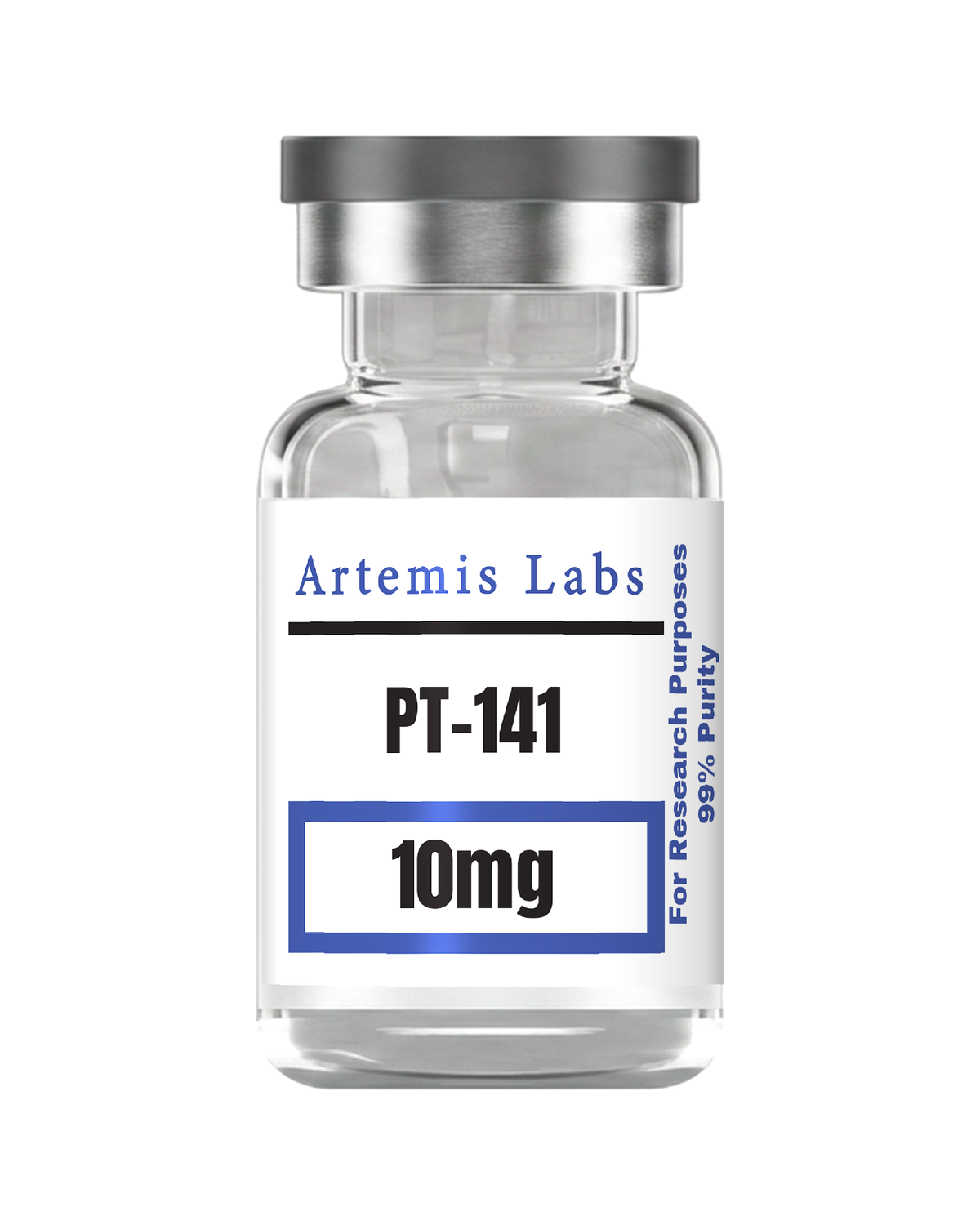
PT-141
$50.00
Most compounds studied for sexual function work on blood flow. PT-141 does not — it acts on melanocortin receptors in the brain’s reward circuitry. It is a rare example of a research compound aimed at the central side of arousal rather than the peripheral one, and that difference is the reason it exists.
Continue readingShow less
What the published work describes. PT-141 is a selective MC3R/MC4R agonist. Preclinical circuit mapping in the female Syrian hamster localised melanocortin-mediated reward effects to specific receptor circuits (Borland 2025, PMID 39793696). A transbuccal biodegradable patch achieved ~26% relative bioavailability against subcutaneous delivery — the first non-injectable pharmacokinetics with usable numbers (Krupke 2025, PMID 40513668). MC1R/MC3R/MC4R polymorphisms predict response variability (Bardhan 2025, PMID 41002740).
An important distinction. Artemis Labs PT-141 is not Vyleesi®, the approved bremelanotide product. Same active molecule, different product, and the approval attaches to theirs.
Supplied as lyophilized cyclic melanocortin agonist, for laboratory research use only.
Free shipping on orders over $300
Pay by Venmo or Cash App — instructions are emailed with your order.
14 published sources cited on this page see them
For research use only. Not for human consumption.
Description
PT-141, also called bremelanotide, is a lab-made peptide. It is seven amino acids joined in a ring. PT-141 switches on two brain receptors, MC3R and MC4R. Most of the research asks how the brain drives sexual arousal. Newer work looks at cancer cells and at patch delivery. Artemis Labs ships it as a dry powder for lab use.
Reviewed August 22, 2026 · Artemis Labs
What is PT-141 (bremelanotide)?
PT-141 (bremelanotide) is a 7-residue cyclic heptapeptide (Ac-Nle-cyclo[Asp-His-D-Phe-Arg-Trp-Lys]-OH, Asp-Lys lactam cyclization; molecular formula C₅₀H₆₈N₁₄O₁₀; MW 1025.18 Da; CAS 189691-06-3; DrugBank DB11580; PubChem CID 9941379). It is derived from the active core of α-melanocyte-stimulating hormone (α-MSH) and acts as a selective MC3R/MC4R melanocortin-receptor agonist within central nervous system melanocortin signaling pathways.
Is Artemis Labs PT-141 the same thing as Vyleesi®?
Artemis Labs PT-141 is NOT Vyleesi®. Vyleesi® (bremelanotide injection, Palatin Technologies / Cosette Pharmaceuticals) was approved by the U.S. FDA in June 2019 for acquired, generalized hypoactive sexual desire disorder (HSDD) in premenopausal women — this is cited solely as a fact of regulatory record. Artemis Labs does NOT offer, substitute for, or reference clinical indications of the Vyleesi product. Our PT-141 is a research-grade lyophilized reference compound for in vitro and IACUC-approved animal research workflows. The FDA has reminded compounders that compounded bremelanotide is not the FDA-approved product; Artemis Labs PT-141 is supplied strictly as a research reagent — not as a Vyleesi substitute, not as a compounded pharmaceutical.
What has PT-141 research reported since 2024?
The 2024-2026 peer-reviewed literature substantially refined the PT-141 research narrative beyond the early 2000s sexual-arousal framing:
- Central reward-circuit mapping — Borland et al. 2025 (PMID 39793696): female Syrian hamster models localized bremelanotide effects within MC-receptor-mediated sexual-reward circuitry, refining earlier MPOA-dopamine-centric models.
- Pharmacogenomic response variability — Bardhan et al. 2025 (PMID 41002740): MC1R/MC3R/MC4R coding-variant associations with differential bremelanotide response — opens a pharmacogenomic research dimension.
- Novel oncology axis — Suzuki et al. 2024 (PMID 39197897): bremelanotide induces glioblastoma cell death and growth inhibition via survivin suppression — first documented oncology mechanism entirely distinct from sexual-arousal pharmacology.
- Delivery-route innovation — Krupke et al. 2025 (PMID 40513668): biodegradable transbuccal suction patch achieved ~26% relative bioavailability vs subcutaneous bremelanotide — first non-injectable PK demonstration with usable numbers.
- 2026 meta-analysis — Toledo et al. 2026 (PMID 40543759): systematic review and meta-analysis of female sexual desire/arousal/orgasmic dysfunctions including bremelanotide pooled efficacy.
- Male sexual-arousal re-evaluation — Pfaus et al. 2026 (PMID 41960633): mechanistic separation of bremelanotide from PDE5-inhibitor mechanisms in male sexual arousal/desire research.
How does Artemis Labs source PT-141?
Each lot is supplied as a lyophilized peptide powder. The compound shipped is the canonical 7-mer cyclic sequence with Asp-Lys lactam cyclization. The manufacturer performs periodic quality testing on production batches.
What does the PT-141 evidence not show?
(1) Pharmacogenomic response variability. Bardhan 2025 (PMID 41002740) demonstrates MC1R/MC3R/MC4R polymorphism-driven response heterogeneity — broad efficacy claims are pharmacogenomically fragile. (2) Cardiovascular safety pool signal. Across the ~3,500-subject development program, transient SBP/DBP rise of ~2-3 mmHg appeared 0-4h post-dose and resolved by 8-10h. Documented in published safety pool. (3) Non-injectable PK ceiling. The Krupke 2025 transbuccal patch (PMID 40513668) achieved only ~26% relative bioavailability vs subcutaneous — non-injectable delivery remains a research-development frontier, not a solved problem. (4) No FDA approval beyond Vyleesi® HSDD indication. Bremelanotide is not approved for male sexual dysfunction, oncology, or any other indication despite preclinical-research signals.
How does PT-141 differ from other melanocortin research compounds?
Unlike Melanotan-2 (non-selective MC1R-MC5R agonist with prominent pigmentary effects), PT-141 selectively targets MC3R/MC4R. Unlike oxytocin (OXTR-acting hypothalamic nonapeptide), PT-141 acts on melanocortin reward circuitry. Bardhan 2025 treats PT-141 as the clinically validated MC-selective comparator within the melanocortin family. See VIP for autonomic-research context and Semax for ACTH(4-10)-derived neuropeptide research.
What is the regulatory status of PT-141?
Vyleesi® (injectable bremelanotide) is FDA-approved (June 2019) for HSDD in premenopausal women. No FDA approval exists for any other indication. Not DEA-scheduled. Not on the WADA Prohibited List 2026. No EMA or MHRA approval. Artemis Labs explicitly does NOT make sexual-function, HSDD, oncology, or any other therapeutic claims for the product given the limited pharmacogenomically-modulated evidence base. Research-use-only framing applies to all commercial supply. These statements have not been evaluated by the FDA. Not for human consumption, therapeutic use, or veterinary use.
Analytical Specifications
| Property | Value |
|---|---|
| Chemical name | Ac-Nle-cyclo[Asp-His-D-Phe-Arg-Trp-Lys]-OH |
| Sequence | Cyclic heptapeptide (Nle-Asp-His-D-Phe-Arg-Trp-Lys, Asp-Lys lactam) |
| Molecular formula | C₅₀H₆₈N₁₄O₁₀ |
| Molecular weight | 1025.18 Da |
| CAS number | 189691-06-3 |
| PubChem CID | 9941379 |
| DrugBank | DB11580 |
| ChEMBL | |
| Wikidata | |
| Form | Lyophilized white powder, 10 mg per vial |
| Storage | ≤ −20 °C, desiccated, protected from light |
References
- Suzuki S et al. (2024). Anticancer Research. PMID 39197897
- Gollapudi M et al. (2024). Cureus. PMID 39036127
- Borland JM et al. (2025). Neuropharmacology. PMID 39793696
- How A et al. (2025). Clin Obstet Gynecol. PMID 39846877
- Ila V et al. (2025). Expert Opin Pharmacother. PMID 40069591
- Krupke H et al. (2025). J Control Release. PMID 40513668
- Bhinder JK et al. (2025). Support Care Cancer. PMID 40518469
- Toledo RG et al. (2026). J Minim Invasive Gynecol. PMID 40543759
- Barakeh D et al. (2025). Ann Pharmacother. PMID 38767282
- Bardhan M et al. (2025). Diseases. PMID 41002740
- Fuhrman J et al. (2025). Expert Rev Clin Pharmacol. PMID 41088800
- Mihulka O et al. (2025). J Minim Invasive Gynecol. PMID 41419078
- Pfaus JG et al. (2026). J Clin Psychopharmacol. PMID 41960633
- Renke G et al. (2026). Int J Mol Sci. PMID 42123471
Additional information
| Vial Size | 10mg |
|---|
Science & Research
Science & Research
How does PT-141 act at MC3R and MC4R?
PT-141 binds the MC3 and MC4 melanocortin receptors, both Gs-coupled G-protein-coupled receptors, with selectivity that distinguishes it from the non-selective melanocortin agonist melanotan-2 (which binds MC1R-MC5R). Receptor activation drives adenylyl-cyclase/cAMP signaling cascades. MC3R and MC4R are expressed in brain regions associated with reward, arousal, and energy homeostasis — including the medial preoptic area (MPOA), paraventricular nucleus (PVN), and ventral tegmental area (VTA).
What did 2024-2026 research refine?
Borland et al. 2025 (PMID 39793696) used female Syrian hamster models to map bremelanotide effects within MC-receptor-mediated sexual-reward circuitry, refining earlier MPOA-dopamine-centric models. Bardhan et al. 2025 (PMID 41002740) reported MC1R/MC3R/MC4R coding-variant associations with differential bremelanotide response — opening a pharmacogenomic research dimension that constrains broad efficacy generalization.
Suzuki et al. 2024 (PMID 39197897) reported bremelanotide induces glioblastoma cell death and growth inhibition via survivin suppression — the first documented oncology mechanism, entirely distinct from sexual-arousal pharmacology. Krupke et al. 2025 (PMID 40513668) demonstrated a biodegradable transbuccal suction patch achieving ~26% relative bioavailability vs subcutaneous bremelanotide — the first non-injectable PK with practical numbers.
What did the pooled cardiovascular safety data show?
Across 43 studies in the development program (~3,500 subjects pooled), serious cardiovascular events were extremely rare. A transient SBP/DBP rise of ~2-3 mmHg appeared 0-4 hours post-dose and resolved by 8-10 hours. This is cited as a documented finding from the published safety pool, not as an Artemis Labs safety claim for any indication.
What clinical-adjacent research cites bremelanotide?
- Toledo RG et al. 2026 (PMID 40543759) — systematic review + meta-analysis: bremelanotide pooled efficacy across female sexual desire/arousal/orgasmic dysfunctions.
- How A et al. 2025 (PMID 39846877) — comparative review of flibanserin and bremelanotide for female sexual dysfunction.
- Pfaus JG et al. 2026 (PMID 41960633) — re-evaluation of bremelanotide for male sexual arousal/desire disorders; mechanistic separation from PDE5 inhibitors.
- Mihulka O et al. 2025 (PMID 41419078) — bremelanotide review for sexual-health management after breast/gynecologic cancer.
- Bhinder JK et al. 2025 (PMID 40518469) — survivorship-guideline comparison citing bremelanotide for cancer-survivor low desire.
- Fuhrman J et al. 2025 (PMID 41088800) — vasomotor + sexual-symptom management in breast-cancer survivors; emerging libido agents including bremelanotide.
- Renke G et al. 2026 (PMID 42123471) — therapeutic peptides across aesthetic/metabolic/endocrine medicine; bremelanotide positioning.
- Ila V et al. 2025 (PMID 40069591) — IV peptides + amino acids for ED research including PT-141 future directions.
- Gollapudi M et al. 2024 (PMID 39036127) — PMDD/FSD overlap; bremelanotide + flibanserin pharmacotherapy context.
- Barakeh D et al. 2025 (PMID 38767282) — pharmacotherapy review confirming bremelanotide + flibanserin as FDA-approved HSDD agents.
Entity Disambiguation
| Identifier | Value |
|---|---|
| Chemical name | Ac-Nle-cyclo[Asp-His-D-Phe-Arg-Trp-Lys]-OH |
| Sequence | Cyclic heptapeptide (Nle-Asp-His-D-Phe-Arg-Trp-Lys, Asp-Lys lactam) |
| Molecular formula | C₅₀H₆₈N₁₄O₁₀ |
| Molecular weight | 1025.18 Da |
| CAS | 189691-06-3 |
| DrugBank | DB11580 |
| PubChem CID | 9941379 |
Quality and Specifications
- Form: Lyophilized white powder, 10 mg/vial
- Storage: Lyophilized ≤ -20°C, desiccated, protected from light
What does the PT-141 evidence not show?
- Pharmacogenomic response heterogeneity — Bardhan 2025 (PMID 41002740): MC-receptor polymorphisms drive differential response; broad efficacy claims are fragile.
- Cardiovascular safety pool signal — transient SBP/DBP rise (~2-3 mmHg, 0-4h post-dose) documented across the published safety pool.
- Non-injectable PK ceiling — Krupke 2025 (PMID 40513668) achieves only ~26% relative bioavailability vs subcutaneous; non-injectable delivery remains research-development frontier.
- No FDA approval beyond Vyleesi® HSDD indication — bremelanotide is not approved for male sexual dysfunction, oncology, or any other indication despite preclinical signals.
- NOT Vyleesi® — Artemis Labs PT-141 is a research-grade reference compound, not a substitute for any FDA-approved bremelanotide product.
References (14 PubMed-Verified)
- Suzuki S et al. (2024). Anticancer Research. PMID 39197897
- Gollapudi M et al. (2024). Cureus. PMID 39036127
- Borland JM et al. (2025). Neuropharmacology. PMID 39793696
- How A et al. (2025). Clin Obstet Gynecol. PMID 39846877
- Ila V et al. (2025). Expert Opin Pharmacother. PMID 40069591
- Krupke H et al. (2025). J Control Release. PMID 40513668
- Bhinder JK et al. (2025). Support Care Cancer. PMID 40518469
- Toledo RG et al. (2026). J Minim Invasive Gynecol. PMID 40543759
- Barakeh D et al. (2025). Ann Pharmacother. PMID 38767282
- Bardhan M et al. (2025). Diseases. PMID 41002740
- Fuhrman J et al. (2025). Expert Rev Clin Pharmacol. PMID 41088800
- Mihulka O et al. (2025). J Minim Invasive Gynecol. PMID 41419078
- Pfaus JG et al. (2026). J Clin Psychopharmacol. PMID 41960633
- Renke G et al. (2026). Int J Mol Sci. PMID 42123471
Research Pairings
Research Pairings
Pairing rationale below is mechanistic only. No dosing, frequency, duration, route, or human-use guidance is provided. Researchers design their own studies against their own IACUC / institutional review, not against vendor copy. PT-141 is not combined with any FDA-approved drug, PDE5 inhibitor, or pharmaceutical product in any Artemis Labs research framing.
Why is PT-141 studied alongside Melanotan-2?
Both are melanocortin agonists. PT-141 is MC3R/MC4R-selective; Melanotan-2 is non-selective MC1R-MC5R. Useful mechanism-comparison research model for dissecting selective MC3R/MC4R signaling vs broader pan-MC engagement. Inozemtseva et al. 2024 explicitly compared MT-II with Semax across the melanocortin family; PT-141 serves as the MC-selective comparator in such designs.
Why is PT-141 studied alongside oxytocin?
Orthogonal receptor systems: PT-141 acts on MC3R/MC4R; oxytocin acts on OXTR. Both are CNS-acting neuropeptides studied within central arousal/social-bonding research contexts. Mechanistically orthogonal, useful research-model pairing for dissecting melanocortin vs OXTR contributions.
Why is PT-141 studied alongside VIP?
Vasoactive intestinal peptide × PT-141 pairing studied in preclinical autonomic and vascular research models with a central-arousal counterpart. Different receptor systems with convergent autonomic effects in research designs.
Why is PT-141 studied alongside BPC-157 / TB-500?
Tissue-repair pairing studied in genitourinary preclinical models. Mechanism rationale only: central arousal axis (PT-141) combined with documented preclinical tissue-repair mechanism research compounds. No human use is implied.
Why is PT-141 studied alongside Semax?
Melanocortin / neuropeptide research-model pairing. Semax is an ACTH(4-10)-derived BDNF-axis neuropeptide; PT-141 is an alpha-MSH-derived MC3R/MC4R agonist. Both have melanocortin-family origins but act on different receptor systems. Useful comparative model for melanocortin-family research designs.
What related compounds does Artemis Labs list?
For broader melanocortin-axis research see Melanotan 2. For CNS neuropeptide research see Oxytocin, Semax, Selank. For autonomic / vascular research see VIP.
Related products
Tissue-Repair Research
Metabolic Research
Mitochondrial & NAD+ Research