VIP
$65.00
VIP is a 28-amino-acid signalling peptide that turns inflammation down in some tissues and up in others. That is not a contradiction in the data — it is the finding. Which way it goes depends on the tissue and the receptor mix present, which makes it a useful tool for asking how context decides an immune response.
Continue readingShow less
What the 2026 work describes. VIP signals through VPAC1 and VPAC2 receptors, with effects reported as anti-inflammatory in sepsis-class models and pro-inflammatory in psoriasis-class models. Recent mechanism papers span PKCδ → Drp1 mitochondrial fragmentation (Xu 2026, PMID 42003223), SIRT3-dependent autophagy (Li 2026, PMID 41891524), osteoprotective effects via reduced RANKL/OPG and SOST in a human triple-culture (Castro-Vázquez 2026, PMID 42013997), and VIPR1 control of intestinal stem-cell lineage (Anastasio & Peduto 2026, PMID 41795422).
Design implication. Because direction of effect is context-dependent, a result in one tissue model does not predict another. That is the single most important thing to carry into a protocol using it.
Supplied as lyophilized 28-amino-acid secretin-family peptide, for laboratory research use only.
Free shipping on orders over $300
Pay by Venmo or Cash App — instructions are emailed with your order.
16 published sources cited on this page see them
For research use only. Not for human consumption.
Description
What VIP Is
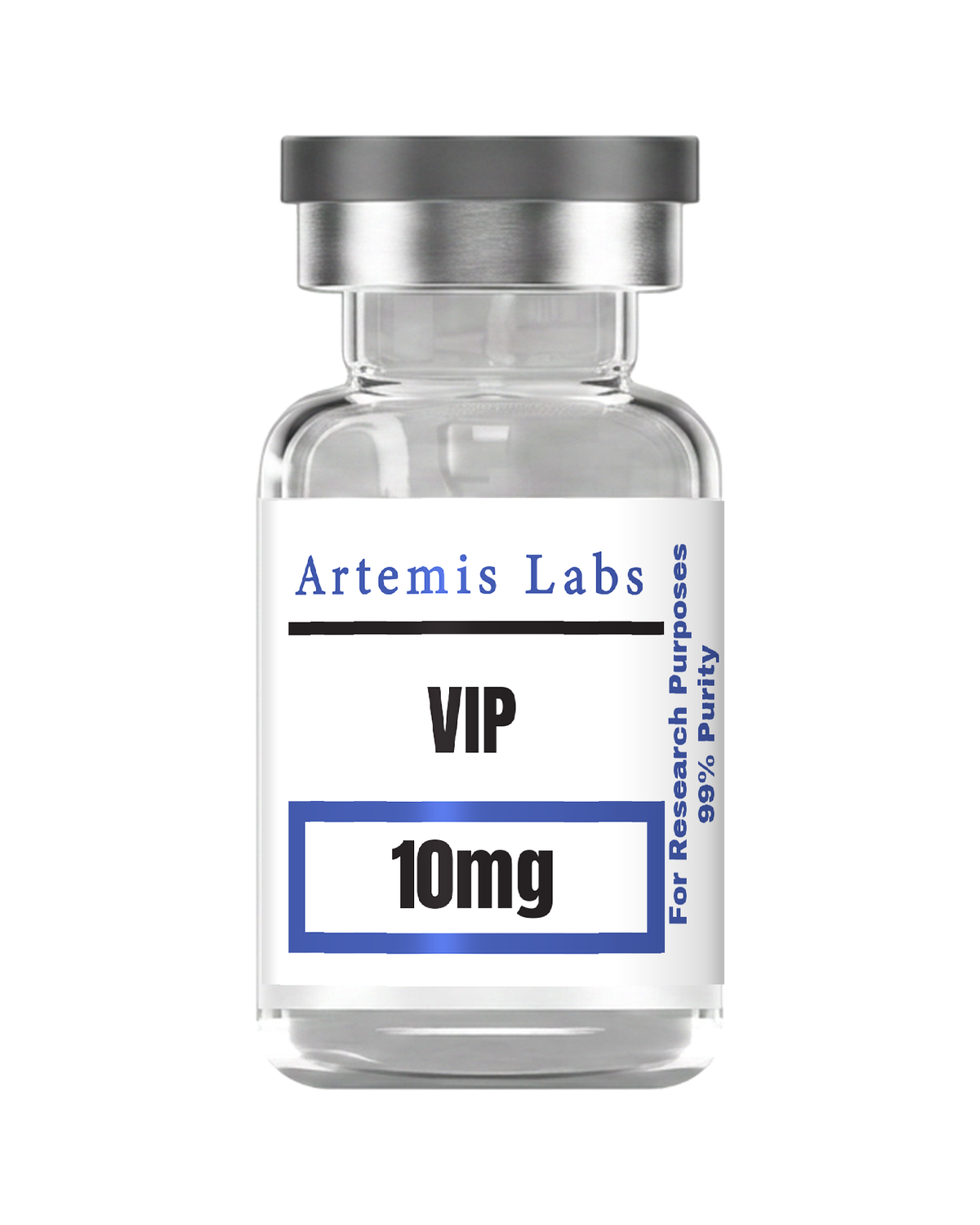
Vasoactive intestinal peptide (VIP) is a 28-amino-acid secretin-family neuropeptide (HSDAVFTDNYTRLRKQMAVKKYLNSILN-NH₂; molecular formula C₁₄₇H₂₃₇N₄₃O₄₃S; MW 3326.79 Da; CAS 37221-79-7; PubChem CID 53314964). It is the canonical endogenous ligand of the VPAC1 and VPAC2 G-protein-coupled receptors of the secretin receptor family. Artemis Labs supplies it as a lyophilized white powder, 10 mg per vial. Supplied for laboratory research use only.
Mechanism as the Published Literature Reports It
Direction of effect depends on tissue context. VIP is described as anti-inflammatory in sepsis-class models and as a pro-inflammatory mediator in psoriatic neuroimmune crosstalk through the IL-23/IL-17 axis (Gao et al. 2025, PMID 41428266; Singh & Taliyan 2026, PMID 41391748; Dawlaty et al. 2026, PMID 42117802). That split is the finding, not a contradiction in the data. It is also the reason a result in one tissue model does not carry across to another.
- Receptor signaling. VIP binds VPAC1 and VPAC2, class-B G-protein-coupled receptors that couple to Gs and raise intracellular cAMP. Receptor distribution differs by tissue; Joo 2004 mapped VPAC1, VPAC2 and PAC1 across rat brain regions (PMID 15282712).
- PKCδ-Drp1 mitochondrial fragmentation. Xu et al. 2026 reported that VIP at 100 nM activates PKCδ, phosphorylating Drp1 at Ser616 and driving mitochondrial fragmentation in nasopharyngeal carcinoma cells (Drug Dev Res, PMID 42003223).
- SIRT3-dependent autophagy. Li et al. 2026 reported VIP-induced autophagy and cytotoxicity localized to VPAC1-expressing renal-cell-carcinoma cells (J Biochem Mol Toxicol, PMID 41891524).
- Skeletal triple-culture. Castro-Vázquez et al. 2026 reported a reduced RANKL/OPG ratio and decreased SOST expression in a human osteocyte/osteoblast/osteoclast triple-culture (Transl Res, PMID 42013997).
- Intestinal stem-cell regulation. Anastasio & Peduto 2026 described neuronal VIP-VIPR1 signaling as a brake on intestinal stem-cell secretory-lineage expansion (Cell Stem Cell, PMID 41795422). Li T et al. 2026 connected VIPR1 suppression to a microbiota-dependent constipation-relief pathway (J Ethnopharmacol, PMID 42134502).
- Circadian biology. Harmar 2002 reported that the VPAC2 receptor is essential for circadian function in the suprachiasmatic nucleus (Cell, PMID 12086606); Shen 2000 reported an altered circadian phenotype with human VPAC2 overexpression in the SCN (PNAS, PMID 11027354).
- Neuroprotection. Rangon 2005 reported VPAC2-mediated VIP neuroprotection against neonatal excitotoxic brain lesions (JPET, PMID 15872042).
- Pulmonary neuroimmune context. Ehlers et al. 2026 list VIP among the immunomodulatory neuropeptides in sensory-neuron control of pulmonary defense and tissue repair (Nat Rev Neurosci, PMID 42062471).
All of the above describe cell-culture, ex vivo or animal work unless stated otherwise. The 2026 oncology mechanism papers are preclinical in vitro findings and are not clinical claims.
Honest Limitations of the VIP Evidence Base
- The half-life is the central obstacle. Native VIP is degraded by circulating peptidases within roughly one to two minutes, which is the principal reason it has never converted into a systemic drug (PMID 23094831).
- Non-selective receptor activation. Broad VPAC1/VPAC2 distribution produces systemic effects, including vasodilation and hypotension, that limit isolating any single action in a whole-animal model.
- Human translation is thin and unconverted. Human studies remain small and early-phase — a Phase II sarcoidosis study enrolled 20 patients and reported immunologic signals, not approved endpoints (PMID 20442436).
- Delivery remains unsolved. Rapid degradation and hemodynamic effects have pushed the field toward local and encapsulated formulations; Dawlaty et al. 2026 review liposomal encapsulation and engineered analogs addressing exactly this problem (PMID 42117802).
Regulatory Status
There is no FDA-approved VIP-class drug. The synthetic VIP analog aviptadil (RLF-100 / Zyesami) received compassionate-use INDs during COVID-19 but no FDA approval, and the Phase 3 ACTIV-3b/TESICO outcomes did not support an approval pathway. Artemis Labs does not carry forward any pulmonary or infectious-disease framing from those trials. VIP is not DEA-scheduled, has no EMA approval, and is not on the WADA Prohibited List 2026.
Analytical Specifications
| Chemical name | Vasoactive intestinal polypeptide (28-aa secretin-family neuropeptide) |
| Sequence | HSDAVFTDNYTRLRKQMAVKKYLNSILN-NH₂ (28 aa) |
| Molecular formula | C₁₄₇H₂₃₇N₄₃O₄₃S |
| Molecular weight | 3326.79 Da |
| CAS number | 37221-79-7 |
| External identifiers | PubChem CID 53314964 · |
| Appearance | White lyophilized powder, 10 mg per vial |
| Storage | ≤ −20 °C, desiccated, protected from light |
| Country of synthesis | USA / EU contract manufacturers |
References
- Anastasio C, Peduto L. (2026). Neuronal VIP-VIPR1 restrains intestinal stem-cell secretory-lineage expansion. Cell Stem Cell. PMID 41795422
- Xu J, Wu G, Chen M, Chen G. (2026). VIP activates PKCδ and Drp1(Ser616) phosphorylation driving mitochondrial fragmentation in nasopharyngeal carcinoma. Drug Development Research. PMID 42003223
- Li L, et al. (2026). VIP induces autophagy and cytotoxicity in renal cell carcinoma via SIRT3-dependent signaling. Journal of Biochemical and Molecular Toxicology. PMID 41891524
- Castro-Vázquez D, et al. (2026). VIP osteoprotective effects in human osteocyte/osteoblast/osteoclast triple-culture. Translational Research. PMID 42013997
- Li T, et al. (2026). VIPR1 suppression linked to a microbiota-dependent constipation-relief pathway. Journal of Ethnopharmacology. PMID 42134502
- Ehlers AM, Guerrero-Fonseca IM, Altier C, Yipp BG, Talbot S. (2026). Neuroimmune lung control by sensory neurons. Nature Reviews Neuroscience. PMID 42062471
- Dawlaty R, Entsie P, Amoafo EB, Liverani E, Dorsam GP. (2026). Five-decade review of VIP and PACAP as immune modulators in sepsis. Biology (Basel). PMID 42117802
- Singh H, Taliyan R. (2026). Neurogenic inflammation in psoriasis: VIP from remodeled sensory nerves. American Journal of Pathology. PMID 41391748
- Gao H, et al. (2025). VIP and PACAP as proinflammatory mediators in psoriatic neuroimmune crosstalk. Inflammation. PMID 41428266
- Harmar (2002). The VPAC2 receptor is essential for circadian function in the suprachiasmatic nuclei. Cell. PMID 12086606
- Shen (2000). Human VPAC2 overexpression in the SCN alters the circadian phenotype. PNAS. PMID 11027354
- Rangon (2005). VPAC2 mediates VIP neuroprotection against neonatal excitotoxic brain lesions. JPET. PMID 15872042
- Pilzer (2006). VIP cytoprotection via a PACAP-receptor splice variant. Peptides. PMID 16905223
- Joo (2004). Maps VPAC1/VPAC2/PAC1 receptor distribution in rat brain. J Comp Neurol. PMID 15282712
- Peptidase degradation and delivery constraints on native VIP (~1–2 minute circulating half-life). PMID 23094831
- Phase II study of VIP in sarcoidosis, 20 patients enrolled; immunologic signals reported, not approved endpoints. PMID 20442436
Regulatory Framing
Supplied by Artemis Labs strictly for in-vitro and pre-clinical laboratory research. For research use only — not for human consumption, therapeutic use, or veterinary use. These statements have not been evaluated by the FDA. No handling, preparation, or administration guidance is provided or supported.
Additional information
| Vial Size | 10mg |
|---|
Science & Research
Science & Research
VPAC1 / VPAC2 Receptor Signaling
VIP is the canonical endogenous ligand of VPAC1 and VPAC2, two class-B G-protein-coupled receptors of the secretin receptor family. Both couple to Gs proteins, activate adenylyl cyclase and raise intracellular cAMP, which in turn activates protein kinase A and cAMP-response-element binding protein. Receptor expression is tissue-specific, and that distribution — not the ligand — is what determines the regional effect observed in a given model. Joo 2004 mapped VPAC1, VPAC2 and PAC1 receptor distribution across rat brain regions (J Comp Neurol, PMID 15282712).
Immune Modulation Is Context-Dependent, Not Directional
The classical description of VIP in the immune literature is a shift away from Th1 cytokine output (IL-2, IFN-γ) toward Th2 output (IL-10, IL-4), together with reduced pro-inflammatory macrophage and microglial activation. Dawlaty et al. 2026 review five decades of that work on VIP and PACAP as immune modulators in sepsis models (Biology (Basel), PMID 42117802).
The opposite direction is also documented. Gao et al. 2025 characterize VIP and PACAP as proinflammatory mediators in psoriatic neuroimmune crosstalk through the IL-23/IL-17 axis (Inflammation, PMID 41428266), and Singh & Taliyan 2026 describe VIP released from remodeled sensory nerves activating immune cells in cutaneous and systemic disease (Am J Pathol, PMID 41391748). A model that reports one direction does not predict the other.
Circadian Integration
VIP-expressing neurons in the suprachiasmatic nuclei relay light-entrained clock signals to downstream circadian centers. Harmar 2002 reported that the VPAC2 receptor is essential for circadian function in the SCN (Cell, PMID 12086606), and Shen 2000 reported an altered circadian phenotype with human VPAC2 overexpression in the SCN (PNAS, PMID 11027354).
Pharmacokinetic Constraint
Native VIP is degraded by circulating peptidases within roughly one to two minutes, and that short plasma half-life — not receptor pharmacology — is the central obstacle to its use as a systemic agent (PMID 23094831). Broad VPAC1/VPAC2 distribution compounds the problem by producing systemic vasodilation and hypotension that complicate isolating a single action in a whole-animal model. Dawlaty et al. 2026 review the liposomal-encapsulation and engineered-analog work that exists specifically to address this limitation (PMID 42117802).
2025-2026 Peer-Reviewed Findings
Disambiguation note. PubMed carries a large “VIP+ interneuron” literature — cells that express VIP as a marker, not VIP as a research compound. Those records are excluded from the list below; every citation here concerns VIP-as-peptide.
- PKCδ-Drp1 mitochondrial fragmentation — Xu et al. 2026 (Drug Dev Res, PMID 42003223): VIP at 100 nM activates PKCδ, phosphorylating Drp1 at Ser616 and driving mitochondrial fragmentation and metabolic crisis in nasopharyngeal carcinoma cells. Preclinical in vitro finding, not a clinical claim.
- SIRT3-dependent autophagy — Li et al. 2026 (J Biochem Mol Toxicol, PMID 41891524): VIP-induced autophagy and cytotoxicity in renal cell carcinoma, localized to VPAC1-expressing cells. Preclinical in vitro finding.
- Osteoprotective triple-culture data — Castro-Vázquez et al. 2026 (Transl Res, PMID 42013997): reduced RANKL/OPG ratio and decreased SOST expression in a human osteocyte/osteoblast/osteoclast triple-culture.
- Intestinal stem-cell regulation — Anastasio & Peduto 2026 (Cell Stem Cell, PMID 41795422): neuronal VIP-VIPR1 signaling restrains intestinal stem-cell secretory-lineage expansion while balancing the mucosal immune response.
- VIPR1 and gut motility — Li T et al. 2026 (J Ethnopharmacol, PMID 42134502): VIPR1 suppression linked to a microbiota-dependent constipation-relief pathway.
- Pulmonary neuroimmune control — Ehlers et al. 2026 (Nat Rev Neurosci, PMID 42062471): VIP listed among immunomodulatory neuropeptides in sensory-neuron control of pulmonary defense and tissue repair.
- Neuroprotection via VPAC2 — Rangon 2005 (JPET, PMID 15872042): VPAC2 mediates VIP neuroprotection against neonatal excitotoxic brain lesions.
- Receptor-splice-variant cytoprotection — Pilzer 2006 (Peptides, PMID 16905223): VIP cytoprotection through a PACAP-receptor splice variant.
Regulatory Status (Reference Only)
- FDA: no approved VIP-class drug. The VIP analog aviptadil (RLF-100 / Zyesami) received compassionate-use INDs during COVID-19 but no approval; Phase 3 ACTIV-3b/TESICO outcomes did not support an approval pathway. Artemis Labs does not carry forward any pulmonary framing from those trials.
- DEA: not scheduled. EU/UK: no EMA approval. WADA: not on the 2026 Prohibited List.
- All references above describe cell-culture, ex vivo or animal research unless explicitly identified as human clinical data.