
What Is TB-500 Studied For? Research Areas Explained
Aug
What Is TB-500 Studied For?
Published August 23, 2026 · Artemis Labs
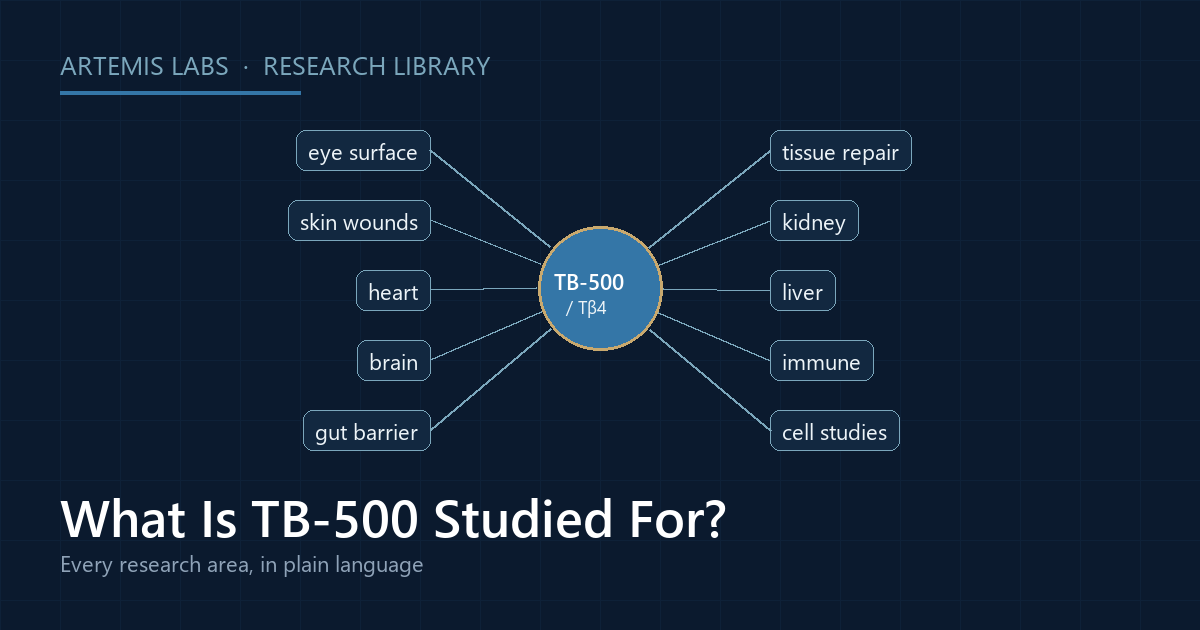
TB-500 — answer capsule: TB-500 is a lab-made peptide of seven amino acids, Ac-LKKTETQ, copying residues 17–23 of a larger natural protein called thymosin β4. Nearly every published study is of the 43-amino-acid parent protein rather than the fragment, and those studies span wound and skin healing, the surface of the eye, the heart, the brain, the gut, the kidney, the liver, and immune response. There is no published human clinical trial of TB-500 itself, and one 2026 review lists the parent and the fragment as two separate unapproved compounds (Mendias 2026, PMID 41966639). Only a handful of published studies gave the fragment to animals or cells. One of them concluded that a breakdown product, not TB-500, may be the form doing the work (Rahaman 2024, PMID 38382158).
Key findings
- TB-500 is seven amino acids long. Thymosin β4 is 43 amino acids and roughly five and a half times heavier. They are related molecules, and they are not the same molecule.
- Every human study in this record used full-length thymosin β4. The human work sits in eye, skin, and one heart trial — not in muscle, tendon, or ligament, where a 2026 review in Am J Sports Med states that human orthopaedic data are lacking (Mayfield 2026, PMID 41476424).
- A 2026 PRISMA scoping review found that 67% of publications on these compounds used preclinical animal models, and concluded that claimed recovery benefits remain “unsubstantiated by current human trials” (Tewari 2026, PMID 42578445).
- Not all findings point the same way. In an irritable bowel syndrome model, thymosin β4 released by mast cells impaired the intestinal barrier in rats and mice (Sun 2025, PMID 41278163).
Why does this page keep saying “the parent protein”?
Because most pages about TB-500 quietly skip it. Thymosin β4 is a protein the human body already makes. TB-500 is a short synthetic piece of it — residues 17 through 23, with a small chemical cap called an acetyl group on one end. The molecule sold as TB-500 weighs about 889 g/mol; the parent protein weighs about 4,963 Da.
Almost all of the research below was done on the parent. A study of a 43-amino-acid protein is not automatically a study of a seven-amino-acid piece of it, so each section names the form actually tested. Where nobody has tested the fragment, this page says so instead of guessing.
Has anyone studied TB-500 itself?
A few groups have. Philp and colleagues reported in 2003 that the seven-amino-acid synthetic peptide LKKTETQ promoted repair in aged mice, at a level comparable to the parent molecule (PMID 12581423). A 2010 review describes that short sequence as the central actin-binding domain — actin being the protein scaffolding inside cells — and reports that it promotes angiogenesis, wound healing, and cell migration (Sosne 2010, PMID 20179146). Against that, a 2024 pharmacology paper opens by stating flatly that the biological effects of TB-500 “have not been documented,” and its own results suggest the previously reported wound-healing activity may come from a metabolite called Ac-LKKTE rather than from TB-500 itself (Rahaman 2024, PMID 38382158). That question is not settled.
What research areas does the published record actually cover?
Wound healing and skin
This is where the human work on the parent protein is strongest. A Phase 2 trial across eight European sites gave topical thymosin β4 to 73 patients with venous stasis ulcers — slow-healing leg wounds caused by poor blood return. The authors called the safety profile “acceptable and comparable to placebo,” and wrote that efficacy findings only “suggest” one dose “may have the potential” to speed healing, with complete healing inside three months in about 25% of patients (Guarnera 2010, PMID 20536470). A summary of two Phase 2 ulcer trials reports healing accelerated by almost a month “in those patients that did heal” — a conditional clause worth reading twice (Treadwell 2012, PMID 23050815). Both used the full-length parent protein.
The surface of the eye
The deepest human dataset here is ophthalmic, and it is not a clean win. A Phase II dry-eye study randomized 72 subjects and reported that neither pre-specified primary endpoint — eye discomfort or lower corneal staining — differed significantly between treatment and control (Sosne & Ousler 2015, PMID 26056426). A Phase III study in neurotrophic keratopathy, a condition where the cornea stops healing normally, found complete healing at four weeks in 6 of 10 treated subjects versus 1 of 8 on placebo — but at p = 0.0656, above the usual 0.05 cutoff (Sosne 2022, PMID 36613994). An independent 2025 Cochrane review of that same trial graded the evidence low-certainty, with a confidence interval crossing 1 (PMID 41347649). All of that used full-length thymosin β4. The one eye study using the fragment was in mice and rabbits with alkali burns, and its authors call it “the first ocular application of TB500” (Lu 2025, PMID 41359360).
The heart
One randomized, placebo-controlled, double-blind trial gave recombinant human thymosin β4 to 96 patients after a heart attack. A subgroup that received the first dose early showed significantly smaller damaged areas at 90 days — but the whole-cohort comparison was not significant, and the authors themselves call for further rigorous randomized studies (Zhang 2025, PMID 41229390). Three co-authors were employees of the manufacturer. Separately, an intravenous Phase 1 safety study in healthy volunteers reported synthetic thymosin β4 was well tolerated with no dose-limiting toxicity, and concluded only that further development “should be considered” (Ruff 2010, PMID 20536472). Parent protein in both.
The brain and nervous system
This is the one area where the fragment itself was given to an animal. A 2026 study reported that TB500 and a different fragment reduced neurite atrophy in cultured neurons, calmed inflammatory signals in microglia — the brain’s resident immune cells — and improved maze and object-recognition performance in a transgenic Alzheimer’s mouse line. The same paper reports a negative result that belongs beside it: hippocampal amyloid-beta burden remained unchanged (Ou 2026, PMID 41443105). Work on the parent protein found it protected blood-brain-barrier cells from low-oxygen damage — human cells in a dish, not human subjects (Stewart 2025, PMID 41326489).
The gut — where the findings run the other way
In an irritable bowel syndrome model, Sun and colleagues reported that thymosin β4 released by mast cells reduced tight junction proteins and impaired intestinal barrier integrity in rats and mice, with elevated thymosin β4 measured in the colonic mucus of IBS patients (PMID 41278163). The study examined the body’s own full-length thymosin β4, not the TB-500 fragment, and no human received any dose of anything. A 2024 paper points the same direction in inflammatory bowel disease, reporting a damaged mucus barrier in treated mice (Hao 2024, PMID 38049080) — though its author group overlaps with Sun’s, so these are related programmes rather than independent replication.
The kidney
A 2026 narrative review examined thymosin β4 and one of its breakdown products in kidney injury and repair across preclinical models, with no human trial data. It does not hand down a simple verdict: it calls for frameworks that account for “bidirectional effects on fibrosis” — meaning the effect on scarring can run either way depending on the model — and names comprehensive safety assessment as an unfinished task (Di 2026, PMID 41570941).
The liver
A 2016 review makes a distinction most summaries flatten. Treatment with thymosin β4 given from outside the body inhibited the activation of hepatic stellate cells and reduced liver scarring, while the thymosin β4 those same cells produce internally promoted their activation (Kim & Jung 2016, PMID 27450733). Same tissue, same protein, opposite directions depending on where it came from. That review also lists cancer progression among the cellular processes this protein is involved in.
Immune response
In a mouse endotoxin model, giving thymosin β4 after a lethal dose of bacterial toxin significantly reduced mortality (Badamchian 2003, PMID 12860178). Mice, parent protein, one paper. This is the thinnest area on the page.
What the research does not show
No published human clinical trial of TB-500 has ever been run. Every human study named above used full-length thymosin β4, and the only study in which TB-500 was given to a living animal outside the lab bench was a doping-control detection assay in horses. There is no primary tendon, ligament, or muscle study of either form in this record — so “recovery,” the word most associated with this compound in the market, is exactly where the evidence is thinnest. There is no FDA approval; a 2025 paper states approval remains pending for the ophthalmic programme (PMID 41235866). A 2026 review in Sports Med puts the safety position plainly: “rigorous human safety data are scarce, and there is potential for serious harm to patients” (PMID 41966639). And the gut findings above are a real counterweight, not a footnote.
Both the parent protein and TB-500 appear on the WADA 2026 Prohibited List under section S2.3, which covers growth factors and growth factor modulators, prohibited at all times (WADA Prohibited List).
Frequently asked questions
Are TB-500 and thymosin β4 the same thing?
No. TB-500 is a synthetic seven-amino-acid peptide matching residues 17–23 of thymosin β4, with an acetyl cap. Thymosin β4 is a 43-amino-acid protein. A 2026 review lists them as two separate entries among unapproved compounds (PMID 41966639).
Has TB-500 been tested in people?
Not in any published clinical trial. Searches across the fragment’s names and sequence turned up no human trial of it. The sibling page TB-500 human trials walks through every human study that does exist and which molecule each one used.
Which research area has the most human data?
The eye, followed by chronic skin wounds — both on the parent protein, and both with honest limits attached, including missed primary endpoints and a low-certainty Cochrane grade.
Is TB-500 sold on its own?
No. For the tissue-repair literature in depth, see TB-500 tissue repair research, and for the wider category, the comparison of BPC-157, TB-500, KPV and GHK-Cu across the tissue-repair cascade.
References
- Mendias CL, et al. Sports Med. 2026. PMID 41966639
- Rahaman A, et al. 2024. PMID 38382158
- Philp D, et al. 2003. PMID 12581423
- Sosne G, et al. 2010 (review). PMID 20179146
- Mayfield CK, et al. Am J Sports Med. 2026. PMID 41476424
- Tewari A, et al. 2026 (PRISMA scoping review). PMID 42578445
- Guarnera G, et al. 2010 (Phase 2, venous stasis ulcers). PMID 20536470
- Treadwell T, et al. 2012. PMID 23050815
- Sosne G, Ousler GW. 2015 (Phase II, CAE dry-eye model). PMID 26056426
- Sosne G, et al. 2022 (Phase III, neurotrophic keratopathy). PMID 36613994
- Kruoch Z, et al. Cochrane Database Syst Rev CD015723. 2025. PMID 41347649
- Lu Y, et al. ACS Appl Mater Interfaces. 2025. PMID 41359360
- Zhang Y, et al. Cardiovasc Res. 2025 (STEMI trial). PMID 41229390
- Ruff D, et al. 2010 (Phase 1 intravenous safety). PMID 20536472
- Ou Z, et al. 2026. PMID 41443105 · doi:10.1016/j.intimp.2025.116097
- Stewart R, et al. 2025. PMID 41326489 · doi:10.1038/s41598-025-28435-2
- Sun YS, et al. World J Gastroenterol. 2025. PMID 41278163 · doi:10.3748/wjg.v31.i42.111706
- Hao X, et al. Exp Cell Res. 2024. PMID 38049080
- Di W, et al. Peptides. 2026 (review). PMID 41570941 · doi:10.1016/j.peptides.2026.171467
- Kim J, Jung Y. 2016 (review). PMID 27450733
- Badamchian M, et al. 2003. PMID 12860178
- Ho ENM, et al. J Chromatogr A. 2012 (equine detection assay). PMID 23084823
- 2025. FDA approval status, ophthalmic programme. PMID 41235866
- World Anti-Doping Agency, 2026 Prohibited List, §S2.3. wada-ama.org/en/prohibited-list
Methodology: this page draws only on the Artemis Labs TB-500 verified facts sheet, built from PubMed abstract retrieval and PubChem identity checks; every claim above traces to a numbered reference. Last verified August 23, 2026.
All compounds sold by Artemis Labs are for laboratory research use only. Nothing on this page is medical advice, and no statement has been evaluated by the FDA.
