
TB-500 Human Trials: What Exists and What Does Not
Aug
TB-500 Human Trials: What Exists and What Does Not
Published August 23, 2026 · Artemis Labs
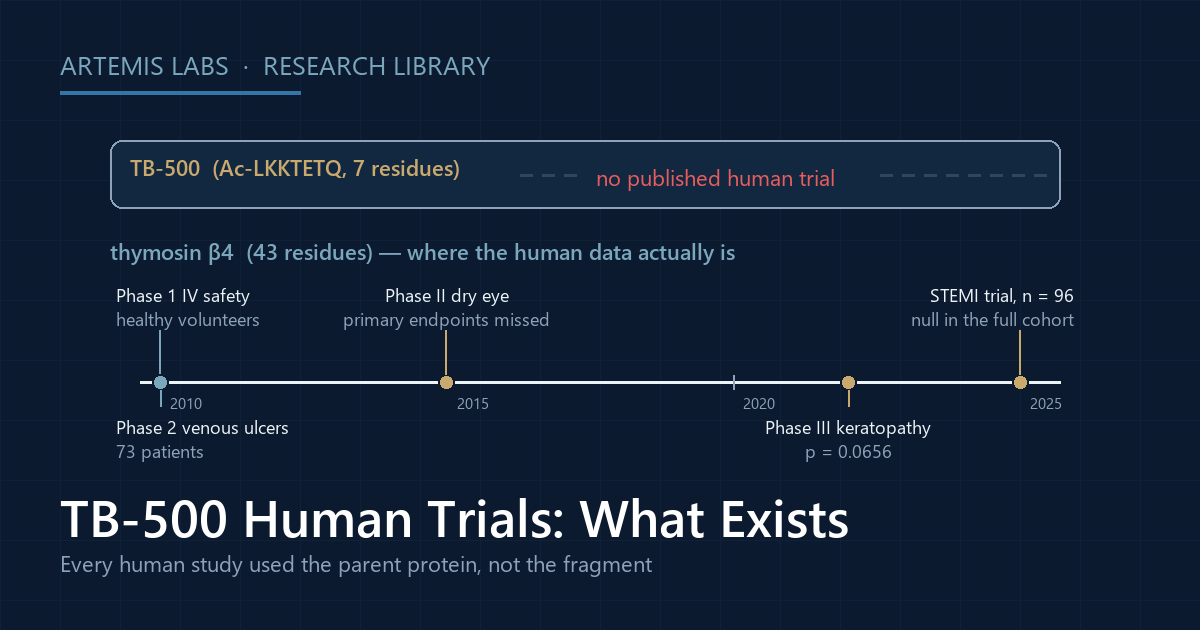
TB-500 human trials — There is no published human clinical trial of TB-500. Not one. Every human study that gets cited in TB-500 marketing used a different molecule: thymosin beta-4, the 43-amino-acid parent protein that TB-500 is a seven-amino-acid piece of. Eleven human studies of that parent protein exist, and they cover the eye, the skin, and one heart trial, with several honest misses inside them. There is no human musculoskeletal or recovery data for either molecule, and no regulatory approval for either.
Key findings
- No published human trial has tested TB-500 (Ac-LKKTETQ) itself. The pharmacology paper on the fragment opens by saying so in plain words: “The biological effects of TB-500, however, have not been documented” (Rahaman 2024, PMID 38382158).
- The eleven human studies in the record all used full-length thymosin beta-4. Their strongest programme is eye drops, and an independent Cochrane review graded that evidence “low or very low certainty” (Kruoch 2025, PMID 41347649).
- The one randomized heart trial was null across its whole group of 96 patients; only a subgroup dosed early showed a difference (Zhang 2025, PMID 41229390).
- Neither molecule is approved. A 2025 research paper states it verbatim: corneal wound-healing work led “to a clinical trial (RGN-259), with full US Food and Drug Administration approval still pending” (PMID 41235866).
Which molecule was actually studied?
This page only makes sense once two names are kept apart.
Thymosin beta-4, written Tβ4, is a protein your own cells make. It is 43 amino acids long and weighs about 4,963 daltons. A dalton is the unit chemists use for the weight of a molecule.
TB-500 is a synthetic seven-amino-acid piece of that protein, residues 17 through 23, with a small chemical cap called an acetyl group added to one end. Its sequence is Ac-LKKTETQ and it weighs 889.0 grams per mole (PubChem CID 62707662). It is roughly one-fifth the size of the parent.
They are related. They are not the same molecule, and a study of one is not a study of the other. Two 2026 medical reviews list them as separate entries: Mendias 2026 (PMID 41966639) writes “Tβ4 (thymosin beta-4), and TB-500 (thymosin beta-4 fragment)”, and Mayfield 2026 (PMID 41476424) writes “TB-4 and its derivative TB-500”. If professional reviewers bother to separate them, a product page should too.
Has TB-500 itself ever been tested in a human trial?
No. Searches on the fragment by every name it goes by — TB-500, TB500, and the sequence LKKTETQ — return no human trial of any size, phase, or design. There is no Phase 1, no Phase 2, no Phase 3, and no case series.
The only study anywhere that gave TB-500 to a living body and measured what happened to it was run in horses, and it was built to catch doping rather than to test whether the compound helps anything (Ho 2012, PMID 23084823).
There is a further wrinkle worth knowing. Rahaman 2024 (PMID 38382158) followed what happens to TB-500 in human serum and in rat urine, and concluded that the wound-healing activity reported in earlier literature “may be due to its metabolite Ac-LKKTE rather than the parent form”. A metabolite is what a molecule breaks down into. Read plainly, it is not settled that the seven-residue molecule sold as TB-500 is the active thing at all.
What human studies of thymosin beta-4 exist?
Eleven. Every one used the full-length 43-amino-acid parent protein, never the fragment. Outcomes below are stated as each abstract states them, including the misses.
| Study | Form used | Design / phase | Population | Outcome, as the abstract states it |
|---|---|---|---|---|
| Ruff 2010, PMID 20536472 | Full-length synthetic Tβ4 | Phase 1, intravenous, randomized, placebo-controlled | 40 healthy volunteers (four cohorts of 10) | “Well tolerated with no evidence of dose limiting toxicity.” Safety and tolerability only; no efficacy endpoint. |
| Guarnera 2010, PMID 20536470 | Full-length Tβ4, applied to the skin | Phase 2, double-blind, placebo-controlled | 73 patients with venous stasis ulcers, eight European sites | Safety “acceptable and comparable to placebo.” Efficacy hedged by the authors: one dose “may have the potential” to speed healing, with complete healing within 3 months in “about 25% of the patients.” |
| Treadwell 2012, PMID 23050815 | Full-length Tβ4, applied to the skin | Report covering two Phase 2 trials | Patients with stasis and pressure ulcers | “Accelerate healing by almost a month in those patients that did heal.” The closing clause is part of the finding. |
| Dunn 2010, PMID 20536469 | Full-length Tβ4 eye drops | Compassionate use, uncontrolled case series | 9 patients with chronic non-healing corneal defects | Mixed. Six patients with geographic defects “showed dramatic healing”; “stromal thinning was observed in one patient”; three patients with punctate defects “did not have a demonstrable change.” |
| Sosne 2015, PMID 25826322 | 0.1% RGN-259 (full-length Tβ4) | Phase 2, vehicle-controlled | 9 patients with severe dry eye, two US sites | At day 56, “35.1% reduction of ocular discomfort” (P = 0.0141) and “59.1% reduction of total corneal fluorescein staining” (P = 0.0108). The authors call it “this small trial.” |
| Sosne & Ousler 2015, PMID 26056426 | 0.1% full-length Tβ4 | Phase 2, randomized 1:1, placebo-controlled | 72 subjects with moderate-to-severe dry eye | “Neither of the primary endpoints, ie, ocular discomfort or inferior corneal staining, showed a significant difference between treatment and control groups.” Several secondary measures were positive. |
| Sosne 2022, PMID 36613994 | 0.1% RGN-259 (full-length Tβ4) | Phase 3, placebo-controlled | 18 patients with neurotrophic keratopathy, stages 2 and 3 | Complete healing at 4 weeks in “6 of the 10” treated and “1 of the 8” placebo patients, “(p = 0.0656)”. That is above the 0.05 cutoff. Secondary measures reached significance. “No significant adverse effects were observed.” |
| Kruoch 2025 (Cochrane), PMID 41347649 | Independent appraisal of the trial above | Cochrane systematic review CD015723 | Same 18 participants | 0.1% RGN-259 “may not increase the proportion with corneal re-epithelialization” (RR 9.00, 95% CI 0.57 to 141.88; low-certainty evidence). The interval crosses 1. |
| Zhang 2025, PMID 41229390 | Recombinant human Tβ4 (full-length) | Randomized, double-blind, placebo-controlled | 96 patients after a major heart attack (STEMI) | “The overall differences in infarcted areas were not significantly between the rhTB4 group and the placebo group (n = 96).” A subgroup dosed within 8 hours after their artery was reopened (n = 43) did show reduced infarct areas at 90 days. Three co-authors work for the manufacturer. |
| Yang 2019, PMID 31649007 | Full-length Tβ4 | Review article, authors employed by the developer | Chronic human wounds, described in general | Reports faster repair in “pressure ulcers, stasis ulcers, and epidermolysis bullosa lesions.” No trial design, endpoint, number of patients, or dose appears in the abstract. |
| Sun 2025, PMID 41278163 | Endogenous full-length Tβ4 (the body’s own) | Measurement in patients plus animal experiments | Patients with irritable bowel syndrome; rats and mice | Elevated Tβ4 measured in the colonic mucus of IBS patients; in the animal arms Tβ4 “caused a reduction in tight junction proteins” and impaired the gut lining. Nobody was given anything: there was no human dosing arm. |
One more paper is often miscounted as a result. Sosne 2018 (PMID 30063853) says only that Phase 3 trials in dry eye and neurotrophic keratopathy “are currently ongoing.” A trial that is running is not a trial that reported. Since then, two dry-eye Phase 3 trials have posted results on the public trial registry, with no journal paper: ARISE-2 (601 people, posted 2022) and ARISE-3 (700 people, posted August 28, 2026). On both main measures of both trials, the average for the eye drop was no better than the average for placebo, and no statistical test was posted (NCT02974907; NCT03937882).
How strong is the strongest human programme?
The eye work is the deepest human dataset either molecule has, and it is not a clean win. The larger of the two dry-eye Phase 2 trials missed both of the endpoints it had committed to in advance. The Phase 3 trial in neurotrophic keratopathy, a condition where the cornea loses feeling and stops healing, landed at p = 0.0656 on its main measure, which is on the wrong side of the usual 0.05 line. Cochrane reviewers then looked at that same trial and graded the evidence low certainty, with a confidence interval so wide it includes no effect at all. Our full write-up of that programme is on the thymosin beta-4 eye research page.
The heart trial has the same shape. It was properly randomized and placebo-controlled, which is the design that counts, and across all 96 patients it found nothing. The positive result lives in a subgroup, and subgroups found after the fact are the weakest kind of finding in clinical research. The authors say so themselves: “further rigorous randomized studies are needed.” That trial is covered in detail on the thymosin beta-4 heart research page.
Is there any human data for tendons, muscle, or recovery?
No, for either molecule. This is the area TB-500 is best known for, and it is the emptiest part of the file.
Four 2026 review papers written for physicians say it in their own abstracts. Mayfield 2026 (PMID 41476424): thymosin beta-4 and TB-500 promoted repair “in preclinical models, but human orthopaedic data are lacking.” Rahman 2026 (PMID 41490200): “although preclinical studies are promising, there is a current lack of clinical trials.” Tewari 2026 (PMID 42578445), a scoping review that searched for both names, found “67% of identified publications utilized preclinical animal models” and concluded that claimed benefits “remain unsubstantiated by current human trials.” Mendias 2026 (PMID 41966639) adds that “rigorous human safety data are scarce, and there is potential for serious harm to patients.”
Readers comparing repair compounds usually arrive here from our older BPC-157 and TB-500 tissue repair comparison. The honest correction to make there is that neither compound has human repair trial data, and TB-500 has no human data of any kind. The two are sold together as the BPC-157 and TB-500 research pair, and no published study has tested that combination either.
What the research does not show
No human trial of TB-500 exists, so nothing in the published record establishes what the fragment does in a person, at any dose, for any condition. The eleven human studies listed above used the 43-amino-acid parent protein, and their results cannot be moved across to a seven-amino-acid fragment as though the two were interchangeable. Inside those studies, the misses are real: two missed primary endpoints in dry eye, p = 0.0656 in the neurotrophic keratopathy Phase 3, a low-certainty Cochrane grade on that same trial, stromal thinning in one compassionate-use patient with no change in three others, and a null whole-group result in the heart trial. Sun 2025 (PMID 41278163) points the other way entirely, reporting that the body’s own thymosin beta-4 impaired the gut lining in animal models of irritable bowel syndrome. Neither molecule holds an FDA approval, and no human study of either has looked at tendons, muscle, or athletic recovery.
Frequently asked questions
Has TB-500 ever been given to a human in a study?
Not in any published study we can find. The only administration study of the fragment in a living body was done in horses, and it was a doping-detection assay rather than a test of whether it works (Ho 2012, PMID 23084823).
Why do sellers cite human trials for TB-500 then?
Because human trials of thymosin beta-4 do exist, and the two names get blurred. Those trials used a protein about five and a half times heavier than the fragment, given as eye drops, as a skin treatment, or into a vein. Citing them for TB-500 swaps one molecule for another.
Is TB-500 or thymosin beta-4 FDA approved?
No. A 2025 research paper states that after corneal wound-healing work led to the RGN-259 clinical trial, “full US Food and Drug Administration approval” is “still pending” (PMID 41235866).
Does an empty trial record mean TB-500 does not work?
No. It means the question has not been asked in people. An absent record is not evidence in either direction, and Rahaman 2024 adds a second open question by suggesting a breakdown product, not TB-500 itself, may carry the activity reported in earlier work.
References
- Rahaman 2024. TB-500 metabolism in human serum, in-vitro enzyme systems, and rat urine; Ac-LKKTE metabolite finding. PMID 38382158
- Ruff 2010. Phase 1 intravenous safety and tolerability study of synthetic thymosin beta-4 in healthy volunteers. PMID 20536472
- Guarnera 2010. Phase 2 dose-escalation trial of topical thymosin beta-4 in venous stasis ulcers. PMID 20536470
- Treadwell 2012. Report covering two Phase 2 trials in stasis and pressure ulcers. PMID 23050815
- Dunn 2010. Compassionate-use case series, chronic non-healing corneal epithelial defects. PMID 20536469
- Sosne 2015. Phase 2 trial of 0.1% RGN-259 in severe dry eye. PMID 25826322
- Sosne & Ousler 2015. Phase 2 controlled adverse environment dry-eye trial; both primary endpoints missed. PMID 26056426
- Sosne 2022. Phase 3 trial of 0.1% RGN-259 in neurotrophic keratopathy; complete healing p = 0.0656. PMID 36613994
- Kruoch 2025. Cochrane review CD015723; low-certainty evidence, RR 9.00 (95% CI 0.57 to 141.88). PMID 41347649
- Zhang 2025. Randomized, double-blind, placebo-controlled trial of recombinant human thymosin beta-4 in 96 STEMI patients. PMID 41229390
- Yang 2019. Developer-authored review of thymosin beta-4 in chronic human wounds. PMID 31649007
- Sun 2025. Thymosin beta-4 released by mast cells impairs the intestinal epithelial barrier via IL22RA1/JAK1/STAT3 signalling in irritable bowel syndrome. PMID 41278163 · DOI 10.3748/wjg.v31.i42.111706
- ARISE-2. Phase 3 dry-eye trial of RGN-259; registry results posted 2022; no journal paper. NCT02974907
- ARISE-3. Phase 3 dry-eye trial of RGN-259; registry results posted August 28, 2026; no journal paper. NCT03937882
- Sosne 2018. Statement that Phase 3 dry-eye and neurotrophic keratopathy trials were ongoing. PMID 30063853
- PMID 41235866 (2025). Corneal wound-healing research paper; FDA approval “still pending.” PMID 41235866
- Mayfield 2026. Narrative review; human orthopaedic data lacking for TB-4 and TB-500. PMID 41476424
- Mendias 2026. Review listing Tβ4 and TB-500 as separate unapproved compounds; scarce rigorous human safety data. PMID 41966639
- Rahman 2026. Orthopaedic peptide review; “a current lack of clinical trials.” PMID 41490200
- Tewari 2026. PRISMA scoping review; benefits “unsubstantiated by current human trials.” PMID 42578445
- Ho 2012. Detection of TB-500 administration in horses; doping-control assay. PMID 23084823
Methodology: this page draws on the Artemis Labs TB-500 / thymosin beta-4 facts sheet, a PMID- and DOI-verified citation set built by transcribing each abstract directly from PubMed and checking compound identity against PubChem; last verified August 23, 2026.
All compounds sold by Artemis Labs are for laboratory research use only. Nothing on this page is medical advice, and no statement has been evaluated by the FDA.
