
TB-500 and Eye Research: The Deepest Human Dataset
Aug
TB-500 and Eye Research: The Deepest Human Dataset
Published August 23, 2026 · Artemis Labs
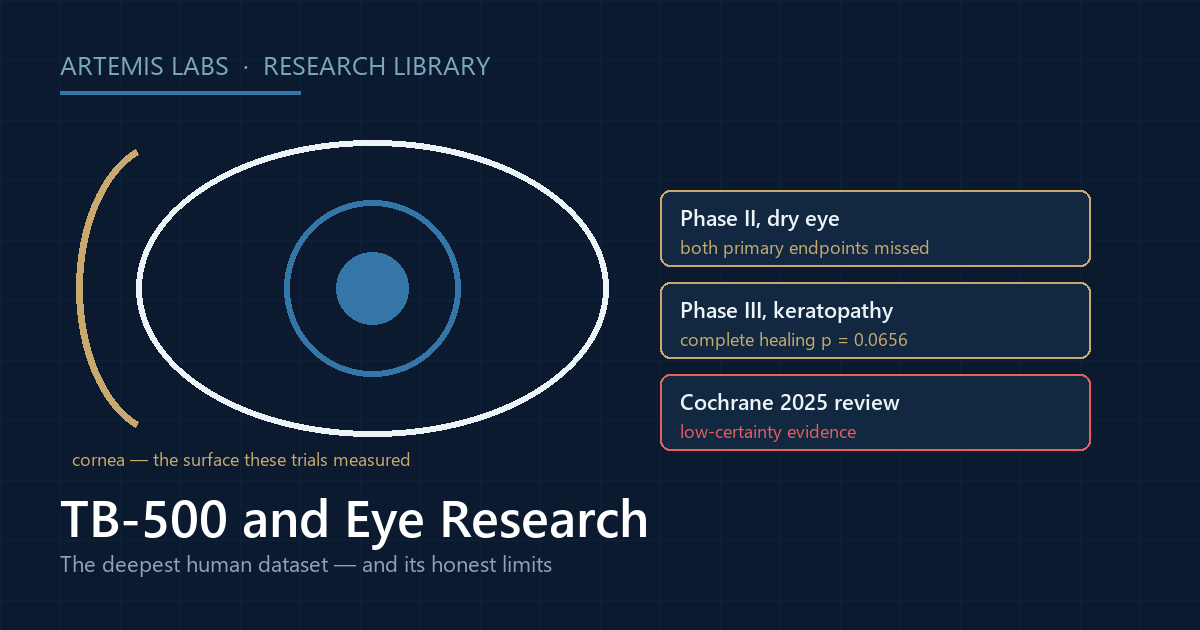
TB-500 and eye research — answer capsule: The eye is where this family of peptides has been tested in people most, and the record is mixed. A Phase II dry eye trial in 72 people missed both primary endpoints. A Phase III trial in 18 people with corneal nerve damage fell short of significance at p = 0.0656, and a 2025 Cochrane review graded that evidence low-certainty. Every human study used full-length thymosin β4, not the TB-500 fragment.
Key findings
- A Phase II dry eye trial randomized 72 subjects 1:1 to a 0.1% thymosin β4 eye drop or placebo for 28 days. Verbatim: “Neither of the primary endpoints, ie, ocular discomfort or inferior corneal staining, showed a significant difference between treatment and control groups at visit 5” (PMID 26056426).
- In a Phase III trial in neurotrophic keratopathy — a disease in which the nerves supplying the cornea stop working properly — complete healing after 4 weeks occurred in 6 of 10 treated subjects and 1 of 8 placebo subjects, p = 0.0656, above the usual 0.05 threshold (PMID 36613994).
- A 2025 Cochrane review (CD015723) assessed that same 18-person trial independently: risk ratio 9.00, 95% confidence interval 0.57 to 141.88, low-certainty evidence (PMID 41347649).
- The TB-500 fragment itself has been tested in eyes once, in animals: a 2025 hydrogel study in an alkali-burn model in mice and rabbits, called by its authors “the first ocular application of TB500” (PMID 41359360).
Why does the eye have more human data than anywhere else?
Most of what people read about this compound online is about tissue repair, tendons, or recovery. The human evidence is not there. It is on the ocular surface: the clear front window of the eye and the tear film covering it. A synthetic thymosin β4 eye drop was carried through numbered human trials under the code name RGN-259, and several were published and indexed, which gives this area named endpoints, placebo groups, patient counts, and p-values anyone can check.
One boundary matters before reading any of it. Thymosin β4 is a 43-amino-acid protein. TB-500 is a synthetic seven-residue peptide, Ac-LKKTETQ, matching residues 17–23 of that protein, weighing about 889 g/mol against the parent’s roughly 4,963 Da. They are related, and they are not the same molecule. Every human eye study below used the parent protein.
What did the dry eye trials actually find?
Two were published, and they point in different directions. The smaller one enrolled nine patients with severe dry eye at two US sites and ran 56 days against a vehicle control (PMID 25826322). At day 56 the treated eyes showed a 35.1% reduction in ocular discomfort (P = 0.0141) and a 59.1% reduction in total corneal fluorescein staining (P = 0.0108). Fluorescein staining is a dye test: the dye sticks where surface cells are damaged, so a lower score means less damage. The authors opened that result with the phrase “In this small trial.”
The larger one matters more, because it was built to be harder to pass. It used a controlled adverse environment model, a room set up to provoke dry eye symptoms on purpose so everyone is tested under the same stress. Both pre-specified primary endpoints came back non-significant, while some secondary measures did separate, including a 27% reduction in discomfort on day 28 (P = 0.0244) and corneal staining scores at P = 0.0075 and P = 0.0210 (PMID 26056426). Primary endpoints are chosen before a trial starts, precisely so the winning number cannot be picked afterwards. When the primaries miss and the secondaries hit, the honest reading is that the trial did not show what it set out to show.
What happened in the neurotrophic keratopathy trial?
This was the Phase III, in stages 2 and 3 of the disease, with 18 participants split 10 and 8 (PMID 36613994). Six of ten treated subjects healed completely by four weeks against one of eight on placebo. On raw numbers that is a large gap. On the statistics it landed at p = 0.0656, which the authors called “a strong efficacy trend” — their characterization, not a result. Two secondary measures did reach significance: a healing measure at p = 0.0359 and a corneal nerve staging score at day 43 at p = 0.0467.
Then the same trial was assessed from the outside. The 2025 Cochrane review put the effect at a risk ratio of 9.00 with a confidence interval from 0.57 to 141.88 across those 18 participants, graded low-certainty (PMID 41347649). The interval crosses 1, meaning “no difference” is still inside the range the data allows. Cochrane’s broader verdict was that evidence on corneal re-epithelialization, visual acuity, and corneal sensitivity is of “low or very low certainty.”
Has TB-500 itself ever been studied in an eye?
Once, in animals. The Lu 2025 hydrogel study in an alkali-burn model in mice and rabbits is described by its own authors as the first ocular application of TB500 (PMID 41359360); no amount is stated in its abstract. Everything else here is the parent protein, including two animal dry eye models (PMID 26096547, PMID 35628276).
A compassionate-use series in nine patients with chronic non-healing corneal defects gave the most textured result of the set (PMID 20536469): six patients with geographic defects “showed dramatic healing,” while stromal thinning was seen in one patient and three with punctate defects showed no demonstrable change. There was no control group, so nothing in it can be attributed to the drop with confidence.
What the research does not show
No human clinical trial of TB-500 (Ac-LKKTETQ) exists, for eyes or for anything else. Every human number on this page belongs to the 43-residue parent protein.
There is no approval behind any of it either. A 2025 paper states that corneal wound-healing work led to a clinical trial, “with full US Food and Drug Administration approval still pending” (PMID 41235866). A 2018 paper noted Phase 3 trials in both dry eye and neurotrophic keratopathy were then ongoing (PMID 30063853); only the neurotrophic keratopathy Phase III was ever published in a journal. Two dry eye Phase 3 trials have since posted results on the public trial registry, and in neither did the eye drop do better than placebo: on both main measures of ARISE-2 (601 people, results posted 2022) and ARISE-3 (700 people, results posted August 28, 2026), the average for the eye drop was no better than the average for placebo. In ARISE-3, corneal staining changed by −0.41 on the eye drop and −0.46 on placebo, and eye discomfort by −0.4 in both groups (NCT02974907; NCT03937882). The sponsor posted no statistical test for either trial, and neither has a journal paper.
A 2024 pharmacology study of the fragment opened with “The biological effects of TB-500, however, have not been documented,” and concluded that previously reported wound-healing activity “may be due to its metabolite Ac-LKKTE rather than the parent form” (PMID 38382158). It is not settled that the molecule sold as TB-500 is the active species at all. A 2026 review of unapproved compounds adds that “rigorous human safety data are scarce, and there is potential for serious harm to patients” (PMID 41966639).
Then the counter-evidence Artemis Labs publishes on every page in this series. In an irritable bowel syndrome model, Sun and colleagues (2025) reported that thymosin β4 released by mast cells reduced tight junction proteins and impaired intestinal epithelial barrier integrity in rats and mice, with elevated Tβ4 measured in the colonic mucus of IBS patients (PMID 41278163). That study examined endogenous full-length Tβ4, not the fragment, and had no human dosing arm. It is a finding about disease mechanism rather than a toxicity report, and a reminder that the same protein does not behave the same way in every tissue.
Frequently asked questions
Is the eye research about TB-500 or about thymosin β4?
Thymosin β4, in every human study. The one ocular study of the TB-500 fragment was in mice and rabbits (PMID 41359360). Any page presenting the eye trials as TB-500 results is blurring two different molecules.
Did the eye trials work?
Partly, and not cleanly. The larger dry eye Phase II missed both primary endpoints (PMID 26056426). The Phase III in neurotrophic keratopathy showed a numerical gap that did not reach significance at p = 0.0656 (PMID 36613994), and an independent review graded that evidence low-certainty (PMID 41347649).
What does “low-certainty evidence” mean?
It is a formal grade reviewers assign when the underlying studies are small, few, or open to bias. It does not mean a result is wrong. It means the data are too thin to be confident either way.
What does Artemis Labs supply here?
TB-500 is not sold on its own. It is supplied in research blends, including the BPC-157 and TB-500 research pair, 10 mg per vial each in two separate vials. For the full human-evidence inventory see TB-500 human trials; for the skin side of the same programme see TB-500 and wound and skin research.
References
- Sosne G, Ousler GW. Phase II randomized trial of thymosin β4 in moderate-to-severe dry eye, controlled adverse environment model, 72 subjects, 2015. PMID 26056426
- Sosne G, et al. Phase III trial of 0.1% RGN-259 in neurotrophic keratopathy stages 2 and 3, n = 18, 2022. PMID 36613994
- Kruoch Z, et al. Cochrane systematic review CD015723, neurotrophic keratopathy, 2025. PMID 41347649
- Lu et al. First ocular application of TB500 in an enzyme-triggered hydrogel, alkali-burn mouse and rabbit model. ACS Appl Mater Interfaces, 2025. PMID 41359360
- Sosne G, et al. Phase 2 trial of RGN-259 (0.1%) in severe dry eye, nine patients, two US sites. Cornea, 2015. PMID 25826322
- Dunn SP, et al. Compassionate use of thymosin β4 eye drops in nine patients with chronic non-healing neurotrophic corneal epithelial defects, 2010. PMID 20536469
- Sosne G, et al. Murine controlled adverse environment dry eye model; active concentrations of 0.1% and 0.5% determined, 2015. PMID 26096547
- Zhai J, et al. Recombinant human thymosin β4 eye drops at 0.05% and 0.1% in a preservative-induced mouse dry eye model, 2022. PMID 35628276
- Nguyen J, et al. Corneal wound-healing research paper noting full US FDA approval still pending for the programme, 2025. PMID 41235866
- ReGenTree. ARISE-2, Phase 3 dry eye trial of RGN-259; results posted on ClinicalTrials.gov 2022; no journal paper. NCT02974907
- ReGenTree. ARISE-3, Phase 3 dry eye trial of RGN-259; results posted on ClinicalTrials.gov August 28, 2026; no journal paper. NCT03937882
- Sosne G. Statement that Phase 3 trials in dry eye and neurotrophic keratopathy were ongoing, 2018. PMID 30063853
- Rahaman et al. TB-500 metabolism in human serum, in-vitro enzyme systems, and rat urine; Ac-LKKTE identified as the species showing wound-healing activity, 2024. PMID 38382158
- Mendias CL, et al. Review of unapproved peptide compounds, listing Tβ4 and TB-500 as separate entries. Sports Med, 2026. PMID 41966639
- Sun YS, et al. Thymosin β4 released by mast cells impairs the intestinal epithelial barrier via IL22RA1/JAK1/STAT3 signalling in irritable bowel syndrome. World J Gastroenterol, 2025. PMID 41278163 · 10.3748/wjg.v31.i42.111706
Methodology: this page draws only on the peer-reviewed abstracts listed above, each checked against its PubMed record; peptide identity values were confirmed against PubChem. Last verified August 23, 2026.
All compounds sold by Artemis Labs are for laboratory research use only. Nothing on this page is medical advice, and no statement has been evaluated by the FDA.
