
TB-500 Doses Used in Published Research
Aug
TB-500 Doses Used in Published Research
Published August 23, 2026 · Artemis Labs
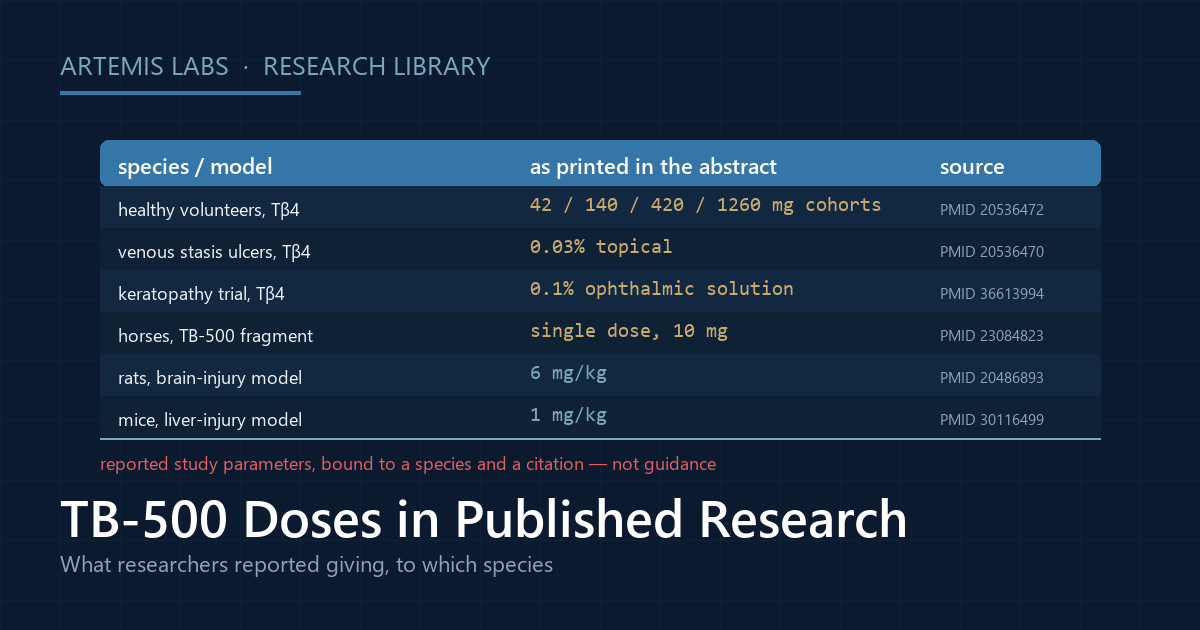
TB-500 doses in published research — answer capsule: No human dose of TB-500 has ever been published. Every human figure here belongs to full-length thymosin β4, the 43-amino-acid parent protein, not the seven-amino-acid TB-500 fragment: an intravenous Phase 1 safety study used single doses of 42, 140, 420, or 1260 mg (Ruff 2010, PMID 20536472), and the eye and skin trials used 0.1% or 0.03% solutions. The only administered TB-500 amount in this record is a single dose containing 10 mg, given to horses in a doping-detection study (Ho 2012, PMID 23084823). Everything below is a study parameter quoted from a published abstract — never guidance of any kind.
Key findings
- No published human dose of TB-500 exists. Searches across both of our verification passes found no human study that gave the fragment to anyone, and the reviews agree that “the indications, dosing, frequency, and duration of treatment remains unknown” for this class (Mayfield 2026, PMID 41476424).
- The only human systemic dose-ranging study used full-length thymosin β4, not TB-500: four cohorts of ten healthy volunteers received a single intravenous dose of placebo or synthetic Tβ4 at 42, 140, 420, or 1260 mg (Ruff 2010, PMID 20536472).
- The human eye trials used 0.1% solutions and the venous ulcer trial reported 0.03% — strengths of a liquid, again all full-length Tβ4 (Sosne 2015, PMID 25826322; Guarnera 2010, PMID 20536470).
- The single administered TB-500 figure in this whole record is 10 mg of N-acetylated LKKTETQ in horses, from a laboratory paper about detecting the compound in plasma and urine (Ho 2012, PMID 23084823).
Why publish this page at all?
The question gets asked constantly, and most of the answers online are invented. Sites that sell peptides publish TB-500 charts, calculators and schedules. None of that comes from the scientific literature, because the literature contains no human dosing study of TB-500. What it does contain is a set of experiments — mostly in animals, mostly using a different molecule — each of which recorded the exact amounts used. Reporting those numbers, with their sources and their limits, is the only honest version of this page anyone can write.
These are past-tense descriptions of experiments, quoted from cited abstracts. They are not instructions, starting points, or suggestions, and no figure here transfers to any other setting. Where a paper stated no number, this page attaches none and says so.
Which molecule was actually studied?
Almost every number below belongs to a different compound than the one people mean when they say TB-500. TB-500 is a synthetic seven-amino-acid peptide, Ac-LKKTETQ, weighing about 889 g/mol — a stretch of seven building blocks matching residues 17–23 from the middle of a longer protein. Thymosin β4 itself is 43 amino acids and roughly 4,963 daltons, about five and a half times heavier. They are related, and they are not the same molecule. A review in Sports Med lists them as two separate entries: “Tβ4 (thymosin beta-4), and TB-500 (thymosin beta-4 fragment)” (Mendias 2026, PMID 41966639).
So one rule governs this page: no dose from a thymosin β4 study is a TB-500 dose. Each figure below carries its form, species and method as the abstract states them. Our page on TB-500 human trials works through the same distinction study by study.
What amounts did the human studies use?
Every human study here used full-length thymosin β4.
- Intravenous Phase 1, healthy volunteers. “Four cohorts, with 10 healthy subjects each, were given a single intravenous dose of placebo or synthetic Tbeta4. Cohorts received ascending doses of either 42, 140, 420, or 1260 mg,” then “the same dose regimen daily for 14 days.” The range was “well tolerated with no evidence of dose limiting toxicity.” This was a safety study with no effectiveness endpoint (Ruff 2010, PMID 20536472).
- Severe dry eye, Phase 2. “RGN-259 (0.1%) or vehicle control 6 times daily over a period of 28 days” in nine patients (Sosne 2015, PMID 25826322). RGN-259 is a thymosin β4 eye solution.
- Dry eye in a controlled-environment model, Phase II. 72 subjects randomized 1:1 to “0.1% Tβ4” or placebo for 28 days (Sosne & Ousler 2015, PMID 26056426). Both pre-specified primary endpoints were missed in this trial — see the limitations below.
- Neurotrophic keratopathy, Phase III. 0.1% RGN-259 in 18 participants. Gap: the abstract does not state how often it was given (Sosne 2022, PMID 36613994). An independent 2025 Cochrane review restates the same concentration, “0.1% RGN-259” (PMID 41347649).
- Venous stasis ulcers, Phase 2. Topical Tβ4 in 73 patients across eight European sites; the authors wrote that “a Tbeta4 dose of 0.03% may have the potential to accelerate wound healing.” Gap: the abstract gives only “all doses” for the rest of the escalation ladder (Guarnera 2010, PMID 20536470).
- Compassionate use, corneal defects. Nine patients “treated with thymosin beta 4 (Tbeta4) sterile eye drops for 28 or 49 days.” Gap: no concentration is stated in the abstract (Dunn 2010, PMID 20536469).
- Heart attack trial. 96 patients, with a subgroup that “received the first dose of rhTB4 within 8 h after PCI (n = 43).” Gap: the milligram amount, how it was given, and the schedule are all absent from the abstract. This page supplies none (Zhang 2025, PMID 41229390).
Six of those studies print a figure. Two state a regimen with no figure at all. None of them is TB-500.
What amounts did the animal studies use?
These figures are written as milligrams per kilogram, meaning the amount scaled to the animal’s body weight. All are full-length thymosin β4 unless the entry says otherwise.
- Mice, Alzheimer’s model with an immune challenge: “Tβ4 (5 mg/kg, i.v.) or PBS … immediately following and at 2 and 4 h after the PBS or LPS challenge, and then once daily for 6 days” (Othman 2023, PMID 36878045).
- Pregnant mice: “intraperitoneal injection of TB4 … 6 mg/kg in PBS” (PMID 33506933). Intraperitoneal means into the abdominal cavity.
- Mice, alcohol-related liver injury: “Tβ4 (1 mg/kg, intraperitoneal) was administered for 1 week” (PMID 30116499).
- Diabetic mice, burn wound: “Five mg/kg of Tβ4 … injected intradermally near the burn wound twice a week for 2 weeks” (PMID 25230158) — into the skin at the wound itself, not through the body.
- Rats, traumatic brain injury: “Thymosin β(4) (6 mg/kg) … intraperitoneally starting at Day 1 and then every 3 days for an additional 4 doses” (Xiong 2011, PMID 20486893).
- Rats, interrupted blood flow to the aorta: “Tβ4 (10 mg/kg, intravenous) … at two different periods” (PMID 31121838).
- Mice, multiple-sclerosis model: “Tbeta4 (6 mg/kg, n=10) every 3 days … total five doses” (Zhang 2009, PMID 19782721).
- Mice, sepsis model: “100 microg of Tbeta(4)” given after an LPS challenge (Badamchian 2003, PMID 12860178). This one is printed per animal, not per kilogram, and this page does not convert it. The 24 mg/kg and 60 mg/kg figures in that same abstract are amounts of LPS, the bacterial toxin used to cause the illness — not amounts of Tβ4.
- Rats, brain injury, a different fragment: “AcSDKP (0.8 mg/kg/day) … starting 1 hour postinjury and continuously for 3 days using an osmotic minipump” (Zhang 2017, PMID 28245754). Ac-SDKP is the 1–4 fragment of thymosin β4 — a different piece of the protein than TB-500’s 17–23 stretch, and a third molecule again.
Three more animal studies report a concentration in a liquid or a mixture rather than a body-weight amount. In a rabbit-ear fat-grafting model, Tβ4 at “5 μg/mL” and “10 μg/mL” was premixed into the graft tissue itself (Qu 2020, PMID 32144415). A mouse dry-eye study “tested six different doses,” reporting that “active doses of 0.1 and 0.5% were determined” — the other four are not stated in the abstract (Sosne 2015, PMID 26096547). Another used “eye drops consisting of 0.05% and 0.1% rhTβ4” (Zhai 2022, PMID 35628276). A mixing ratio is a property of a preparation, not a body dose, and cannot be restated as one.
Is there any published TB-500 figure at all?
One, and it is not what people hope for. A doping-control laboratory paper describes “horses administered with a single dose of TB-500 (containing 10 mg of N-acetylated LKKTETQ),” and reports detection limits of “0.02 ng/mL in equine plasma and 0.01 ng/mL in equine urine” (Ho 2012, PMID 23084823). Its purpose was to build a test that finds the compound in a racehorse sample. It measured no healing and no clinical outcome of any kind. That is the only administered TB-500 amount in this entire record, and it belongs to horses and to analytical chemistry.
A second fragment paper looked at what happens to TB-500 in the body rather than what amount to give. It followed the compound in human serum, in laboratory enzyme systems, and in urine from rats that had received it, opening with the line: “The biological effects of TB-500, however, have not been documented.” It concluded that “the previously reported wound-healing activity of TB-500 in literature may be due to its metabolite Ac-LKKTE rather than the parent form.” Gap: the incubation concentrations and rat figures are not stated in the abstract (Rahaman 2024, PMID 38382158). It is not settled that the molecule sold as TB-500 is the active one.
What amounts were used in cell studies?
Cell work happens in a dish, so its numbers are concentrations in the growth liquid. Rat spinal-cord stem and progenitor cells were exposed to Tβ4 at “1, 2.5, 5 μg/ml” against an injury induced by “500 μM H2O2” (Li 2022, PMID 35979771). One frequently misquoted number belongs in a different category: a study of human blood-vessel cells “determined for Tβ4 binding to the β subunit of ATP synthase a K(D) of 12 nM” (Freeman 2011, PMID 21106936). That is a binding strength — how tightly two molecules stick together — not an amount given to anything, and never a dose.
What the research does not show
Study parameters are the weakest kind of evidence there is. They tell you what researchers tried, not what worked, and this page is a list of what was tried.
No human trial of TB-500 has ever been published — not for tissue repair, not for anything. Every human figure above is thymosin β4, a different and much larger molecule. Even inside that parent-protein record the results are mixed: the controlled-environment dry-eye Phase II missed both pre-specified primary endpoints, the Phase III in neurotrophic keratopathy reached p = 0.0656 on complete healing (above the usual 0.05 threshold), the Cochrane reviewers graded that same trial low-certainty with a confidence interval crossing 1, and the heart-attack trial’s whole-group comparison was not significant. Counter-evidence runs the other way too: in an irritable bowel syndrome model, Sun and colleagues (2025) reported that thymosin β4 released by mast cells reduced tight junction proteins and impaired intestinal barrier integrity in rats and mice, with elevated Tβ4 measured in the colonic mucus of patients (PMID 41278163). That study examined the body’s own full-length Tβ4, not the TB-500 fragment, and it reports no dose, concentration or schedule at all — so this page reports none for it. Our TB-500 safety research summary covers those findings in full.
Two figures you may meet elsewhere are absent here on purpose. Program code names sometimes attached to the intravenous Phase 1 return zero PubMed records, so this page names that study by its PMID instead. And BPC-157’s well-known two-arm design belongs to a different compound’s literature; nothing in this record attaches it to thymosin β4 or TB-500.
Frequently asked questions
Is there a recommended dose of TB-500?
No. There is no approved use, no published human trial of the fragment, and no published human dosing study. Any source stating one is not getting it from the scientific literature.
Does the Phase 1 human range apply to TB-500?
No. Those cohorts received full-length thymosin β4 — the 43-amino-acid parent protein — in a safety study in healthy volunteers. TB-500 is a seven-amino-acid piece of that protein, and it was not the compound tested.
Can the animal figures be converted into a human amount?
No published work makes that conversion for thymosin β4 or TB-500, and this page will not either. Species differ in how they handle peptides, several of these studies delivered the compound directly into a wound or a body cavity, and there is no human fragment trial to anchor a conversion against.
Where can I check these numbers myself?
Every figure links to its PubMed record in the References below.
References
- Ruff D, et al. (2010). Phase 1 intravenous safety study of synthetic thymosin β4 in healthy volunteers; ascending cohorts 42/140/420/1260 mg. Ann N Y Acad Sci. PMID 20536472
- Sosne G, et al. (2015). Phase 2, severe dry eye; RGN-259 (0.1%) six times daily for 28 days. Cornea. PMID 25826322
- Sosne G, Ousler GW. (2015). Phase II, controlled adverse environment dry-eye model; 72 subjects, 0.1% Tβ4, 28 days; both primary endpoints missed. PMID 26056426
- Sosne G, et al. (2022). Phase III, neurotrophic keratopathy; 0.1% RGN-259; complete healing p = 0.0656. PMID 36613994
- Kruoch Z, et al. (2025). Cochrane review CD015723; 0.1% RGN-259 restated; low-certainty evidence. PMID 41347649
- Guarnera G, et al. (2010). Phase 2, venous stasis ulcers, 73 patients; 0.03% topical Tβ4. PMID 20536470
- Dunn SP, et al. (2010). Compassionate use, nine patients; eye drops for 28 or 49 days; concentration not stated. PMID 20536469
- Zhang J, et al. (2025). Randomized placebo-controlled rhTB4 trial in STEMI, 96 patients; dose, route and schedule not stated in abstract. Cardiovasc Res. PMID 41229390
- Ho ENM, et al. (2012). Doping-control detection of TB-500 in horses; single dose containing 10 mg N-acetylated LKKTETQ. J Chromatogr A. PMID 23084823
- Rahaman KA, et al. (2024). TB-500 metabolism; “biological effects … have not been documented”; Ac-LKKTE as possible active metabolite. PMID 38382158
- Othman MA, et al. (2023). Mice, APP/PS1 model with LPS challenge; Tβ4 5 mg/kg i.v. PMID 36878045
- Pregnant-mouse study (2021). TB4 6 mg/kg in PBS, intraperitoneal. PMID 33506933
- Alcoholic liver injury study (2018). Mice; Tβ4 1 mg/kg intraperitoneal for one week. PMID 30116499
- Diabetic-mouse burn-wound study (2014). Tβ4 5 mg/kg intradermally near the wound, twice weekly for two weeks. PMID 25230158
- Xiong Y, et al. (2011). Rats, traumatic brain injury; Tβ4 6 mg/kg intraperitoneally, Day 1 then every 3 days ×4. PMID 20486893
- Aortic ischemia-reperfusion study (2019). Rats; Tβ4 10 mg/kg intravenous at two time points. PMID 31121838
- Zhang J, et al. (2009). SJL/J mice, EAE model; Tβ4 6 mg/kg every 3 days, five doses. PMID 19782721
- Badamchian M, et al. (2003). Mice, endotoxin model; 100 µg Tβ4 per animal (not per kg). PMID 12860178
- Zhang Y, et al. (2017). Rats, TBI; AcSDKP (the 1–4 fragment) 0.8 mg/kg/day by osmotic minipump for 3 days. PMID 28245754
- Qu Z, et al. (2020). Rabbit-ear fat grafting; Tβ4 premixed at 5 and 10 µg/mL. PMID 32144415
- Sosne G, et al. (2015). Murine controlled-adverse-environment dry eye; six doses tested, active doses 0.1% and 0.5%. PMID 26096547
- Zhai J, et al. (2022). BAC-induced mouse dry eye; eye drops of 0.05% and 0.1% rhTβ4. PMID 35628276
- Li X, et al. (2022). Rat spinal-cord neural stem/progenitor cells; Tβ4 at 1, 2.5 and 5 µg/mL against 500 µM H2O2. PMID 35979771
- Freeman KW, et al. (2011). HUVECs; K(D) of 12 nM for Tβ4 binding to the β subunit of ATP synthase — an affinity constant, not a dose. PMID 21106936
- Sun YS, et al. (2025). Thymosin β4 from mast cells impairs the intestinal epithelial barrier in an IBS model; no dose figures reported. World J Gastroenterol. PMID 41278163 · DOI: 10.3748/wjg.v31.i42.111706
- Mayfield CK, et al. (2026). Physician review; indications, dosing, frequency and duration “remains unknown”; human orthopaedic data lacking. Am J Sports Med. PMID 41476424
- Mendias CL, Awan TM. (2026). Review listing “Tβ4 (thymosin beta-4), and TB-500 (thymosin beta-4 fragment)” as separate compounds; human safety data scarce. Sports Med. PMID 41966639
Methodology: every figure on this page was taken verbatim from its PubMed abstract and checked against the Artemis TB-500 verified facts sheet on August 23, 2026; where an abstract states no number, this page states none, and no figure was converted, normalised, or transferred between species, forms, or routes.
All compounds sold by Artemis Labs are for laboratory research use only. Nothing on this page is medical advice, and no statement has been evaluated by the FDA.
