
Reading a TB-500 Certificate of Analysis
Aug
Reading a TB-500 Certificate of Analysis
Published August 23, 2026 · Artemis Labs
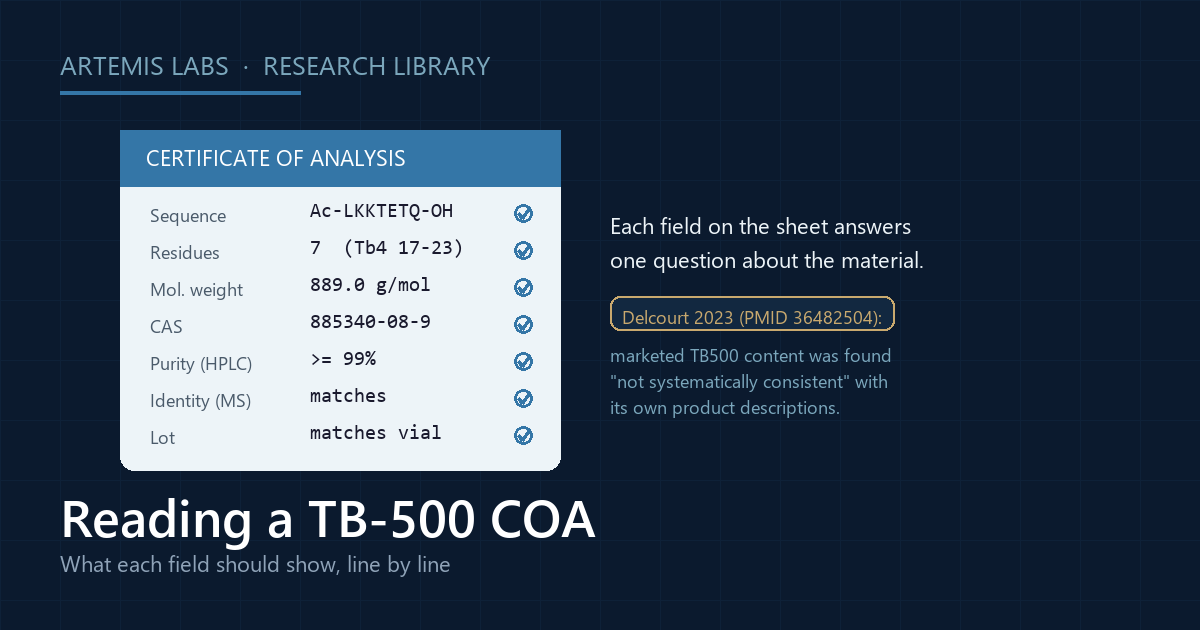
Certificate of analysis (COA) — answer capsule: a COA is the lab report that says what is actually inside a vial. For TB-500 it should match one specific molecule: the acetylated seven-residue peptide Ac-LKKTETQ, molecular weight 889.0 g/mol. A 2023 peer-reviewed analysis of marketed TB500 and TB1000 products reported that their content “is not systematically consistent” with the descriptions sold alongside them (PMID 36482504). That published result is the reason batch-level testing matters for this compound in particular.
Key findings
- Delcourt and colleagues (2023) analysed products sold as TB500 and TB1000 and concluded that their content “is not systematically consistent with it’s former descriptions” — a finding about the marketed product class, not about any one seller (PMID 36482504).
- The identity a TB-500 COA has to land on: Ac-Leu-Lys-Lys-Thr-Glu-Thr-Gln-OH, seven amino acids with an acetyl cap on the front end. Formula C38H68N10O14, molecular weight 889.0 g/mol, CAS 885340-08-9, PubChem CID 62707662.
- The uncapped version of the same seven amino acids is a separate compound at 847.0 g/mol (PubChem CID 10169788). The cap is a real +42 Da difference, and two primary papers state that TB-500 is the acetylated form (PMID 23084823, PMID 22962027).
What is a certificate of analysis?
A certificate of analysis is a short lab report tied to one specific batch of material, called a lot. It answers two questions: what is this? and how much of the sample is that thing? Different tests, and a COA answering only one has told you half the story. The general walkthrough of COA sections and terms lives in the guide to reading one. This page is the TB-500-specific companion, because TB-500 carries an identity trap most compounds do not.
Why does TB-500 need a batch report more than most compounds?
Because the published literature says products sold under that name have not reliably been what their labels claimed. Delcourt et al. published an analysis in Drug Testing and Analysis in 2023 titled “TB500/TB1000 and SGF1000: A scientific approach for a better understanding of misbranded and adulterated drugs.” Their conclusion, verbatim: “We confirm that the content of TB500/TB1000 products is not systematically consistent with it’s former descriptions.” The same paper describes the wider category as carrying a “lack of official control over the production of these substances and the absence of approval by health authorities.”
Read plainly: a peer-reviewed group looked at what was in TB500-labelled vials on the market and found the labels and the contents did not line up dependably. That is the literature making the case for lot testing, not a seller making it. It is also a finding about the products those authors obtained — it does not test, clear, or condemn any particular supplier’s current material, ours included. Any specific vial only gets an answer from a report on its own lot.
What identity values should a TB-500 COA match?
Four values, and they should agree with each other.
Sequence. Leu-Lys-Lys-Thr-Glu-Thr-Gln, written LKKTETQ. Seven residues, matching positions 17 through 23 of a larger protein called thymosin β4. That relationship is covered in depth on what TB-500’s sequence actually is.
The acetyl cap. The marketed article is acetylated at the N-terminus — the front end of the chain carries a small added group. Two primary abstracts say so outright. PMID 23084823: “The key ingredient of TB-500 is the peptide LKKTETQ with artificial acetylation of the N-terminus.” PMID 22962027 calls it “the N-terminal acetylated 17-23 fragment of human thymosin beta 4 (Ac-LKKTETQ).”
Molecular weight and identifiers. 889.0 g/mol, formula C38H68N10O14, CAS 885340-08-9, PubChem CID 62707662, UNII QHK6Z47GTG. The 889.0 figure is what a mass spectrometry trace should support.
Here is the trap. A COA reporting a mass near 847 is describing the uncapped free acid — the same seven amino acids without the acetyl group, filed on PubChem as a separate compound, CID 10169788. A 42-dalton gap looks small and is a different molecule. Either result is a legitimate thing for a lab to report; only one is the article sold as TB-500.
One further number, so it is not mistaken for a match: roughly 4,963 Da, CAS 77591-33-4. That is full-length thymosin β4, the 43-amino-acid parent protein, about five and a half times heavier than the fragment. Related molecule, not the same one.
What do the HPLC and MS lines actually tell you?
Reverse-phase HPLC — high-performance liquid chromatography — pushes the sample through a column so its components come out separated in time. The report gives a percentage: how much of the total signal belongs to the largest peak. That is purity. A specification is the number a product is meant to meet; a lot report is what a specific batch actually measured. They are not the same document and a specification is not evidence about any particular vial.
Mass spectrometry weighs the molecule, and that is the identity half. Purity alone says one component dominates without saying which. Purity plus a mass matching 889.0 is the pair that means something.
What changes when TB-500 comes in a blend?
TB-500 is not sold on its own here.
For any multi-component blend, one combined assay is not enough. Each component needs its own HPLC trace and its own mass identity confirmation, because a single number covering a mixture cannot be worked backwards into the purity of one ingredient inside it. A blend COA showing one peak percentage and one mass has not reported per-component data, whatever the header says.
What the research does not show
A COA describes the contents of a container. It says nothing about what the compound does, and on that question the record is thin.
There is no published human clinical trial of TB-500 itself. Not one. A 2026 review in Sports Medicine lists “Tβ4 (thymosin beta-4), and TB-500 (thymosin beta-4 fragment)” as two separate unapproved compounds and states that “rigorous human safety data are scarce, and there is potential for serious harm to patients” (PMID 41966639). Nearly every study cited for TB-500 was run on the 43-residue parent protein, not the seven-residue fragment.
Even the identity question has an open end. Rahaman et al. (2024) followed TB-500 through human serum, laboratory enzyme systems, and urine from treated rats. Their opening line: “The biological effects of TB-500, however, have not been documented.” They concluded that previously reported wound-healing activity “may be due to its metabolite Ac-LKKTE rather than the parent form” (PMID 38382158). A COA confirms the vial holds Ac-LKKTETQ. Whether Ac-LKKTETQ is the active species is unsettled.
Counter-evidence exists on the parent protein. In an IBS model, Sun et al. (2025) reported that thymosin β4 released by mast cells reduced tight junction proteins and impaired intestinal epithelial barrier integrity in rats and mice, with elevated Tβ4 measured in the colonic mucus of IBS patients. That study examined endogenous full-length Tβ4, not the TB-500 (17–23) fragment (PMID 41278163).
And what this site does not offer yet. There is no public lot-lookup portal and no page of published chromatograms. We do not currently publish batch documents. The manufacturer performs periodic quality testing on production batches. If independent batch-matched documentation becomes something we can publish and defend, this page will say so.
Frequently asked questions
My COA says 847 g/mol. Is that TB-500?
That mass corresponds to the uncapped free acid LKKTETQ (PubChem CID 10169788), not the acetylated form sold as TB-500. The acetylated article is 889.0 g/mol, CID 62707662. Ask the supplier which one the lot contains.
Does a COA prove a compound works?
No. A COA is an inventory of what is in the vial. It carries no information about biological effect, and for TB-500 there is no published human trial of the fragment to draw on regardless.
Does a COA from a different lot count?
It tells you about that lot only. The Delcourt 2023 finding is specifically about content varying against description, which is a batch-level problem, so a report from another batch does not answer the question for the one in front of you.
References
- Delcourt et al., 2023. “TB500/TB1000 and SGF1000: A scientific approach for a better understanding of misbranded and adulterated drugs.” Drug Test Anal. PMID 36482504 — product content “is not systematically consistent with it’s former descriptions.”
- Ho et al., 2012. J Chromatogr A. PMID 23084823 — doping-control detection study in horses; states that “the key ingredient of TB-500 is the peptide LKKTETQ with artificial acetylation of the N-terminus.”
- PMID 22962027, 2012 — describes “the N-terminal acetylated 17-23 fragment of human thymosin beta 4 (Ac-LKKTETQ).”
- Rahaman et al., 2024. PMID 38382158 — TB-500 metabolism in human serum, in-vitro enzyme systems, and urine from treated rats.
- Mendias et al., 2026. Sports Med. PMID 41966639 — review listing Tβ4 and TB-500 as separate unapproved compounds.
- Sun YS, Bai XQ, Sun KD, Li J, Liu L, Chen YY, Zeng ZY, Wang Q, Guo YB, 2025. “Thymosin β4 released by mast cells under stress conditions impairs intestinal epithelial barrier via IL22RA1/JAK1/STAT3 signaling in irritable bowel syndrome.” World J Gastroenterol. 2025 Nov 14;31(42):111706. PMID 41278163 · DOI 10.3748/wjg.v31.i42.111706
- PubChem compound records: CID 62707662 (Ac-LKKTETQ, 889.0 g/mol), CID 10169788 (LKKTETQ free acid, 847.0 g/mol), CID 45382195 (thymosin β4, 43 residues). Retrieved 2026-08-23.
Methodology: this page draws on the Artemis Labs TB-500 verified facts sheet — PubMed abstracts retrieved by NCBI E-utilities and compound identity values pulled from PubChem PUG-REST. Last verified 2026-08-23.
All compounds sold by Artemis Labs are for laboratory research use only. Nothing on this page is medical advice, and no statement has been evaluated by the FDA.
