
TB-500 Sequence and Identity: The Analytical Facts
Aug
TB-500 Sequence and Identity: The Analytical Facts
Published August 23, 2026 · Artemis Labs
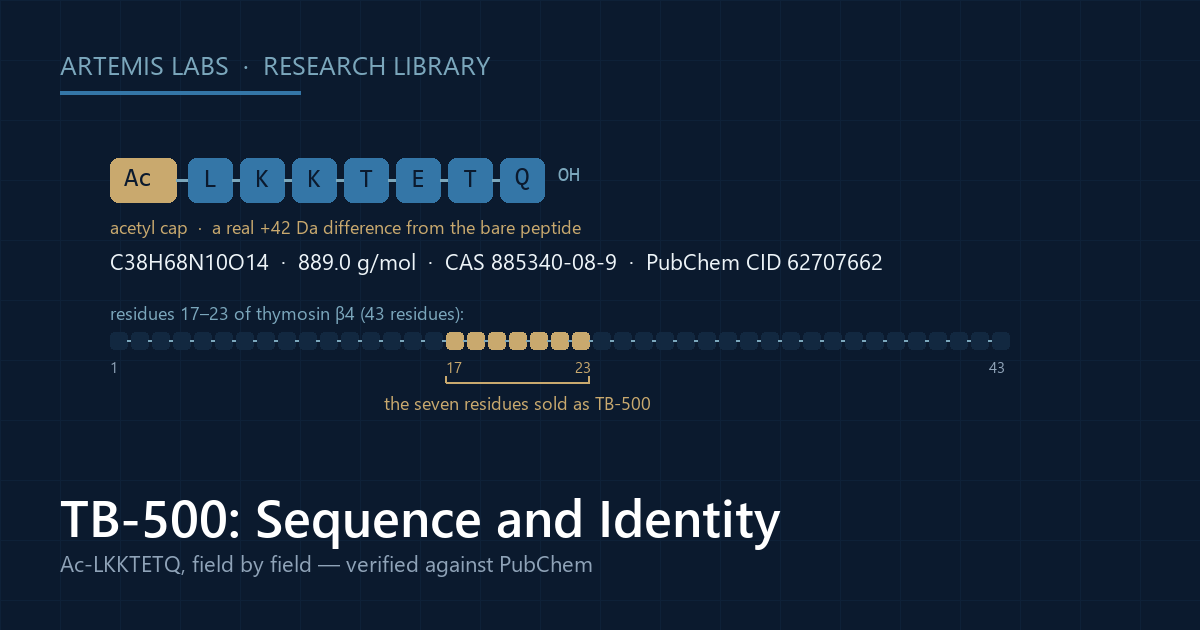
TB-500 — answer capsule: TB-500 is a seven-amino-acid synthetic peptide, written Ac-LKKTETQ-OH. It copies residues 17 to 23 of thymosin β4, a 43-amino-acid parent protein. The form sold as TB-500 carries an acetyl cap on one end: molecular weight 889.0 g/mol, formula C38H68N10O14, CAS 885340-08-9, PubChem CID 62707662. The uncapped version of those same seven letters weighs 847.0 and is a separate database record.
Key findings
- The acetyl cap is stated outright in two published abstracts, not inferred: “the key ingredient of TB-500 is the peptide LKKTETQ with artificial acetylation of the N-terminus” (PMID 23084823), and “the N-terminal acetylated 17-23 fragment of human thymosin beta 4 (Ac-LKKTETQ)” (PMID 22962027).
- The parent protein’s length is confirmed twice in recent abstracts: a 2026 review calls thymosin β4 “a highly conserved 43-amino-acid peptide encoded by the X-linked TMSB4x gene” (PMID 41570941), and a 2025 cell study calls it “a secreted 43 amino acid peptide” (PMID 41326489).
- CAS 77591-33-4 belongs to the parent protein, not the fragment. It resolves to PubChem CID 16132341, titled timbetasin. The fragment’s own number is CAS 885340-08-9.
- One review is the only checked source calling this sequence an actin-binding domain: “LKKTETQ, the central actin-binding domain (aa 17-23) plus 1 additional amino acid (Q)” (PMID 20179146).
What is TB-500, spelled out letter by letter?
A peptide is a short chain of amino acids, the building blocks that also make up proteins. Each amino acid in a chain is called a residue. TB-500 has seven, in this order: leucine, lysine, lysine, threonine, glutamic acid, threonine, glutamine. Chemists shorten each to a single letter, which gives LKKTETQ.
Written in full, the molecule sold as TB-500 is Ac-Leu-Lys-Lys-Thr-Glu-Thr-Gln-OH, usually shortened to Ac-LKKTETQ-OH. The “Ac-” at the front is an acetyl group, a small chemical cap on one end of the chain. That cap is part of the molecule, and it changes the numbers.
What are the verified identity numbers?
These values come from a PubChem lookup run on August 23, 2026, cross-checked against the abstracts cited here. Molecular weight is how heavy one molecule is, in daltons (Da) or grams per mole. A CAS number is a chemical’s unique registry ID; a PubChem CID is its record number in the public PubChem database.
| Property | TB-500 (the fragment) | Thymosin β4 (the parent) |
|---|---|---|
| Sequence | Ac-LKKTETQ-OH | Full 43-residue chain (see alignment below) |
| Length | 7 amino acids | 43 amino acids |
| Position in parent | Residues 17–23 | Residues 1–43 |
| Molecular formula | C38H68N10O14 | C212H350N56O78S |
| Molecular weight | 889.0 g/mol | ~4,963 Da |
| CAS number | 885340-08-9 | 77591-33-4 (thymosin β4 / timbetasin) |
| PubChem CID | 62707662 | 45382195 / 16132341 |
| UNII code | QHK6Z47GTG | not recorded in this review |
The weight gap is the fastest sanity check available. The parent protein is roughly five and a half times heavier than the fragment. Any listing that puts a four-figure weight next to the name TB-500 is describing the parent protein, whatever the label says.
Artemis does not sell TB-500 on its own.
Why does the acetyl cap matter?
Adding an acetyl group to the end of a peptide adds 42 daltons of mass. That is small next to the whole molecule, and large enough to show up clearly on a mass spectrometer, the instrument a testing lab uses to weigh molecules and confirm what is in a vial. So the same seven letters exist as two separate database entries:
- Acetylated (Ac-LKKTETQ-OH) — formula C38H68N10O14, MW 889.0, PubChem CID 62707662. This is the form commercial TB-500 and reference standards are sold as.
- Free acid (bare LKKTETQ) — formula C36H66N10O13, MW 847.0, PubChem CID 10169788. Same sequence, no cap, different record.
The identification trap follows from that. If a spec sheet or a lab report shows 847.0 under the heading TB-500, the two forms have been confused somewhere in the chain. It is not a rounding difference. Artemis publishes 889.0 because that is the number matching the acetylated article, and a spec sheet that leaves the cap unstated leaves a real 42-dalton question open.
The same logic applies to the registry numbers. CAS 77591-33-4 resolves to PubChem CID 16132341, titled timbetasin, the international nonproprietary name for the parent protein. The fragment’s number is 885340-08-9. Swapping the two is the most common identity error in this compound’s paperwork, and it appeared in Artemis’s own internal records before this review corrected it.
Where does the fragment sit inside the parent protein?
Thymosin β4 is a 43-residue protein the body makes on its own. Line the fragment up against the full chain (PubChem CID 45382195) and the match is exact:
Ac-SDKPDMAEIEKFDKSK|LKKTETQ|EKNPLPSKETIEQEKQAGES-OH
The section between the bars is positions 17 through 23: L-K-K-T-E-T-Q. That is the whole of TB-500. Everything outside those bars is in the parent protein and absent from the fragment.
One more molecule gets tangled into this. Ac-SDKP is a different piece of the same parent: residues 1 to 4, at the opposite end, produced when the body breaks thymosin β4 down. Several published studies use Ac-SDKP. It is not TB-500, and a finding about one fragment is not a finding about the other.
The plain-language version, repeated on every page in this series: TB-500 is a synthetic, acetylated seven-residue peptide matching residues 17–23 of thymosin β4. Thymosin β4 itself is a 43-residue protein about five and a half times heavier. They are related, and they are not the same molecule. A 2026 sports-medicine review lists them as two separate entries for that reason, naming “Tβ4 (thymosin beta-4), and TB-500 (thymosin beta-4 fragment)” (PMID 41966639). The full side-by-side comparison lives on TB-500 vs thymosin beta-4.
What is known about what this sequence does?
Actin is a protein that forms part of a cell’s internal scaffolding. An actin-binding domain is the stretch of a larger protein that attaches to actin. Sosne and colleagues, in a 2010 review, wrote that “a short sequence containing LKKTETQ, the central actin-binding domain (aa 17-23) plus 1 additional amino acid (Q), promotes angiogenesis, wound healing, and cell migration” (PMID 20179146). Angiogenesis means the growth of new blood vessels.
That sentence is the extent of the verified support for calling this sequence an actin-binding domain, and it comes from a review summarising other work rather than from an experiment in that paper. Artemis states it as what one review said and does not extend it.
What the research does not show
There is no published human clinical trial of TB-500 itself. Searches on TB-500, TB500, and LKKTETQ crossed with human, patient, safety, and adverse terms returned none. The human studies in this area all used the 43-residue parent protein.
The fragment’s own pharmacology paper opens by saying so. Rahaman and colleagues (2024) wrote: “The biological effects of TB-500, however, have not been documented” (PMID 38382158). That study followed TB-500 in human serum, in laboratory enzyme systems, and in urine from rats given TB-500, and concluded that “the previously reported wound-healing activity of TB-500 in literature may be due to its metabolite Ac-LKKTE rather than the parent form.” It is not settled that the seven-residue molecule is the active species at all.
Several mechanism phrases that circulate widely for this compound, including claims about sequestering free actin and about mobilising stem cells, are not supported by any abstract checked for this page. Artemis removed them rather than repeat them unsourced.
Counter-evidence belongs here too. Sun and colleagues (2025) reported that thymosin β4 released by mast cells reduced tight junction proteins and impaired intestinal barrier integrity in rats and mice, with elevated thymosin β4 measured in the colonic mucus of patients with irritable bowel syndrome (PMID 41278163). That study examined the body’s own full-length thymosin β4, not the TB-500 fragment, and it had no human dosing arm of any kind.
Frequently asked questions
Is TB-500 the same thing as thymosin β4?
No. TB-500 is seven amino acids and weighs 889.0. Thymosin β4 is 43 amino acids and weighs about 4,963 daltons. The fragment matches positions 17 to 23 of the parent.
Why do different sources give 889.0 and 847.0?
They describe different forms of the same sequence: 889.0 is the acetylated molecule (CID 62707662), 847.0 the uncapped free acid (CID 10169788). TB-500 is the acetylated one.
Does TB-500 have five amino acids?
No. It has seven: L, K, K, T, E, T, Q. The “five” figure appears in some comparison articles and matches neither PubChem nor the published abstracts.
How would a lab confirm which molecule is in a vial?
Two checks together: HPLC for purity, and mass spectrometry for identity, since the acetyl cap shifts the measured mass by a known 42 daltons. Delcourt and colleagues (2023) examined marketed TB500 and TB1000 products and reported that “the content of TB500/TB1000 products is not systematically consistent with it’s former descriptions” (PMID 36482504). What a certificate of analysis should show is covered on the TB-500 certificate of analysis guide.
References
- Ho (2012), J Chromatogr A — doping-control detection work in horses; states the artificial N-terminal acetylation of LKKTETQ. PMID 23084823
- Analytical report naming “the N-terminal acetylated 17-23 fragment of human thymosin beta 4 (Ac-LKKTETQ)”. PMID 22962027
- Sosne (2010), review — LKKTETQ described as the central actin-binding domain, residues 17-23. PMID 20179146
- Di (2026), Peptides — narrative review of the thymosin β4 / Ac-SDKP axis in kidney injury and repair; source of the 43-amino-acid, TMSB4x-encoded description. PMID 41570941 · doi:10.1016/j.peptides.2026.171467
- Stewart (2025), Sci Rep — study in human brain microvascular endothelial cells; source of the “secreted 43 amino acid peptide” description. PMID 41326489 · doi:10.1038/s41598-025-28435-2
- Rahaman (2024) — TB-500 metabolism in human serum, in vitro enzyme systems, and urine from TB-500-treated rats. PMID 38382158
- Mendias (2026), Sports Med — review of unapproved gray-market peptides; lists thymosin beta-4 and TB-500 as two separate entries. PMID 41966639
- Sun YS, Bai XQ, Sun KD, Li J, Liu L, Chen YY, Zeng ZY, Wang Q, Guo YB. “Thymosin β4 released by mast cells under stress conditions impairs intestinal epithelial barrier via IL22RA1/JAK1/STAT3 signaling in irritable bowel syndrome.” World J Gastroenterol. 2025 Nov 14;31(42):111706. PMID 41278163 · doi:10.3748/wjg.v31.i42.111706
- Delcourt (2023), Drug Test Anal. “TB500/TB1000 and SGF1000: A scientific approach for a better understanding of misbranded and adulterated drugs.” PMID 36482504
- PubChem PUG-REST records, retrieved August 23, 2026: CID 62707662 (Ac-LKKTETQ-OH), CID 10169788 (LKKTETQ free acid), CID 45382195 and CID 16132341 (thymosin β4 / timbetasin).
Methodology: this page draws on a fresh PubChem identity lookup and on the abstracts of the peer-reviewed papers listed above, each read in full and quoted verbatim where a number or a definition is at stake. Identity values last verified August 23, 2026.
All compounds sold by Artemis Labs are for laboratory research use only. Nothing on this page is medical advice, and no statement has been evaluated by the FDA.
