
TB-500 Safety Research: Published and Missing
Aug
TB-500 Safety Research: What Is Published and What Is Missing
Published August 23, 2026 · Artemis Labs
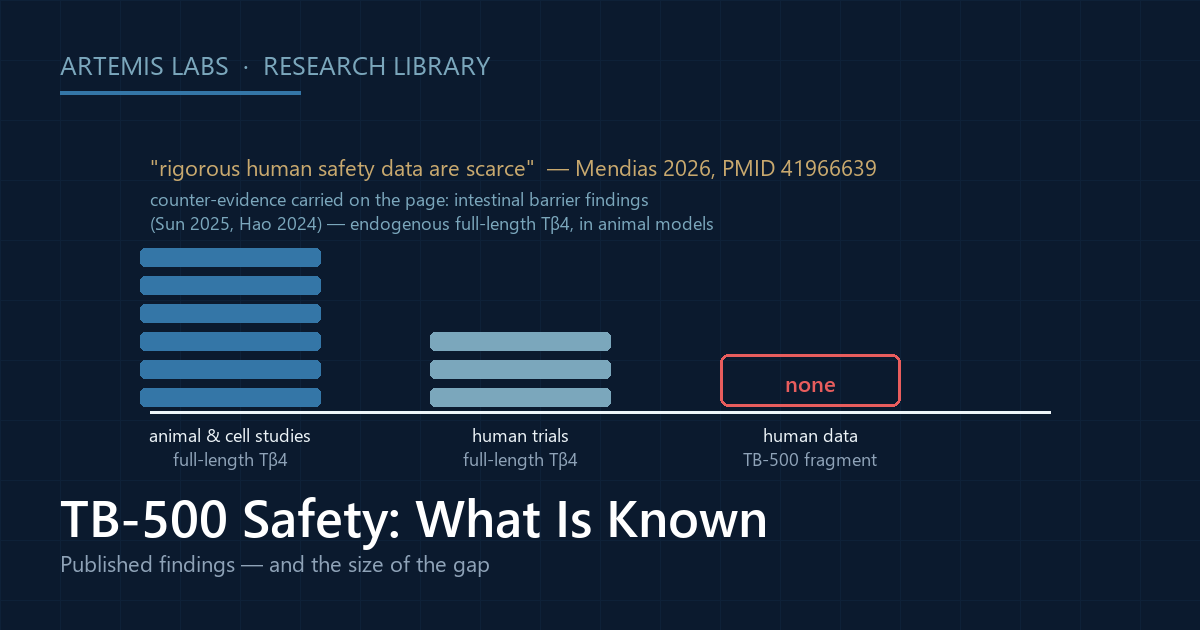
TB-500 safety research — answer capsule: No published human trial of TB-500 exists, so the molecule sold under that name has no human safety record. The safety papers that do exist tested full-length thymosin β4, the 43-amino-acid parent protein, chiefly a Phase 1 intravenous study in 40 healthy volunteers that found no dose-limiting toxicity. Other studies report negative findings, including gut-barrier damage in rodents. A 2026 Sports Medicine review: “rigorous human safety data are scarce, and there is potential for serious harm to patients.”
Key findings
- Mendias et al. (2026), reviewing unapproved gray-market compounds, lists “Tβ4 (thymosin beta-4), and TB-500 (thymosin beta-4 fragment)” as two separate entries and states that “rigorous human safety data are scarce, and there is potential for serious harm to patients” (PMID 41966639).
- The one published human systemic safety study used synthetic full-length thymosin β4 in four cohorts of 10 healthy subjects each, and reported it “well tolerated with no evidence of dose limiting toxicity” (PMID 20536472).
- Two rodent studies report the parent protein damaging the intestinal barrier rather than protecting it (PMID 41278163, PMID 38049080).
- An analysis of commercial TB500/TB1000 products found their contents “not systematically consistent with it’s former descriptions” (PMID 36482504).
Which molecule was actually tested?
This question decides everything else on the page. TB-500 is a synthetic seven-residue peptide, Ac-LKKTETQ, capped with an acetyl group at one end, matching residues 17 to 23 of thymosin β4. Thymosin β4 itself is a 43-residue protein about five and a half times heavier. They are related, and they are not the same molecule.
Nearly every safety paper below tested the parent, not the fragment. Where a study did test the fragment, this page says so in the sentence that cites it. Blurring that line turns a parent-protein safety record into a fragment record it was never meant to be.
What did the human safety study find?
Ruff and colleagues (2010) ran a Phase 1 study of synthetic full-length thymosin β4 given intravenously. The design, as printed: four cohorts, 10 healthy subjects each, randomized to placebo or peptide at one of four ascending dose levels, repeated daily for 14 days after a safety review. Reported outcome, verbatim: “Adverse events were infrequent, and mild or moderate in intensity. There were no dose limiting toxicities or serious adverse events.”
Three boundaries travel with that result. The compound was the parent protein, not TB-500. The participants were healthy volunteers in small cohorts. And the study measured safety only, with no efficacy endpoint. A tolerability signal in 40 healthy adults over two weeks is not a long-term safety record. Two smaller parent-protein datasets point the same way: a Phase 2 trial in 73 patients with venous stasis ulcers called the safety profile “acceptable and comparable to placebo” (PMID 20536470), and a Phase 3 eye trial in 18 patients reported that “no significant adverse effects were observed” (PMID 36613994). A 2026 gerontology review put the whole class in context: non-approved peptides “lack long-term safety data and systematic validation” (PMID 42021992).
Where has published research reported harm?
Sun et al. (2025) studied thymosin β4 in irritable bowel syndrome. Their reported result: thymosin β4 released by mast cells, the immune cells that sit in tissue and release signalling molecules under stress, reduced tight junction proteins — the proteins that seal the gaps between gut lining cells — and impaired intestinal barrier integrity in rats and mice. Rats genetically lacking the protein resisted stress, and adding it back removed that resistance. Elevated levels were measured in the colonic mucus of IBS patients.
Three limits keep that finding honest. The study examined endogenous, full-length thymosin β4 that the body makes itself, not the TB-500 fragment. There was no human dosing arm; the human component was a measurement. And it is a finding about disease mechanism, with the authors interested in blocking the protein in IBS, rather than a toxicity study. Our TB-500 gut research page works through it in full.
Hao et al. (2024) points the same direction in a different model, reporting that upregulated thymosin β4 in inflammatory bowel disease “impairs the intestinal mucus barrier by inhibiting autophagy in mice,” with reduced mucin2 production and disrupted tight junctions in treated mice, confirmed in cultured cells and human colon tissue. Two caveats: the dose is not stated in the abstract, and the author group overlaps with Sun 2025. These are related programmes, not independent replication.
Why does the source of the peptide change the answer?
A 2016 liver review states the tension directly. Verbatim: “Treatment with the exogenous Tβ4 peptide inhibits the proliferation and migration of activated HSCs and reduces liver fibrosis, indicating it has an antifibrotic action. Meanwhile, the endogenously expressed Tβ4 in activated HSCs is shown to promote HSC activation” (PMID 27450733). HSCs are hepatic stellate cells, the liver cells that drive scar formation. In one tissue, peptide supplied from outside and peptide made inside the cell pushed in opposite directions. That is why the gut findings above are hard to transfer either way.
What went wrong inside the positive studies?
Safety and reliability are not the same thing. Several better-known positive results carry negative details that usually get dropped. All but the last used the parent protein.
- In a Phase 2 dry-eye trial of 72 subjects, “neither of the primary endpoints, ie, ocular discomfort or inferior corneal staining, showed a significant difference between treatment and control groups at visit 5” (PMID 26056426). The positive numbers were secondary.
- In the Phase 3 neurotrophic keratopathy trial, complete healing at 4 weeks occurred in 6 of 10 treated and 1 of 8 placebo subjects, p = 0.0656, above the 0.05 threshold. An independent Cochrane review of that trial graded the evidence low-certainty, with a confidence interval crossing 1 (PMID 41347649).
- In a randomized trial in 96 heart attack patients, “the overall differences in infarcted areas were not significantly between the rhTB4 group and the placebo group.” The positive result was a subgroup, and three co-authors are employees of the manufacturer (PMID 41229390).
- In a compassionate-use series of nine patients, six with geographic corneal defects healed, but “stromal thinning was observed in one patient” and three showed no demonstrable change (PMID 20536469).
- A mouse study of the fragment TB500 in an Alzheimer’s model reported improved behaviour and reduced glial activation, and also that “hippocampal Aβ burden remained unchanged” (PMID 41443105).
What is in a vial sold as TB-500?
A 2023 paper in Drug Testing and Analysis examined misbranded and adulterated TB500/TB1000 products and concluded, verbatim: “We confirm that the content of TB500/TB1000 products is not systematically consistent with it’s former descriptions.” The authors added that administering such products is dangerous “considering the lack of official control over the production of these substances and the absence of approval by health authorities.” That is the clearest published argument for insisting on a lot-specific certificate of analysis.
What the research does not show
No published human clinical trial of TB-500 (Ac-LKKTETQ) exists. Searches on TB-500, TB500, and LKKTETQ crossed with human, patient, adverse, and safety terms returned none, so every human safety figure on this page belongs to the 43-residue parent protein. There is also no human musculoskeletal, tendon, muscle, or recovery evidence for either molecule: a 2026 orthopaedic review reported that both “promoted angiogenesis and tissue repair in preclinical models, but human orthopaedic data are lacking” (PMID 41476424), and a PRISMA scoping review found 67% of publications used animal models, with human studies “most lacking robust controls or rigorous study designs” (PMID 42578445). Parent-protein human data is confined to eye, skin, and one cardiac trial, and its best-developed programme is graded low-certainty by Cochrane. Full US Food and Drug Administration approval is still pending, per a 2025 research paper (PMID 41235866).
One further gap sits underneath all of it. A 2024 metabolism study opened by stating that “the biological effects of TB-500, however, have not been documented,” and concluded that the reported wound-healing activity “may be due to its metabolite Ac-LKKTE rather than the parent form” (PMID 38382158). It is not settled that the seven-residue molecule is the active species at all. Our page on TB-500 human trials covers that inventory in detail.
Frequently asked questions
Is there a human safety study of TB-500?
No. The Phase 1 intravenous safety study in healthy volunteers used synthetic full-length thymosin β4, the 43-residue parent protein. No human study of the seven-residue TB-500 fragment has been published.
Does the gut research mean TB-500 harms the intestine?
It does not show that. Sun 2025 and Hao 2024 studied the parent protein, mostly in rodents, and Sun 2025 examined the body’s own supply rather than an administered preparation. Neither included a human dosing arm.
Why do researchers report both protective and harmful results?
The 2016 liver review found that peptide supplied from outside and peptide expressed inside cells pushed fibrosis in opposite directions in the same tissue. Model, species, source, and tissue all changed the reported direction.
References
- Mendias CL, et al. Unapproved peptides in sport. Sports Med. 2026. PMID 41966639
- Ruff D, et al. Phase 1 intravenous safety study of synthetic thymosin β4 in healthy subjects. Ann N Y Acad Sci. 2010. PMID 20536472
- Guarnera G, et al. Phase 2 topical thymosin β4 in venous stasis ulcers. 2010. PMID 20536470
- Sosne G, et al. Phase 3 RGN-259 in neurotrophic keratopathy. 2022. PMID 36613994
- Mavrych V, et al. Therapeutic peptides in gerontology. Front Aging. 2026. PMID 42021992
- Mayfield C, et al. Therapeutic peptides review. Am J Sports Med. 2026. PMID 41476424
- Tewari S, et al. PRISMA scoping review of peptide supplements in musculoskeletal recovery. 2026. PMID 42578445
- Sun YS, et al. Thymosin β4 released by mast cells impairs intestinal epithelial barrier via IL22RA1/JAK1/STAT3 signaling in irritable bowel syndrome. World J Gastroenterol. 2025. PMID 41278163 · 10.3748/wjg.v31.i42.111706
- Hao Y, et al. Upregulated Tβ4 expression in inflammatory bowel disease impairs the intestinal mucus barrier by inhibiting autophagy in mice. Exp Cell Res. 2024. PMID 38049080
- Kim J, Jung Y. Thymosin β4 in liver fibrosis (review). 2016. PMID 27450733
- Sosne G, Ousler GW. Phase 2 thymosin β4 in moderate-to-severe dry eye, CAE model. 2015. PMID 26056426
- Kruoch Z, et al. Interventions for neurotrophic keratopathy (Cochrane review CD015723). 2025. PMID 41347649
- Zhang Y, et al. Recombinant human thymosin β4 in STEMI: randomized, placebo-controlled trial. Cardiovasc Res. 2025. PMID 41229390
- Dunn SP, et al. Compassionate-use thymosin β4 eye drops in nonhealing corneal epithelial defects. 2010. PMID 20536469
- Ou Z, et al. TB500 and Ac-SDKP in Alzheimer’s disease models. Int Immunopharmacol. 2026. PMID 41443105 · 10.1016/j.intimp.2025.116097
- Delcourt V, et al. TB500/TB1000 and SGF1000: misbranded and adulterated drugs. Drug Test Anal. 2023. PMID 36482504
- Rahaman A, et al. TB-500 metabolism and the Ac-LKKTE metabolite. 2024. PMID 38382158
- Thymosin β4 and corneal wound healing; FDA approval pending. 2025. PMID 41235866
Methodology: this page draws only on the PubMed-indexed abstracts cited above, each checked against the source record; last verified August 23, 2026.
All compounds sold by Artemis Labs are for laboratory research use only. Nothing on this page is medical advice, and no statement has been evaluated by the FDA.
