
TB-500 and Gut Research: The Counter-Evidence
Aug
TB-500 and Gut Research: What the Counter-Evidence Shows
Published August 23, 2026 · Artemis Labs
TB-500 and gut research — answer capsule: Two published studies have looked at thymosin β4 and the lining of the intestine, and both pointed in a negative direction. In rat and mouse models, the 43-amino-acid parent protein lowered the proteins that seal gut cells to each other. Neither study tested TB-500, the seven-amino-acid fragment. Neither gave the peptide to a person. We publish this because the negative results are part of the record, and most sellers leave them out.
Key findings
- In an IBS model, Sun et al. (2025) reported that thymosin β4 released by mast cells reduced tight junction proteins and impaired intestinal epithelial barrier integrity in rats and mice, with elevated Tβ4 measured in the colonic mucus of IBS patients. The study examined endogenous full-length Tβ4, not the TB-500 (17–23) fragment (PMID 41278163).
- Hao et al. (2024) titled their paper “Upregulated Tβ4 expression in inflammatory bowel disease impairs the intestinal mucus barrier by inhibiting autophagy in mice” (PMID 38049080). Its author group overlaps with the 2025 paper, so these are related programmes rather than independent confirmation.
- The signalling change Sun et al. described was inhibition of the IL22RA1 / JAK1 / STAT3 pathway, not activation.
- No published human trial of TB-500 exists. Tewari et al. (2026) concluded that claimed benefits “remain unsubstantiated by current human trials” (PMID 42578445).
What did the 2025 irritable bowel syndrome study find?
Sun and colleagues published in World Journal of Gastroenterology in November 2025. Their stated aim was “to investigate the role of MC-derived thymosin β4 (Tβ4) in stress-induced intestinal barrier dysfunction.” MC means mast cell, an immune cell that sits in body tissue and releases signalling molecules under stress.
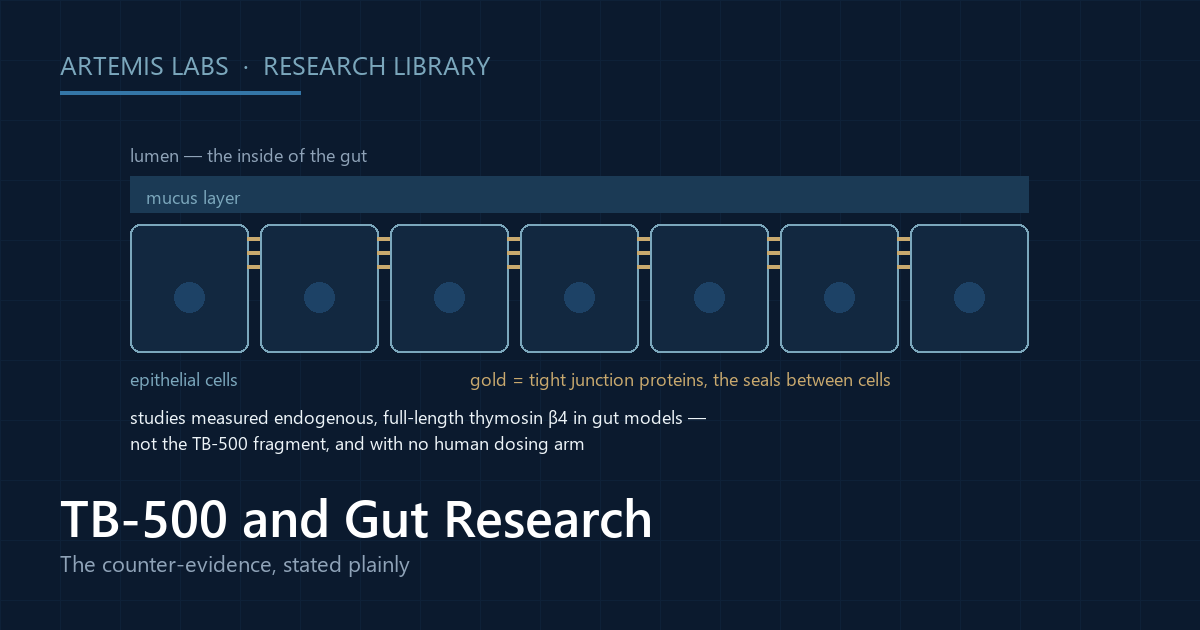
They measured how much Tβ4 was present in the colonic mucus of people with irritable bowel syndrome, a common gut condition usually shortened to IBS, then worked in rats bred to lack the Tβ4 gene and mice bred to lack mast cells. They reported that high levels of Tβ4 in IBS mucus and in intestinal mast cells “mediate stress-associated disruptive changes to the epithelial barrier.” The epithelial barrier is the single layer of cells lining the gut, which decides what passes into the body and what does not. Treating mice with Tβ4 “caused a reduction in tight junction proteins,” the proteins that glue neighbouring lining cells together and seal the gaps between them.
The strongest part of the design is the knockout arm. Rats lacking Tβ4 “were resistant to stress,” and putting Tβ4 back removed that protection. Take the molecule away and the animals held up; add it back and they did not. That is evidence about the direction of cause, not just a correlation. The authors concluded that Tβ4 “plays a crucial role in the pathogenesis of IBS.”
What does that study not show?
Three limits travel with this paper everywhere we cite it.
It studied the parent protein, made inside the body. Thymosin β4 is a 43-amino-acid protein the body produces on its own. TB-500 is a synthetic seven-amino-acid fragment matching residues 17–23 of that protein, with an acetyl cap on one end (PMID 22962027). The parent is about five and a half times heavier. Sun et al. worked on Tβ4 released by the animals’ own mast cells, not on a TB-500 preparation.
There was no human dosing arm of any kind. The human part of the study was a measurement: how much Tβ4 sat in the colonic mucus of IBS patients. Nobody was given anything. The study does not show that administering TB-500 harms a human gut, because it never administered anything to a human.
This is a finding about disease mechanism, not toxicity. The researchers were asking what drives IBS, and their interest is in blocking Tβ4 as a possible treatment, which is why the conclusion mentions “diagnostic and therapeutic targeting.” Naming a molecule as part of a disease process is not the same as measuring a poison.
Which way did the signalling go?
IL22RA1 is a receptor on gut lining cells. JAK1 and STAT3 are relay proteins that carry the receptor’s message to the cell nucleus. Sun et al. reported that the effect of Tβ4 “was accompanied by IL22RA1/Janus kinase 1 (JAK1)/signal transducer and activation of transcription 3 (STAT3) pathway inhibition, suggesting a mechanism for physical and immune barrier suppression.” The word that matters is inhibition: the pathway was turned down, not up. Copy that describes this paper as STAT3 activation has inverted the result.
Did a second study point the same way?
Yes, a year earlier. Hao et al. (2024), in Experimental Cell Research, worked in inflammatory bowel disease models. Mice given thymosin β4 “had damaged intestinal mucus barriers and decreased LC3II levels.” LC3II is a marker of autophagy, the process a cell uses to break down and recycle its own worn-out parts. The same abstract reports that Tβ4 “inhibited colonic mucin2 production, disrupted tight junctions, and downregulated autophagy; these results were confirmed in Caco2 cells and normal human colon tissue.” Mucin2 is the main protein in gut mucus, the layer that keeps bacteria away from the lining.
One honest qualification: the author list overlaps with the 2025 paper (Bai X, Wang Q, Sun Y appear on both). These are connected research programmes, not two independent laboratories reaching the same answer separately. The dose used in the 2024 mouse work is not stated in the abstract, so we do not report one.
Does it matter where the peptide comes from?
A 2016 review by Kim and Jung suggests it can. Writing about liver fibrosis, they noted that “treatment with the exogenous Tβ4 peptide inhibits the proliferation and migration of activated HSCs and reduces liver fibrosis, indicating it has an antifibrotic action. Meanwhile, the endogenously expressed Tβ4 in activated HSCs is shown to promote HSC activation.” HSCs are hepatic stellate cells, liver cells that drive scarring when they switch on.
In one tissue, then, Tβ4 supplied from outside and Tβ4 made inside the cell pushed opposite ways. That does not cancel the gut findings, but it does mean nobody should assume they transfer cleanly to a different source of the molecule, in either a reassuring or an alarming direction.
Is any of this a TB-500 finding?
No. Both gut studies used full-length thymosin β4. There is no published gut study of the TB-500 fragment in any species.
There is a further wrinkle. Rahaman et al. (2024) opened their pharmacology paper by stating that “the biological effects of TB-500, however, have not been documented.” They followed TB-500’s breakdown in human serum, in laboratory enzyme systems, and in urine from rats that had received it, then concluded that “the previously reported wound-healing activity of TB-500 in literature may be due to its metabolite Ac-LKKTE rather than the parent form.” It is not settled that the seven-residue molecule is the active species at all.
Artemis sells TB-500 only inside blends. No published study has tested that combination either.
What the research does not show
- No human trial of TB-500 exists, for the gut or for anything else. Our page on TB-500 human trials covers what human data does exist and which molecule it actually used.
- The gut papers are not a safety verdict. They describe a disease mechanism in animals and cells. Separately, Mendias et al. (2026) wrote that for this class of compounds “rigorous human safety data are scarce, and there is potential for serious harm to patients” (PMID 41966639). Our TB-500 safety research page collects the fuller picture.
- No dose figures are available. Sun 2025 reports no Tβ4 dose, concentration, route or schedule in its abstract; Hao 2024 states a route but no dose. We do not supply numbers a source did not print.
- Neither result has been replicated by an unconnected group.
Why publish a finding that works against the product?
Because the people buying these compounds read abstracts themselves. A paper titled “thymosin β4 … impairs intestinal epithelial barrier” sits in World Journal of Gastroenterology whether or not we mention it. Our standing rule is that when the published record includes negative findings for a compound we sell, those findings appear alongside the rest.
Frequently asked questions
Did the 2025 study give thymosin β4 to people with IBS?
No. The human portion measured how much Tβ4 was present in the colonic mucus of IBS patients. All administration happened in rats and mice.
Is TB-500 the same thing as thymosin β4?
No. Thymosin β4 is a 43-amino-acid protein. TB-500 is a synthetic seven-amino-acid fragment matching residues 17–23 of it, acetylated at one end. They are related and they are not the same molecule, which is why parent-protein findings cannot be relabelled as TB-500 findings.
Does this mean TB-500 damages the gut?
The published work does not say that. It reports that full-length thymosin β4 was associated with a weaker intestinal barrier in laboratory models. No study has tested the TB-500 fragment in the gut, in any species.
References
- Sun YS, Bai XQ, Sun KD, et al. Thymosin β4 released by mast cells under stress conditions impairs intestinal epithelial barrier via IL22RA1/JAK1/STAT3 signaling in irritable bowel syndrome. World J Gastroenterol. 2025 Nov 14;31(42):111706. PMID 41278163 · DOI 10.3748/wjg.v31.i42.111706
- Hao et al. Upregulated Tβ4 expression in inflammatory bowel disease impairs the intestinal mucus barrier by inhibiting autophagy in mice. Exp Cell Res. 2024 Jan 1;434(1):113871. PMID 38049080
- Kim J, Jung Y. 2016 — review; exogenous versus endogenously expressed thymosin β4 in hepatic stellate cells and liver fibrosis. PMID 27450733
- Rahaman et al. 2024 — TB-500 metabolism in human serum, in-vitro enzyme systems, and urine from TB-500-treated rats. PMID 38382158
- Tewari et al. 2026 — PRISMA scoping review of peptide supplements for musculoskeletal recovery and performance. PMID 42578445
- Mendias et al. Sports Med. 2026 — review of unapproved gray-market peptides, listing Tβ4 and TB-500 as separate entries. PMID 41966639
- 2012 — source describing the N-terminal acetylated 17-23 fragment of human thymosin beta 4 (Ac-LKKTETQ). PMID 22962027
Methodology: this page draws only on the Artemis Labs TB-500 verified facts sheet, in which every citation above was checked line by line against the published abstract via NCBI E-utilities, with compound identity confirmed against PubChem. Last verified August 23, 2026.
All compounds sold by Artemis Labs are for laboratory research use only. Nothing on this page is medical advice, and no statement has been evaluated by the FDA.
