
TB-500 and Heart Research: The Human Trial
Aug
TB-500 and Heart Research: The Human Trial and What It Found
Published August 23, 2026 · Artemis Labs
TB-500 and heart research — answer capsule: No published study has tested TB-500, the seven-amino-acid fragment, in the heart. The one randomized human heart trial used recombinant full-length thymosin β4 in 96 people after a heart attack, and found no significant difference in damaged heart-muscle area across the whole group. A subgroup dosed within 8 hours of the artery-opening procedure did show a reduction at 90 days. The authors called for further rigorous randomized studies.
Key findings
- In a randomized, placebo-controlled, double-blind trial of 96 patients with a fully blocked coronary artery, the overall comparison of damaged heart-muscle area between the treatment group and placebo was not significant (Zhang 2025, PMID 41229390).
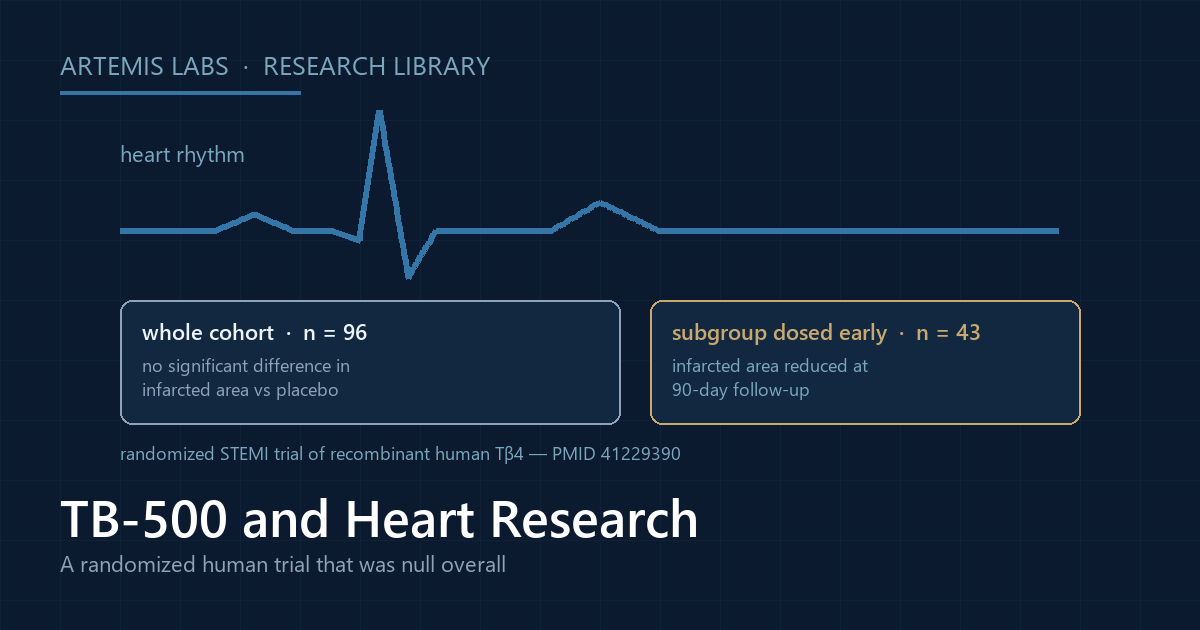
- In the same trial, the 43 patients whose first dose came within 8 hours of the artery-opening procedure had significantly smaller damaged areas than placebo at the 90-day check (Zhang 2025, PMID 41229390).
- That trial used recombinant full-length thymosin β4 — a 43-amino-acid protein — not the seven-amino-acid fragment sold as TB-500.
- An earlier intravenous Phase 1 study of synthetic thymosin β4 in healthy volunteers reported no dose-limiting toxicity; its authors concluded only that development for cardiac ischemia “should be considered” (Ruff 2010, PMID 20536472).
What is TB-500, and how is it different from thymosin β4?
TB-500 is a synthetic peptide — a short chain of amino acids, the building blocks that make up proteins. It is seven amino acids long, written Ac-LKKTETQ, with an acetyl cap on one end. Its molecular weight is 889.0 g/mol (PubChem CID 62707662, CAS 885340-08-9). One published abstract describes it plainly as “the N-terminal acetylated 17-23 fragment of human thymosin beta 4” (PMID 22962027).
Thymosin β4 is the parent protein that fragment was copied from: 43 amino acids, roughly 4,963 daltons, about five and a half times heavier. Positions 17 through 23 are described in one review as the central actin-binding domain — the part of the protein that grips actin, a structural fiber inside cells (Sosne 2010, PMID 20179146).
Related, not the same molecule. That distinction decides how you read everything below, because the heart research is all parent-protein research.
What did the human heart trial actually find?
The study is Zhang 2025, published in Cardiovascular Research (PMID 41229390). It enrolled 96 patients with STEMI — a heart attack in which a coronary artery is completely blocked. All of them had PCI, the catheter procedure that reopens that artery. The design was randomized, placebo-controlled and double-blind, meaning neither the patients nor the researchers knew who got what.
The trial has two results, and they point in different directions.
The first is the one that gets quoted. Among the 43 patients who received their first dose of recombinant human thymosin β4 within 8 hours after PCI, the infarcted areas — the patches of heart muscle killed by the blockage — were significantly reduced compared with placebo at the 90-day follow-up.
The second usually gets dropped. In the authors’ own words: “the overall differences in infarcted areas were not significantly between the rhTB4 group and the placebo group (n = 96).” Across the full trial, the treatment did not beat placebo.
Two more things belong on the record. Three co-authors are employees of the manufacturer, Beijing Northland Biotech. And the abstract states no amount, schedule or route, so no figure can honestly be quoted for it.
Why does the “within 8 hours” detail matter so much?
Because a subgroup result and a whole-trial result are not the same kind of evidence. A trial is designed around its main comparison. When that comparison comes back null, a positive finding inside a slice of the same patients is a lead, not a conclusion — the slice was not the question the trial was built to answer, and cutting a dataset several ways raises the odds that one cut looks good by chance.
The authors say as much themselves. Their closing line is a request, not a result: “Further rigorous randomized studies are needed to assess the significance of early rhTB4 use post-myocardial infarction reperfusion.” More of the human record is collected on our page covering the human trials of thymosin β4.
What did the intravenous safety study in healthy volunteers show?
Before the heart-attack trial there was a Phase 1 study of synthetic thymosin β4 given intravenously to healthy volunteers (Ruff 2010, PMID 20536472). Four groups of ten received ascending amounts, first as a single infusion and then, after a safety review, on the same daily regimen for 14 days. It reported that the compound was “well tolerated with no evidence of dose limiting toxicity,” and that “adverse events were infrequent, and mild or moderate in intensity.”
It reported no efficacy endpoint. A Phase 1 study asks whether a compound is tolerated, not whether it works, and this one enrolled healthy people rather than cardiac patients. Its cardiac sentence is a recommendation: development for cardiac ischemia “should be considered.” Again, full-length thymosin β4, not TB-500. The wider safety picture is covered on our page about TB-500 safety research.
One animal study in the same area is on record: rats undergoing aortic ischemia-reperfusion — 90 minutes of blocked blood flow, then 180 minutes of restored flow — given full-length thymosin β4 intravenously at two time points (PMID 31121838). We hold the design of that study and not its outcome, so we report the design only.
Has anyone tested TB-500 itself in heart research?
No. Not in a human, and not in an animal heart model. Every heart study named here used the full-length parent protein. Four published studies do test the seven-amino-acid fragment, and none is cardiac: repair in aged mice (Philp 2003, PMID 12581423), a mouse brain model, a mouse and rabbit eye model, and a doping-detection assay in horses. That is the whole fragment literature.
There is a further wrinkle. A 2024 pharmacology paper opens by stating that “the biological effects of TB-500, however, have not been documented,” and, after tracking how the peptide breaks down in human serum and in rats, suggests the wound-healing activity reported for TB-500 “may be due to its metabolite Ac-LKKTE rather than the parent form” (Rahaman 2024, PMID 38382158). Which molecule does the work is not settled.
What the research does not show
- No human trial of TB-500 exists. Not for the heart, not for anything else. The human heart data belongs to full-length thymosin β4.
- The one randomized human heart trial was null on its full cohort. A page that reports the 8-hour subgroup without that sentence is reporting half a study.
- Thymosin β4 is not always protective in the studies that measure it. In an irritable bowel syndrome model, Sun and colleagues reported that thymosin β4 released by mast cells reduced tight junction proteins and impaired intestinal barrier integrity in rats and mice (PMID 41278163). That study examined the body’s own full-length thymosin β4, not the TB-500 fragment, and had no human dosing arm.
- Two 2026 reviews list TB-500 among unapproved compounds, stating that “rigorous human safety data are scarce, and there is potential for serious harm to patients” (Mendias 2026, PMID 41966639), and that both parent and derivative “remain banned substances in sports” (Mayfield 2026, PMID 41476424).
- The WADA 2026 Prohibited List names “Thymosin-β4 and its derivatives e.g. TB-500” under section S2.3, prohibited at all times (WADA Prohibited List).
Frequently asked questions
Was the human heart trial positive or negative?
Both, depending on which comparison you read. The whole-group comparison of infarcted area was not significant. The subgroup dosed within 8 hours after the artery-opening procedure was significant at 90 days. The trial’s own authors ask for further randomized studies.
Did that trial use TB-500?
No. It used recombinant human thymosin β4, the 43-amino-acid parent protein. TB-500 is a seven-amino-acid fragment of that protein and was not tested.
How much cardiac evidence is there in total?
One Phase 1 safety study in healthy volunteers, one randomized trial that was null overall, and animal models. All of it used the parent protein.
References
- Zhang et al. (2025). Recombinant human thymosin β4 in STEMI, randomized placebo-controlled trial. Cardiovascular Research. PMID 41229390
- Ruff et al. (2010). Intravenous Phase 1 study of synthetic thymosin β4 in healthy volunteers. Ann N Y Acad Sci. PMID 20536472
- Rat aortic ischemia-reperfusion model, thymosin β4 given intravenously (2019). PMID 31121838
- Rahaman et al. (2024). TB-500 metabolism and the Ac-LKKTE metabolite. PMID 38382158
- Philp et al. (2003). LKKTETQ synthetic peptide and repair in aged animals. PMID 12581423
- Sosne et al. (2010). Review describing LKKTETQ as the central actin-binding domain. PMID 20179146
- N-terminal acetylated 17-23 fragment of human thymosin β4 (Ac-LKKTETQ). PMID 22962027
- Mendias et al. (2026). Unapproved peptide compounds in sport. Sports Med. PMID 41966639
- Mayfield et al. (2026). TB-4 and TB-500 in orthopaedic sports medicine. Am J Sports Med. PMID 41476424
- Sun et al. (2025). Thymosin β4 and the intestinal epithelial barrier in IBS. World J Gastroenterol. PMID 41278163 · 10.3748/wjg.v31.i42.111706
- World Anti-Doping Agency, 2026 Prohibited List, section S2.3. wada-ama.org/en/prohibited-list
Methodology: this page draws only on the Artemis Labs verified facts sheet for thymosin β4 and TB-500, compiled from PubMed abstract retrieval and PubChem identity checks. Every study is named with its species and model. Last verified August 23, 2026.
All compounds sold by Artemis Labs are for laboratory research use only. Nothing on this page is medical advice, and no statement has been evaluated by the FDA.
