
TB-500 vs Thymosin Beta-4: Not the Same Molecule
Aug
TB-500 vs Thymosin Beta-4: They Are Not the Same Molecule
Published August 23, 2026 · Artemis Labs
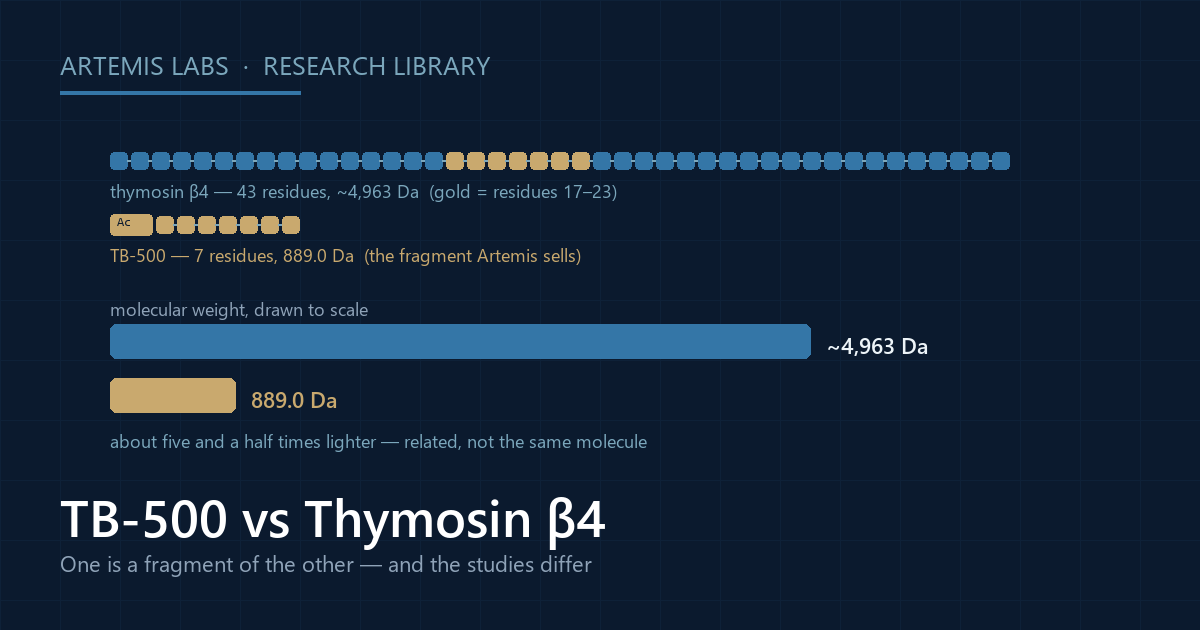
TB-500 vs thymosin β4 — answer capsule: TB-500 and thymosin β4 are related, and they are not the same molecule. TB-500 is a lab-made seven-amino-acid peptide, Ac-LKKTETQ, that copies residues 17–23 of thymosin β4 and adds an acetyl cap. Thymosin β4 is the full 43-amino-acid parent protein, roughly 4,963 daltons against the fragment’s 889.0 — about five and a half times heavier. Nearly every published study behind the “TB-500” name used the parent protein, not the fragment. A 2024 paper on the fragment itself opens by stating that its biological effects have not been documented.
Key findings
- Seven residues, not five, and not 43. The material sold as TB-500 is Ac-Leu-Lys-Lys-Thr-Glu-Thr-Gln-OH: seven amino acids, molecular weight 889.0 g/mol, CAS 885340-08-9, PubChem CID 62707662, UNII QHK6Z47GTG (PubChem, verified 2026-08-23). Thymosin β4 is a 43-amino-acid peptide of about 4,963 daltons, CAS 77591-33-4.
- The reviews themselves treat them as separate. Mendias 2026 (PMID 41966639) names “Tβ4 (thymosin beta-4), and TB-500 (thymosin beta-4 fragment)” as two items in one list of unapproved compounds.
- The fragment’s own pharmacology paper says the record is thin. Rahaman 2024 (PMID 38382158) opens, verbatim: “The biological effects of TB-500, however, have not been documented.”
- No human trial of the fragment has been published. Every human study in this cluster’s source set used full-length thymosin β4.
What is TB-500, exactly?
Peptides are short chains of amino acids, the building blocks that proteins are made from. TB-500 is a short one. Its chain is written Ac-LKKTETQ-OH, where each letter stands for one amino acid. Seven letters, seven amino acids.
The “Ac-” at the front is an acetyl group — a small chemical cap added to one end of the chain during manufacture. Two primary papers state this outright. PMID 23084823 reads, verbatim: “The key ingredient of TB-500 is the peptide LKKTETQ with artificial acetylation of the N-terminus.” PMID 22962027 calls it “the N-terminal acetylated 17-23 fragment.”
You will sometimes see the number 847.0 attached to TB-500. That is the weight of the uncapped chain — a separate PubChem entry, CID 10169788, formula C36H66N10O13. The cap adds 42 daltons. A dalton is the unit chemists use to weigh molecules. So 847.0 and 889.0 are two different substances, and the one sold under the TB-500 name is the capped one at 889.0.
What is thymosin beta-4?
Thymosin β4, often shortened to Tβ4, is the parent protein the fragment was copied from. It is 43 amino acids long. Two primary abstracts confirm the length independently: Di 2026 (PMID 41570941) describes “a highly conserved 43-amino-acid peptide encoded by the X-linked TMSB4x gene,” and Stewart 2025 (PMID 41326489) calls it “a secreted 43 amino acid peptide.”
Line the two up and the relationship is easy to see. The full 43-residue chain reads Ac-SDKPDMAEIEKFDKSKLKKTETQEKNPLPSKETIEQEKQAGES-OH. Positions 17 through 23 are exactly L-K-K-T-E-T-Q. That stretch, copied and capped, is TB-500.
There is a third molecule in this family that gets tangled into the same conversation: Ac-SDKP, the first four residues of the parent, produced when the parent breaks down in the body. Ac-SDKP has its own literature. It is not TB-500, and it is not the 17–23 fragment.
Side by side: how the three molecules differ
| TB-500 (the fragment) | Thymosin β4 (the parent) | Ac-SDKP (a different fragment) | |
|---|---|---|---|
| What it is | A lab-made copy of one short stretch of the parent, with an acetyl cap added | The whole natural protein, made in the body from the TMSB4x gene | The first four residues of the parent, formed when the parent breaks down |
| Length | 7 amino acids (Ac-LKKTETQ) | 43 amino acids | 4 amino acids (SDKP) |
| Molecular weight | 889.0 g/mol | about 4,963 daltons | Not listed in the sources this page uses |
| Formula | C38H68N10O14 | C212H350N56O78S | Not listed in the sources this page uses |
| CAS number | 885340-08-9 | 77591-33-4 (thymosin β4 / timbetasin) | Not listed in the sources this page uses |
| PubChem CID | 62707662 | 45382195 / 16132341 | Not listed in the sources this page uses |
| Position in the parent chain | Residues 17–23 | The whole chain | Residues 1–4 |
| Published human trials in this source set | None | Eye-surface, skin-wound, and one heart trial | None found |
| Studies in this cluster’s source set | Four papers, all in animals or cells | Five primary papers plus reviews | Appears in brain and kidney papers on the parent |
Which molecule did each study actually use?
This is where most write-ups on this compound go wrong. A study is run on full-length thymosin β4, and the result gets reported under the TB-500 name as if the seven-residue fragment had been tested. It was not.
Four sports-medicine reviews published in 2026 make the state of the evidence plain in their own words. Mayfield 2026 (PMID 41476424): “TB-4 and its derivative TB-500 promoted angiogenesis and tissue repair in preclinical models, but human orthopaedic data are lacking, and both remain banned substances in sports.” Mendias 2026 (PMID 41966639): “rigorous human safety data are scarce, and there is potential for serious harm to patients.” Rahman 2026 (PMID 41490200): “Although preclinical studies are promising, there is a current lack of clinical trials.” Tewari 2026 (PMID 42578445), a PRISMA scoping review that searched for “thymosin beta-4 or TB-500,” found that “67% of identified publications utilized preclinical animal models,” and concluded that the claimed benefits “remain unsubstantiated by current human trials.”
Rahaman 2024 (PMID 38382158) goes one step further. That team followed what happens to TB-500 in human serum, in laboratory enzyme systems, and in urine from rats given TB-500. Their conclusion, verbatim: “our results also suggest that the previously reported wound-healing activity of TB-500 in literature may be due to its metabolite Ac-LKKTE rather than the parent form.” Read plainly: it is not settled that the seven-residue molecule is the active species at all.
The four studies that did test the fragment
Four papers actually gave or tested the 17–23 fragment. None is a human trial.
Philp 2003 (PMID 12581423) is where the whole fragment-equals-parent idea started. Verbatim: “The actin-binding domain of thymosin beta 4 duplicated in a seven-amino acid synthetic peptide, LKKTETQ, was able to promote repair in the aged animals comparable to that observed with the parent molecule.” Those were aged mice, and the abstract does not claim the same for the study’s diabetic arm.
Ou 2026 (PMID 41443105) is the strongest fragment anchor in this source set — the one paper where TB500 itself was given to an animal. It reported reduced neurite atrophy in cultured mouse cells and improved maze and object-recognition performance in 5×FAD transgenic mice, alongside its own negative result: “hippocampal Aβ burden remained unchanged.”
Lu 2025 (PMID 41359360) used the fragment in a gel delivered to alkali-burned eyes in mice and rabbits: “Our work represents the first ocular application of TB500.” Ho 2012 (PMID 23084823) gave TB-500 to horses, but that paper is a doping-control detection assay — a test for finding the compound in plasma and urine, not a study of whether it works.
One review, Sosne 2010 (PMID 20179146), describes the sequence in general terms: “a short sequence containing LKKTETQ, the central actin-binding domain (aa 17-23) plus 1 additional amino acid (Q), promotes angiogenesis, wound healing, and cell migration.” That is a review’s summary of the sequence, not an experiment on the material Artemis supplies.
What the research does not show
No published human clinical trial has tested TB-500 (Ac-LKKTETQ) itself. Searches on TB-500, TB500 and LKKTETQ crossed with human and safety terms returned none. The only study anywhere that gave the fragment and reported it is the horse detection assay above. Our inventory of the human trials that do exist covers what was studied instead, all of it the parent protein.
The parent protein also carries a counter-finding that belongs on every page in this cluster. Sun et al. (2025) (PMID 41278163) reported that thymosin β4 released by mast cells reduced tight junction proteins and impaired intestinal barrier integrity in rats and mice, with elevated Tβ4 measured in the colonic mucus of patients with irritable bowel syndrome. That study examined the body’s own full-length Tβ4, not the TB-500 fragment, and it had no human dosing arm of any kind. It is a finding about how a disease may work, not a toxicity result. We surface it because it points the opposite way from the repair literature.
Frequently asked questions
Is TB-500 just another name for thymosin beta-4?
No. TB-500 weighs 889.0 g/mol and is seven residues long; thymosin β4 weighs about 4,963 daltons and is 43. Mendias 2026 (PMID 41966639) lists them as two separate entries.
Why do so many pages treat the two names as interchangeable?
Because the fragment was copied from the parent, and almost all published work used the parent. Repeating a parent-protein result under the fragment’s name is quicker than naming the molecule that was actually in the study. It is also inaccurate. Our page on the fragment’s verified sequence and identity numbers walks through the values one at a time.
Is Ac-SDKP a form of TB-500?
No. Ac-SDKP is the first four residues of thymosin β4; TB-500 copies residues 17 through 23. Different length, different sequence, different literature. Several papers study Ac-SDKP specifically, and those results do not belong to TB-500.
Where does TB-500 appear in the Artemis catalog?
TB-500 is not sold on its own. For how the two compounds are discussed side by side, see BPC-157 and TB-500 compared for tissue repair.
References
- Rahaman et al. 2024. TB-500 metabolism in human serum, enzyme systems, and rat urine. PMID 38382158
- Ho et al. 2012. Detection of N-acetylated LKKTETQ in horses. J Chromatogr A. PMID 23084823
- N-terminal acetylated 17-23 fragment of human thymosin beta 4 (Ac-LKKTETQ). PMID 22962027
- Philp et al. 2003. LKKTETQ and repair in aged animals. PMID 12581423
- Ou et al. 2026. TB500 and Ac-SDKP in Alzheimer’s disease models. PMID 41443105 · DOI 10.1016/j.intimp.2025.116097
- Lu et al. 2025. First ocular application of TB500, alkali-burn mouse and rabbit model. ACS Appl Mater Interfaces. PMID 41359360
- Sosne et al. 2010. Review: LKKTETQ as the central actin-binding domain. PMID 20179146
- Mayfield et al. 2026. Am J Sports Med. PMID 41476424
- Mendias et al. 2026. Sports Med. PMID 41966639
- Rahman et al. 2026. JAAOS Glob Res Rev. PMID 41490200
- Tewari et al. 2026. PRISMA scoping review. PMID 42578445
- Di et al. 2026. Thymosin β4 as a 43-amino-acid peptide encoded by TMSB4x. Peptides. PMID 41570941 · DOI 10.1016/j.peptides.2026.171467
- Stewart et al. 2025. Thymosin β4 and S1PR1 in human brain microvascular endothelial cells. PMID 41326489 · DOI 10.1038/s41598-025-28435-2
- Sun et al. 2025. Thymosin β4 released by mast cells impairs the intestinal epithelial barrier in irritable bowel syndrome models. World J Gastroenterol. PMID 41278163 · DOI 10.3748/wjg.v31.i42.111706
- PubChem: CID 62707662 (Ac-LKKTETQ-OH), CID 10169788 (LKKTETQ free acid), CID 45382195 and CID 16132341 (thymosin β4 / timbetasin). Identity values retrieved via PubChem PUG-REST, 2026-08-23.
Methodology: this page draws only on the peer-reviewed abstracts listed above, retrieved through NCBI E-utilities, and on identity records retrieved from PubChem. Molecular weights, formulas, CAS numbers and sequence positions were verified against PubChem on 2026-08-23. Where a figure is not stated in a paper’s abstract, this page says so rather than supplying one.
All compounds sold by Artemis Labs are for laboratory research use only. Nothing on this page is medical advice, and no statement has been evaluated by the FDA.
