
Is TB-500 Banned by WADA? The 2026 List, Quoted
Aug
Is TB-500 Banned by WADA? The Primary-Source Answer
Published August 23, 2026 · Artemis Labs
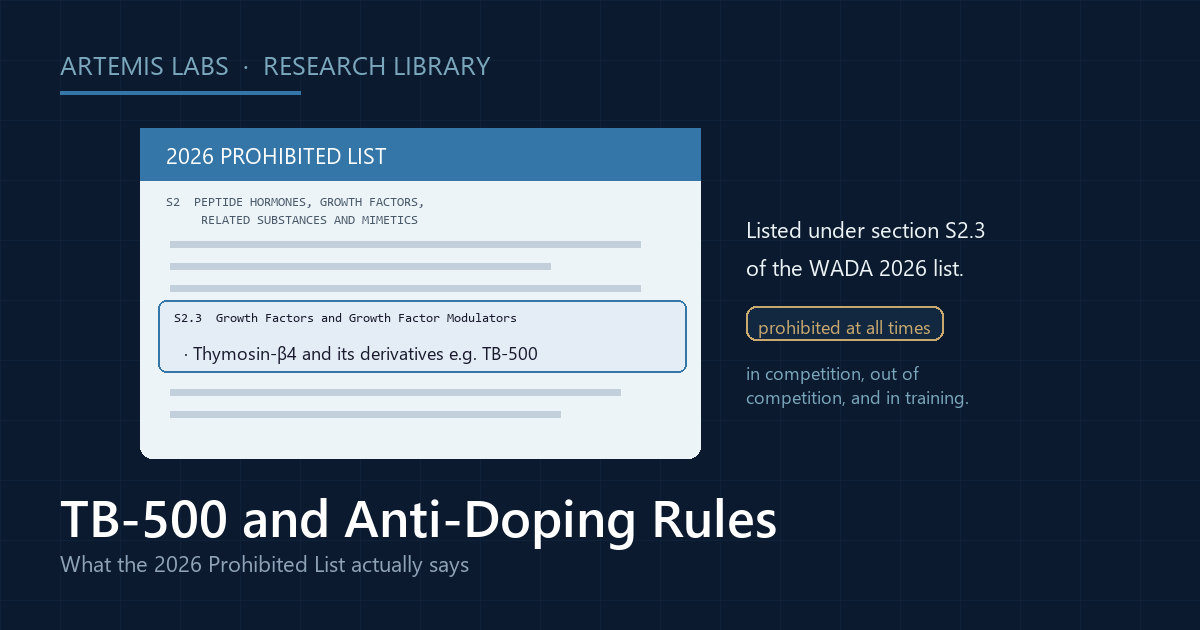
TB-500 and the WADA Prohibited List — answer capsule: Yes. The World Anti-Doping Agency’s 2026 Prohibited List names “Thymosin-β4 and its derivatives e.g. TB-500” in section S2.3, Growth Factors and Growth Factor Modulators. Everything in section S2 is listed as prohibited at all times, meaning both in competition and out of competition. A 2026 review in the American Journal of Sports Medicine puts it the same way, writing that thymosin β4 and TB-500 “both remain banned substances in sports.” This page quotes the List document itself rather than a summary of it.
Key findings
- The 2026 WADA Prohibited List includes “Thymosin-β4 and its derivatives e.g. TB-500” in the “including, but not limited to” list under S2.3, verified on page 8 of the List document on August 23, 2026 (WADA Prohibited List; 2026 List PDF).
- The naming covers the parent protein and the fragment together. A 2026 review in Sports Medicine lists them as two separate items: “Tβ4 (thymosin beta-4), and TB-500 (thymosin beta-4 fragment)” (PMID 41966639).
- A published laboratory method can find TB-500 at very low levels. Working in horses, Ho et al. (2012) reported detection limits of 0.02 ng/mL in equine plasma and 0.01 ng/mL in equine urine (PMID 23084823).
- No published human clinical trial of the TB-500 fragment exists in the source set behind this page. The same 2026 American Journal of Sports Medicine review states that “human orthopaedic data are lacking” (PMID 41476424).
What does the 2026 WADA Prohibited List actually say?
The Prohibited List is the document the World Anti-Doping Agency publishes each year to say which substances are banned in sport. It is organised into lettered sections. Section S2 is titled “Peptide Hormones, Growth Factors, Related Substances and Mimetics.” Inside it, subsection S2.3 covers “Growth Factors and Growth Factor Modulators.”
S2.3 gives examples rather than a closed catalogue. The wording is “including, but not limited to,” and one of the entries reads: “Thymosin-β4 and its derivatives e.g. TB-500.”
That sentence is the whole answer to the page’s question, and it comes from the List document, not from a secondary summary. We checked it by opening the 2026 List PDF on August 23, 2026, where the entry appears on page 8. Both the List’s landing page and the PDF are linked in the References below so a reader can confirm it without taking our word for it.
One important limit on that quote: the List is a sport-governance document. It records what a sport’s anti-doping rules prohibit. It is not a statement about national law, and this page does not treat it as one.
What does “prohibited at all times” mean here?
The List sorts substances by when the prohibition applies. Some categories are banned only in competition. Section S2, which contains the thymosin β4 entry, is grouped under the substances the List marks as prohibited at all times — in competition and out of competition alike.
Read plainly, and staying inside what the document itself says: an athlete under an anti-doping code that follows the WADA List does not have an off-season window for an S2.3 substance. Anything further, such as how a specific federation enforces its rules or what happens in a given case, is outside the source we verified, so this page does not go there.
Does the entry cover TB-500, thymosin β4, or both?
Both. The entry names thymosin β4 first, then extends to “its derivatives,” with TB-500 given as the worked example.
That matters because the two are not the same molecule, and most writing about them blurs the difference. Thymosin β4 is a natural protein 43 amino acids long, weighing roughly 4,963 daltons. TB-500 is a synthetic seven-amino-acid piece of it, Ac-LKKTETQ, matching residues 17 to 23 of the parent, with an acetyl cap added to one end. Its molecular weight is about 889.0 g/mol, so the parent is around five and a half times heavier. One primary paper describes the marketed form in exactly those words, calling it “the N-terminal acetylated 17-23 fragment of human thymosin beta 4 (Ac-LKKTETQ)” (PMID 22962027).
Reviewers in sports medicine keep the two apart as well. Mendias and colleagues (2026) list “Tβ4 (thymosin beta-4), and TB-500 (thymosin beta-4 fragment)” as separate entries among unapproved compounds circulating outside the regulated supply chain, and note in the same abstract that “rigorous human safety data are scarce, and there is potential for serious harm to patients” (PMID 41966639). If you want the full molecular comparison, we wrote it up separately at TB-500 vs thymosin β4.
Can a testing laboratory detect TB-500?
A published method can, at least in one species. Ho et al. (2012), writing in the Journal of Chromatography A, built a doping-control detection assay for horses. In that work, horses were “administered with a single dose of TB-500 (containing 10 mg of N-acetylated LKKTETQ),” and the resulting method reached detection limits of 0.02 ng/mL in equine plasma and 0.01 ng/mL in equine urine (PMID 23084823).
Two boundaries travel with that study and should not be dropped. It is an equine method, developed for horse racing samples, not a validated human screening assay. And it is a detection study, not an efficacy study — it asked whether the compound could be found in a sample, never whether it did anything useful.
It is also, as far as our verified source set goes, the only place where an administered TB-500 dose figure is published anywhere. Every other study in that set gave the full-length 43-amino-acid parent protein instead.
What the record does not show
Three honest gaps belong on this page.
There is no published human clinical trial of TB-500 itself. Searches for the fragment crossed with human, patient, safety and adverse-event terms returned none. Mayfield and colleagues (2026) reported that thymosin β4 and TB-500 “promoted angiogenesis and tissue repair in preclinical models” — that is, in animals and cells — “but human orthopaedic data are lacking,” and added that “information regarding the indications, dosing, frequency, and duration of treatment remains unknown” (PMID 41476424). We collected the full human-evidence inventory at TB-500 human trials.
We cannot tell you why the entry is on the List. We looked for a sourced account of what led to the listing and did not find one we could verify. Rather than repeat a story we cannot check, this page reports the entry and stops.
Findings on thymosin β4 are not all favourable. In an irritable bowel syndrome model, Sun et al. (2025) reported that thymosin β4 released by mast cells reduced tight junction proteins and impaired intestinal epithelial barrier integrity in rats and mice, with elevated thymosin β4 measured in the colonic mucus of IBS patients (PMID 41278163). That study examined endogenous full-length thymosin β4, not the TB-500 fragment, and it included no human dosing group of any kind.
One more finding is worth knowing for anyone comparing labelled products. Delcourt et al. (2023) analysed TB500/TB1000 preparations and reported that “the content of TB500/TB1000 products is not systematically consistent with it’s former descriptions” (PMID 36482504).
Frequently asked questions
Is TB-500 banned only during competition?
No. The 2026 List places the thymosin β4 entry in section S2, which the List groups with substances prohibited at all times, in and out of competition.
Is thymosin β4 banned separately from TB-500?
The single S2.3 entry covers both, since it reads “Thymosin-β4 and its derivatives e.g. TB-500.” The parent protein is named first and the fragment is given as the example.
Does being on the WADA List make a compound illegal?
The List is a sport-governance document that defines what anti-doping rules prohibit. It is not a criminal or drug-scheduling statute, and we have not verified any national-law question here, so this page makes no claim about one.
Are there human safety data behind the compound?
Not for the fragment. Mendias and colleagues (2026) wrote that “rigorous human safety data are scarce, and there is potential for serious harm to patients” for the unapproved compounds in their review, which listed thymosin β4 and TB-500 separately (PMID 41966639).
References
- World Anti-Doping Agency. 2026 Prohibited List, section S2.3 (Growth Factors and Growth Factor Modulators), p. 8 — “Thymosin-β4 and its derivatives e.g. TB-500.” https://www.wada-ama.org/en/prohibited-list · 2026list_en_final_clean_september_2025.pdf
- Mayfield C, et al. Am J Sports Med. 2026 — “TB-4 and its derivative TB-500 promoted angiogenesis and tissue repair in preclinical models, but human orthopaedic data are lacking, and both remain banned substances in sports.” PMID 41476424
- Mendias CL, et al. Sports Med. 2026 — “Tβ4 (thymosin beta-4), and TB-500 (thymosin beta-4 fragment)”; “rigorous human safety data are scarce.” PMID 41966639
- Ho ENM, et al. J Chromatogr A. 2012 — equine doping-control detection of TB-500; limits of detection 0.02 ng/mL plasma, 0.01 ng/mL urine. PMID 23084823
- Identity of the marketed fragment — “the N-terminal acetylated 17-23 fragment of human thymosin beta 4 (Ac-LKKTETQ).” PMID 22962027
- Sun YS, et al. World J Gastroenterol. 2025;31(42):111706 — thymosin β4 released by mast cells impairs the intestinal epithelial barrier in an IBS model. PMID 41278163 · DOI 10.3748/wjg.v31.i42.111706
- Delcourt V, et al. Drug Test Anal. 2023 — “TB500/TB1000 and SGF1000: A scientific approach for a better understanding of misbranded and adulterated drugs.” PMID 36482504
Methodology: this page draws on the WADA 2026 Prohibited List document itself (section S2.3, p. 8) plus six PubMed-indexed papers, each quoted from its published abstract. The List entry and the policy pages linked here were last verified on August 23, 2026.
All compounds sold by Artemis Labs are for laboratory research use only. Nothing on this page is medical advice, and no statement has been evaluated by the FDA.
