
TB-500 and Wound Research: What Human Skin Trials Found
Aug
TB-500 and Wound Research: What Human Skin Trials Found
Published August 23, 2026 · Artemis Labs
TB-500 and wound research — answer capsule: TB-500 is a seven-amino-acid piece of a larger protein called thymosin beta-4. The human skin-wound trials people point to did not test TB-500. They tested the full 43-amino-acid parent protein, applied to the skin, in pressure ulcers and venous stasis ulcers. The reported Phase 2 results were modest, and the authors hedged them with conditions. No human trial of TB-500 itself has been published.
Key findings
- A Phase 2 trial in 73 venous stasis ulcer patients used topical thymosin beta-4, the 43-residue parent protein — not TB-500 (PMID 20536470).
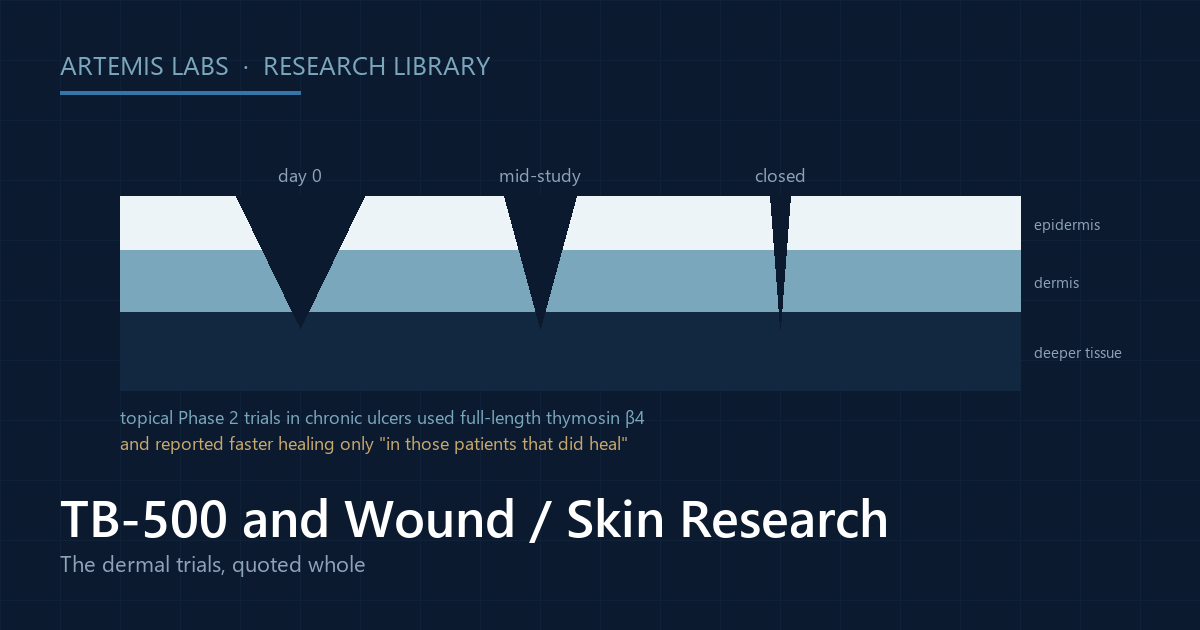
- Across “two phase 2 clinical trials of stasis and pressure ulcers, it was found to accelerate healing by almost a month in those patients that did heal” (PMID 23050815).
- A rabbit ear fat-grafting study mixed thymosin beta-4 into graft tissue against a saline control (PMID 32144415).
- One 2010 review says the fragment itself, LKKTETQ, “promotes angiogenesis, wound healing, and cell migration” (PMID 20179146) — a review sentence, not a trial result.
What is the difference between TB-500 and thymosin beta-4?
Thymosin beta-4 is a protein the body makes. It is 43 amino acids long — amino acids are the beads that link together to form a peptide or protein — and weighs roughly 4,963 daltons. TB-500 copies seven of those beads, positions 17 through 23 of the parent, written Ac-LKKTETQ. The “Ac” is an acetyl cap on one end; one paper describes the compound as “the N-terminal acetylated 17-23 fragment of human thymosin beta 4” (PMID 22962027). Capped, it weighs about 889 daltons — roughly a fifth of the parent.
A 2026 sports-medicine review lists them as separate entries — “Tβ4 (thymosin beta-4), and TB-500 (thymosin beta-4 fragment)” (PMID 41966639). They are related, and they are not the same molecule. That distinction runs through everything below, because almost every wound study was done on the parent.
What did the human skin-wound trials actually test?
The most-cited human dermal work is a Phase 2 study in venous stasis ulcers — slow-healing open sores on the lower leg caused by poor blood return in the veins. It enrolled 73 patients at eight European sites, was double-blind and placebo-controlled, and compared several strengths of a topical thymosin beta-4 preparation. On safety, the authors wrote that “the safety profile of all doses of administered Tbeta4 was deemed acceptable and comparable to placebo.” On effectiveness they hedged their own result: “Efficacy findings from this Phase 2 study suggest that a Tbeta4 dose … may have the potential to accelerate wound healing and that complete wound healing can be achieved within 3 months in about 25% of the patients” (PMID 20536470). Two conditions sit inside that sentence: “may have the potential,” and about one patient in four.
A 2012 paper adds the pressure-ulcer arm. Quoted whole, because the ending changes the meaning: “in two phase 2 clinical trials of stasis and pressure ulcers, it was found to accelerate healing by almost a month in those patients that did heal” (PMID 23050815).
What about epidermolysis bullosa?
Epidermolysis bullosa is a rare inherited condition in which the skin is so fragile that light friction causes blisters and open wounds. A 2019 paper states that “thymosin β4 promotes faster repair in various chronic human wounds, including pressure ulcers, stasis ulcers, and epidermolysis bullosa lesions” (PMID 31649007).
Three things travel with that sentence. It is a review, not a trial report — no design, endpoint, patient count or dose appears in the abstract. Its authors were employed by the company developing the compound. And the same paper closes by saying that for this disease “there is no cure … and careful wound management is the standard of care.”
What did animal skin models show?
Two animal wound studies sit in this record, both of the parent protein. In a rabbit ear fat-grafting model, researchers mixed thymosin beta-4 into the graft tissue at two concentrations before placing it, against a phosphate-buffered saline control (PMID 32144415). The compound was blended into the tissue rather than given to the animal, so those figures are formulation concentrations and nothing else.
A 2014 burn study used db/db mice — a strain bred to develop diabetes, which slows wound healing — and gave thymosin beta-4 near the burn wound twice a week for two weeks (PMID 25230158). Again: mice, parent protein, a named model.
A 2026 orthopaedic review adds a class-level statement — wound-healing peptides “such as BPC-157, TB-500, and GHK-Cu promote angiogenesis, integrin-mediated extracellular matrix remodeling, and fibroblast activation” — while noting “a current lack of clinical trials” (PMID 41490200). Fibroblasts are the cells that build connective tissue. That is a review summarising a category, not an experiment.
Has the fragment itself ever been tested in a wound model?
In animals, yes. A 2003 study reported that “the actin-binding domain of thymosin beta 4 duplicated in a seven-amino acid synthetic peptide, LKKTETQ, was able to promote repair in the aged animals comparable to that observed with the parent molecule” (PMID 12581423). The animals were aged mice, the dose is not stated in the abstract, and the comparison covers that aged group only. This one sentence is the origin of the idea that the fragment does what the parent does.
A 2010 review restates it generally: a short sequence containing “LKKTETQ, the central actin-binding domain (aa 17-23) plus 1 additional amino acid (Q), promotes angiogenesis, wound healing, and cell migration” (PMID 20179146). Actin is the protein that gives cells their internal scaffolding and lets them crawl.
A 2024 pharmacology paper complicates both. It opens by stating that “the biological effects of TB-500, however, have not been documented,” tracked TB-500 through human serum, laboratory enzyme systems and urine from treated rats, and concluded that “the previously reported wound-healing activity of TB-500 in literature may be due to its metabolite Ac-LKKTE rather than the parent form” (PMID 38382158). It is not settled that the molecule sold as TB-500 is the active substance in the wound work attributed to it.
What the research does not show
No published human clinical trial has tested TB-500. Every human wound result on this page used full-length thymosin beta-4, and none of it transfers to the fragment by default. The Phase 2 dermal findings are hedged by their own authors, and the ulcer speed-up applies to the subset of patients who healed. A 2026 scoping review of this compound class found that “67% of identified publications utilized preclinical animal models” and concluded that claimed benefits “remain unsubstantiated by current human trials” (PMID 42578445).
Counter-evidence belongs here too. In an irritable bowel syndrome model, Sun and colleagues reported that thymosin beta-4 released by mast cells reduced tight junction proteins and impaired intestinal epithelial barrier integrity in rats and mice, with raised thymosin beta-4 measured in the colonic mucus of patients (PMID 41278163). That study examined the body’s own full-length protein, not the TB-500 fragment, and nobody was dosed in it — but it shows this protein does not point the same way in every tissue. Separately, a 2023 analytical paper found that “the content of TB500/TB1000 products is not systematically consistent with it’s former descriptions” (PMID 36482504).
Where this sits in the wider record
Skin is one of three areas with human data on the parent protein. The eye is the deepest, and it carries its own missed endpoints — see TB-500 and eye research. The musculoskeletal side, which most people assume is strongest, is the thinnest; that record is in TB-500 and tissue repair research, and our comparison of BPC-157, TB-500, KPV and GHK-Cu across the tissue-repair cascade sets it beside the other compounds studied in repair contexts. Artemis Labs supplies TB-500 inside the BPC-157 and TB-500 research pair.
Frequently asked questions
Has TB-500 been tested in a human wound trial?
No. No published human clinical trial of TB-500 (Ac-LKKTETQ) exists. The human ulcer trials used full-length thymosin beta-4 (PMID 20536470).
Why does the parent-versus-fragment distinction matter so much?
Because the results people quote for TB-500 were mostly produced by a protein five and a half times its size. A 2024 paper goes further and suggests a breakdown product, not TB-500 itself, may account for the wound activity reported in the literature (PMID 38382158).
Is the safety record settled?
No. The venous ulcer trial called its safety profile comparable to placebo, but a 2026 review of this compound class states that “rigorous human safety data are scarce, and there is potential for serious harm to patients” (PMID 41966639).
References
- Mendias C, et al. Peptides in sports medicine. Sports Med. 2026. PMID 41966639
- Detection of the N-terminal acetylated 17-23 fragment of human thymosin beta 4 (Ac-LKKTETQ). PMID 22962027
- Guarnera G, et al. Thymosin beta-4 and venous stasis ulcers, Phase 2. 2010. PMID 20536470
- Treadwell T, et al. Thymosin beta-4 in wound repair. 2012. PMID 23050815
- Yang C, et al. Thymosin beta-4 in chronic human wounds (review; developer-affiliated authors). 2019. PMID 31649007
- Rahman A, et al. Therapeutic peptides in orthopaedics. JAAOS Glob Res Rev. 2026. PMID 41490200
- Qu C, et al. Thymosin beta-4 in a rabbit ear fat-grafting model. 2020. PMID 32144415
- Thymosin beta-4 in a db/db diabetic mouse burn-wound model. 2014. PMID 25230158
- Philp D, et al. LKKTETQ promotes repair in aged mice. 2003. PMID 12581423
- Sosne G, et al. Thymosin beta-4 actin-binding domain review. 2010. PMID 20179146
- Rahaman A, et al. TB-500 metabolism and the Ac-LKKTE metabolite. 2024. PMID 38382158
- Tewari S, et al. Peptide supplements for musculoskeletal recovery: PRISMA scoping review. 2026. PMID 42578445
- Sun YS, et al. Thymosin β4 released by mast cells impairs the intestinal epithelial barrier via IL22RA1/JAK1/STAT3 signaling in irritable bowel syndrome. World J Gastroenterol. 2025;31(42):111706. PMID 41278163 · DOI 10.3748/wjg.v31.i42.111706
- Delcourt V, et al. TB500/TB1000 and SGF1000: misbranded and adulterated drugs. Drug Test Anal. 2023. PMID 36482504
Methodology: this page draws only on the Artemis Labs TB-500 verified facts sheet, built from PubMed abstract retrieval and PubChem identity checks; every citation above was confirmed against its abstract. Last verified August 23, 2026.
All compounds sold by Artemis Labs are for laboratory research use only. Nothing on this page is medical advice, and no statement has been evaluated by the FDA.
