
NA-Semax vs N-Acetyl Semax Amidate: What PubChem Says | Artemis Labs
Aug
N-acetyl Semax and N-acetyl Semax amidate — what the record actually shows
Published August 26, 2026 · Artemis Labs
N-acetyl Semax is not a single, settled chemical identity in the public record. Searching PubChem, the U.S. National Library of Medicine’s chemical database, for “N-Acetyl Semax” and for “N-Acetyl Semax Amidate” returns the same record, CID 172638603, even though those two names describe chemically different molecules. The literal string “NA-Semax” returns no record at all. The two candidate molecules differ by about one dalton in the direction most people would not guess: the amidate is the lighter one. The only published head-to-head test of acetylated Semax against ordinary Semax that we could find reported that acetylation removed the protective effect, not that it improved it.
Key findings
- PubChem’s name index maps both “N-Acetyl Semax” and “N-Acetyl Semax Amidate” to the same record, CID 172638603, whose structure is the amidate. The primary source is doing the merging.
- The N-acetyl free acid, which is the molecule the name “NA-Semax” ought to describe, sits at CID 172107353. Its only listed synonym is
SCHEMBL30910841, an automatically generated name from patent text mining. No CAS number is returned for it. - The molecular weights run against intuition. The amidate (CID 172638603) is listed at 855.0. The free acid (CID 172107353) is listed at 856.0. A specification sheet that puts 856 next to the word “amidate” has the two swapped.
- In a 2016 Italian cell-culture study, acetylating the N-terminus of Semax abolished the protection the unmodified peptide showed against copper-induced toxicity (PMID 27586814).
Artemis Labs does not sell either acetylated form. We sell the unmodified parent compound, Semax. This page exists because researchers keep asking us what “NA-Semax” is, and the honest answer is that the name does not resolve to one molecule.
Why doesn’t the name “NA-Semax” point to one molecule?
A chemical name is only useful if it maps to one structure. “NA-Semax” does not.
Querying PubChem by the literal name NA-Semax returns a 404 error and no compound ID. So does Acetyl-Semax. The abbreviation is in wide circulation, but it is not an indexed entity at the primary chemical database.
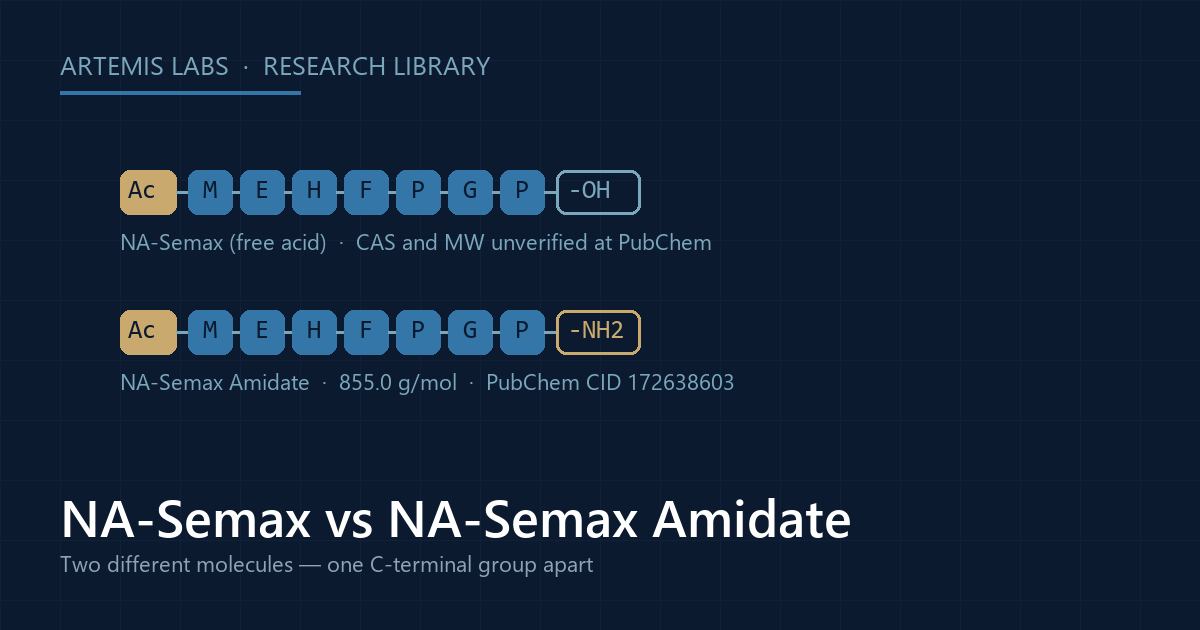
Query the fuller names and a second problem appears. N-Acetyl Semax returns CID 172638603, and N-Acetyl Semax Amidate returns the same record. Acetylation and amidation are separate chemical changes at opposite ends of the peptide. Acetylation caps the N-terminus, the head of the chain. Amidation converts the C-terminus, the tail, from an acid group to an amide. PubChem’s name index nonetheless routes both names to one record, and that record’s structure is the amidated one.
The practical consequence is a quiet failure mode. Any lab, vendor, or software pipeline that looks up “N-acetyl semax” by name and trusts the answer receives the amidate’s numbers while believing it has the plain N-acetyl compound.
What are the two candidate molecules?
Both records exist, and each carries its own structural fingerprint.
CID 172638603, N-acetyl Semax amidate. Molecular formula C39H54N10O10S. Molecular weight 855.0. CAS 2920938-90-3. InChIKey QQOAKFVAEDCKGY-HPMAGDRPSA-N. The structure ends in a carbamoyl group, which is what confirms the C-terminal amide. Every one of those figures comes from CID 172638603 and belongs only to the amidate.
CID 172107353, the N-acetyl free acid. Molecular formula C39H53N9O11S. Molecular weight 856.0. InChIKey MIWARHZZOIAHQG-HPMAGDRPSA-N. Its terminus is a carboxylic acid, matching the parent peptide’s own C-terminus. PubChem returns no CAS number for it, and its only synonym is the patent-mining auto-name SCHEMBL30910841. At the primary source, this molecule is effectively unnamed.
We publish no CAS number and no molecular weight under the bare label “NA-Semax.” That label is unverified as an identifier, and attaching a hard figure to it would be inventing a fact. Each number above is stated with the CID it was read from, so anyone can open that record and check it.
Is the amidate really the lighter of the two?
It is. PubChem lists the amidate at 855.0 and the free acid at 856.0. The formulas differ as well: N10 and O10 for the amidate, against N9 and O11 for the free acid.
The error this invites runs one way. “Amidate” sounds like something added, so 856 reads as the amidate’s number to most people. It is the reverse. If a certificate of analysis lists “amidate” beside 856, either the label or the number is wrong, and there is no way to tell which from the sheet alone. Our guide to reading a Semax certificate of analysis covers what an identity document should contain.
What happened when acetylated Semax was tested against ordinary Semax?
One published experiment compared them directly. It was run at the Istituto di Biostrutture e Bioimmagini of the Consiglio Nazionale delle Ricerche in Catania, Italy, and published in the Journal of Inorganic Biochemistry in 2016. It used SH-SY5Y cells, a neuroblastoma cell line grown in culture. No animals and no people were involved.
The finding, in the authors’ own words: “Semax acetylation did not protect from Cu(II) induced toxicity on a SH-SY5Y neuroblastoma cell line, thus demonstrating the crucial role played by the free NH2 terminus in the cell protection.” The same paper reports that acetylation changed how the peptide binds copper: “In the amino-free form, the resulting complex species is redox-stable and unreactive against ascorbic acid, unlike the acetylated form.”
Read that carefully before drawing conclusions from it. This is one endpoint, protection against copper-induced toxicity, in one cell line, and not a general comparison of potency. What it does say is narrow and clear: in this test, the free amino head was the part doing the work, and capping it removed the effect. The same Italian group’s related work on Semax and copper-driven amyloid aggregation was also done in artificial membrane models rather than living systems (PMID 35080861).
What the research does not show
There is no human research on either acetylated form. None. The record for these two molecules is a single cell-culture paper and two database entries.
The parent compound is barely better served. Semax’s entire human literature consists of Russian studies of a Russian pharmaceutical preparation, with no meta-analyses, no systematic reviews, no double-blind studies, and no replication of any result outside Russia. A 2026 review that searched regulatory databases through January 2026 classifies Semax among “Non-approved peptides” (PMID 42021992). Whatever is or is not true of the parent does not transfer automatically to a modified version of it.
The 2016 Italian result also does not show that acetylation is useless in general. It shows that acetylation removed one specific protective effect in one specific assay, and no one has repeated the experiment, so even that narrow finding stands unreplicated.
And the database situation is a gap in the record, not a claim about anyone selling these compounds. A missing CAS number means the registry has not assigned one that PubChem returns. It does not tell you what is in a given vial. Only an analysis of that vial can do that.
Frequently asked questions
Is NA-Semax the same thing as N-acetyl Semax amidate?
They are different molecules, but PubChem’s name index treats them as one: both names return CID 172638603, whose structure is the amidate. The free acid has its own separate record at CID 172107353.
What molecular weight should I expect for NA-Semax?
We do not publish one, because the name does not resolve to a single record. What we can say is which weight belongs to which CID: 855.0 for CID 172638603 (the amidate) and 856.0 for CID 172107353 (the free acid). Match the number to a CID, never to the abbreviation.
Does acetylation make Semax more stable or longer-lasting?
No published study we found tested that question directly. The one head-to-head experiment on record measured protection against copper-induced toxicity in a cultured cell line, and acetylation lost that protection (PMID 27586814). Anything beyond that endpoint is unestablished.
Does Artemis Labs sell either of these?
No. We stock the unmodified parent peptide only. Its verified identity data — sequence, formula, weight, CAS, and CID — is set out in our Semax sequence and identity reference.
References
- PubChem Compound Summary, CID 172638603 (N-acetyl semax amidate). https://pubchem.ncbi.nlm.nih.gov/compound/172638603 — formula C39H54N10O10S, molecular weight 855.0, CAS 2920938-90-3, InChIKey QQOAKFVAEDCKGY-HPMAGDRPSA-N. Retrieved August 26, 2026.
- PubChem Compound Summary, CID 172107353 (N-acetyl Semax free acid). https://pubchem.ncbi.nlm.nih.gov/compound/172107353 — formula C39H53N9O11S, molecular weight 856.0, InChIKey MIWARHZZOIAHQG-HPMAGDRPSA-N, no CAS returned, sole synonym
SCHEMBL30910841. Retrieved August 26, 2026. - PubChem Compound Summary, CID 9811102 (Semax). https://pubchem.ncbi.nlm.nih.gov/compound/9811102 — the unmodified parent peptide. Retrieved August 26, 2026.
- “Influence of the N-terminus acetylation of Semax, a synthetic analog of ACTH(4-10), on copper(II) and zinc(II) coordination and biological properties.” Journal of Inorganic Biochemistry, 2016. PMID 27586814 · DOI 10.1016/j.jinorgbio.2016.08.013. Consiglio Nazionale delle Ricerche, Catania, Italy.
- “Semax, a Synthetic Regulatory Peptide, Affects Copper-Induced Abeta Aggregation and Amyloid Formation in Artificial Membrane Models.” ACS Chemical Neuroscience, 2022. PMID 35080861 · DOI 10.1021/acschemneuro.1c00707. Consiglio Nazionale delle Ricerche, Catania, Italy.
- PubMed record PMID 42021992 — 2026 review that searched regulatory databases from inception through January 2026 and classifies Semax among “Non-approved peptides.”
Methodology: this page draws on PubChem compound records retrieved directly from the PUG REST interface and on PubMed abstracts retrieved through NCBI E-utilities. All chemical identifiers and quoted study text were verified against those primary sources on August 26, 2026.
All compounds sold by Artemis Labs are for laboratory research use only. Nothing on this page is medical advice, and no statement has been evaluated by the FDA.
