
Semax Sequence, Molecular Weight and CAS Number | Artemis Labs
Aug
Semax sequence, molecular weight and identifiers
Published August 26, 2026 · Artemis Labs
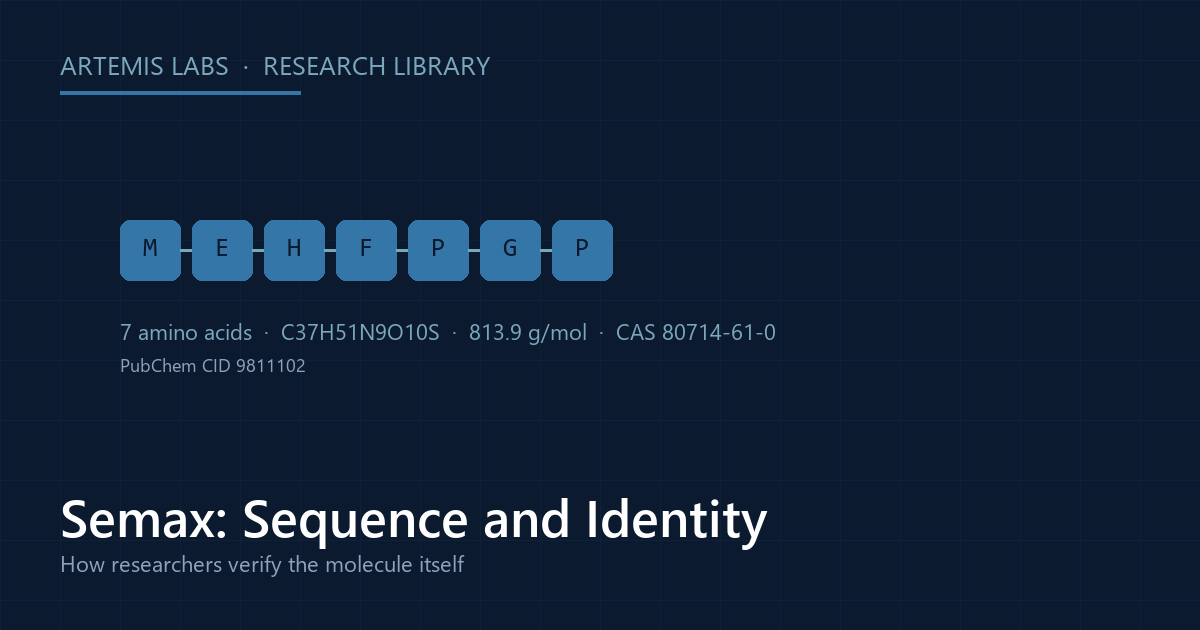
Semax is a synthetic peptide of seven amino acids with the sequence Met-Glu-His-Phe-Pro-Gly-Pro, written MEHFPGP in one-letter code. PubChem, the chemical database run by the U.S. National Library of Medicine, lists Semax as CID 9811102 with the molecular formula C37H51N9O10S, an average molecular weight of 813.9, and a monoisotopic mass of 813.34796003. The CAS number is 80714-61-0, the FDA UNII is I5FAL2585H, and the InChIKey is AFEHBIGDWIGTEH-AQRCPPRCSA-N. Every figure on this page was read directly from that PubChem record on August 26, 2026. Identifiers describe what a molecule is, not what it does, and none of these codes indicates regulatory approval in any country.
Key findings
- Semax is a heptapeptide — seven amino acids joined in a chain. PubChem CID 9811102 gives the sequence as MEHFPGP, which is the same thing as Met-Glu-His-Phe-Pro-Gly-Pro written in shorthand.
- Two different weights appear in the record and both are correct: 813.9 is the average molecular weight, and 813.34796003 is the monoisotopic mass that a mass spectrometer would target.
- The N-acetyl analogs sold under names like “NA-Semax” are different molecules with different formulas, different weights and different identifiers. None of the numbers on this page belongs to them.
- An FDA UNII code and a WHO drug-dictionary entry both exist for this peptide. Neither is an approval. PubChem’s record for CID 9811102 carries no FDA Orange Book section and no drug-and-medication section at all.
What is the verified identity data for Semax?
The table below is the whole record we can verify at the primary source. Each field was pulled from PubChem’s programming interface for compound CID 9811102 on August 26, 2026, rather than copied from a supplier sheet.
| Field | Value |
|---|---|
| PubChem CID | 9811102 |
| Sequence (one-letter) | MEHFPGP |
| Sequence (three-letter) | Met-Glu-His-Phe-Pro-Gly-Pro |
| Amino-acid count | 7 (a heptapeptide) |
| Molecular formula | C37H51N9O10S |
| Molecular weight (average) | 813.9 |
| Exact / monoisotopic mass | 813.34796003 |
| CAS number | 80714-61-0 |
| UNII | I5FAL2585H |
| InChIKey | AFEHBIGDWIGTEH-AQRCPPRCSA-N |
These are the figures we publish for Semax, and they are the figures a certificate of analysis should be checked against.
What do MEHFPGP and Met-Glu-His-Phe-Pro-Gly-Pro mean?
They are the same sequence written two ways. Chemists use two shorthands for amino acids: a three-letter code that is easy to read aloud, and a one-letter code that is compact enough to fit a long protein on one line. Line the two up position by position and the mapping is plain.
M is methionine. E is glutamic acid. H is histidine. F is phenylalanine. P is proline. G is glycine. The last P is proline again. Reading either notation left to right gives the order of the residues from the N-terminus — the head of the chain, which carries a free amino group — to the C-terminus, the tail, which carries an acid group.
Order matters completely. The same seven amino acids in a different order would be a different molecule, so the sequence is the most basic identity check there is. If a supplier’s sequence does not read MEHFPGP, whatever is in the vial is not this compound. Note also that the single methionine is the only sulfur-containing residue in the chain, which is why one S closes the molecular formula.
Why are there two different masses, 813.9 and 813.34796003?
Because they measure different things, and both are legitimate.
Most chemical elements occur as a mixture of isotopes — atoms of the same element that carry different numbers of neutrons and therefore weigh slightly different amounts. Carbon is mostly carbon-12, with about one percent carbon-13. The average molecular weight, 813.9 here, adds up the element weights as nature actually mixes them. That is the number to use for anything measured by mass on a balance, such as preparing a solution of known concentration.
The monoisotopic mass, 813.34796003, is calculated a different way. It assumes every atom in the molecule is the most common isotope of its element: every carbon a carbon-12, every nitrogen a nitrogen-14, the sulfur a sulfur-32. A mass spectrometer does not weigh a bulk sample. It separates individual molecules by mass, so it sees a family of separate peaks, and the largest one for a peptide this size sits at the monoisotopic mass. That is the figure an analytical chemist compares a spectrum against.
The gap between the two numbers is a little over half a dalton. It looks trivial and is not. Comparing a mass-spectrometry result to the average weight, or a balance measurement to the monoisotopic figure, produces a mismatch that has nothing to do with the sample.
What are the CAS number, UNII and InChIKey actually for?
Each is a way of naming the substance without arguing about words. They serve different systems.
CAS number: 80714-61-0. The Chemical Abstracts Service, a division of the American Chemical Society, assigns a registry number to each substance it indexes. The digits carry no chemical meaning; they are just a unique label. Because CAS numbers appear on safety data sheets, customs paperwork, purchase orders and regulatory filings, they are the identifier most likely to be asked for by an institution rather than by a chemist.
UNII: I5FAL2585H. A Unique Ingredient Identifier is a ten-character code from the substance registration system operated by the U.S. Food and Drug Administration with the U.S. Pharmacopeia. It exists so that the same ingredient can be tracked across databases where names vary. Registration is indexing, not endorsement: a UNII means the substance has an entry, and nothing more. PubChem’s full record for CID 9811102 contains no FDA Orange Book section and no drug-and-medication section, and the record’s synonym list includes a World Health Organization drug-dictionary term that is likewise an index entry rather than evidence of approval.
InChIKey: AFEHBIGDWIGTEH-AQRCPPRCSA-N. The International Chemical Identifier is a text description of a structure generated by open-source software, and the InChIKey is a fixed-length code computed from it. The first block of fourteen letters comes from how the atoms are connected. The second block of ten covers the finer details, including stereochemistry — the three-dimensional handedness of the molecule, which matters for peptides because the residues in a synthetic peptide are meant to be the L-forms found in nature. The final letter marks the protonation state.
The practical use of an InChIKey is search. Paste it into a search engine or a chemical database and you retrieve records for that exact structure, including ones filed under a name you have never seen. Matching keys mean the same structure; different keys mean different structures, whatever the labels say.
PubChem CID: 9811102. The CID is PubChem’s own record number, and the fastest way to point someone at the source we used — which is why we cite it beside every figure above.
Is Semax an ACTH(4-10) analog or ACTH(4-7)PGP?
Both, and the two descriptions do not conflict. PubChem’s structural description of CID 9811102 reads ACTH (4-7), Pro-Gly-Pro-, describing what the molecule is built from. Much of the published literature instead calls Semax an analog of ACTH(4-10), describing what it is an analog of. Each is exact, and a page that switches between them without explaining why reads as an error even though it is not. We have given the resolution its own page: how Semax relates to ACTH(4-10) sets out both fragments side by side.
Do the N-acetyl analogs share these numbers?
No, and this is the most common way the identity data on this page gets misused. N-acetyl Semax free acid and N-acetyl Semax amidate are separate molecules with their own PubChem records, their own molecular formulas and their own weights. Nothing in the table above applies to either of them. The naming is worse than it sounds, because PubChem’s own name index returns a single record for two different names, and the abbreviation “NA-Semax” returns no record at all. Our page on what the record shows for the N-acetyl forms works through which figure belongs to which compound ID.
What the research does not show
Verified identity data is a statement about structure only. It tells you what molecule is described. It does not tell you what that molecule does, and it does not tell you what is inside any particular vial — only an analysis of that vial can do that.
The evidence about what Semax does is thin and geographically narrow. The entire human literature consists of Russian studies of a Russian pharmaceutical preparation. There are no meta-analyses, no systematic reviews, no double-blind studies, and no replication of any human result outside Russia. A 2026 review that searched FDA and WADA regulatory databases through January 2026 classifies Semax among “Non-approved peptides” and notes that such compounds “lack long-term safety data and systematic validation” (PMID 42021992). A separate 2026 review written by clinicians in the United States states plainly that “there is a current lack of clinical trials” (PMID 41490200).
You will also find a half-life figure for Semax on other specification sheets. We do not publish one. We could not trace any circulating figure to a published measurement, and a number printed in a specification table reads as measured whether or not anyone measured it. Where we cannot verify, we leave the row out rather than fill it.
Frequently asked questions
How many amino acids are in Semax?
Seven, which makes it a heptapeptide. The sequence is Met-Glu-His-Phe-Pro-Gly-Pro, or MEHFPGP in one-letter code (PubChem CID 9811102).
Which molecular weight should appear on a certificate of analysis?
It depends on the method. A mass-spectrometry identity result should be compared against the monoisotopic mass, 813.34796003. Anything based on weighing a bulk sample uses the average molecular weight, 813.9. A certificate that reports only one figure is normal; a certificate whose figure matches neither is worth questioning.
What is the CAS number for Semax?
80714-61-0, as listed in PubChem’s synonym record for CID 9811102. That number belongs to the unmodified peptide only, not to any acetylated version of it.
Does a UNII code mean Semax is FDA-approved?
No. A UNII is an index entry in a substance registration system, so that databases can refer to the same ingredient consistently. No FDA or EMA approval can be established from any primary source we checked, and PubChem’s record carries none of the sections that approved drugs normally have.
References
- PubChem Compound Summary, CID 9811102 (Semax). https://pubchem.ncbi.nlm.nih.gov/compound/9811102 — sequence MEHFPGP / Met-Glu-His-Phe-Pro-Gly-Pro, molecular formula C37H51N9O10S, molecular weight 813.9, exact and monoisotopic mass 813.34796003, CAS 80714-61-0, UNII I5FAL2585H, InChIKey AFEHBIGDWIGTEH-AQRCPPRCSA-N. Retrieved August 26, 2026.
- PubChem Compound Summary, CID 9811102, full record heading list — no Drug and Medication Information section, no FDA Orange Book section, no DrugBank section returned. Retrieved August 26, 2026.
- PubChem Compound Summary, CID 123787 (ACTH(4-10)). https://pubchem.ncbi.nlm.nih.gov/compound/123787 — sequence Met-Glu-His-Phe-Arg-Trp-Gly, CAS 4037-01-8, molecular weight 962.1. Retrieved August 26, 2026.
- PubChem Compound Summary, CID 172638603 (N-acetyl semax amidate). https://pubchem.ncbi.nlm.nih.gov/compound/172638603. Retrieved August 26, 2026.
- PubChem Compound Summary, CID 172107353 (N-acetyl Semax free acid). https://pubchem.ncbi.nlm.nih.gov/compound/172107353. Retrieved August 26, 2026.
- PubMed record PMID 42021992 — 2026 review that searched FDA and WADA regulatory databases from inception through January 2026 and classifies Semax among “Non-approved peptides.”
- PubMed record PMID 41490200 · DOI 10.5435/JAAOSGlobal-D-25-00236 — 2026 review from clinicians in the United States: “Although preclinical studies are promising, there is a current lack of clinical trials.”
Methodology: every identifier on this page was read from PubChem’s PUG REST interface for the compound records cited above, and the quoted study text from PubMed abstracts retrieved through NCBI E-utilities. Last verified August 26, 2026.
All compounds sold by Artemis Labs are for laboratory research use only. Nothing on this page is medical advice, and no statement has been evaluated by the FDA.
