
Semax Safety Research: What the Published Studies Report | Artemis Labs
Aug
Semax safety research: what published studies report, including the negative findings
Published August 26, 2026 · Artemis Labs
Semax — answer capsule: Semax is a seven-amino-acid research peptide whose published safety record is small, entirely Russian on the human side, and full of findings that cut against the compound. A 1999 Russian study of 73 patients reported that EEG recordings showed episodes of paroxysmal activity in some patients after Semax was given (PMID 10199046). The Russian laboratory that originated the peptide wrote in 2024 that the risks of use in an uninjured brain still need study, and reported immune-gene suppression in healthy rats (PMID 39418522). A 2026 review placed Semax among non-approved peptides that lack long-term safety data and systematic validation (PMID 42021992). PubMed indexes no meta-analysis, no systematic review, and no double-blind study of Semax, and no human Semax study has been run outside Russia.
Key findings
- A Russian study of 73 patients reported that in some cases EEG showed
episodes of paroxysmal activity after semax injection
(PMID 10199046). Paroxysmal activity means an abrupt burst of electrical activity in a brain recording. - In healthy rats, the originating Russian group reported the peptides tested
predominantly caused decrease in expression of the genes associated with the immune system
, and wrote that the risks of use under normal conditions still need study (PMID 39418522). - A pharmacology study reported
Neither mexidol nor semax upon single administration were effective on the models of acute hemic and histotoxic hypoxia
, and called the dose–effect relationshipsbell-shaped
(PMID 20486550). Such a curve rises and then falls, so more is not better. - Two animal studies of sound sensitivity point opposite ways: one reported reduced audiogenic-epilepsy predisposition
in only one-month-old DBA/2J mice
out of five strains (PMID 19145359), the other that Semaxincreased the sensitivity to sound
(PMID 14714455).
What did the one human study that recorded a safety signal report?
The clearest human safety observation in the indexed literature comes from a 1999 Russian paper in the journal Anesteziol Reanimatol. It followed 73 patients with posthypoxic encephalopathy, a brain injury that follows a period of oxygen shortage, and reported that the therapy helped those with mnestic, meaning memory, disorders. It also reported something else. In some cases, EEG recordings showed episodes of paroxysmal activity after semax injection
(PMID 10199046). EEG is a recording of the brain’s electrical activity taken from the scalp.
On the strength of that observation those researchers set a precaution for their own study, in which a first administration was carried out while brain activity was being recorded. That describes how a 1999 study was run. It is not guidance.
Two limitations travel with the finding. The paper describes no control group, so there is nothing to judge the EEG episodes against. And no Russian human Semax result has an independent replication in either direction, so the signal is neither confirmed nor ruled out.
What did the originating research group say about healthy brains?
Most Semax animal work uses an injury model, usually a rat with an experimentally induced stroke. That says little about a brain that is not injured. In 2024 the Russian institute behind the peptide published a rat study aimed at that gap. Working in normal Wistar rats, the authors reported that both peptides tested predominantly caused decrease in expression of the genes associated with the immune system
, and wrote that it is necessary to study influence of the peptide on the brain cells under normal physiological conditions, including understanding the risks of their use
(PMID 39418522). Gene expression is a measure of which genes are switched on; a decrease means those genes were less active.
That is an unusual thing for an originating laboratory to publish. The group with the most reason to present Semax favourably is on record calling its effects in a healthy brain an open risk question.
Does more Semax produce more effect?
Not in the one study that examined the shape of the curve. A pharmacology paper comparing Semax against the drug mexidol reported that Neither mexidol nor semax upon single administration were effective on the models of acute hemic and histotoxic hypoxia
, and described Semax as showing bell-shaped
reversible dose-effect relationships (PMID 20486550). Those two hypoxia models starve tissue of usable oxygen by different mechanisms.
Both halves matter. A null result there undercuts a broad protective story, and a bell-shaped relationship undercuts a potency story, because the measured effect rose and then fell as the studied amount changed.
Why do two animal studies of sound sensitivity disagree?
Nobody has resolved it. One study gave the peptide to newborn mice of five inbred strains and reported reduced predisposition to audiogenic epilepsy, meaning seizure activity provoked by loud sound, in only one-month-old DBA/2J mice
(PMID 19145359). That is one positive strain and four null ones. A separate study reported the opposite, that Semax increased the sensitivity to sound
(PMID 14714455).
Two animal papers pointing opposite ways on a seizure-adjacent endpoint is not a footnote, especially next to the human EEG observation above. It is the kind of contradiction a systematic review would settle, and for Semax none exists.
What safety data does the human record actually contain?
Very little, and all of it from one country. Four PubMed records carry a clinical-trial publication type and all four were conducted in Russia. One carries the Randomized Controlled Trial tag, though its own abstract describes an open-label design in sequential groups, and it was negative on its primary endpoint (PMID 18379501).
One Russian study of 187 patients with cerebrovascular insufficiency did report tolerability, saying the drug is featured by minor percent of side-effects and is well tolerated by patients, including those of older age groups
(PMID 15792140). Read that with its design attached. No control arm is described anywhere in the abstract, the side-effect rate is never quantified, and PubMed does not tag the record as a clinical trial. An uncontrolled tolerability impression is weak evidence of safety.
Reviews from outside Russia agree. A 2026 review by United States authors says of these neuroactive peptides that there is a current lack of clinical trials
(PMID 41490200), and a 2026 gerontology review that searched regulatory databases through January 2026 lists Semax among non-approved peptides, which it says lack long-term safety data and systematic validation
(PMID 42021992).
What the research does not show
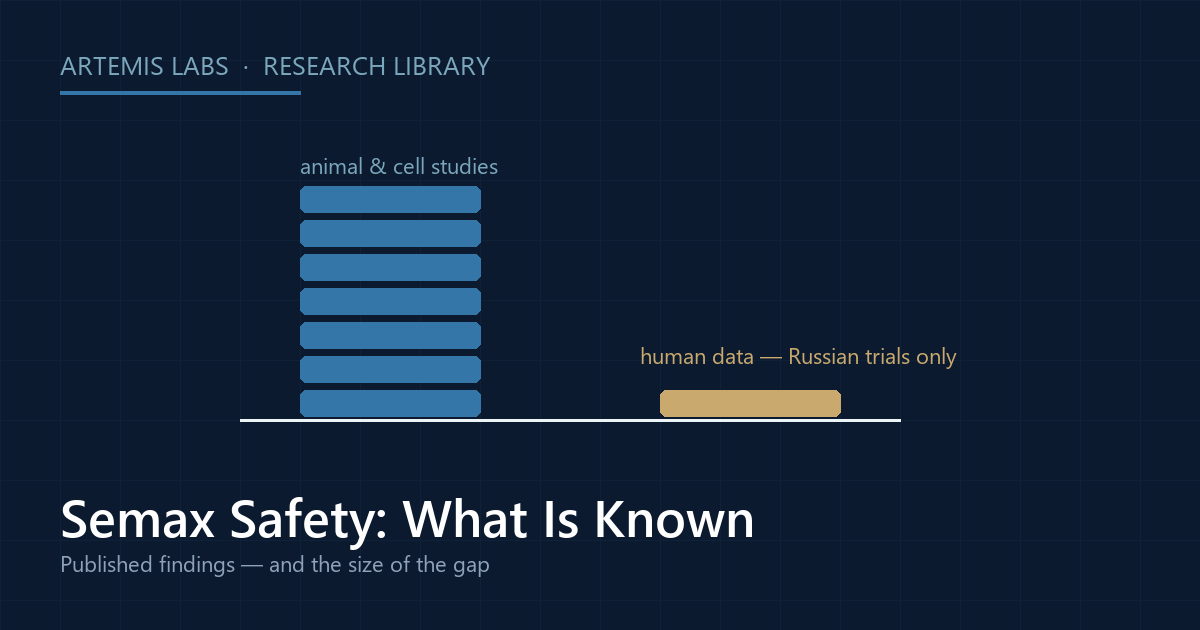
No human Semax study has been conducted outside Russia. Every human record is Russian-affiliated or published in a Russian-language Russian journal, studying a Russian intranasal pharmaceutical preparation, and none of it has been independently replicated anywhere.
There is no long-term safety data, and the 2026 review above says so directly (PMID 42021992). PubMed indexes no meta-analysis, no systematic review, and no double-blind study of Semax, so the contradictions on this page have never been formally adjudicated.
The EEG observation in PMID 10199046 was never quantified, replicated, or compared against a control group, so its frequency and cause are unknown. The immune-gene decrease in PMID 39418522 is a measurement in rats, not a clinical outcome. No page, this one included, can say what any of it means for a person, because that research has not been done.
Frequently asked questions
Is Semax approved by the FDA?
No FDA or EMA approval can be established from any primary source. PubChem’s record carries no drug-information, Orange Book, or DrugBank section, and the 2026 review above classifies Semax among non-approved peptides (PMID 42021992). Russian authors describe it as a registered domestic drug inside their papers, which we report as their description, not as our own claim.
Are there reported side effects of Semax?
The indexed human literature holds one explicit safety observation, the EEG episodes in a 1999 Russian study (PMID 10199046), and one uncontrolled tolerability statement (PMID 15792140). Neither is a systematic safety assessment. A 2020 analysis separately found Semax in seized cognitive-enhancing preparations, describing a compound that has not completed clinical trials
(PMID 31667971).
Why is this page less confident than other sites about Semax?
Because the record is thin and we would rather say so. Zero meta-analyses, zero systematic reviews, zero double-blind studies, zero replications outside Russia, and one randomized-controlled-trial record negative on its primary endpoint. A page more confident than that is describing something other than the published evidence. The full compound record sits on the Semax page.
Where can I read more about the studies themselves?
Our companion pages walk through the Semax human trials one at a time with each design attached, and cover the Semax BDNF and neurotrophin research, where the reported gene-expression change is bidirectional rather than a clean increase.
References
- [Use of semax at a follow-up of patients with posthypoxic encephalopathy]. Anesteziol Reanimatol, 1999. Russia. PMID 10199046
- Changes of Transcriptomic Activity in Rat Brain Cells under the Influence of Synthetic Adrenocorticotropic Hormone-Like Peptides. Biochemistry (Mosc), 2024. National Research Centre “Kurchatov Institute”, Moscow, Russia. PMID 39418522 · doi:10.1134/S0006297924090104
- Hemic and histotoxic hypoxia model study quoted above. Cited by PMID only; no title or DOI is carried in our verified citation record. PMID 20486550
- Audiogenic-epilepsy predisposition study in five inbred mouse strains, quoted above. Cited by PMID only; no title or DOI is carried in our verified citation record. PMID 19145359
- Sound-sensitivity study quoted above. Cited by PMID only; no title or DOI is carried in our verified citation record. PMID 14714455
- [The study of chronic partial denervation and quality of life in patients with motor neuron disease treated with semax]. Zh Nevrol Psikhiatr Im S S Korsakova, 2007. Russia. PMID 18379501
- [Semax in prevention of disease progress and development of exacerbations in patients with cerebrovascular insufficiency]. Zh Nevrol Psikhiatr Im S S Korsakova, 2005. Russia. PMID 15792140
- Review of neuroactive peptides, 2026. Pacific Coast Sports Medicine, Los Angeles, CA; Lenox Hill Hospital, New York. Cited without title per our citation policy. PMID 41490200 · doi:10.5435/JAAOSGlobal-D-25-00236
- Gerontology review classifying non-approved peptides, 2026. Alfaisal University, Riyadh; St. Matthew’s University, George Town. Cited without title per our citation policy. PMID 42021992 · doi:10.3389/fragi.2026.1790247
- Vanhee C, Francotte A, Janvier S, Deconinck E. The occurrence of putative cognitive enhancing research peptides in seized pharmaceutical preparations: An incentive for controlling agencies to prepare for future encounters of the kind. Drug Testing and Analysis, 2020. PMID 31667971 · DOI 10.1002/dta.2717
Methodology: this page draws only on primary-source records verified against PubChem and PubMed via NCBI E-utilities and transcribed verbatim in the Artemis Labs Semax citation record; last verified August 26, 2026.
All compounds sold by Artemis Labs are for laboratory research use only. Nothing on this page is medical advice, and no statement has been evaluated by the FDA.
