
Semax and BDNF: What Published Research Reports | Artemis Labs
Aug
What published research reports about Semax and BDNF
Published August 26, 2026 · Artemis Labs
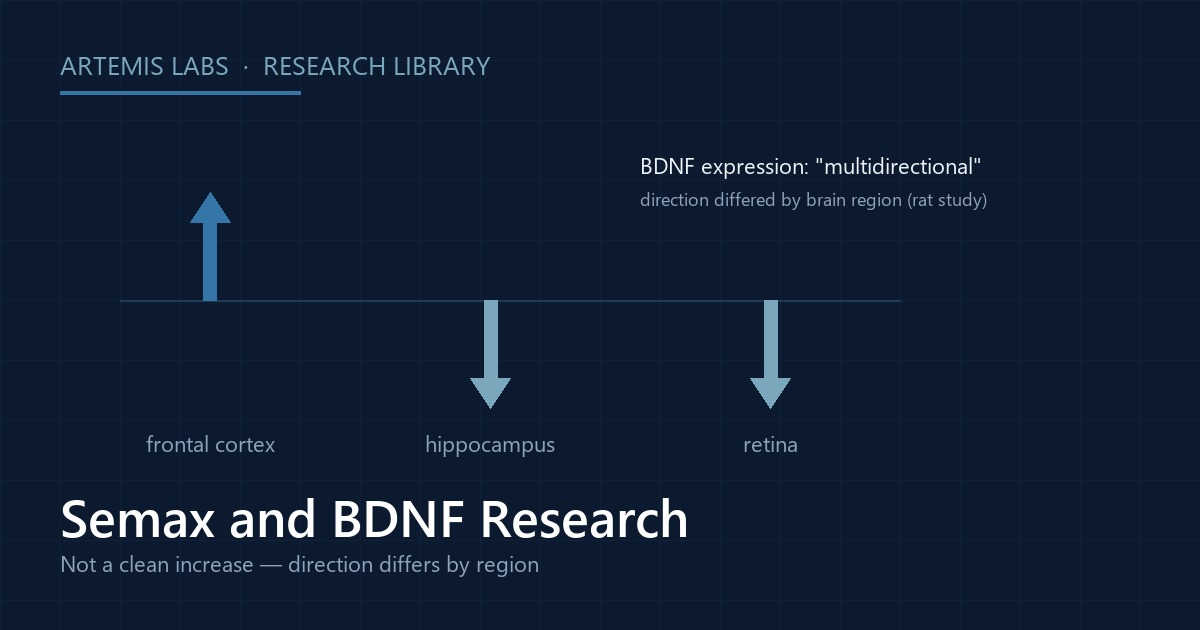
Semax and BDNF — answer capsule: Semax is a seven-amino-acid research peptide (PubChem CID 9811102) commonly described as raising BDNF, short for brain-derived neurotrophic factor, a protein that supports the upkeep of nerve cells. The most-cited measurement behind that description is a rat study from a Moscow research institute, and what it reported was not a simple increase. BDNF gene expression fell in the hippocampus and the retina 20 minutes after Semax was given and rose in the frontal cortex; the authors’ own word for the pattern was multidirectional. A 2018 study at a Moscow medical university reported higher BDNF in the blood of 110 stroke patients, but Semax there was given alongside rehabilitation, so the two cannot be separated. No study in the published record establishes the receptor-level step popular summaries assert.
Key findings
- The rat study cited for this mechanism reported a region-dependent result. Verbatim: The expression of both neurotrophin genes was decreased in rat hippocampus and retina 20 min after Semax administration and was increased in the frontal cortex. (PMID 19662538, Institute of Molecular Genetics RAS, Moscow.)
- That paper’s word for the pattern is multidirectional, which is not a synonym for “increased”. Timing moved the answer too: retinal BDNF was down at 20 minutes, then significantly increased 90 min after Semax administration.
- The only human BDNF measurement states no randomization or blinding and is confounded by co-treatment. A 2018 study at Pirogov Russian National Research Medical University in Moscow reported that Administration of semax, regardless of the timing of rehabilitation, increased BDNF plasma levels which remained high during the whole study period (PMID 29798983).
What is BDNF, and why is it attached to Semax?
BDNF belongs to a family called neurotrophins, signalling proteins that help nerve cells survive, form connections, and repair themselves. NGF, or nerve growth factor, is another member. BDNF is the measurement most often quoted from Semax’s research record, and the quotation is four words long: Semax raises BDNF. The measurement behind it is not.
What did the main rat study actually measure?
The study is PMID 19662538, published in 2010 by the Institute of Molecular Genetics of the Russian Academy of Sciences in Moscow, using male Wistar rats. It tracked how the genes for NGF and BDNF switched on or off in three tissues: the hippocampus, a structure involved in memory; the frontal cortex; and the retina. Gene expression measures how much a cell is reading a gene to build its protein, one step upstream of the protein itself.
The three regions did not agree. Twenty minutes after Semax was given, expression of both neurotrophin genes was lower in the hippocampus and lower in the retina, and higher in the frontal cortex. Two of three moved down, and the authors named that rather than smoothing it: the pattern is multidirectional in their own wording.
Time mattered too. Retinal NGF stayed practically constant early on while BDNF was significantly increased 90 min after Semax administration. One tissue gave a decrease at one point and an increase at another. A four-word claim cannot carry that, because it says neither where nor when.
Has BDNF been measured in people given Semax?
Once, in Russia. PMID 29798983 is a 2018 report from Pirogov Russian National Research Medical University in Moscow. It examined 110 patients after ischemic stroke, split into early and late rehabilitation groups, each subdivided into semax and non-semax subgroups. PubMed classifies it as a Clinical Trial, and its abstract states no placebo, no randomization, and no blinding.
Plasma BDNF rose in the semax subgroups and stayed high, and the paper reports that Administration of semax and high BDNF levels accelerated the improvement and ameliorated the final outcome of Barthel score index. Read the design before the result. Every patient was in a rehabilitation program, and the paper’s framing is joint: Early rehabilitation and administration of semax increase BDNF plasma level. That shows two things travelled together, not which one did the work.
Blood BDNF is also not brain BDNF. The rat study measured gene expression inside tissue; this one measured a protein circulating in plasma. No work we reviewed connects the two for this compound.
What happened to BDNF in the chronic-stress rat model?
A 2024 study from the National Research Center “Kurchatov Institute” in Moscow (PMID 39442746) used male Sprague-Dawley rats under chronic unpredictable stress, a model in which hippocampal BDNF falls. Treatment with Semax and a second peptide reversed or substantially attenuated CUS-induced anhedonia, BW gain suppression, adrenal hypertrophy and a decrease in the hippocampal levels of BDNF.
That is a protection result, not a boost result: the change is measured against a stress-induced fall, not in an untouched animal. The same abstract carries its own null: In the forced swim test, no effects of the CUS procedure or peptides on the duration of rat immobility were detected.
What do the other signalling studies show?
On dopamine, a brain chemical involved in movement, a 2005 rodent study from a Moscow pharmacology institute reported a null result: This peptide alone failed to alter the tissue and extracellular concentrations of dopamine and its metabolites (PMID 16362768). A 2021 mouse study in a Parkinson’s model found an effect and sized it against a stronger comparator: Semax slightly but reliably increased dopamine in the striatum, while nomifensine almost completely protected dopamine-carrying nerve fibres (PMID 34707903).
On gene expression, a 2020 rat study of brain ischemia (PMID 32580520) found 394 genes changed after Semax, and stated the position this page rests on: However, its molecular mechanisms of action within the brain are not yet fully understood. A 2024 study by the same group used healthy rats, and the dominant direction was downward: Both peptides predominantly caused decrease in expression of the genes associated with the immune system (PMID 39418522). Those authors write that it is necessary to study influence of the peptide on the brain cells under normal physiological conditions, including understanding the risks of their use. That finding is covered in our Semax safety research summary; the ischemia work is treated in our Semax neuroprotection research summary.
What the research does not show
No Semax study in people has been run outside Russia. Four PubMed records carry a clinical-trial publication type and all four are Russian; the wider human literature of roughly eighteen records is Russian-affiliated or in Russian journals. There are no meta-analyses, no systematic reviews, no double-blind studies, and no independent replication in either direction. Two 2026 reviews say as much: one, from US authors, states there is a current lack of clinical trials (PMID 41490200); the other finds limited clinical evidence but lack long-term safety data and systematic validation (PMID 42021992).
Three limits travel with any BDNF claim here. The direction of change is not uniform, and in the only region-by-region measurement it fell in two tissues of three. The receptor step most summaries attach to it, in which BDNF acts through its TrkB receptor, is not established by any study reviewed here, and we do not assert it. And nothing in this record shows a cognitive or clinical benefit arising from a BDNF change, because no study reviewed here was designed to test that link.
Frequently asked questions
Does Semax raise BDNF?
In the study cited for it, the answer depended on tissue and timing. BDNF gene expression fell in rat hippocampus and retina at 20 minutes, rose in the frontal cortex, and rose in the retina by 90 minutes (PMID 19662538).
What does “multidirectional” mean here?
It is the authors’ term for a result that moved different ways in different places. It describes the data rather than hedging it, which is why a flat statement that the peptide increases BDNF misreports the paper.
Is the BDNF–TrkB pathway established for Semax?
Not by the record reviewed here. The rat work measured gene expression and the human work measured a protein in blood. Neither measured receptor activity, so that step is an unestablished mechanism.
Has any group outside Russia measured Semax and BDNF?
No. The non-Russian primary research indexed for this compound is entirely non-human and reports no BDNF measurement: two Italian in-vitro studies and one Indonesian rat study. Analytical identity is on our Semax product page.
References
- Comparison of the temporary dynamics of NGF and BDNF gene expression in rat hippocampus, frontal cortex, and retina under Semax action. J Mol Neurosci. 2010. PMID 19662538 · doi:10.1007/s12031-009-9270-z
- [The efficacy of semax in the tretament of patients at different stages of ischemic stroke]. Zh Nevrol Psikhiatr Im S S Korsakova. 2018. (The misspelling is in the PubMed record and is quoted as indexed.) PMID 29798983 · doi:10.17116/jnevro20181183261-68
- Antidepressant-like and antistress effects of the ACTH(4-10) synthetic analogs Semax and Melanotan II on male rats in a model of chronic unpredictable stress. Eur J Pharmacol. 2024. PMID 39442746 · doi:10.1016/j.ejphar.2024.177068
- Novel Insights into the Protective Properties of ACTH(4-7)PGP (Semax) Peptide at the Transcriptome Level Following Cerebral Ischaemia-Reperfusion in Rats. Genes (Basel). 2020. PMID 32580520 · doi:10.3390/genes11060681
- Changes of Transcriptomic Activity in Rat Brain Cells under the Influence of Synthetic Adrenocorticotropic Hormone-Like Peptides. Biochemistry (Mosc). 2024. PMID 39418522 · doi:10.1134/S0006297924090104
- Neurochem Res. 2005. PMID 16362768 · doi:10.1007/s11064-005-8826-8 (cited without title)
- 2021. PMID 34707903 · doi:10.32607/actanaturae.11433 (cited without title)
- 2026 review, US authors. PMID 41490200 · doi:10.5435/JAAOSGlobal-D-25-00236 (cited without title)
- 2026 review. PMID 42021992 · doi:10.3389/fragi.2026.1790247 (cited without title)
Methodology: this page draws only on primary records retrieved from PubChem and from PubMed via NCBI E-utilities and transcribed verbatim into the Artemis Labs Semax fact file; quotations are reproduced as indexed, including source typographical errors. Last verified August 26, 2026.
All compounds sold by Artemis Labs are for laboratory research use only. Nothing on this page is medical advice, and no statement has been evaluated by the FDA.
