
How to Read a Certificate of Analysis for Semax | Artemis Labs
Aug
How to read a certificate of analysis for Semax
Published August 26, 2026 · Artemis Labs
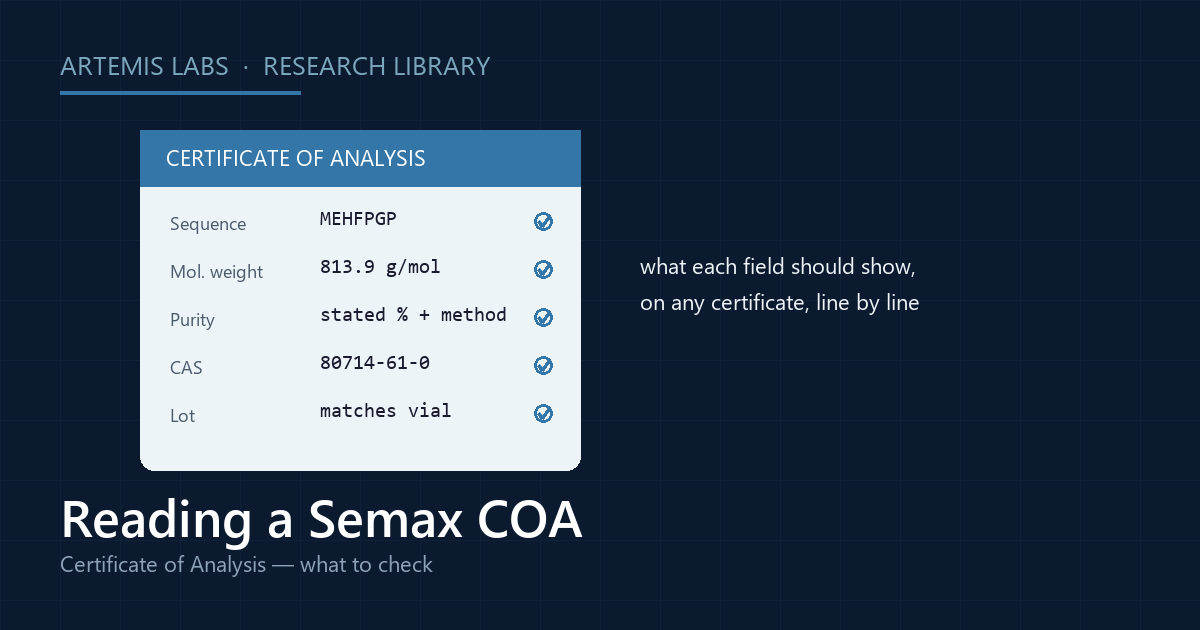
Semax is a seven-residue peptide with the sequence Met-Glu-His-Phe-Pro-Gly-Pro, written MEHFPGP in one-letter code, and it is indexed at PubChem as CID 9811102 with CAS number 80714-61-0. A certificate of analysis, usually shortened to COA, is a lab document that reports what an analytical test found in a specific batch of material. For Semax the identity half of that document matters more than the purity half, because two acetylated analogs circulate under names that the public chemical databases themselves confuse, and their masses sit about forty daltons away from the parent. A COA is a chemistry document: it reports what a molecule is, never what a molecule does.
Key findings
- The verified identity set for Semax is: sequence Met-Glu-His-Phe-Pro-Gly-Pro (MEHFPGP), seven amino acids, molecular formula C37H51N9O10S, molecular weight 813.9, monoisotopic mass 813.34796003, CAS 80714-61-0, UNII I5FAL2585H, InChIKey AFEHBIGDWIGTEH-AQRCPPRCSA-N, PubChem CID 9811102.
- A document can carry two different mass numbers for Semax and be right both times: 813.9 is the average molecular weight, 813.34796003 the monoisotopic mass. The roughly half-dalton gap between them is expected, not an error.
- An HPLC purity figure is a relative measure of what one detector saw. It is not an identity test, and alone it cannot tell you which molecule the main peak belongs to.
- The identity check carries unusual weight here. PubChem returns the same record, CID 172638603, for both “N-Acetyl Semax” and “N-Acetyl Semax Amidate,” while the literal string “NA-Semax” returns nothing at all.
This page is a general guide to reading a certificate of analysis for this molecule. It describes what such a document contains and how to check it against the public chemical record. It makes no statement about any particular vendor’s documents, testing, or lots, including our own.
Which identifiers on a COA should match what?
Start with the identity block at the top of the sheet. For a peptide every other identifier is derived from the sequence, so that is where a check begins.
Count the letters in MEHFPGP. There are seven: methionine, glutamic acid, histidine, phenylalanine, proline, glycine, proline. A sheet that names Semax and lists a sequence of any other length has an internal contradiction, and one of the two entries is wrong.
Then check that the identifiers agree with each other. The formula C37H51N9O10S, the CAS registry number 80714-61-0, and the CID 9811102 all point at the same structure, and any of them can be typed into PubChem, the U.S. National Library of Medicine’s public chemical database, to check that they return the same record. If a CAS number resolves to a different compound than the name printed beside it, settle that before reading anything else on the page.
Two fields do more work than they look like they do. The UNII, I5FAL2585H, is the FDA’s unique ingredient identifier — a substance registry code and nothing more, an index entry rather than a statement of approval. The InChIKey, AFEHBIGDWIGTEH-AQRCPPRCSA-N, is a fixed-length fingerprint calculated from the structure itself, with the first fourteen characters encoding the molecular skeleton. Two documents describing the same molecule carry identical InChIKeys, which makes it the fastest single field to compare.
What should a mass spectrometry result land near, and why are there two numbers?
Mass spectrometry sorts molecules by weight. On a peptide COA it is normally the identity test, and its result gets compared against a calculated expectation. The confusion is that Semax has two correct calculated masses.
The molecular weight, 813.9, is an average. Elements occur in nature as a mix of isotopes — carbon is mostly carbon-12 with a little carbon-13 — and the average weight is calculated across those natural abundances. It describes a bulk population of molecules, which is what a balance weighs.
The monoisotopic mass, 813.34796003, is the mass of a single molecule built entirely from each element’s most common isotope. A mass spectrometer resolves individual ions, so this is the figure its main peak is calculated against. The roughly half-dalton gap between the two is a property of the formula, not a defect in either number.
One more offset trips people up. Instruments usually detect a charged form of the molecule rather than the neutral one, most often the molecule plus an added proton, and that ion is about one dalton heavier than the neutral mass a COA lists. A peak near 814 for a singly protonated Semax ion is consistent with a neutral monoisotopic mass of 813.34796003. It is not a mismatch. What the sheet should make clear is which quantity it reports.
Mass is powerful evidence of identity but not proof by itself, because different sequences built from the same amino acids can share a formula and therefore a mass. Mass narrows the field; sequence confirmation closes it.
What does an HPLC purity figure tell you, and what does it not?
High-performance liquid chromatography, or HPLC, pushes a sample through a column so its components separate and come off at different times. A detector watches the outflow and draws a peak for each one. The purity number on a COA is normally the area of the largest peak as a percentage of all the peak area the detector recorded.
Everything HPLC purity cannot tell you follows from that definition.
It is not an identity test. The figure describes how dominant the main peak is, not which molecule that peak contains. A sample of the wrong peptide, cleanly made, produces an excellent purity number.
It is also relative to what the detector saw. Peptide COAs commonly monitor ultraviolet absorbance around 214 or 220 nanometres, where the peptide bond absorbs. Anything that does not absorb there, or does not come off the column at all, contributes nothing to the denominator and cannot lower the percentage.
And it is not the same as peptide content. Synthesized peptides are typically isolated as salts and hold residual water, so the share of a vial’s mass that is peptide can sit well below the chromatographic purity figure. Those are two separate measurements, and a document reporting only one has told you only one thing.
Why is the identity check the whole game for Semax?
Because the names in circulation do not map cleanly to molecules.
Query PubChem for “N-Acetyl Semax” and it returns CID 172638603. Query it for “N-Acetyl Semax Amidate” and it returns CID 172638603 again — the same record, for two names that describe chemically different changes at opposite ends of the peptide. Query the common abbreviation “NA-Semax” and PubChem returns a 404 and no compound at all. The merge is happening at the primary source, not in some vendor’s paperwork.
The two candidate analogs then differ by about one dalton, in the direction most readers guess wrong. The amidate at CID 172638603 is listed at molecular weight 855.0. The N-acetyl free acid at CID 172107353 is listed at 856.0. No molecular weight and no CAS number appear on this page under the bare label “NA-Semax,” because that label is unverified as an identifier — a figure like this is only meaningful stated with the CID it came from. A sheet that puts 856 beside the word “amidate” has something swapped, and the sheet alone will not tell you which. Our page on N-acetyl Semax and N-acetyl Semax amidate works through that record in full.
Both of those numbers sit roughly forty daltons above the parent’s 813.9, so a reader who checks the mass against the right molecule catches a mislabel immediately, and a reader who does not may be holding a COA for a different compound than the label says. Identity verification also has a documented reason to matter for this specific compound: a 2020 analytical report, PMID 31667971, described Semax found in seized cognitive-enhancing preparations and noted it as a compound that “has not completed clinical trials.” The full verified identity set for the parent peptide is laid out in our Semax sequence and identity reference, alongside the product record for Semax.
What the research does not show
A certificate of analysis is evidence about chemistry and nothing else. It can support a claim that a batch of material matches a structure. It cannot support any claim about what that structure does in a cell, an animal, or a person, and no purity figure however high changes that.
The underlying evidence base for Semax is thin, which is worth stating plainly on a page about verification. Its entire human literature consists of Russian studies of a Russian pharmaceutical preparation. There are no meta-analyses, no systematic reviews, no double-blind studies, and no independent replication of any result outside Russia. The single record carrying a randomized-controlled-trial publication type, PMID 18379501, was negative on its primary endpoint: it reports that Semax “does not influence either the course of CPD or the dynamics of clinical estimates” — neither the course of the condition studied nor the clinical measures moved. A 2026 review that searched regulatory databases through January 2026 classifies Semax among “Non-approved peptides” (PMID 42021992), and a separate 2026 review written by U.S. authors states of this class that “there is a current lack of clinical trials” (PMID 41490200).
The database gaps described above are gaps in the public record, not findings about any seller. A missing CAS number means the registry has not assigned one that PubChem returns; it says nothing about what is in a given vial. Only analysis of that vial can speak to that.
Frequently asked questions
What molecular weight should a Semax COA show?
813.9 as the average molecular weight, or 813.34796003 as the monoisotopic mass. Both are correct, and they answer different questions. A document should say which one it is reporting.
Does a high HPLC purity percentage mean the vial contains Semax?
No. Purity by HPLC describes how dominant the main peak is relative to other peaks the detector recorded. Identity comes from mass spectrometry and sequence confirmation, checked against CID 9811102 and the formula C37H51N9O10S.
How many amino acids should be listed for Semax?
Seven. The sequence is Met-Glu-His-Phe-Pro-Gly-Pro, or MEHFPGP. A different residue count on a sheet labelled Semax is an internal contradiction on that sheet.
What if a COA lists a mass near 855 or 856?
Neither figure belongs to Semax, whose masses are 813.9 average and 813.34796003 monoisotopic. 855.0 is listed for the amidate at CID 172638603 and 856.0 for the N-acetyl free acid at CID 172107353. Those are separate molecules, and the analog names for them collide at PubChem itself.
References
- PubChem Compound Summary, CID 9811102 (Semax). https://pubchem.ncbi.nlm.nih.gov/compound/9811102 — sequence Met-Glu-His-Phe-Pro-Gly-Pro (MEHFPGP), 7 residues, formula C37H51N9O10S, molecular weight 813.9, monoisotopic mass 813.34796003, CAS 80714-61-0, UNII I5FAL2585H, InChIKey AFEHBIGDWIGTEH-AQRCPPRCSA-N. Retrieved August 26, 2026.
- PubChem Compound Summary, CID 172638603 (N-acetyl Semax amidate). https://pubchem.ncbi.nlm.nih.gov/compound/172638603 — molecular weight 855.0. Returned for both the queries “N-Acetyl Semax” and “N-Acetyl Semax Amidate.” Retrieved August 26, 2026.
- PubChem Compound Summary, CID 172107353 (N-acetyl Semax free acid). https://pubchem.ncbi.nlm.nih.gov/compound/172107353 — molecular weight 856.0, no CAS number returned. Retrieved August 26, 2026.
- Vanhee C, Francotte A, Janvier S, Deconinck E. The occurrence of putative cognitive enhancing research peptides in seized pharmaceutical preparations: An incentive for controlling agencies to prepare for future encounters of the kind. Drug Testing and Analysis, 2020. PMID 31667971 · DOI 10.1002/dta.2717
- PubMed record PMID 18379501 — the single Semax record carrying a Randomized Controlled Trial publication type; self-described open-label; negative on its primary endpoint.
- PubMed record PMID 42021992 — 2026 review that searched regulatory databases through January 2026 and classifies Semax among “Non-approved peptides.” DOI 10.3389/fragi.2026.1790247.
- PubMed record PMID 41490200 — 2026 review by U.S. authors stating “there is a current lack of clinical trials.” DOI 10.5435/JAAOSGlobal-D-25-00236.
Methodology: this page draws on PubChem compound records retrieved directly from the PUG REST interface and on PubMed records retrieved through NCBI E-utilities. All chemical identifiers and quoted study text were verified against those primary sources on August 26, 2026.
All compounds sold by Artemis Labs are for laboratory research use only. Nothing on this page is medical advice, and no statement has been evaluated by the FDA.
