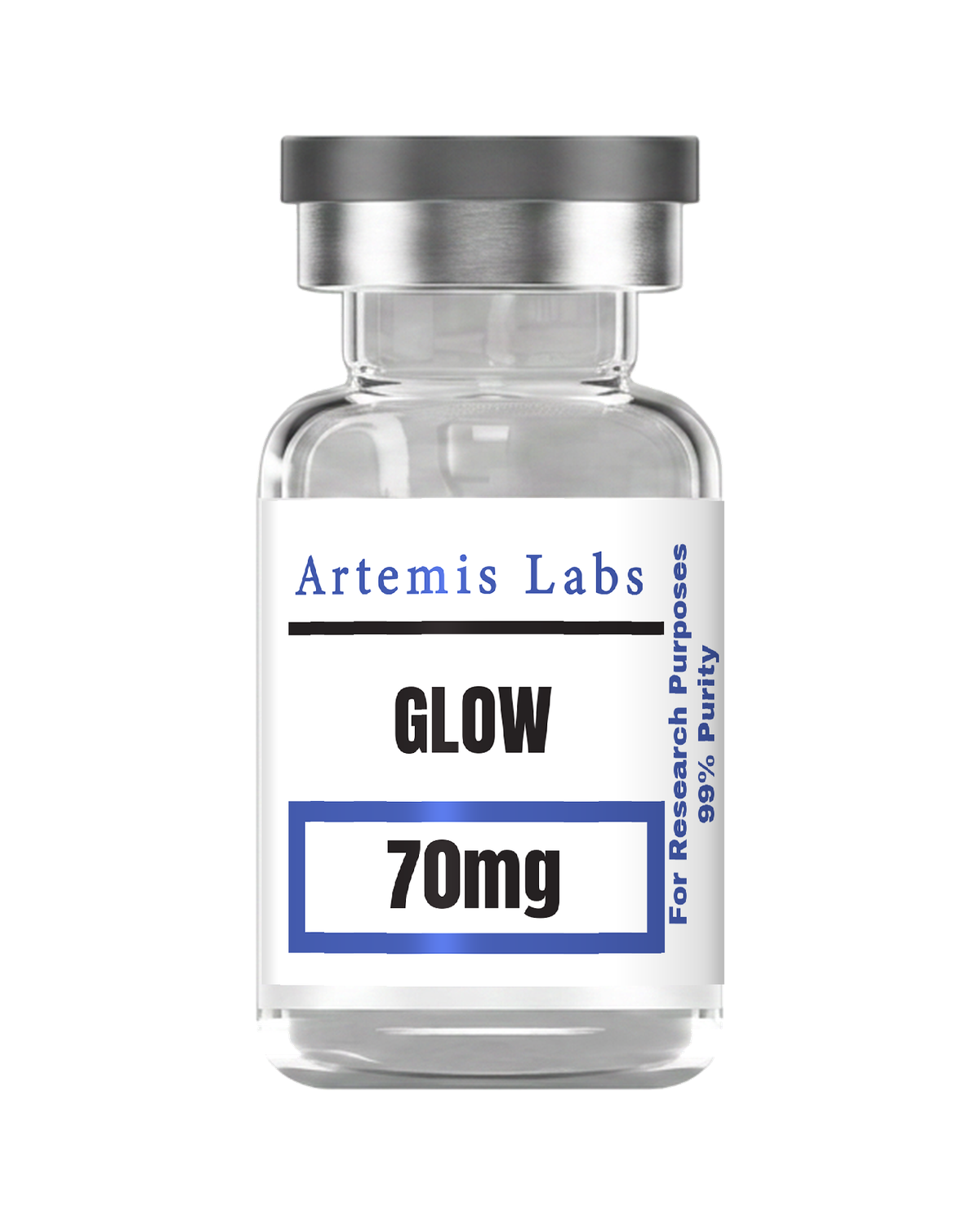
GLOW (GHK-Cu + BPC-157 + TB-500) Research Blend
$140.00
Three repair compounds in one vial, chosen because they act at different points rather than duplicating the same effect. BPC-157 works on blood supply signalling, TB-500 on the cell’s internal scaffolding, GHK-Cu on which genes are switched on in the first place. Downstream, structural, transcriptional — three different levels of the same problem.
Continue readingShow less
The rationale, stated honestly. The three engage non-redundant pathways, and that is the published research rationale — not a claim that combining them multiplies the effect. No study has tested this three-way combination.
The 2026 evidence, per component. BPC-157: first human-tissue ex-vivo vascular mechanism (Yildirim 2026, PMID 42123221). TB-500 / Tβ4: kidney-disease candidate (Di 2026, PMID 41570941) and Alzheimer’s neuroinflammation work (Ou 2026, PMID 41443105). GHK-Cu: zebrafish anti-inflammatory (Hu 2026, PMID 41997403) and C. elegans lifespan extension (Wen 2026, PMID 42084774).
Counter-evidence. Sun 2025 (PMID 41278163) reported Tβ4-mediated intestinal barrier impairment in an IBS model. Ships as one vial, not three.
Lyophilized three-component blend.
29 in stock
Free shipping on orders over $300
Pay by Venmo or Cash App — instructions are emailed with your order.
23 published sources cited on this page see them
For research use only. Not for human consumption.
Description
GLOW is a ready-made blend of three research peptides in one vial: 50 mg GHK-Cu, 10 mg BPC-157 and 10 mg TB-500, 70 mg in total. The three are studied together because they act at different points in tissue-repair research, not because their effects add up. No human trial has tested the blend as a unit.
Reviewed August 21, 2026 · Artemis Labs
What is GLOW?
GLOW is a pre-formulated 3-component lyophilised research reagent containing 50 mg GHK-Cu (CAS 89030-95-5; 340.4 Da; copper-tripeptide), 10 mg BPC-157 (CAS 137525-51-0; 1,419.54 Da; pentadecapeptide GEPPPGKPADDAGLV), and 10 mg TB-500 (Thymosin beta-4 17-23 active fragment LKKTETQ; 888.0 Da; parent Tβ4 CAS 77591-33-4) totaling 70 mg per vial. The three peptides target non-overlapping repair pathways in preclinical models and are studied together for mechanism complementarity, not additive efficacy. GLOW is the 3-component variant.
Is GLOW a compounded pharmaceutical or an FDA-approved product?
Artemis Labs GLOW is NOT a compounded pharmaceutical and is NOT a substitute for any FDA-approved product. None of the three components are FDA-approved as therapeutic drugs. BPC-157 was on the FDA 503A interim Category 2 list (September 2023), then removed September 27, 2024 following nominator withdrawal. In May 2026 the FDA’s own evaluations concluded the evidence weighs against listing either BPC-157 or TB-500 for pharmacy compounding. On July 23, 2026 the Pharmacy Compounding Advisory Committee voted 8-6 to recommend listing both anyway. Those votes are advisory; the FDA has not acted on them, and no rule has been proposed. GHK-Cu has approved cosmetic-ingredient status, but Artemis supplies research-grade reagent through a distinct supply chain. TB-500’s full-length parent Thymosin beta-4 has multiple investigational INDs (RGN-259, RGN-352 by RegeneRx), none approved. Two of three components (BPC-157, TB-500) are on the WADA Prohibited List 2026 Section S2 at all times; GHK-Cu is not on the WADA list. Artemis Labs supplies GLOW strictly as a research-grade reagent for laboratory use – not for human consumption, therapeutic use, or as a substitute for any approved pharmaceutical.
Why are these three peptides studied together?
The blend rationale published in the research literature is non-redundant mechanism complementarity, not additive efficacy claim. Mavrych et al. 2026 (PMID 42021992) and Rahman 2026 (PMID 41490200) frame the rationale: BPC-157 contributes downstream signalling (VEGFR2-Akt-eNOS, FAK, GHR upregulation); TB-500 contributes upstream cytoskeletal remodelling (G-actin sequestration) and stem-cell mobilisation; GHK-Cu contributes copper-mediated chromatin-protein and transcription-factor interactions plus mitochondrial-function preservation (Wen 2026 PMID 42084774). This is observed in preclinical models and is the published rationale for studying the three peptides together, NOT an additive-efficacy claim and NOT a therapeutic recommendation. The blend has not been studied as a unit in any human trial.
What did the 2024–2026 studies on each component report?
- First human-tissue mechanism (BPC-157) – Yildirim et al. 2026 (PMID 42123221): concentration-dependent, endothelium-dependent, nitric-oxide-mediated vasorelaxation of human internal mammary artery tissue ex vivo. Moves BPC-157 from ‘preclinical only’ to ‘human ex-vivo mechanism confirmed.’
- In-vivo anti-inflammatory + antioxidant (GHK-Cu) – Hu et al. 2026 (PMID 41997403): zebrafish larvae in CuSO4 and LPS inflammation models; reduced neutrophil + macrophage migration, suppressed pro-inflammatory markers, decreased ROS, enhanced antioxidant enzyme activity.
- Lifespan extension preclinical signal (GHK-Cu) – Wen et al. 2026 (PMID 42084774): C. elegans via DAF-16 / SKN-1 stress-response pathways and mitochondrial-function preservation. Preclinical model only, not a human longevity claim.
- Renoprotective + neuroprotective Tβ4 candidacy – Di 2026 (PMID 41570941) kidney disease; Ou et al. 2026 (PMID 41443105) Alzheimer’s neuroinflammation in 5×FAD mice; Stewart et al. 2025 (PMID 41326489) brain microvascular endothelial protection under hypoxia via S1PR1 signalling.
- Unified cytoprotection hypothesis (BPC-157) – Sikiric 2026 (PMID 41901308 + PMID 41754776) and Smoday 2026 (PMID 41599787): framing across hemorrhage, thrombosis, arrhythmia, and aortic remodelling in animal models.
- Analgesic mechanism (BPC-157) – Yuan et al. 2026 (PMID 41898733): via microvascular and dopaminergic pathways; pain reduction independent of pure tissue-repair effects.
- Updated orthopaedic synthesis (BPC-157) – Matek 2026 (PMID 41754849): tendon/ligament/muscle mechanism synthesis.
How is this compound supplied?
Each lot is supplied as a pre-formulated lyophilised peptide-blend powder. The blend ratio is verified at fill: GHK-Cu 50 mg + BPC-157 10 mg + TB-500 10 mg per vial. A per-component, MS identification is available on request. Reference third-party verification labs commonly cited in the research-peptide quality landscape include Janoshik Analytical, Freedom Diagnostics, Kovera Group, and BioRegen Laboratories. Artemis Labs operates within research-grade reagent supply chains – distinct from compounding-pharmacy and cosmetic-ingredient channels.
What does the evidence on GLOW not show?
(1) No human trial of the blend as a unit. Mechanism complementarity is preclinical-model observation; the blend has not been studied as a unit in any human trial. Component-level human data exists only for BPC-157 (limited pilot IV safety, Mendias 2026 PMID 41966639; Mayfield 2026 PMID 41476424). (2) Counter-evidence on Tβ4 intestinal barrier (Sun 2025, PMID 41278163). Mast-cell-released Tβ4 impairs intestinal epithelial barrier in IBS models via IL22RA1/JAK1/STAT3 signalling – disclosed honestly per CLAUDE.md content rule #6. Whether this transfers to the TB-500 17-23 active fragment specifically vs. the full-length parent requires further research. (3) FDA 503A status fragmentation. BPC-157 was on Category 2, then removed; GHK-Cu and TB-500 never were on Category 2. Transparent disclosure per shifting regulatory landscape. (4) WADA Section S2 prohibition on two of three components (BPC-157, TB-500) at all times. (5) Copper-loading caution at the 50 mg GHK-Cu dose for researchers studying copper-overload-sensitive models (Wilson’s disease and adjacent copper-handling pathology). Research-only framing applies. (6) Evidence-density asymmetry across components: BPC-157 has the deepest 2024-2026 evidence base; GHK-Cu well-studied; TB-500 fragment-specific literature is thinner than parent-Tβ4 literature.
How does GLOW compare with KLOW and the two-component blend?
Unlike the BPC-157 / TB-500 combo (2-component, both repair-pathway peptides), GLOW adds a third mechanism class (GHK-Cu copper-mediated). Unlike the 4-component KLOW blend (which adds KPV anti-inflammatory tripeptide), GLOW omits the inflammatory-axis component. For single-component research see the standalone GHK-Cu and BPC-157 product pages. A four-component version of this repair-pathway research pattern is described in our BPC-157, TB-500, KPV and GHK-Cu research overview.
What is the regulatory status of each component?
None of the GLOW components are FDA-approved therapeutic drugs. BPC-157: was on FDA 503A interim Category 2 (Sept 2023), removed Sept 27, 2024 following nominator withdrawal. In May 2026 the FDA’s own evaluation concluded the evidence weighs against listing BPC-157 for pharmacy compounding. On July 23, 2026 the Pharmacy Compounding Advisory Committee voted 8-6 to recommend listing it anyway. That vote is advisory; the FDA has not acted on it, and no rule has been proposed. GHK-Cu: approved cosmetic-ingredient status only; Artemis supplies research-grade through distinct supply chain. TB-500: not FDA-approved; the FDA’s May 2026 evaluation weighed against listing it for compounding, and the advisory committee’s 8-6 vote in July 2026 to recommend it has not been acted on; full-length parent Tβ4 under multiple INDs (RGN-259, RGN-352) for dry-eye, neurotrauma, wound-healing – none approved. WADA Prohibited List 2026 Section S2: BPC-157 and TB-500 are prohibited at all times; GHK-Cu is not on the WADA list. Not DEA-scheduled. No EMA or MHRA approval. These statements have not been evaluated by the FDA. Not for human consumption, therapeutic use, or veterinary use.
Analytical Specifications
| Component | Per vial | Sequence / form | MW | CAS |
|---|---|---|---|---|
| GHK-Cu | 50 mg | Gly-His-Lys-Cu²⁺ | 340.4 Da (free tripeptide) | 89030-95-5 |
| BPC-157 | 10 mg | GEPPPGKPADDAGLV (15-mer) | 1,419.54 Da | 137525-51-0 |
| TB-500 | 10 mg | LKKTETQ (Tβ4 17-23 fragment) | 888.0 Da | parent Tβ4 77591-33-4 |
| Blend total | 70 mg | Pre-formulated lyophilised white powder | &mdash | &mdash |
| Storage | &mdash | Lyophilised ≤−20 °C, desiccated, protected from light | &mdash | &mdash |
For how the three components are studied together, see the GLOW blend explainer.
References
- Wen H et al. (2026). GHK-Cu delays aging in C. elegans via DAF-16/SKN-1. Biogerontology. PMID 42084774
- Hu J et al. (2026). GHK-Cu attenuates CuSO₄/LPS inflammation in zebrafish larvae. Eur J Pharmacol. PMID 41997403
- Yu X et al. (2026). Microenvironment-responsive injectable hydrogel for radiation-induced skin injury. PMID 42058630
- Aguilar L et al. (2026). Copper-tripeptide complexes for wound repair. ChemMedChem. PMID 42047624
- Chen JS et al. (2026). Laccase-like property of GHK-Cu. Biosensors (Basel). PMID 42041438
- Arciola CR et al. (2026). Multifunctional wound-repair strategies in regenerative medicine. Antibiotics (Basel). PMID 41594073
- Rahman OF et al. (2026). Therapeutic peptides in orthopaedics. PMID 41490200
- Renke G, Chinellato L. (2026). Therapeutic-peptide review; copper-peptide class positioning. Int J Mol Sci. PMID 42123471
- Yildirim M et al. (2026). NO-mediated vasorelaxation of human internal mammary artery ex vivo (BPC-157). J Clin Med. PMID 42123221
- Sikiric P et al. (2026). Unified cytoprotection framing (BPC-157). PMID 41901308
- Sikiric P et al. (2026). Cytoprotection across hemorrhage/thrombosis/arrhythmia models (BPC-157). PMID 41754776
- Smoday IM et al. (2026). Aortic remodelling animal models (BPC-157). PMID 41599787
- Yuan Y et al. (2026). Analgesic mechanism via microvascular and dopaminergic pathways (BPC-157). PMID 41898733
- Matek D et al. (2026). Tendon/ligament/muscle mechanism synthesis (BPC-157). PMID 41754849
- Medvidovic Grubisic M et al. (2026). Electrolyte-homeostasis protective effects (BPC-157). PMID 41832718
- Di Y et al. (2026). Renoprotective Tβ4 candidacy. PMID 41570941
- Ou Z et al. (2026). Tβ4 and Alzheimer neuroinflammation in 5×FAD mice. PMID 41443105
- Stewart R et al. (2025). Brain microvascular endothelial protection under hypoxia via S1PR1 (Tβ4). PMID 41326489
- Mavrych V et al. (2026). Therapeutic peptides in gerontology. Front Aging. PMID 42021992
- Mendias CL, Awan TM. (2026). Approved and unapproved peptide therapies; BPC-157 pilot human IV safety. Sports Med. PMID 41966639
- Mayfield CK et al. (2026). BPC-157 musculoskeletal mechanism review. PMID 41476424
- Counter-evidence: Sun X et al. (2025). Mast-cell-released Tβ4 impairs the intestinal epithelial barrier in IBS models via IL22RA1/JAK1/STAT3. PMID 41278163
Additional information
| Vial Size | 50mg/10mg/10mg blend |
|---|
Science & Research
Science & Research
Component Profile
GHK-Cu (50 mg per vial) – copper-tripeptide (Gly-His-Lys-Cu²⁺; CAS 89030-95-5; 340.4 Da). Mechanism is copper-mediated chromatin-protein and transcription-factor interactions rather than receptor binding (Arciola 2026 PMID 41594073); 2026 expansions include in-vivo anti-inflammatory and antioxidant effects (PMID 41997403), microenvironment-responsive injectable hydrogel for radiation-induced skin injury (PMID 42058630), C. elegans lifespan extension via DAF-16/SKN-1 (PMID 42084774 – preclinical only), and laccase-like enzymatic activity (PMID 42041438). See standalone GHK-Cu page for full citations.
BPC-157 (10 mg per vial) – pentadecapeptide (GEPPPGKPADDAGLV; CAS 137525-51-0; 1,419.54 Da). 2026 work delivered the first ex-vivo human-tissue mechanism evidence (Yildirim et al. PMID 42123221 – NO-mediated vasorelaxation of human internal mammary artery). Unified cytoprotection hypothesis advanced across hemorrhage / thrombosis / arrhythmia / aortic remodelling animal models (Sikiric PMID 41901308 + PMID 41754776; Smoday PMID 41599787). Analgesic mechanism via microvascular + dopaminergic pathways (Yuan PMID 41898733). Updated orthopaedic synthesis (Matek PMID 41754849). Electrolyte homeostasis protective effects (Medvidovic Grubisic PMID 41832718). Pilot human IV safety in current peptide-therapy reviews (PMID 41966639, PMID 41476424). See standalone BPC-157 page for full mechanism, regulatory, and counter-evidence coverage.
TB-500 (10 mg per vial) – Thymosin beta-4 17-23 active fragment (sequence LKKTETQ; 888.0 Da; parent Tβ4 CAS 77591-33-4, 43 residues, ~4,963 Da). Mechanism is cytoskeletal protein interaction – binds monomeric G-actin and modulates actin polymerisation dynamics; parent Tβ4 promotes stem/progenitor cell recruitment to injury sites. 2026 Tβ4 research surface includes renoprotective candidacy (PMID 41570941), Alzheimer’s neuroinflammation alleviation in 5×FAD mice (PMID 41443105), brain microvascular protection under hypoxia via S1PR1 signalling (PMID 41326489 – 2025), and BRAF/MEK-inhibitor-resistant melanoma secretome involvement (PMID 41742019 – mechanism-pathway literature only). See BPC-157/TB-500 combo product page for the canonical TB-500 source content.
Mechanism Complementarity (Published Research Rationale)
Mavrych 2026 (PMID 42021992) and Rahman 2026 (PMID 41490200) frame the blend rationale as non-redundant mechanism complementarity: BPC-157 contributes downstream signalling (VEGFR2-Akt-eNOS, FAK, GHR upregulation); TB-500 contributes upstream cytoskeletal remodelling (G-actin sequestration) and stem-cell mobilisation; GHK-Cu contributes copper-mediated chromatin-protein and transcription-factor interactions plus mitochondrial-function preservation (Wen 2026 PMID 42084774). This is observed in preclinical models and is the published rationale for studying the three peptides together – NOT an additive-efficacy claim and NOT a therapeutic recommendation. Mechanistic non-redundancy in preclinical models does not predict any specific outcome in humans, and the blend has not been studied as a unit in any human trial.
Entity Disambiguation
| Component | Per vial | Sequence / formula | MW | CAS |
|---|---|---|---|---|
| GHK-Cu | 50 mg | Gly-His-Lys-Cu²⁺ | 340.4 Da | 89030-95-5 |
| BPC-157 | 10 mg | GEPPPGKPADDAGLV (15-mer) | 1,419.54 Da | 137525-51-0 |
| TB-500 | 10 mg | LKKTETQ (Tβ4 17-23) | 888.0 Da | parent 77591-33-4 |
| Blend total | 70 mg | pre-formulated lyophilised blend | ||
Component Risk Profile (Additive Disclosure)
- WADA Section S2 prohibition at all times: BPC-157 ✓; TB-500 ✓; GHK-Cu NOT prohibited.
- FDA 503A status: BPC-157 was on Category 2 (Sept 2023), removed Sept 27, 2024; GHK-Cu not on Category 2 (has separate cosmetic-ingredient status); TB-500 not FDA-approved (parent Tβ4 under INDs RGN-259 / RGN-352, none approved).
- Counter-evidence on Tβ4 intestinal barrier (PMID 41278163 – Sun 2025): mast-cell-released Tβ4 impairs intestinal epithelial barrier in IBS models via IL22RA1/JAK1/STAT3 signalling. Disclosed honestly per CLAUDE.md content rule #6. Fragment-specific applicability requires further research.
- Copper-loading caution at the 50 mg GHK-Cu dose for copper-overload-sensitive research models (Wilson’s disease, hemochromatosis-adjacent copper handling). Research-only framing applies.
- Limited pilot human safety data exists for BPC-157 only; no human safety data for the GLOW blend as a unit.
- Evidence-density asymmetry across components: BPC-157 (7+ PMIDs), GHK-Cu (8 PMIDs), TB-500 / Tβ4 (5 PMIDs incl. counter-evidence).
Supply Chain Integrity
Quality and Specifications
- Form: Pre-formulated lyophilised white powder, 70 mg total per vial (50/10/10 mg GHK-Cu / BPC-157 / TB-500)
- Storage: Lyophilised ≤−20 °C, desiccated, protected from light
References (20 PubMed-Verified)
Citations grouped by component literature. Per-component master lists in standalone product pages.
GHK-Cu component (8):
- Wen et al. (2026). Biogerontology. PMID 42084774
- Hu et al. (2026). Eur J Pharmacol. PMID 41997403
- Yu et al. (2026). PMID 42058630
- Aguilar et al. (2026). PMID 42047624
- Chen et al. (2026). PMID 42041438
- Arciola et al. (2026). PMID 41594073
- Rahman (2026). PMID 41490200
- Renke et al. (2026). Int J Mol Sci. PMID 42123471
BPC-157 component (7):
- Yildirim et al. (2026). J Clin Med. PMID 42123221
- Sikiric et al. (2026). PMID 41901308
- Sikiric et al. (2026). PMID 41754776
- Smoday et al. (2026). PMID 41599787
- Yuan et al. (2026). PMID 41898733
- Matek (2026). PMID 41754849
- Medvidovic Grubisic et al. (2026). PMID 41832718
TB-500 / Thymosin β4 component (5 + counter-evidence):
- Di et al. (2026). PMID 41570941
- Ou et al. (2026). PMID 41443105
- Stewart et al. (2025). PMID 41326489
- Mavrych et al. (2026). PMID 42021992
- Counter-evidence: Sun et al. (2025). PMID 41278163 (Tβ4 intestinal barrier impairment in IBS).
Additional BPC-157 pilot human safety references: Mendias 2026 PMID 41966639; Mayfield 2026 PMID 41476424.
Related Research Reagents
Related Research Reagents
This tab is navigation between research reagents. It does not describe a combination for anyone to run, and no dosing, frequency, duration, route or human-use guidance appears anywhere on this page. Researchers design their own studies against their own institutional review, not against vendor copy.
How does GLOW relate to KLOW?
KLOW is a separate four-component formula that includes the Lys-Pro-Val tripeptide (KPV) alongside the three compounds in GLOW. KPV is an anti-inflammatory tripeptide and belongs to a different mechanism class from the three repair-pathway compounds here; that difference is the whole distinction between the two products. Each is supplied as its own pre-formulated vial.
How do the GH-axis research peptides differ from these three?
They are a different class studied for different questions. CJC-1295 and Sermorelin are GHRH-receptor analogs, Ipamorelin is a ghrelin-receptor (GHSR-1a) agonist, and Tesamorelin is a further GHRH analog. All four act on pituitary growth-hormone secretion. The three compounds in GLOW act on tissue-repair signalling and do not engage the GH axis at all. That is a contrast in mechanism, and it is the reason the two classes answer different research questions.
Where is single-component research covered?
For research isolating a single mechanism see the standalone GHK-Cu and BPC-157 pages, or the BPC-157 / TB-500 combo, which is the canonical TB-500 source SKU. For the four-component formula see KLOW.
Related products
Mitochondrial & NAD+ Research
Tissue-Repair Research