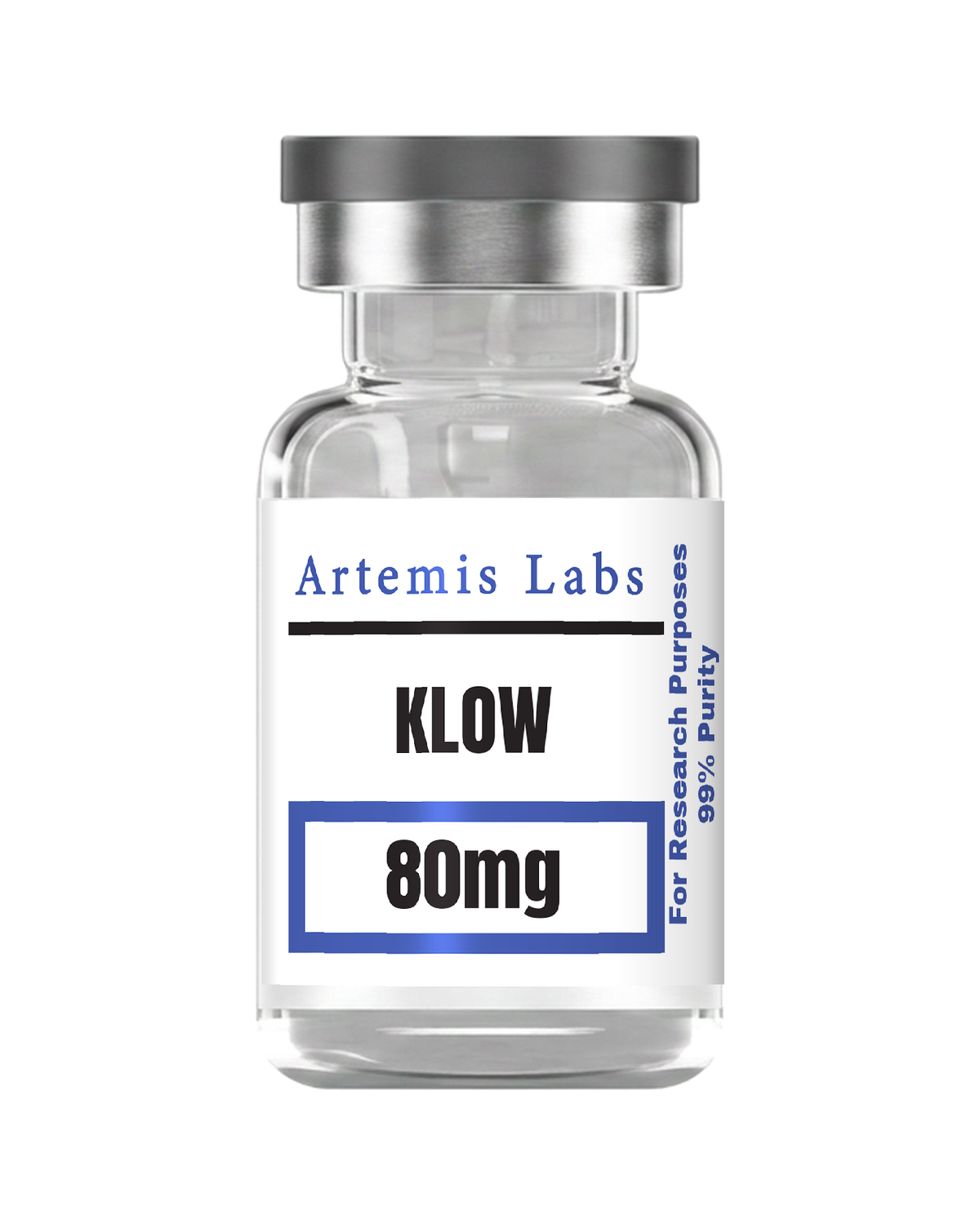
KLOW (KPV + GHK-Cu + BPC-157 + TB-500) Research Blend
$165.00
KLOW is GLOW plus a fourth component, KPV. The first three cover blood supply, cell scaffolding and gene expression; KPV adds a direct brake on NF-κB, the switch most inflammation runs through. Four compounds, four non-overlapping entry points into tissue repair —, as with GLOW, that is an argument about mechanism rather than a demonstrated combined result.
Continue readingShow less
Per-component evidence. Renke 2026 (PMID 42123471) situates GHK-Cu within aesthetic, metabolic and endocrine peptide research; Mendias 2026 (PMID 41966639) and Mayfield 2025 (PMID 41476424) refine BPC-157 musculoskeletal mechanisms; Mavrych 2026 (PMID 42021992) extends Thymosin β4 work; Lee 2026 (PMID 42064835) extends KPV into hepatic lipid metabolism via PPARγ.
Counter-evidence and regulatory notes. Sun 2025 (PMID 41278163) reported Thymosin β4 impairing intestinal barrier integrity in IBS — directly relevant to the TB-500 component. BPC-157 was on the FDA 503A interim Category 2 list from September 2023 and was removed on 27 September 2024. BPC-157 and TB-500 are both on the WADA Prohibited List. Ships as one vial.
Lyophilized four-component blend.
18 in stock
Free shipping on orders over $300
Pay by Venmo or Cash App — instructions are emailed with your order.
9 published sources cited on this page see them
For research use only. Not for human consumption.
Description
KLOW is a ready-made blend of four research peptides in one vial: 50 mg GHK-Cu, 10 mg BPC-157, 10 mg TB-500 and 10 mg KPV, 80 mg in total. It is the same three peptides as GLOW plus KPV, which acts on a separate inflammation pathway. No published trial has tested the four-component blend as a unit.
Reviewed August 21, 2026 · Artemis Labs
What is KLOW?
KLOW is a co-formulated 4-component research blend — a single 80 mg lyophilised vial containing GHK-Cu 50 mg + BPC-157 10 mg + TB-500 10 mg + KPV 10 mg.
What are the four components in KLOW?
- GHK-Cu (50 mg / 62.5% of vial mass): copper-tripeptide; collagen-axis and antioxidant-gene regulation in preclinical models. 2024-2026 positioning per Renke 2026 (PMID 42123471); musculoskeletal context per Mendias 2026 (PMID 41966639).
- BPC-157 (10 mg): pentadecapeptide (GEPPPGKPADDAGLV) derived from a fragment of human gastric juice protein. Published preclinical work surfaces angiogenic, anti-inflammatory, and tendon-bone-tissue-repair mechanisms. 2025-2026 context per Mayfield 2025 (PMID 41476424).
- TB-500 (10 mg): Thymosin β4 17-23 heptapeptide fragment (LKKTETQ). NOT the same molecule as the full-length Tβ4 parent (~4,963 Da). Cytoskeletal actin-binding activity retained from parent. 2025-2026 work per Rahman 2026 (PMID 41490200); Mavrych 2026 (PMID 42021992).
- KPV (10 mg): Lys-Pro-Val tripeptide — the C-terminal three-residue fragment of α-MSH (residues 11-13). Anti-inflammatory signalling via NF-κB / cytokine pathway in preclinical models. 2026 mechanism update: hepatic lipid metabolism via PPARγ per Lee 2026 (PMID 42064835); IBD drug-delivery context per Jeong 2025 (PMID 40030207) and Li 2024 (PMID 38289234).
Why is KLOW sold as one vial rather than four?
The published research rationale is mechanistic non-redundancy, not additive efficacy. The 4 components engage 4 distinct mechanism classes (copper-coordinated collagen-axis, pentadecapeptide repair signalling, cytoskeletal actin modulation, melanocortin-axis-independent anti-inflammation). No clinical trial of the 4-component KLOW blend itself exists in the published literature. This is typical for compound blends but is itself a limitation that researchers should weight transparently. The convenience factor of single-vial co-formulation is a separate consideration from the mechanism rationale.
What risks are specific to a four-component blend?
WADA Section S2 prohibition for BPC-157 + TB-500 — 2 of the 4 components are on the WADA Prohibited List Section S2 at all times in 2026. Competitive-sport-context researchers must factor this into study design. FDA 503A status fragmentation — BPC-157 was on the FDA 503A Interim Category 2 list (Sept 2023) and was removed September 27, 2024. In May 2026 the FDA’s evaluations concluded the evidence weighs against listing BPC-157, TB-500 or KPV for pharmacy compounding; on July 23, 2026 the Pharmacy Compounding Advisory Committee voted 8-6 to recommend listing all three anyway. Those votes are advisory; the FDA has not acted on them, and no rule has been proposed. GHK-Cu, TB-500, and KPV have never been on Category 2. Evidence-density asymmetry — BPC-157 is the most-studied component (12+ PMIDs in the standalone MD); GHK-Cu is well-studied; TB-500 is studied via the broader Tβ4 parent literature; KPV has the sparsest 2024-2026 primary-literature surface (6 PMIDs at lower acceptable bound) — disclosed honestly. Copper-overload caution for GHK-Cu at 50 mg per vial (62.5% of mass) is the dominant component by mass; copper-loading-relevant conditions (Wilson’s disease, hemochromatosis-adjacent copper handling) are appropriate research-design considerations.
Is there counter-evidence researchers should know about?
Sun 2025 (PMID 41278163) reports Thymosin β4 intestinal-barrier impairment in IBS preclinical models. The finding is directly relevant to TB-500 (Tβ4 17-23 fragment) but whether the negative finding applies to the 17-23 fragment specifically vs the full Tβ4 parent is unresolved in the literature. Researchers studying gut-relevant endpoints should design appropriate controls. This counter-evidence disclosure is mandatory per Artemis Labs content rule (CLAUDE.md #6).
How does KLOW compare with GLOW and the two-component blend?
KLOW is the 4-component variant of the recovery-blend product family. The 3-component sibling GLOW (GHK-Cu 50 mg + BPC-157 10 mg + TB-500 10 mg, 70 mg total) omits KPV. The 2-component standalone BPC-157 / TB-500 (live Artemis product) covers only the repair-axis components. For component-only research see the standalone MDs: GHK-Cu, BPC-157, and KPV.
What is the regulatory status of each component?
No KLOW component is FDA-approved as a drug. GHK-Cu has approved cosmetic-ingredient status (a distinct supply chain from research-grade reagent). BPC-157 was on FDA 503A Interim Category 2 (Sept 2023) and was removed September 27, 2024. BPC-157 and TB-500 are on the WADA Prohibited List Section S2 at all times in 2026. Not DEA-scheduled. No EMA or MHRA approval. Several U.S. state Boards of Pharmacy have issued advisories regarding compounded peptide blends. Artemis Labs KLOW is supplied strictly as a research-use-only reagent — NOT a compounded pharmaceutical, NOT a tanning, cosmetic, sexual-enhancement, or self-administered preparation. These statements have not been evaluated by the FDA. Not for human consumption, therapeutic use, or veterinary use.
Analytical Specifications
| Component | Per vial | Sequence | MW | CAS |
|---|---|---|---|---|
| GHK-Cu | 50 mg | Gly-His-Lys-Cu(II) | 340.4 Da (free tripeptide GHK) | 89030-95-5 (GHK-Cu); 49557-75-7 (GHK free) |
| BPC-157 | 10 mg | GEPPPGKPADDAGLV (15-aa) | 1,419.53 Da | 137525-51-0 |
| TB-500 | 10 mg | LKKTETQ (Tβ4 17-23 fragment) | 888.0 Da | 77591-33-4 (parent Tβ4) |
| KPV | 10 mg | Lys-Pro-Val (α-MSH 11-13) | 342.43 Da | 67727-97-3 |
| Blend total | 80 mg | Co-lyophilised white powder | &mdash | &mdash |
| Storage | &mdash | Lyophilised ≤−20 °C, desiccated, protected from light | &mdash | &mdash |
References
- Renke G et al. (2026). Therapeutic-peptide review — GHK-Cu / copper-peptide class positioning. Int J Mol Sci. PMID 42123471
- Mendias CL et al. (2026). Skeletal-muscle peptide research — GHK-Cu and BPC-157 context. Sports Med. PMID 41966639
- Rahman MM et al. (2026). Thymosin β4 mechanism research — relevant to TB-500 (17-23 fragment). PMID 41490200
- Mavrych V et al. (2026). Thymosin β4 research updates — relevant to TB-500 mechanism. PMID 42021992
- Lee H et al. (2026). KPV in hepatic lipid metabolism via PPAR&gamma. PMID 42064835
- Mayfield CK et al. (2025). BPC-157 musculoskeletal mechanism review. PMID 41476424
- Jeong J et al. (2025). KPV IBD drug-delivery research. PMID 40030207
- Li Y et al. (2024). KPV anti-inflammation drug-delivery research. PMID 38289234
- Counter-evidence: Sun X et al. (2025). Thymosin β4 intestinal-barrier impairment in IBS preclinical models — relevant to TB-500. PMID 41278163
Additional information
| Vial Size | 50mg/10mg/10mg/10mg blend |
|---|
Science & Research
Science & Research
Multi-Pathway Mechanistic Non-Redundancy
The 4 KLOW components engage mechanistically non-redundant pathways. This is the published research rationale for the blend — NOT an additive-efficacy claim. Per the 2-component sibling product framing in the Artemis BPC-157/TB-500 MD: the rationale is mechanistic complementarity, not summed effect size.
| Pathway Class | Component | Mechanism (preclinical) |
|---|---|---|
| Copper-coordinated collagen-axis / tissue-quality | GHK-Cu (50 mg) | Antioxidant gene regulation, fibroblast-proliferative signalling |
| Pentadecapeptide repair signalling | BPC-157 (10 mg) | Angiogenic, anti-inflammatory, tendon-bone-tissue-repair |
| Cytoskeletal actin modulation | TB-500 (10 mg) | Tβ4 17-23 fragment retains parent-Tβ4 actin-binding activity |
| Melanocortin-axis-independent anti-inflammation | KPV (10 mg) | α-MSH(11-13)-derived; NF-κB modulation |
2024-2026 Per-Component Evidence
- GHK-Cu: Renke 2026 (PMID 42123471) copper-peptide class positioning within a therapeutic-peptide review; Mendias 2026 (PMID 41966639) skeletal-muscle / fibrosis context
- BPC-157: Mendias 2026 (PMID 41966639) (also relevant); Mayfield 2025 (PMID 41476424) musculoskeletal mechanism
- TB-500 (Tβ4 17-23): Rahman 2026 (PMID 41490200); Mavrych 2026 (PMID 42021992)
- KPV: Lee 2026 (PMID 42064835) hepatic lipid via PPARγ; Jeong 2025 (PMID 40030207) IBD drug delivery; Li 2024 (PMID 38289234) anti-inflammation
Counter-Evidence (Sun 2025 Tβ4 Intestinal-Barrier)
Sun 2025 (PMID 41278163) reports Thymosin β4 intestinal-barrier impairment in IBS preclinical models. Directly relevant to TB-500 (Tβ4 17-23 fragment). Whether the negative finding applies to the 17-23 fragment specifically vs the full Tβ4 parent is unresolved in the literature. Researchers studying gut-relevant endpoints should design appropriate controls. Surfaced in CLAUDE.md content rule #6 as a peptide-counter-evidence example.
Regulatory Framing — Per-Component Summary
| Component | FDA 503A | WADA 2026 | DEA |
|---|---|---|---|
| GHK-Cu | NOT on Category 2; cosmetic-ingredient status | NOT prohibited | Not scheduled |
| BPC-157 | Interim Cat 2 Sept 2023 → REMOVED Sept 27 2024 | Section S2 prohibited at all times | Not scheduled |
| TB-500 | NOT on Category 2 | Section S2 prohibited at all times | Not scheduled |
| KPV | NOT on Category 2 | NOT prohibited | Not scheduled |
Per-Component Identifiers
| Component | CAS | MW (Da) | Sequence / Description |
|---|---|---|---|
| GHK-Cu | 89030-95-5 (GHK-Cu); 49557-75-7 (GHK free) | 340.4 (free tripeptide GHK) | Gly-His-Lys-Cu(II) copper tripeptide |
| BPC-157 | 137525-51-0 | 1419.53 | GEPPPGKPADDAGLV (15-aa) |
| TB-500 | 77591-33-4 | 888.0 (fragment) | LKKTETQ (Tβ4 17-23 fragment) |
| KPV | 67727-97-3 | 342.43 | Lys-Pro-Val (α-MSH 11-13 tripeptide) |
Quality and Specifications
- Form: Co-lyophilised white powder, single 80 mg/vial (50/10/10/10 split)
- Storage: Lyophilised ≤−20 °C, desiccated, protected from light
Honest Limitations of the Blend Evidence Base
- No clinical trial of the 4-component KLOW blend itself exists in the published literature — mechanistic-non-redundancy is the rationale, not validated combined efficacy.
- Evidence-density asymmetry across components — BPC-157 most studied (12+ PMIDs); KPV sparsest (6 PMIDs at lower acceptable bound). Researchers should weight component contributions appropriately.
- TB-500 intestinal-barrier counter-evidence (Sun 2025 PMID 41278163) — gut-relevant endpoints require appropriate controls.
- WADA Section S2 prohibition for BPC-157 + TB-500 — competitive-sport-context constraint.
- Copper-overload caution for GHK-Cu at 50 mg per vial — Wilson’s disease, hemochromatosis-adjacent considerations appropriate.
- Per-component lot integrity — do NOT infer per-component purity from a single blend assay; each must be verified independently.
References (11 PubMed-Verified for Blend Composition)
- Renke G et al. (2026). Int J Mol Sci. PMID 42123471 — GHK-Cu positioning
- Mendias CL et al. (2026). Skeletal-muscle peptide research. PMID 41966639 — GHK-Cu + BPC-157
- Rahman MM et al. (2026). PMID 41490200 — Tβ4 / TB-500
- Mavrych V et al. (2026). PMID 42021992 — Tβ4 mechanism updates
- Lee H et al. (2026). PMID 42064835 — KPV hepatic lipid PPAR&gamma
- Mayfield CK et al. (2025). PMID 41476424 — BPC-157 musculoskeletal
- Jeong J et al. (2025). PMID 40030207 — KPV IBD drug delivery
- Li Y et al. (2024). PMID 38289234 — KPV anti-inflammation
- Sun X et al. (2025). PMID 41278163 — Counter-evidence: Tβ4 intestinal-barrier impairment in IBS
For component-by-component full citation depth see the standalone Artemis component MDs: GHK-Cu, BPC-157, BPC-157 / TB-500 (for TB-500 content), and KPV.
Research Pairings
Research Pairings
KLOW is itself a 4-component blend. Mechanistic rationale for combining the KLOW vial with other Artemis Labs research reference compounds is described below for laboratory-research mechanism work only. No dosing, frequency, duration, route, or human-use guidance is provided. Researchers design their own studies against their own institutional review, not against vendor copy.
Why is KLOW studied alongside CJC-1295 and Ipamorelin?
Growth-hormone-axis (GHRH analog + GHRP) × multi-component repair axis. Non-overlapping pathways studied for combined mechanism research — GH-axis modulation paired with the 4-pathway repair/anti-inflammation/cytoskeletal/tissue-quality activity of KLOW.
Why is KLOW studied alongside Sermorelin?
GHRH-analog × multi-component repair. Sermorelin engages the GHRH receptor on somatotrophs; KLOW components engage the four pathway classes above. Useful for mechanistic dissection of GHRH-driven IGF-1-axis effects vs direct tissue-repair signalling.
Why is KLOW studied alongside MOTS-c?
Mitochondrial-derived peptide × multi-component repair. MOTS-c acts on a mitochondrial axis distinct from any KLOW component — useful research-model pairing for dissecting mitochondrial-versus-tissue-repair contributions to recovery research endpoints.
Why is KLOW studied alongside Tesamorelin?
GHRH(1-44) analog × multi-component repair. Tesamorelin is the FDA-approved-as-Egrifta GHRH(1-44) analog (Artemis Labs supplies research-grade reagent, NOT Egrifta). Useful research-model pairing for clinically-validated-GHRH-axis vs multi-component-repair-axis research.
What related compounds does Artemis Labs carry?
The 3-component sibling GLOW (GHK-Cu + BPC-157 + TB-500, 70 mg, without KPV). The 2-component sibling BPC-157 / TB-500 (live Artemis product, 20 mg). For component-only research see the standalone MDs linked in the main description. For how the four components are studied together, see the KLOW blend explainer.
Related products
Mitochondrial & NAD+ Research
Metabolic Research