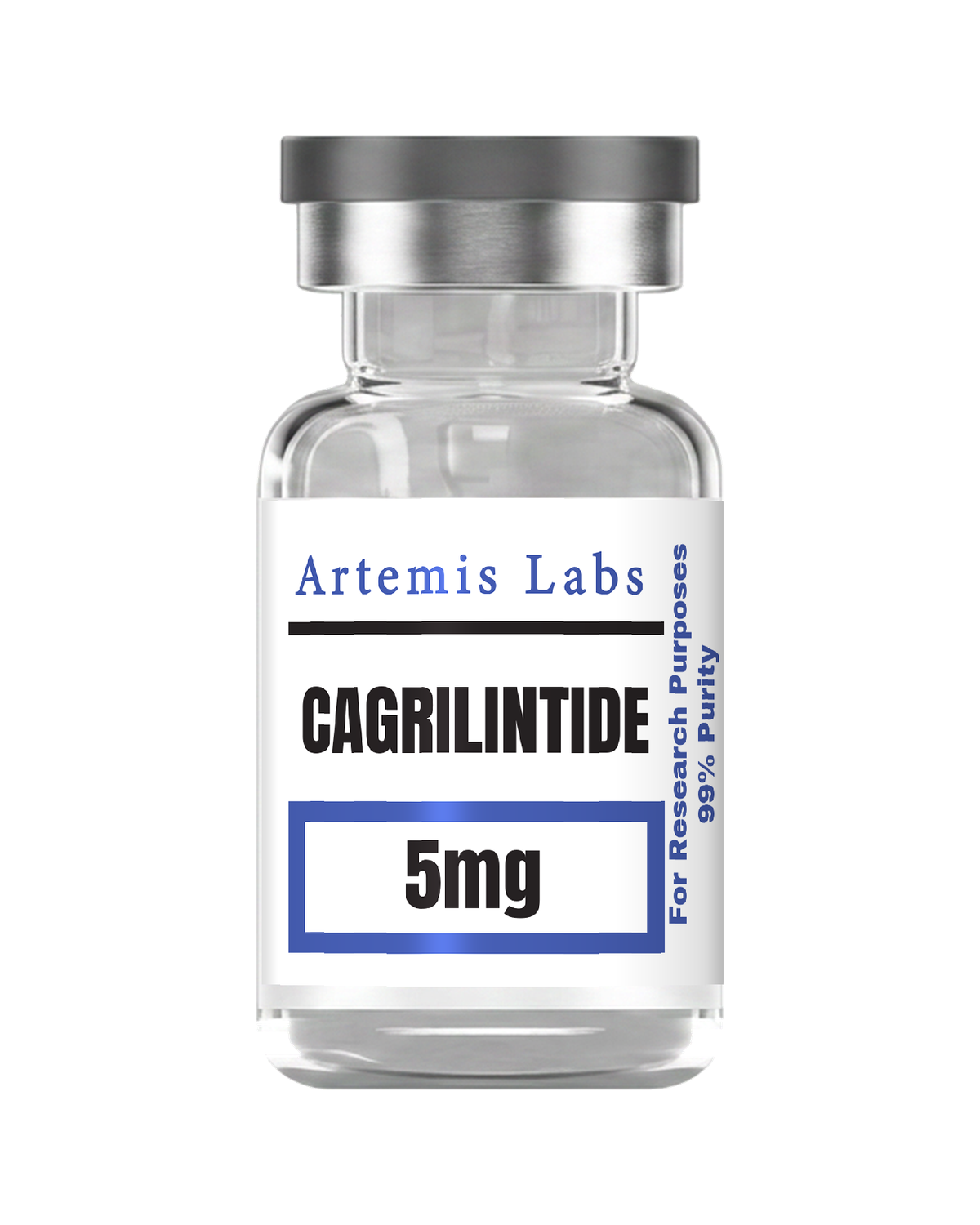
Cagrilintide
$125.00
After a meal the pancreas releases amylin alongside insulin — a satiety signal separate from the gut hormones everything else in this category targets. Cagrilintide is a long-acting amylin analog. Because it works through a different pathway, the research interest is less about cagrilintide alone and more about what happens when it is combined with a GLP-1 compound.
Continue readingShow less
The trial record. REDEFINE-1 (Garvey 2025, PMID 40544433) is a Phase 3 trial of CagriSema — cagrilintide co-administered with semaglutide — not of cagrilintide alone; monotherapy evidence is Phase 2. REDEFINE-5 (Yamauchi 2026, PMID 42009015) extended the Phase 3 work into Japanese and Taiwanese populations. Reported results live in the linked papers, not on this page.
Read the headline carefully. Phase 2 monotherapy results were substantially smaller than the combination figure implies — anyone reading a CagriSema headline as a cagrilintide-alone result is overstating the monotherapy record. Gastrointestinal adverse events characteristic of amylin-plus-incretin combinations were reported across Phase 2/3.
Lyophilized acylated amylin analog.
10 in stock
Free shipping on orders over $300
Pay by Venmo or Cash App — instructions are emailed with your order.
7 published sources cited on this page see them
For research use only. Not for human consumption.
Description
Cagrilintide is a lab-made copy of amylin. Amylin is a hormone made in the pancreas. It works on a different target than the GLP-1 peptides do, so labs study the two side by side. Artemis Labs supplies it as a dry powder for lab research.
Reviewed August 21, 2026 · Artemis Labs
For laboratory research use only. Not for human consumption or veterinary use.
What is cagrilintide (AM833)?
Cagrilintide (development code AM833) is a 37-amino-acid synthetic analog of human amylin (islet amyloid polypeptide, IAPP) engineered for selective activation of the AMY1R complex — the heterodimer formed by the calcitonin receptor (CTR) and receptor-activity-modifying protein 1 (RAMP1). The C-terminal fatty-acid acylation enables albumin binding and extends circulating half-life to ~7 days in published research-model pharmacokinetics. CAS 1415456-99-3; molecular weight 4409.01 g/mol.
Which receptor does cagrilintide act on?
Native amylin is co-secreted from pancreatic β-cells with insulin and acts at AMY1R in the area postrema, nucleus tractus solitarius, and hypothalamic regions controlling satiety and gastric emptying. Cagrilintide preserves this receptor selectivity through engineered substitutions characterized by Kruse et al. (J Med Chem 2021, DOI 10.1021/acs.jmedchem.1c00565). The amylin pathway is mechanistically non-overlapping with the GLP-1 / GIP / glucagon incretin axis, which underlies the additive research-model effects observed when cagrilintide is studied in combination with incretin agonists.
What did the published cagrilintide trials report?
Phase 2 monotherapy dose-finding work (Lau DCW et al., The Lancet 2021, PMID 34798060) established cagrilintide’s monotherapy pharmacology. Phase 2 combination with semaglutide in T2DM (Frias JP et al., The Lancet 2023, PMID 37364590) demonstrated tolerability of the co-administration regimen. The Phase 3 REDEFINE-1 trial (Garvey WT et al., NEJM 2025, PMID 40544433) studied the co-administered cagrilintide + semaglutide combination (CagriSema) over 68 weeks; the primary endpoint was percent change in body weight. The regional Phase 3 REDEFINE-5 (Yamauchi T et al., Lancet Diabetes & Endocrinology 2026, PMID 42009015) extended these findings to Japanese and Taiwanese research populations. No human dosing, administration, preparation, or human-use guidance is provided — these are reported research outcomes from published primary literature only.
What is the regulatory status of cagrilintide?
Cagrilintide is not FDA-approved for any human indication as a standalone product. Novo Nordisk’s CagriSema combination filing is the active regulatory path, with PDUFA action anticipated in late 2026. Standalone cagrilintide has no approved marketing context. There is no 503A/503B compounding pathway for cagrilintide. For research use only.
What does the cagrilintide evidence not show?
Cagrilintide monotherapy efficacy is modest relative to the combination: the widely quoted headline figures come from the CagriSema combination with semaglutide, not from cagrilintide alone. Researchers comparing cagrilintide to GLP-1 monotherapy alone should expect substantially lower standalone effect sizes. Published Phase 2/3 trials (Frias PMID 37364590; Garvey PMID 40544433) document nausea, vomiting, and diarrhea as dose-related adverse events consistent with the broader incretin-class profile. REDEFINE-2 (T2DM) and REDEFINE-3 (head-to-head vs tirzepatide) are pending peer-reviewed publication at time of this writing.
Analytical Specifications
| Common name | Cagrilintide (development code AM833) |
| Class | Long-acting amylin (AMY1R) receptor agonist |
| Sequence length | 37-amino-acid synthetic analog of human amylin (islet amyloid polypeptide, IAPP) |
| Structural modification | C-terminal fatty-acid acylation; enables albumin binding |
| Receptor target | AMY1R — calcitonin receptor (CTR) + receptor-activity-modifying protein 1 (RAMP1) heterodimer |
| Molecular weight | 4409.01 g/mol |
| CAS number | 1415456-99-3 |
| Reported circulating half-life | ~7 days in published research-model pharmacokinetics |
| Vial size | 5 mg per vial |
References
- Kruse et al. (2021). Structural and selectivity engineering of the amylin analog cagrilintide. J Med Chem. DOI 10.1021/acs.jmedchem.1c00565
- Lau DCW, et al. (2021). Once-weekly cagrilintide for weight management in people with overweight and obesity: a phase 2 trial. The Lancet. PMID 34798060
- Frias JP, et al. (2023). Co-administered cagrilintide and semaglutide in type 2 diabetes (Phase 2). The Lancet. PMID 37364590
- Garvey WT, et al. (2025). Coadministered Cagrilintide and Semaglutide in Adults with Overweight or Obesity (REDEFINE-1). NEJM. PMID 40544433
- Yamauchi T, et al. (2026). Co-administered cagrilintide and semaglutide versus semaglutide alone (REDEFINE-5). Lancet Diabetes & Endocrinology. PMID 42009015
For laboratory research use only. No human dosing, administration, therapeutic, diagnostic, or preventative claim is made. These statements have not been evaluated by the FDA.
Additional information
| Vial Size | 5mg |
|---|
Science & Research
Science & Research
What is cagrilintide (AM833)?
Cagrilintide (AM833) is a 37-amino-acid synthetic analog of human amylin (islet amyloid polypeptide, IAPP). It carries C-terminal fatty-acid acylation that enables albumin binding and extends circulating half-life to approximately 7 days in published research-model pharmacokinetics. CAS 1415456-99-3; molecular weight 4409.01 g/mol. Structural and selectivity engineering is characterized in Kruse et al. (J Med Chem 2021, DOI 10.1021/acs.jmedchem.1c00565).
Why is cagrilintide selective for AMY1R?
Cagrilintide is engineered for preferential activation of the AMY1R complex — the heterodimer of the calcitonin receptor (CTR) and receptor-activity-modifying protein 1 (RAMP1). Native amylin is co-secreted from pancreatic β-cells with insulin and acts at AMY1R in the area postrema, nucleus tractus solitarius, and hypothalamic regions controlling satiety and gastric emptying. The CTR + RAMP1 selectivity engineering is intended to reduce calcitonin-receptor off-target signaling that would otherwise occur with non-selective amylin/calcitonin pharmacology. Reviewed in Khachaturov M et al. (Diabetes, Obesity & Metabolism 2026, PMID 42098899) within the broader amylin-analog and combination landscape.
Why is cagrilintide studied alongside an incretin agonist?
The published rationale for studying cagrilintide in combination with GLP-1 (semaglutide) is mechanistic non-overlap: amylin (AMY1R) and GLP-1 (GLP-1R) act through distinct G-protein-coupled receptor pathways and engage distinct neural circuits. AMY1R signaling proceeds primarily through Gαs / cAMP pathways in CTR-expressing satiety neurons; GLP-1R signaling also engages Gαs / cAMP but through anatomically and functionally distinct receptor populations. The published Phase 3 outcome (Garvey et al. 2025, PMID 40544433) reports the magnitude of additive effect across this co-administration in research populations.
What did the published cagrilintide trials report?
- Phase 2 monotherapy — Lau DCW et al. (2021). Phase 2 dose-finding trial of cagrilintide in people with overweight and obesity. The Lancet. PMID 34798060. Established dose-finding pharmacology.
- Phase 2 CagriSema in T2DM — Frias JP et al. (2023). Phase 2 trial of co-administered cagrilintide and semaglutide in type 2 diabetes. The Lancet. PMID 37364590. Combination tolerability in T2DM research populations.
- Phase 3 REDEFINE-1 — Garvey WT et al. (2025). “Coadministered Cagrilintide and Semaglutide in Adults with Overweight or Obesity.” NEJM. PMID 40544433. 68-week Phase 3 co-administration trial; primary endpoint percent change in body weight.
- Phase 3 REDEFINE-5 (regional) — Yamauchi T et al. (2026). “Co-administered cagrilintide and semaglutide versus semaglutide alone.” Lancet Diabetes & Endocrinology. PMID 42009015. Regional Phase 3 evidence extending REDEFINE-1 to Japanese and Taiwanese populations.
What is the regulatory status of cagrilintide?
Cagrilintide is not FDA-approved for any human indication as a standalone product. The CagriSema combination filing (Novo Nordisk) is the active regulatory path; PDUFA action anticipated late 2026. No 503A/503B compounding pathway applies. For research use only.
What does the cagrilintide evidence not show?
- Monotherapy effect size reported in Phase 2 is modest relative to the Phase 3 combination result. Do not extrapolate combination figures to monotherapy contexts.
- GI adverse events (nausea, vomiting, diarrhea) consistent with broader incretin-class profile in the combination context (Frias 2023 PMID 37364590; Garvey 2025 PMID 40544433).
- REDEFINE-2 (T2DM) and REDEFINE-3 (head-to-head vs tirzepatide) are pending peer-reviewed publication; head-to-head class-comparator outcome data not yet available.
- Long-term safety data beyond Phase 3 trial durations is not yet published.
References
- Lau DCW et al. (2021). Once-weekly cagrilintide for weight management in people with overweight and obesity: a phase 2 trial. The Lancet. PMID 34798060
- Frias JP et al. (2023). Efficacy and safety of co-administered once-weekly cagrilintide 2.4 mg with once-weekly semaglutide 2.4 mg in type 2 diabetes (Phase 2). The Lancet. PMID 37364590
- Garvey WT et al. (2025). REDEFINE-1 Phase 3 CagriSema in obesity. NEJM. PMID 40544433
- Yamauchi T et al. (2026). REDEFINE-5 regional Phase 3. Lancet Diabetes Endocrinol. PMID 42009015
- Khachaturov M et al. (2026). Multi-agonists, amylin analogues, and combination strategies. Diabetes Obes Metab. PMID 42098899
- Chan ZH et al. (2026). Incretin-based dual and triple agonists meta-analysis. Cardiology in Review. PMID 41711462
For laboratory research use only. No human dosing, administration, therapeutic, diagnostic, or preventative claim is made. These statements have not been evaluated by the FDA.
Related Research Compounds
Related Research Compounds
Pairing commentary below is restricted to in-vitro and pre-clinical research-design rationale. No dosing, frequency, route, or human-use guidance is provided.
Why is cagrilintide studied alongside semaglutide?
The published Phase 2/3 rationale for studying cagrilintide alongside semaglutide is mechanistic non-overlap. Amylin and GLP-1 are anatomically and pharmacologically distinct satiety pathways: amylin acts through AMY1R (CTR + RAMP1) in the area postrema, nucleus tractus solitarius, and hypothalamus; GLP-1 acts through GLP-1R in overlapping but distinct neural populations. The Phase 3 REDEFINE-1 trial (Garvey WT et al., NEJM 2025, PMID 40544433) is the published evidence base for the additive research-model effect.
Which catalog compounds are studied as comparators?
- Tirzepatide — Dual GIP + GLP-1 incretin agonist; parallel-pathway comparator in receptor-binding research.
- Retatrutide — Triple GIP + GLP-1 + glucagon agonist; parallel-comparator framing for amylin satiety pathway versus incretin-driven thermogenic agonism.
- AOD-9604 — HGH-fragment-derived lipolytic peptide; adipose-tissue research models contrasting amylin-mediated central satiety against non-GHR adipocyte signaling.
How do the class comparators line up?
| Compound | Receptor Class | Published Half-Life | Pivotal Published Trial |
|---|---|---|---|
| Cagrilintide monotherapy | AMY1R (amylin) | ~7 days | Lau 2021 PMID 34798060 (Phase 2 dose-finding) |
| CagriSema (cagri + sema) | AMY1R + GLP-1R | ~7 days (combined) | Garvey 2025 PMID 40544433 (Phase 3, 68-week) |
| Tirzepatide | GIP + GLP-1 (dual) | ~5 days | SURMOUNT-1 PMID 35658024 (Phase 3, 72-week) |
| Retatrutide | GIP + GLP-1 + glucagon (triple) | ~6 days | Jastreboff Phase 2 PMID 37366315 (Phase 2, 48-week) |
For laboratory research use only.
Related products