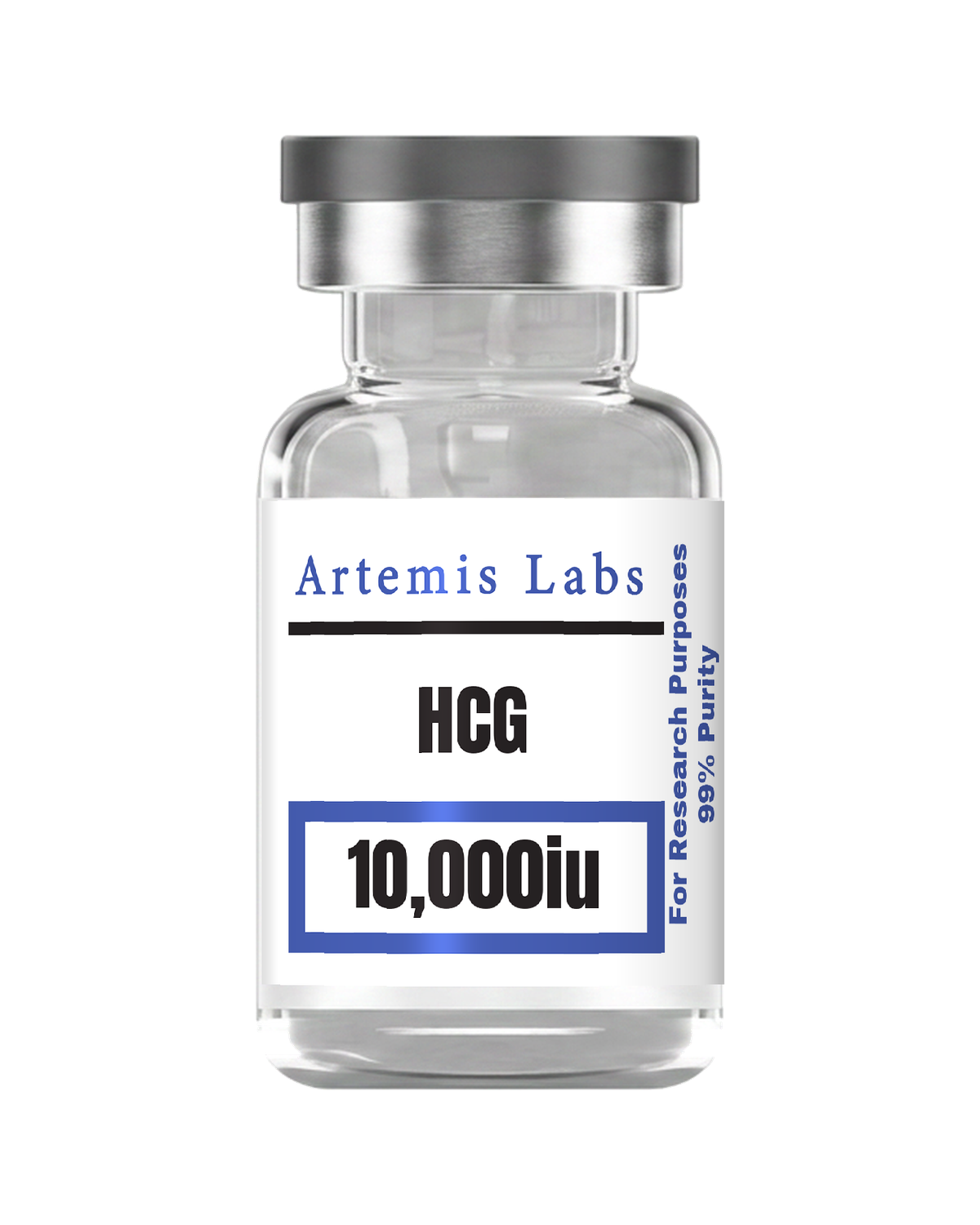
hCG
$70.00
hCG is the pregnancy hormone. Structurally it is a large glycoprotein, not a short synthetic peptide, and it acts on the same receptor as luteinizing hormone — which is why it has genuine research uses in reproductive endocrinology. It also has a famous reputation as a weight-loss aid, and that reputation is wrong.
Continue readingShow less
The weight-loss claim is settled, and it is negative. A criteria-based meta-analysis found no evidence hCG is effective for obesity (Lijesen 1995, PMID 8527285), a double-blind RCT found weight loss identical between hCG and placebo (PMID 595585), and a follow-up review reached the same conclusion (Goodbar 2013, PMID 23606549). Over-the-counter hCG weight-loss products are deemed fraudulent by the FDA and FTC.
Where the real research is. Recent systematic reviews document legitimate gonadotropin roles in pubertal induction and spermatogenesis (Alexander 2024, PMID 38128110; Muir 2025, PMID 39445789). Because it is a large glycoprotein, conclusions drawn from short synthetic peptides do not transfer to it.
Lyophilized heterodimeric glycoprotein.
10 in stock
Free shipping on orders over $300
Pay by Venmo or Cash App — instructions are emailed with your order.
11 published sources cited on this page see them
For research use only. Not for human consumption.
Description
hCG, or human chorionic gonadotropin, is a hormone built from two joined protein chains. One chain is shared with three other hormones. The second is unique to hCG. Labs study how it acts on the LH/CG receptor in fertility and hormone research. hCG does not cause weight loss.
Reviewed August 22, 2026 · Artemis Labs
What is hCG?
hCG (human chorionic gonadotropin) is a heterodimeric glycoprotein hormone composed of an α-subunit (92 amino acids, shared with LH, FSH, and TSH) and a β-subunit (145 amino acids, unique to hCG; confers LHCGR specificity). The Artemis Labs research peptide is supplied for in-vitro and pre-clinical laboratory study of LH/CG-receptor (LHCGR) pharmacology, gonadotropin biology, and hypothalamic-pituitary-gonadal axis research.
Is Artemis Labs hCG the same as Pregnyl, Novarel or Ovidrel?
Supplied strictly as a research reagent — not as a therapeutic equivalent of the FDA-approved parent compound (Pregnyl, Novarel, Ovidrel).
The hCG parent compound is FDA-approved for specific human indications (female ovulation induction, male hypogonadotropic hypogonadism, cryptorchidism in prepubertal males) under brand names Pregnyl, Novarel, Ovidrel. The Artemis Labs research peptide is supplied strictly as a research reagent for laboratory research and is not equivalent to those approved drug products.
Does hCG cause weight loss?
Critical framing notice — hCG is not a weight-loss research compound. Comprehensive meta-analytic evidence published in 1995 (Lijesen et al., British Journal of Clinical Pharmacology, PMID 8527285) and a follow-up clinical analysis in 2013 (Goodbar et al., Annals of Pharmacotherapy, PMID 23606549) established that hCG produces no weight loss beyond what is attributable to severe calorie restriction. The FDA has issued explicit warning letters declaring “HCG Diet Products Are Illegal.” Artemis Labs does not position hCG for weight-loss research and does not market its product for that use.
What is hCG actually studied for?
Legitimate 2024–2025 peer-reviewed research applications centre on hypogonadism and fertility research models. Alexander et al. 2024 (European Journal of Endocrinology, PMID 38128110) systematically reviewed gonadotropins for pubertal induction in males with hypogonadotropic hypogonadism. Grob et al. 2024 (Journal of Paediatrics and Child Health, PMID 38572627) documented long-term fertility outcomes in male adults with congenital hypogonadotropic hypogonadism treated during puberty with hCG and recombinant FSH. Muir et al. 2025 (Clinical Endocrinology, PMID 39445789) provides the most recent meta-analysis on gonadotropin treatment for spermatogenesis induction in pathologic gonadotropin deficiency.
What is the regulatory and anti-doping status of hCG?
Regulatory context: hCG is on the WADA Prohibited List for male athletes (S2 class: Peptide hormones, growth factors, related substances and mimetics) — prohibited at all times for males. This is factual regulatory context; Artemis Labs does not market hCG for athletic-performance use. For laboratory research use only — no human dosing, administration, therapeutic, diagnostic, preventative, weight-loss, or fertility-treatment claim is made.
What does the hCG evidence not show?
- No weight-loss effect. The 1995 Lijesen meta-analysis and the 2013 Goodbar follow-up found no scientific evidence that hCG produces weight loss beyond severe calorie restriction, and the FDA has declared HCG diet products illegal.
- The supporting research is in gonadotropin-deficient populations. Alexander 2024, Grob 2024 and Muir 2025 all studied hypogonadotropic hypogonadism or pathologic gonadotropin deficiency. Those findings do not generalise to people with normal gonadotropin function.
- The molecule is not one fixed thing. hCG is supplied as either urinary-derived (uhCG) or recombinant (rhCG) material and its molecular weight varies with glycosylation.
- The FDA-approved products are different products. Pregnyl, Novarel and Ovidrel are approved drug products; the Artemis Labs research reagent is not a therapeutic equivalent of any of them.
Analytical Specifications
| Property | Value |
|---|---|
| Class | Heterodimeric glycoprotein hormone; LH/CG receptor (LHCGR) agonist |
| α-subunit | 92 amino acids, glycosylated; shared with LH, FSH and TSH |
| β-subunit | 145 amino acids, unique to hCG; confers LHCGR specificity |
| Molecular weight | ~36,700 g/mol (intact heterodimer, varies with glycosylation) |
| CAS number | 9002-61-3 |
| Source | Urinary-derived (uhCG) or recombinant (rhCG) |
| Form | Lyophilised powder |
| Storage | −20 °C, desiccated, protected from light |
References
- Lijesen GK, Theunissen IM, Lems WF, et al. (1995). The effect of human chorionic gonadotropin (HCG) in the treatment of obesity by means of the Simeons therapy: a criteria-based meta-analysis. British Journal of Clinical Pharmacology. PMID 8527285 · DOI 10.1111/j.1365-2125.1995.tb05779.x
- Goodbar NH, Foushee JA, Eagerton DH, et al. (2013). Effect of the human chorionic gonadotropin diet on patient outcomes. Annals of Pharmacotherapy. PMID 23606549 · DOI 10.1345/aph.1R755
- Alexander EC et al. (2024). Gonadotropins for pubertal induction in males with hypogonadotropic hypogonadism: systematic review and meta-analysis. European Journal of Endocrinology. PMID 38128110 · DOI 10.1093/ejendo/lvad166
- Grob F et al. (2024). Fertility outcomes in male adults with congenital hypogonadotropic hypogonadism treated during puberty with human chorionic gonadotropin and recombinant follicle stimulating hormone. Journal of Paediatrics and Child Health. PMID 38572627 · DOI 10.1111/jpc.16540
- Muir CA et al. (2025). Efficacy of Gonadotropin Treatment for Induction of Spermatogenesis in Men With Pathologic Gonadotropin Deficiency: A Meta-Analysis. Clinical Endocrinology (Oxford). PMID 39445789 · DOI 10.1111/cen.15151
Additional information
| Vial Size | 10,000iu |
|---|
Science & Research
Science & Research
How Does hCG Work?
hCG is a heterodimeric glycoprotein hormone composed of two subunits:
- α-subunit — 92 amino acids, glycosylated; shared with luteinizing hormone (LH), follicle-stimulating hormone (FSH), and thyroid-stimulating hormone (TSH).
- β-subunit — 145 amino acids, unique to hCG; the β-subunit C-terminal extension confers receptor specificity for the LH/CG receptor (LHCGR).
In research models, hCG binds and activates the LHCGR — a Class-A G-protein-coupled receptor primarily coupling Gαs. Receptor activation drives adenylyl cyclase, elevating intracellular cAMP and activating PKA. PKA-mediated phosphorylation of steroidogenic-pathway proteins (StAR, P450scc, 3β-HSD, 17α-hydroxylase, 17,20-lyase) drives steroidogenesis — testosterone synthesis in Leydig cells (male research models) and progesterone synthesis / ovulatory signalling in granulosa-luteal cells (female research models).
What Do Published Studies Report About hCG Pharmacokinetics?
- Plasma half-life: ~24–36 hours after parenteral administration in research models — substantially slower than native LH due to extensive glycosylation.
- Source forms: urinary-derived (uhCG, traditional) or recombinant (rhCG / choriogonadotropin alfa, e.g., the parent compound marketed as Ovidrel). The Artemis the supplied form.
- Elimination: primarily renal excretion of intact glycoprotein and metabolites.
What Does the Negative Evidence on hCG and Weight Loss Say?
Per CLAUDE.md content rule #6 (honest counter-evidence disclosure is a competitive advantage), Artemis transparently surfaces the negative-findings literature on hCG weight-loss claims:
- Lijesen GK, Theunissen IM, Lems WF, et al. 1995. *The effect of human chorionic gonadotropin (HCG) in the treatment of obesity by means of the Simeons therapy: a criteria-based meta-analysis.* *British Journal of Clinical Pharmacology.* PMID 8527285 · DOI 10.1111/j.1365-2125.1995.tb05779.x. Landmark meta-analysis — conclusion: no scientific evidence that HCG is effective for weight loss.
- Goodbar NH, Foushee JA, Eagerton DH, et al. 2013. *Effect of the human chorionic gonadotropin diet on patient outcomes.* *Annals of Pharmacotherapy.* PMID 23606549 · DOI 10.1345/aph.1R755. Follow-up clinical analysis confirming the lack of efficacy and documenting safety concerns of the HCG diets studied.
The FDA has issued explicit warning letters declaring “HCG Diet Products Are Illegal,” targeting homeopathic and compounded hCG products marketed for human weight loss. Artemis Labs does not position hCG for weight-loss research and does not market its product for that use.
What Does the Newest 2024–2025 Research Report?
1. Alexander EC et al. 2024. *Gonadotropins for pubertal induction in males with hypogonadotropic hypogonadism: systematic review and meta-analysis.* *European Journal of Endocrinology.* PMID 38128110 · DOI 10.1093/ejendo/lvad166. 2. Grob F et al. 2024. *Fertility outcomes in male adults with congenital hypogonadotropic hypogonadism treated during puberty with human chorionic gonadotropin and recombinant follicle stimulating hormone.* *Journal of Paediatrics and Child Health.* PMID 38572627 · DOI 10.1111/jpc.16540. 3. Muir CA et al. 2025. *Efficacy of Gonadotropin Treatment for Induction of Spermatogenesis in Men With Pathologic Gonadotropin Deficiency: A Meta-Analysis.* *Clinical Endocrinology (Oxford).* PMID 39445789 · DOI 10.1111/cen.15151.
What Is the Regulatory Status of hCG?
- Parent compound FDA-approved for specific human indications (female ovulation induction; male hypogonadotropic hypogonadism; cryptorchidism in prepubertal males) under brand names Pregnyl, Novarel, Ovidrel.
- The Artemis Labs research peptide is supplied strictly as a research reagent and is *not* a therapeutic equivalent of those approved drug products. These statements have not been evaluated by the FDA for the research-reagent supply.
- WADA Prohibited List — hCG is on Section S2 (Peptide hormones, growth factors, related substances and mimetics), prohibited at all times for male athletes. Factual regulatory context.
- FDA position on weight loss — the FDA has stated there is no scientific evidence that hCG is effective for weight loss and has issued warning letters against vendors marketing “HCG diet” products.
Which Research Contexts Does hCG Belong To?
| Research Use Context | hCG Role | Evidence |
|---|---|---|
| Weight loss (“HCG diet”) | No effect beyond severe calorie restriction | Lijesen 1995 (PMID 8527285); FDA warning letters |
| Male hypogonadotropic hypogonadism research | LHCGR agonism → testosterone induction | Alexander 2024 (PMID 38128110) |
| Spermatogenesis induction research | Effective in combination with rFSH | Muir 2025 (PMID 39445789) |
| Long-term fertility-outcome research | Gonadotropin treatment during puberty | Grob 2024 (PMID 38572627) |
Specifications
| Property | Value |
|---|---|
| Class | Heterodimeric glycoprotein hormone; LH/CG receptor agonist |
| α-subunit | 92 aa, glycosylated; shared with LH/FSH/TSH |
| β-subunit | 145 aa, unique to hCG; confers LHCGR specificity |
| Molecular Weight | ~36,700 g/mol (intact heterodimer with glycosylation) |
| CAS Number | 9002-61-3 |
| Source | Urinary-derived (uhCG) or recombinant (rhCG) |
| Half-life (research models) | ~24–36 hours after parenteral administration |
| Storage (lyophilised) | Store at −20 °C, desiccated, protected from light |
No dosing, frequency, route, IU recommendation, or human-use guidance is supplied. For laboratory research use only.
Research Pairings
Research Pairings
What Compounds Is hCG Studied Alongside?
In published gonadotropin research, hCG is studied alongside other hypothalamic-pituitary-axis research peptides because the LHCGR pathway is mechanistically parallel to and complementary with GHRH-axis, GHRP-axis, and melanocortin-receptor research. Pairings below are *research-design rationale*, not human-use recommendations.
Why is hCG studied alongside Sermorelin?
- hCG — heterodimeric glycoprotein; LHCGR agonist; gonadal-axis pharmacology
- Sermorelin — native GHRH(1-29); GHRH-R agonist; somatotroph-axis pharmacology
- Why studied together — parallel hypothalamic-pituitary-axis research models for simultaneous gonadotropin + growth-hormone-axis biology comparison
Why is hCG studied alongside Tesamorelin?
- hCG — gonadotropin LHCGR agonist
- Tesamorelin — trans-3-hexenoyl GHRH(1-44); the only FDA-approved GHRH analog
- Why studied together — parallel endocrine-axis research designs
Why is hCG studied alongside Ipamorelin?
- hCG — LHCGR pathway
- Ipamorelin — selective GHS-R1a agonist
- Why studied together — orthogonal-receptor hypothalamic-pituitary-axis comparator pair
Why is hCG studied alongside PT-141?
- hCG — LHCGR pathway (gonadal-axis)
- PT-141 — melanocortin (MC3R / MC4R) agonist
- Why studied together — distinct-but-related hypothalamic-research framing (PT-141 acts at MC3/4R, not LHCGR; useful comparator for hypothalamic-axis specificity studies)
No dosing, frequency, route, IU recommendation, or human-use guidance is supplied. All commentary above is in-vitro / pre-clinical research-design rationale per CLAUDE.md content rule #1. hCG must not be framed for weight loss — see the Science & Research tab for the Lijesen 1995 + Goodbar 2013 + FDA warning-letter disclosure.
Related products
Metabolic Research