
Semax Human Trials: What the Evidence Actually Shows | Artemis Labs
Aug
What human trials of Semax actually exist
Published August 26, 2026 · Artemis Labs
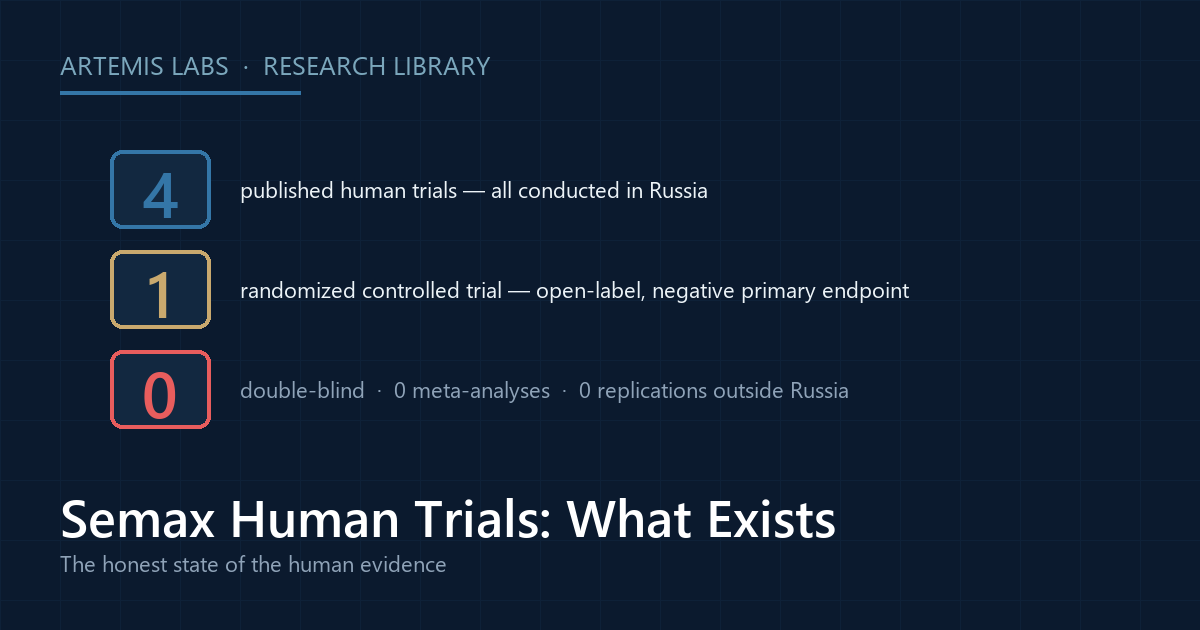
Semax human trials — answer capsule: Semax has four records in PubMed carrying a clinical-trial publication type, and all four studies were run in Russia. Exactly one is tagged a randomized controlled trial; that paper’s own abstract calls the study open-label and reports that Semax did not change its primary measure. PubMed indexes no Semax meta-analysis, no systematic review and no double-blind study. No group outside Russia has ever tried to repeat the Russian human findings in either direction, so those findings have never been checked by anyone else. Semax has no FDA or European Medicines Agency approval establishable from any primary source.
Key findings
- Four trial-typed records, zero outside Russia. They are PMIDs 29798983, 18379501, 10741256 and 11517472 — all Russian-institution or Russian-journal papers, three of them written in Russian.
- The only randomized trial missed its primary endpoint. The single record tagged
Randomized Controlled Trialis a 2007 Russian study in motor neuron disease (PMID 18379501), and its abstract calls the study open-label. - Four categories of evidence are empty. PubMed indexes zero Semax meta-analyses, zero systematic reviews, zero double-blind studies and zero independent replications in either direction.
- No Western approval is establishable. The PubChem record for Semax (CID 9811102) carries no Drug and Medication Information, FDA Orange Book or DrugBank section, and a 2026 review lists Semax among what it calls
Non-approved peptides(PMID 42021992).
How many Semax human trials actually exist?
Four. That is the count of PubMed records carrying a clinical-trial publication type — the tag indexers apply when a paper reports a study run in people under a trial design. Widen the search to every human-indexed record where Semax was given to people and you get roughly eighteen papers, every one Russian-affiliated or published in a Russian-language Russian journal.
Those numbers describe what is indexed in PubMed, which is not the same as what exists; much Russian-language work sits outside that index. We count what we can check. Semax is supplied here as a laboratory reference compound, and the record below is the record we can point to.
What did the only randomized trial find?
PMID 18379501 is a 2007 Russian study of 27 patients with motor neuron disease. PubMed tags it Randomized Controlled Trial. The abstract says something different: The open-label clinical trial of Semax (1% solution) was conducted in sequential groups of patients. Open-label means nobody was blinded, and sequential groups is not randomized allocation. That gap travels with the citation everywhere, including here.
The primary result was negative, verbatim: Semax (1% solution) does not influence either the course of CPD or the dynamics of clinical estimates, in particular the terms of ensuing marked functional deficits on bulbar, cervical and lumbosacral levels of segmental innervation. CPD is chronic partial denervation, the loss of nerve supply to muscle that the study was set up to track. A secondary finding, hedge intact: However, 1% semax significantly improves the total estimate of life quality due to the improvement of emotional state and motivation in MND patients with the maximal effect on day 10. In an unblinded study of 27 people, that is a lead, not a conclusion.
What are the other three trials?
The largest human dataset is PMID 29798983, a 2018 study from Pirogov Russian National Research Medical University in Moscow, in 110 patients after ischemic stroke. PubMed tags it Clinical Trial, not Randomized Controlled Trial, and the abstract states no placebo, no randomization and no blinding. Semax was given alongside a rehabilitation program, so the design cannot separate the compound from rehabilitation timing — and the authors keep the two joined: Early rehabilitation and administration of semax increase BDNF plasma level, speed functional recovery, and improve motor performance. More on that study in our page on Semax stroke and ischemia research.
PMID 10741256 is a 2000 Russian ophthalmology paper — its title calls Semax a new Russian drug — in optic nerve disease. Three groups, one a control, but no patient count, randomization or blinding reported, and Semax was an add-on given in parallel with basic neurotrophic and antiinflammatory therapy.
PMID 11517472 is a 1997 Russian study in 30 patients during acute hemispheric ischemic stroke, against a separately assembled control group of 80 on conventional therapy. Unequal, non-randomized, unblinded. The authors put it weakly themselves: Semax in combined therapy had some influence on the rate of restoration of the damaged neurological functions. We have not upgraded that wording, and neither should anyone citing it.
Has anyone outside Russia studied Semax in people?
No. The non-Russian primary research that exists is entirely non-human: two studies from the Italian National Research Council in Catania (PMID 35080861, artificial membrane models; PMID 27586814, a neuroblastoma cell line) and one from a neurosurgery department in Surabaya, Indonesia (PMID 41179234, in rats). Nobody has published a failed replication of the Russian human work, because nobody has published a replication attempt at all. That absence is the finding, and it cuts in both directions.
Is Semax approved by the FDA or the EMA?
No approval by either agency can be established from any primary source. The 2026 review at PMID 42021992 searched FDA and WADA databases through January 2026 and places Semax in the group it labels Non-approved peptides, compounds that lack long-term safety data and systematic validation. A 2026 review from US clinicians (PMID 41490200) says of this class that there is a current lack of clinical trials.
Russian registration is the claim most often repeated, and it is the one we cannot verify. Russian authors describe Semax as a registered domestic drug inside their own papers — the 2000 ophthalmology title calls it a new Russian drug, and a 1999 stroke paper calls it the first domestic nootropic drug (PMID 10358912). Those are author assertions in research articles, not registry records, and we could not reach a registry to confirm them. So the accurate sentence is that Russian authors describe it as a registered domestic drug; anything stronger would be us inventing a fact. One other thing gets mistaken for approval: the World Health Organization Drug Dictionary synonym PubChem lists for the Semax sequence is a database index term, not an approval.
Why does a forensic chemistry paper belong on this page?
Because it is the most direct outside description of where Semax sits. A 2020 forensic analysis (PMID 31667971) detected Semax in seized cognitive-enhancing preparations and described it as a compound that has not completed clinical trials. We found that paper in our own competitor research file, where an analyst had recommended surfacing it as an honesty move. It never got published until now.
What the research does not show
Nothing in the human record has been tested outside Russia. No group anywhere else has tried to confirm or refute any of it. Three further limits belong on the record:
- The strongest language sits on the weakest design. PMID 15792140, a 2005 Russian study of 187 patients with cerebrovascular insufficiency, reports
significant clinical improvementand a reduced risk of stroke — but it is tagged as no kind of clinical trial, and no control arm is described anywhere in its abstract. - Three of the four trials were add-on designs. Semax was layered on top of rehabilitation, standard neurotrophic therapy or combined intensive therapy. A study built that way cannot tell you what the compound did by itself.
- A frequently repeated attention-and-focus reference contains no data. PMID 16996699 is a 2007 Medical Hypotheses paper. Its own wording is that
it is proposed in this paper that Semax may have good therapeutic potential in ADHD. A proposal is not a result.
No methodological appraisal of the Semax literature has been published either — the evidence base has never been formally graded. Safety carries separate gaps, set out in our page on Semax safety research; for where Semax sits among related compounds see our neuropeptide research topic.
Frequently asked questions
Has Semax ever been studied in a double-blind trial?
Not one that PubMed indexes. A search for Semax records mentioning double-blind methods returns zero, and the only record carrying a randomized-trial tag describes the study as open-label in its own abstract.
Does the negative trial mean Semax does nothing?
No. That trial asked one narrow question in 27 patients with motor neuron disease, without blinding, and answered it in the negative. It says nothing about other research questions. The honest position is that the human record is thin, unreplicated and confined to one country — not that the compound has been ruled out.
Is Semax approved anywhere?
No FDA or EMA approval can be established from any primary source. Russian authors describe Semax as a registered domestic drug in their own papers, but we could not verify that against a registry, so we report it as their description rather than as a fact of our own.
References
- Zh Nevrol Psikhiatr Im S S Korsakova, 2018. Russian-language clinical trial in 110 post-stroke patients, Pirogov Russian National Research Medical University, Moscow. PMID 29798983 · DOI 10.17116/jnevro20181183261-68
- Zh Nevrol Psikhiatr Im S S Korsakova, 2007. Russian-language open-label trial in 27 motor neuron disease patients; the only record tagged
Randomized Controlled Trial. PMID 18379501 (no DOI in the PubMed record) - Vestn Oftalmol, 2000. Russian-language controlled clinical trial in optic nerve disease. PMID 10741256 (no DOI in the PubMed record)
- Zh Nevrol Psikhiatr Im S S Korsakova, 1997. Russian-language controlled clinical trial, 30 patients against 80 controls, acute hemispheric ischemic stroke. PMID 11517472 (no DOI in the PubMed record)
- Zh Nevrol Psikhiatr Im S S Korsakova, 2005. Russian-language evaluation study, 187 patients with cerebrovascular insufficiency; no control arm described in the abstract. PMID 15792140 (no DOI in the PubMed record)
- Zh Nevrol Psikhiatr Im S S Korsakova, 1999. Russian-language retrospective analysis, acute ischemic stroke. PMID 10358912 (no DOI in the PubMed record)
- 2026 review (Alfaisal University, Riyadh; St. Matthew’s University, George Town) searching FDA and WADA databases through January 2026; classes Semax among
Non-approved peptides. PMID 42021992 · DOI 10.3389/fragi.2026.1790247 - 2026 review from US clinicians (Pacific Coast Sports Medicine, Los Angeles; Lenox Hill Hospital, New York; Redox Medical Group, Beverly Hills) noting
there is a current lack of clinical trials. PMID 41490200 · DOI 10.5435/JAAOSGlobal-D-25-00236 - Vanhee C, Francotte A, Janvier S, Deconinck E. The occurrence of putative cognitive enhancing research peptides in seized pharmaceutical preparations: An incentive for controlling agencies to prepare for future encounters of the kind. Drug Testing and Analysis, 2020. PMID 31667971 · DOI 10.1002/dta.2717
- Med Hypotheses, 2007. Hypothesis paper containing no data. PMID 16996699 · DOI 10.1016/j.mehy.2006.07.017
- ACS Chem Neurosci, 2022. Artificial membrane models, Consiglio Nazionale delle Ricerche, Catania, Italy. PMID 35080861 · DOI 10.1021/acschemneuro.1c00707
- J Inorg Biochem, 2016. SH-SY5Y neuroblastoma cell line, Consiglio Nazionale delle Ricerche, Catania, Italy. PMID 27586814 · DOI 10.1016/j.jinorgbio.2016.08.013
- 2023 study in a Sprague Dawley rat spinal cord injury model, Neurosurgery Department, Dr. Soetomo Hospital, Surabaya, Indonesia. PMID 41179234 · DOI 10.12688/f1000research.127413.2
Methodology: this page draws on PubMed records retrieved through NCBI E-utilities and the PubChem record for CID 9811102, with every quoted string transcribed verbatim from the source named beside it; last verified August 26, 2026.
All compounds sold by Artemis Labs are for laboratory research use only. Nothing on this page is medical advice, and no statement has been evaluated by the FDA.
